Chinese Wedding Red Envelope (份子钱) Guide: How Much to Give in 2026
Quick answer
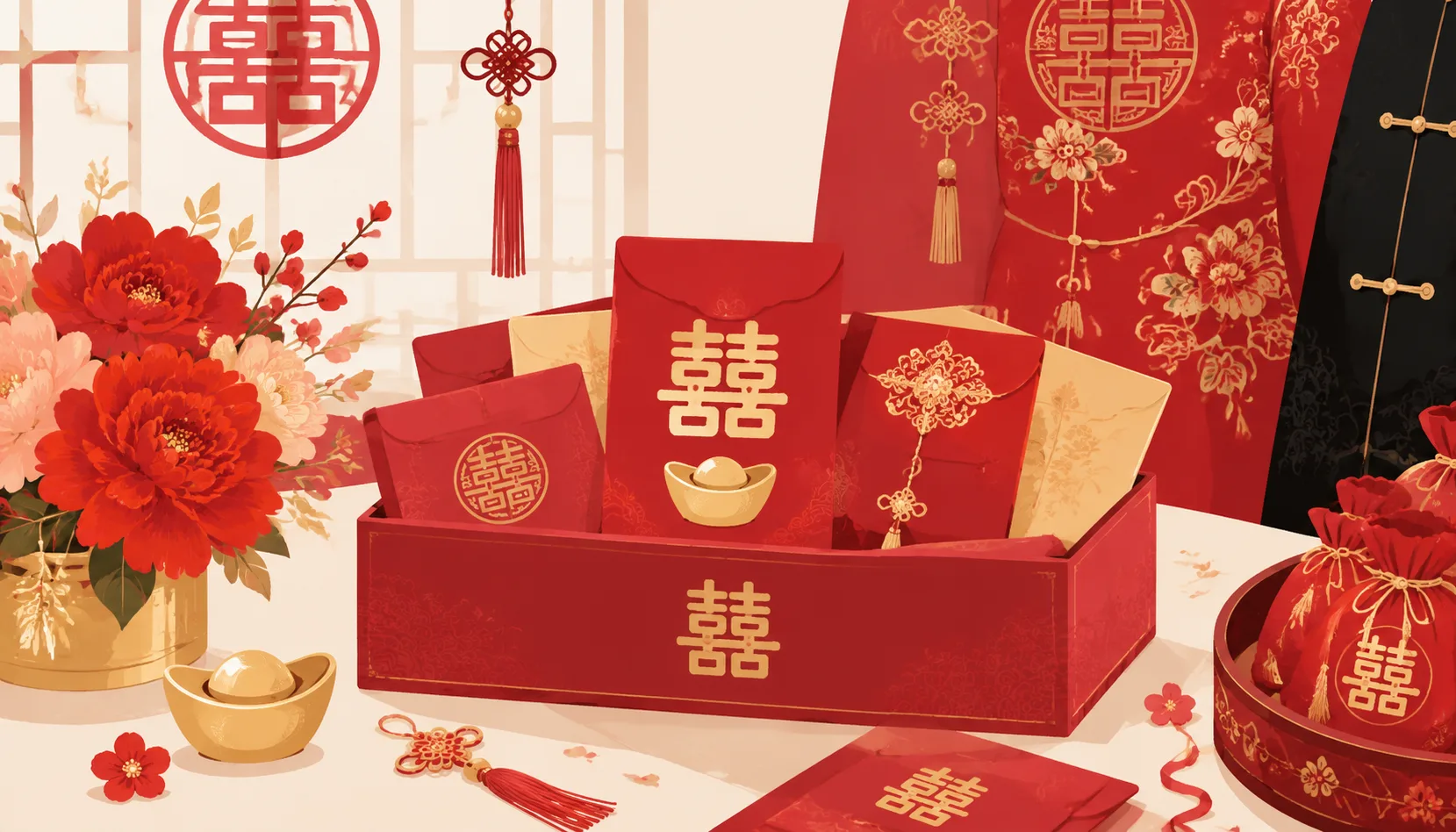
At a Chinese wedding, give a red envelope with cash. Not a gift. Not a gift card. Cash, in a red envelope, in an even amount, written with your name on the envelope. The amount depends on your relationship with the couple and what city they're in. Under-giving is noticed and remembered. Giving in an odd amount, or an amount containing 4, is a bad omen.
Quick Answer
At a Chinese wedding, give a red envelope with cash. Not a gift. Not a gift card. Cash, in a red envelope, in an even amount, written with your name on the envelope. The amount depends on your relationship with the couple and what city they're in. Under-giving is noticed and remembered. Giving in an odd amount, or an amount containing 4, is a bad omen.
Why Cash, Not Gifts
This is the single most important thing to understand before attending a Chinese wedding.
In Western weddings: Guests give gifts from a registry. The personal and practical nature of the gift is the point.
In Chinese weddings: The universal gift is cash in a red envelope (红包, hóngbāo). This is not seen as impersonal — it is the correct and expected form. The couple is starting a new household and needs capital. Cash is the most useful thing you can give them.
An "alternative" gift (kitchen appliances, household items, a fancy centerpiece) marks you as someone who doesn't know how Chinese weddings work. The couple will likely feel awkward — they now have an object they didn't ask for instead of money they need.
Exception: If you are extremely close to the couple (best friend level), you may supplement the red envelope with a personal meaningful gift. But the red envelope still comes first and in full amount.
How Much to Give: The Amount Formula
There is no universal standard — the right amount depends on three factors: your relationship with the couple, the city where the wedding is held, and what others at the table are giving.
The Relationship Tiers
| Your Relationship | Typical Range (RMB) | Notes |
|---|---|---|
| Casual acquaintance / peripheral colleague | ¥200–400 | Minimum respectful; ensure you cover your "seat cost" |
| Regular colleague / friend | ¥400–800 | Common safe range |
| Close friend / good colleague | ¥800–1200 | Shows genuine investment in the relationship |
| Best friend / close family | ¥1000–3000+ | No upper ceiling; match the depth of the relationship |
| Foreigner guest (no close relationship) | ¥300–600 | Local going rate is expected; don't underperform |
The City Factor
Wedding gift expectations correlate with local cost of living. In general:
- Beijing / Shanghai: Higher. ¥600 is floor for any real relationship; ¥1000 is comfortable for friends.
- Guangzhou / Shenzhen / Hangzhou: Similar to Beijing/Shanghai tier.
- Provincial capitals (Wuhan, Chengdu, Xi'an, etc.): ¥300–500 is often standard for colleagues; ¥600–800 for close friends.
- Smaller cities and county towns: Often lower, but ask a local — standards vary dramatically.
The best advice: Ask a trusted local colleague or mutual friend "I'm giving a gift for [name]'s wedding — what's the going rate for someone like me?" This question is completely normal and practical in Chinese social circles. No one will think it's strange.
The Table Cost Logic
Chinese weddings are calculated per-table of 10. Each table costs the couple a specific amount (venue + food + drink). A common heuristic: your red envelope should at least cover your "cost" at the table, plus a surplus as a relationship investment.
Rough rule of thumb: if you estimate the wedding is in a ¥5000/table venue, your share of the table is ¥500. A close friend would give more — ¥800–1500.
The Amount Rules: Auspicious Numbers
Always use even amounts. In Chinese tradition:
- Even numbers = good things come in pairs (好事成双)
- Odd numbers = mourning (used only in funeral/condolence contexts)
Specifically auspicious amounts:
- ¥200, ¥300 — common but modest
- ¥600 — 六六大顺 (smooth sailing in all things)
- ¥800 — prosperity number (8 = 发)
- ¥888 — triple prosperity; widely used
- ¥1000 — round number of respect
- ¥1314 — sounds like "一生一世" (yīshēng yīshì — forever); very romantic, used for close friends
- ¥1688 — "一路发发" (all the way to prosperity); popular
Never give amounts containing 4:
- ¥400 — contains "death"
- ¥40 — same issue
- ¥4000 — same
Odd amounts to avoid:
- ¥100, ¥300, ¥500, ¥700 — odd number, appropriate for funerals only
How to Present the Red Envelope
Buy the right envelope:
- Use a red envelope (红包, hóngbāo) — not a plain white or brown envelope
- Red envelopes are sold at stationery stores, pharmacies, and convenience stores in China year-round
- More elaborate red envelopes with auspicious patterns are available for wedding-specific use
Affiliate placement: → Premium wedding red envelope sets (金色/双喜设计) | Traditional Chinese wedding red envelope packs
What to write on the envelope:
- Your full name (in Chinese if you have a Chinese name, or in English clearly)
- "恭喜新婚" (Gōngxǐ xīnhūn — Congratulations on your wedding)
- Some families note the amount on the outside — this is a bookkeeping convention; follow what others are doing
When to give it:
- At the gift table / sign-in table at the entrance of the wedding (签到台, qiāndào tái)
- This is typically staffed by a friend or family member of the couple who is keeping records
- Your name and amount will be recorded — this is standard practice, not invasive
Affiliate placement: → Chinese wedding red envelopes with premium design
The Guest Book and Records
Chinese weddings maintain meticulous records of who gave how much. This isn't mercenary — it's practical. When the couple is later invited to someone else's wedding, they need to know what that person gave them so they can reciprocate appropriately.
The reciprocity cycle:
- You give ¥600 at their wedding
- When you get married (or have a child, buy a house, etc.), they will give you approximately ¥600–800
- This cycle can continue for decades
What happens if you under-give: Nobody will say anything at the wedding. But it will be noted. In the future, when it's your turn (your wedding, your child's full moon, your housewarming), you may receive a correspondingly modest envelope. The relationship calibration works in both directions.
What to Wear
Do not wear:
- Red (that's the bride's color — you don't want to upstage her or look like you're competing)
- White or black (mourning colors)
- Anything too casual (jeans, athletic wear)
Safe choices:
- Women: dress in any color except red, white, or black; blues, greens, pastels, and floral patterns are all safe
- Men: a dark suit or smart casual; a collared shirt at minimum
What's acceptable:
- Gold, silver, pink, purple, blue, green, floral patterns, stripes
Wedding Banquet Etiquette (What Happens After the Ceremony)
Chinese weddings typically include a large seated dinner (婚宴, hūnyàn). Know these rules:
Seating: You'll be assigned a table based on your relationship to the couple. Don't choose your own seat.
Timing: Don't leave early. The wedding banquet has a structure — ceremony, first dishes, toasts, more dishes. Leaving mid-meal (especially before the couple has come to toast your table) is noticed.
Toasting: The newlyweds will come to each table and toast. When they arrive at your table:
- Stand up
- Hold your glass with both hands
- Let the most senior person at your table toast first
- Drink when instructed
Eat freely: Wedding banquets are not typically a time for formal dining etiquette — the expectation is enjoyment and celebration. Eat well, drink moderately, and celebrate with warmth.
FAQ
Q: I already bought a physical gift before I found out about red envelope culture. What do I do? A: Bring both. A red envelope with an appropriate amount plus the gift you already have. The gift becomes supplementary rather than the main offering. If the gift is from a taboo category (see gift taboo guide), leave it at home and just bring the envelope.
Q: The couple lives in the US/UK/Europe but is having a Chinese wedding — does the red envelope rule still apply? A: Yes, if the event follows Chinese wedding customs (and most Chinese diaspora weddings do). Check the invitation carefully. If the invitation includes a gift registry, the couple has adapted to local customs and physical gifts are fine alongside or instead of envelopes.
Q: What if I can't attend but want to give something? A: Send the red envelope (or transfer via WeChat Pay/Alipay if the couple uses those apps) and pair it with a personal WeChat message or video call on the wedding day. This is completely acceptable and warmly received.
Q: I'm the only foreigner at the wedding. Should I give a red envelope? A: Yes. Your foreigner status doesn't exempt you from the expected social form. If anything, navigating it correctly earns you extra goodwill. The couple (and their family) will notice and appreciate that you did it right.
Q: What if the wedding is a destination wedding and the couple explicitly said "no gifts needed"? A: This is tricky — in international destination weddings where the couple has explicitly westernized the format, a nice congratulatory card and perhaps a meaningful gift from your home country is appropriate. When in doubt, send a small WeChat red envelope (¥200–300 as a symbolic gesture) with a congratulatory message.
One-Line Summary
Give cash, in a red envelope, in an even auspicious amount, with your name written on it, at the sign-in table when you arrive.
What Chinese People Actually Say
- 份子钱 | fènzi qián | wedding gift money | Give in even numbers; avoid 4 (unlucky)
- 随礼 | suílǐ | to give a gift at wedding | Use when referring to the act of giving money
- 红包 | hóngbāo | red envelope | Traditional format; include lucky amounts like 888
2026 Reality Check
2026 Reality Check: The traditional "round number" rules (200元, 600元, 800元) still exist but are increasingly flexible. Digital red packets via WeChat/Alipay have replaced cash in most urban areas.
Gen Z vs. Older Generations: Younger guests often give smaller amounts (100-200元) or skip the cash entirely, gifting items or experiences instead. Older generations still insist on "face-saving" amounts and view low sums as embarrassing.
Beijing/Shanghai vs. Smaller Cities: Tier-1 cities see more variation—some young professionals now give 50-100元 as a token gesture. Smaller cities and rural areas still strictly follow traditional amounts, with 200元 being the minimum for colleagues and 500-1000元 for close family.
Bottom Line: Rules are softening in urban, younger circles but remain culturally important in traditional and rural contexts.
Frequently asked questions
What happens if I give less money than the couple gave at my wedding?
This is noticed and remembered. Chinese wedding records are meticulously kept — the couple's family logs who gave what, often in a notebook or spreadsheet. If you give less than they gave you, it signals disrespect or financial hardship. If you're short on cash, it's better to politely decline the invitation than to under-give.
Can I give a gift instead of cash at a Chinese wedding?
No. In mainland China, physical gifts are almost never given at weddings. Cash in a red envelope is the only acceptable form of gift. Even gift cards are frowned upon because they lack the symbolic red envelope tradition and make tracking awkward. If you're close to the couple, you might add a small sentimental item, but the envelope is what counts.
Is it okay to give a red envelope with a digital transfer instead of cash?
Increasingly yes, especially among younger couples in tier-1 cities like Shanghai or Shenzhen. WeChat or Alipay transfers are accepted, but you must still send it in a red-envelope format (the app's hongbao feature) and include your name in the message. However, for older relatives or in smaller cities, physical cash in a red envelope remains the expected norm.
What if I'm a foreigner — do the same rules apply to me?
Yes, but with lower expectations. Chinese friends will understand that you're not familiar with the system, and you won't be held to the exact same standards as locals. As a baseline, give 200-500 RMB if you're a casual acquaintance, and 800-1,000 RMB if you're a close friend. Write your name on the envelope so they can record it.
Is there a difference between what to give at a Beijing wedding versus a rural wedding?
Huge difference. In Beijing, Shanghai, or Shenzhen, close friends typically give 1,000-2,000 RMB or more, and the wedding banquet alone can cost 10,000 RMB per table. In smaller cities or rural areas, 200-500 RMB is generous. A good rule: the amount should roughly cover your share of the banquet cost, which varies dramatically by region.
Can I give a red envelope with an amount ending in 8 or 9 instead of a round number?
Yes, amounts ending in 8 (like 888 or 1,688) are considered lucky and are perfectly acceptable. Ending in 9 is also fine, symbolizing longevity. Avoid amounts ending in 4 (like 400 or 1,400) because 4 sounds like 'death' in Chinese. Also avoid odd numbers like 333 — even numbers are preferred for weddings.
Try our tools
Related guides
Chinese Wedding Gift Money (份子钱): How Much to Give
At many mainland Chinese weddings, guests commonly give cash in a red envelope (份子钱, fènzi qián), but the amount depends on the relationship, location, invitati…
Read the guide →
Chinese Gift-Giving Guide 2026: Rules, Taboos, What Works
In China, gift-giving is not about the gift. It's about the relationship. The right gift, delivered at the right time with the right words and two hands, commun…
Read the guide →
Chinese Red Envelope (红包) Guide: When to Give & How Much
A red envelope (红包, hóngbāo) is a cash gift in a red wrapper given at Chinese New Year, weddings, births, and milestone birthdays. Key rules: always use red (ne…
Read the guide →