Is scolding a child in public considered bad parenting in China?
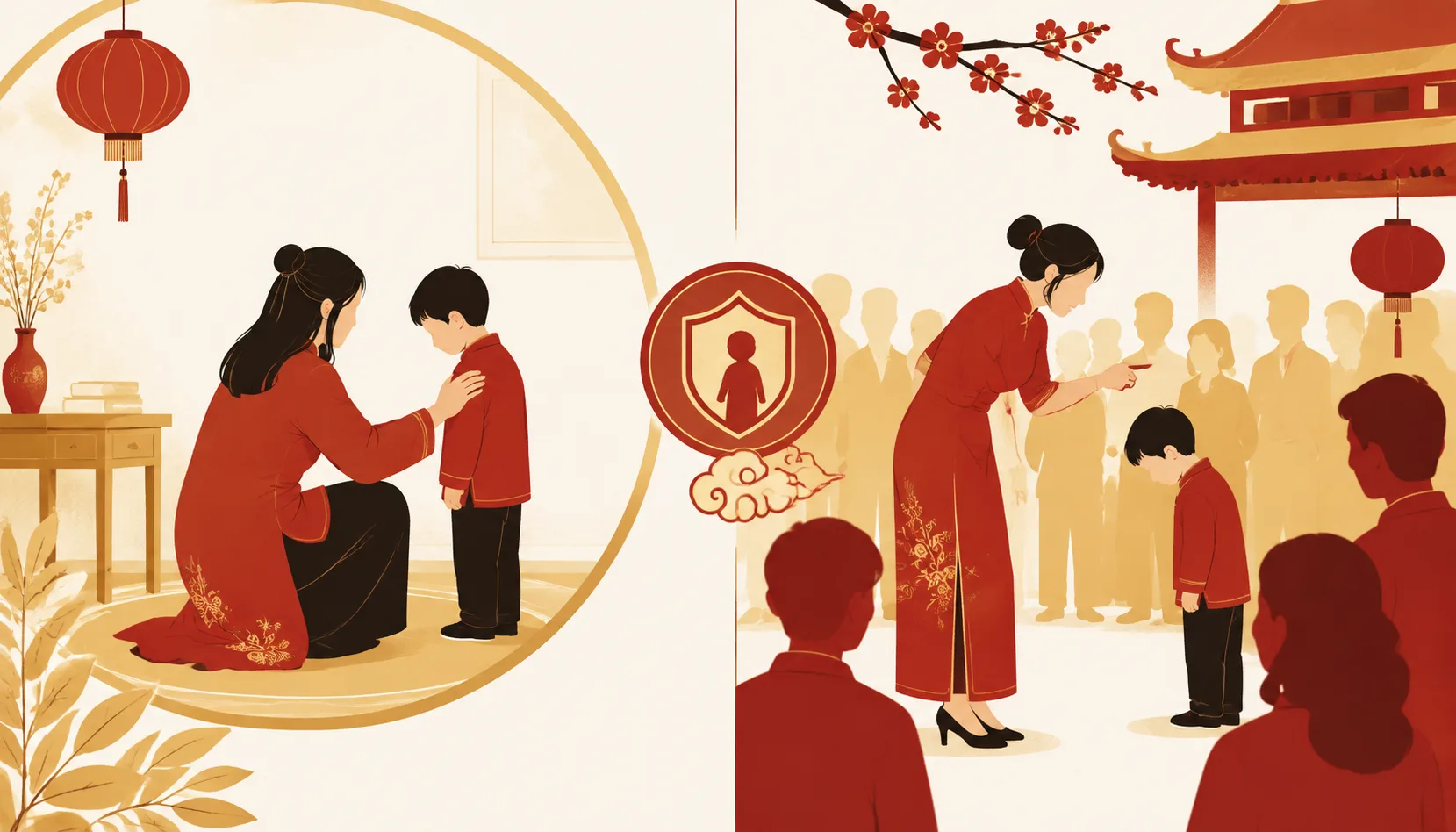
Quick answer
Yes. Criticizing or physically disciplining children in public, especially in front of guests, is increasingly viewed as harmful to the child and embarrassing to the family.
Why This Rule Matters
While traditional Chinese parenting was once more authoritarian, modern Chinese urban culture has shifted toward recognizing children's dignity ('miànzi'). Public shaming damages a child's self-confidence and long-term trust in their parents. Observing adults: scold others' children with caution — this is almost always unwelcome.
What You Should Do
- Handle behavioral issues quietly and privately wherever possible
- Praise children in front of others — public praise builds confidence
- Wait until you're home or alone to address serious misbehavior
What You Shouldn't Do
- Shout at, hit, or loudly criticize a child in front of guests, relatives, or strangers
- Repeatedly point out a child's faults to make them 'improve' in front of others
- Use 'face' pressure to control children — 'everyone is watching you'
Practical Tips for Foreigners
This rule applies in most social and formal settings across China. When in doubt, watch what your Chinese host or senior colleague does and follow their lead. Breaking this rule once is forgivable — breaking it repeatedly signals a lack of cultural awareness.
Generational Shift: Who Cares Most
The rule isn't uniform across China. In first-tier cities like Beijing, Shanghai, and Shenzhen, millennial parents—especially those with college degrees or overseas exposure—are far more likely to adopt Western-style positive parenting. They'll pull a child aside and whisper. But in smaller cities like Chengdu or Zhengzhou, and among grandparents who often handle daily childcare, the old 'spare the rod, spoil the child' mindset still lingers. If you're a guest and a grandparent scolds a child harshly, don't intervene—it's a family matter, and you'll embarrass the parent if you try to 'save' the kid.
Real Scenarios: Scolding a Child in Public
- A Canadian father in a Chengdu park loudly scolded his 6-year-old for spilling juice on his shirt. A nearby grandmother intervened, saying, 'He's just a child, don't shame him,' and then gave the boy candy—leaving the father embarrassed and unsure how to respond.
- At a Shanghai restaurant, a German mother sharply reprimanded her daughter for dropping a chopstick. The waiter immediately brought a new one and softly told the mother, 'Little ones are learning,' while other diners glanced disapprovingly, making the mother feel judged and isolated.
- A French tourist in Xi'an raised his voice at his son for running near a museum exhibit. A Chinese security guard approached and, in a firm but polite tone, said, 'Please don't frighten the child; we can talk calmly,' causing the father to realize his behavior was seen as disruptive to the child's well-being.
- In a Guangzhou shopping mall, an Australian mother yanked her son's arm and scolded him loudly for touching a display. A shop assistant stepped in, gently guiding the boy away and offering him a toy, while whispering to the mother, 'Better to teach softly—he will listen more.' The mother felt ashamed and later apologized to her son.
The Unspoken Host Thought
What does the Chinese host think when you scold your child publicly? They won't say it, but they're thinking: 'You're losing face, and you're making ME lose face for having you here.' To them, a public outburst signals you can't control your household—a direct reflection on your competence and social maturity. They'll smile politely, but you've dropped several notches in their estimation. Quietly handling a tantrum in another room earns silent respect; doing it in front of the table earns silent judgment.
Regional Nuance: North vs South
Northern cities like Beijing and Tianjin have a more direct, 'thick-skinned' <a href="/business/chinese-communication-style/">communication style</a>—parents might scold loudly but move on quickly, and guests are expected to brush it off. In the South, especially in Shanghai and Hangzhou, there's more emphasis on 'face' and subtlety; loud scolding is seen as cruder and more embarrassing. If you're a foreigner living in the South, err on the side of extreme discretion. In the North, a brief firm word might pass, but never raise your voice—it's the volume, not the reprimand, that crosses the line.
What Chinese People Actually Say
- 家丑不可外扬 | jiā chǒu bù kě wài yáng | Family shame should not be publicized | Use to remind parents not to expose children's mistakes to outsiders
- 给人留面子 | gěi rén liú miànzi | Give someone face/preserve dignity | Use when asking others to avoid embarrassing children publicly
- 不当众批评孩子 | bù dāngzhòng pīpíng háizi | Don't criticize children in public | Direct phrase for the main etiquette rule
2026 Reality Check
In 2026, this etiquette rule survives but with cracks. Older generations (40+) still largely uphold it—public shaming feels "losing face" for the whole family. But pressure is growing.
Gen Z parents, especially in tier-1 cities, are more vocal about "positive parenting." They avoid public批评 (criticism), opting for private talks. However, some admit grandparents still scold openly at family gatherings.
Beijing and Shanghai lead the shift—private schools, parenting apps, and Western influence encourage gentle discipline. Smaller cities and rural areas? Tradition holds stronger. Public scolding at markets, school gates, and family dinners remains common. "不打不骂不成材" (spare the rod, spoil the child) still echoes.
The verdict: rule weakening in urban Gen Z, but far from dead. Expect gradual change over the next decade.
Frequently asked questions
Is it acceptable to scold a child in public in China?
No, it's generally considered poor parenting. Public criticism or discipline embarrasses both the child and the family, and modern Chinese parenting advice strongly discourages it.
What should I do if my child misbehaves while we have guests?
Quietly and calmly remove the child from the room, speak to them privately, and redirect their attention. Avoid raising your voice or making a scene in front of others.
Are there traditional Chinese views that support public discipline?
Older generations sometimes used public scolding to show strictness, but this is fading. Current norms emphasize saving face and protecting a child's self-esteem, so private correction is preferred.
How can I correct my child's behavior without embarrassing them in public?
Use a low tone, gentle eye contact, and brief, clear instructions. Save longer discussions for when you're alone, and praise good behavior openly to encourage positive actions.
What if other parents or grandparents scold children in public?
It's best not to intervene unless the child is in danger. Respect their family style, but you can model calm, private correction with your own child and quietly suggest alternative methods if asked.
Does this rule apply equally to tourists or foreigners in China?
Yes, as a guest or visitor, following local etiquette is important. Avoid public scolding to prevent misunderstandings and to show respect for Chinese social norms around face and family harmony.
Try our tools
Related guides

Chinese Face-Saving Language: Compliments, Refusals, and Farewells
Face-saving language in Chinese runs through compliments (always deflect, never accept directly), refusals (always indirect), and farewells (longer and more rit…
Read the guide →
Understanding Mianzi (Face) in China: The Rule Beneath All the Rules
Mianzi (面子) is social reputation and dignity — the invisible currency that governs Chinese social life. It can be given, lost, saved, or attacked. Almost every …
Read the guide →
10 Chinese Social Myths — Debunked
Many widely circulated 'rules' about Chinese culture are oversimplified, outdated, or simply wrong. Chewing loudly is not a compliment everywhere. Baijiu does n…
Read the guide →