Which things foreigners believe about Chinese social rules are actually myths?
Quick answer
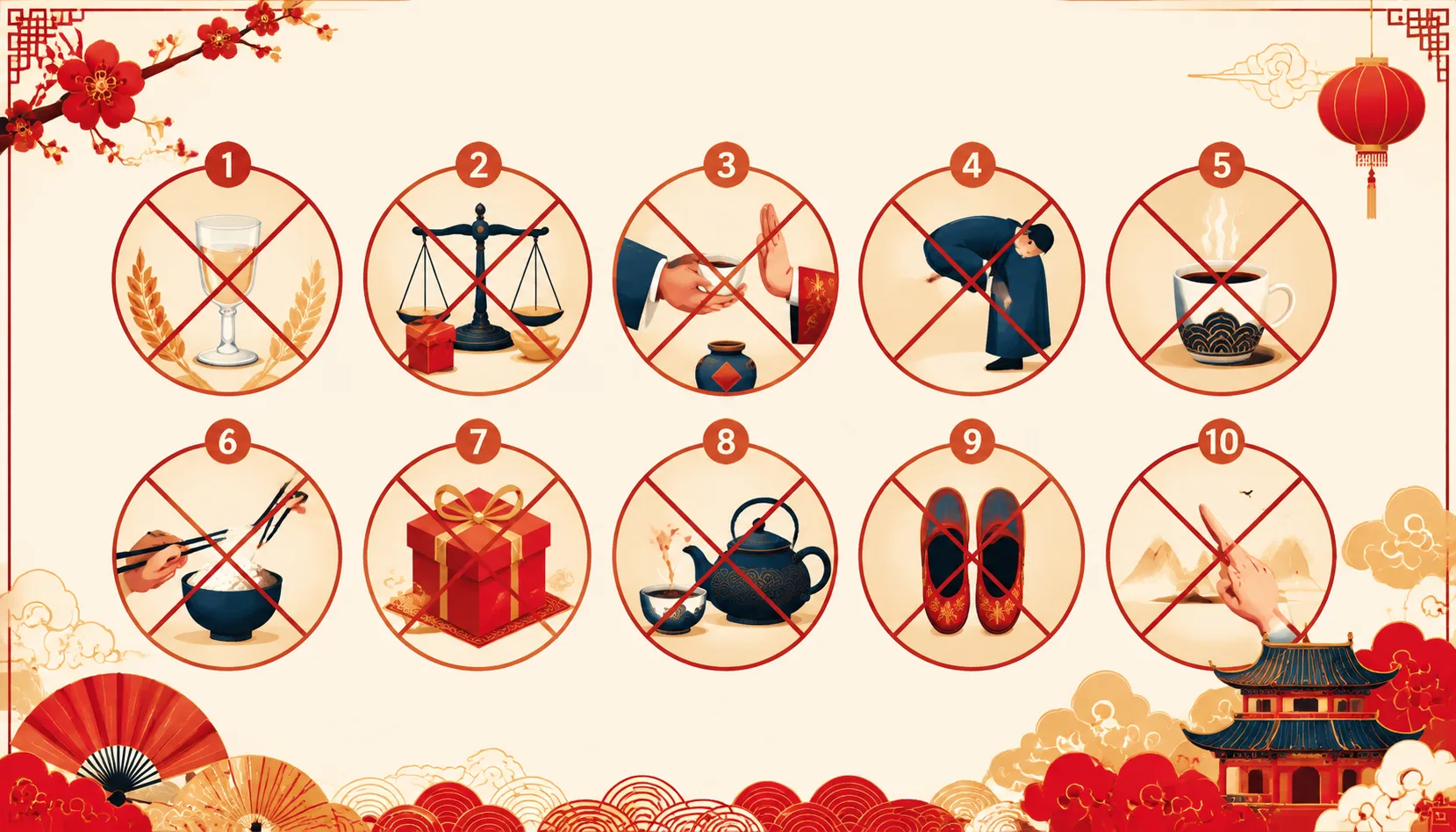
Many widely circulated 'rules' about Chinese culture are oversimplified, outdated, or simply wrong. Chewing loudly is not a compliment everywhere. Baijiu does not need to be drained in one go. The left hand is not universally taboo. Guanxi is not corruption. A foreigner does not automatically get special treatment for being Western.
Myths 1–5: Food, Drink, and Body Language
Myth 1: Loud chewing means the food is delicious.
Partly true in some regional contexts, but not a universal Chinese norm. In formal dining and urban middle-class settings, noisy eating is not considered a compliment — it is simply tolerated more than in some Western contexts. Do not use this "rule" to justify table manners your host might actually find unpleasant.
Myth 2: You must drain your baijiu glass in one shot (gānbēi means bottoms up every time).
干杯 (gānbēi — dry cup / cheers) literally suggests finishing the glass, but in practice, this is highly contextual. Many modern Chinese drinkers — especially women, health-conscious professionals, and anyone not in a hardcore business banquet context — sip rather than drain. You can always say 我以茶代酒 (I'll drink tea in place of alcohol) or take a small sip respectfully. Nobody needs to be pressured into drinking.
Myth 3: Bargaining is expected in all transactions, so cut prices by half immediately.
This was true in market settings and has some application in certain contexts (wet markets, tourist souvenir shops). It is completely inappropriate in restaurants, formal shops, and any setting with displayed prices. Aggressive haggling in the wrong context embarrasses everyone.
Myth 4: The left hand is always taboo in China.
There is some cultural association between the left hand and negative connotations (inherited from older Chinese tradition), but this is not a live, enforced rule in modern Chinese life. Handing something with your left hand while your right is occupied is not a social crisis. Use both hands when you can — that is the actual operative norm.
Myth 5: Chinese people are all emotionally reserved and never show feelings openly.
Strongly regional and generational. Southerners and northerners, urban and rural, young and old all express emotion very differently. Cantonese banquet culture is boisterous. Sichuan social life is warm and demonstrative. Do not confuse formal-context restraint with blanket emotional flatness.
Myths 6–10: Relationships, Status, and Social Rules
Myth 6: All Chinese people drink hot water for health reasons.
Hot water (热水, rè shuǐ) is widespread and culturally rooted in traditional medicine beliefs about digestion and health. But plenty of Chinese people drink cold water, iced drinks, and coffee without concern. It is more of a generational and regional tendency than a universal rule.
Myth 7: More expensive gifts = better relationships and faster results.
Very expensive gifts can create anxiety and obligation for the recipient. The perceived value of a gift in Chinese culture includes appropriateness for the occasion, the relationship level, and the thoughtfulness behind it — not just the price tag. An outrageously expensive gift from someone you have just met reads as either naive or inappropriate. Calibrate to relationship depth.
Myth 8: As a Westerner, you will automatically receive preferential treatment.
This varies dramatically by context and generation. In some settings — especially those involving international business or tourism — foreign visitors may be treated with additional hospitality. In many everyday contexts, this simply does not apply. Do not expect special treatment and do not be surprised when you do not receive it.
Myth 9: You must master chopsticks to be socially accepted in China.
Chopstick proficiency is appreciated but a fork will always be found for you if needed. What matters infinitely more is the effort — trying with chopsticks and laughing at yourself when you drop something reads as charming and engaged. Refusing to try at all reads as aloof. The gesture matters, not the skill level.
Myth 10: Guanxi is essentially legalized corruption.
This is the most damaging myth because it produces genuinely bad behavior. Guanxi is relationship capital built through genuine mutual investment over time — showing up when it matters, remembering important things, returning favors thoughtfully. It overlaps with some behaviors that can become corrupt in extreme cases, but at its core it is simply a relationship-first approach to social and professional life. Most professionals in any country operate on some version of this logic.
How to Evaluate Any "Chinese Rule" You Hear
Before following or spreading any social rule about China, apply these five questions:
- Who said it? Did it come from someone with lived experience in China, or from secondhand accounts and stereotypes?
- Which China? Beijing, Shanghai, Chengdu, Guangzhou, and a rural county in Hunan can feel like different countries. Region matters enormously.
- Which generation? What is true for a 70-year-old in a traditional family may be irrelevant to a 28-year-old urban professional.
- What context? Business banquet rules, family dinner rules, and street food counter rules are completely different.
- Is it still true? China changes fast. Rules from 2005 may not apply in 2026.
The most important rule of all: treat the actual person in front of you as an individual, not as a representative sample of "Chinese culture." Every generalization has exceptions, and the exceptions are often the people you are actually talking to.
What Chinese People Actually Say
- 慢走 | màn zǔ | "Take care" / "Mind your step" | Use when seeing guests off; it's not literally about walking slowly.
- 敬酒 | jìng jiǔ | "To toast" | Always toast with glass lower than elders or seniors in formal settings.
- 客气 | kè qi | "You're too kind" / modest | Humble response to compliments; don't just say "thank you."
2026 Reality Check
1. Never stick chopsticks upright in rice: Gen Z finds this hilarious—memes about it dominate Weibo. Older generations still wince. Urban young people joke about it; rural elders consider it genuinely offensive.
2. Red envelopes must be even numbers: Dead myth. WeChat red packets now favor odd numbers (like 168 yuan "一路发" for luck). Gen Z doesn't care; grandparents still insist on 888, 999 for prosperity.
3. Never give clocks as gifts: Beijing/Shanghai under-30s laugh at this. Smaller cities and older gens still see it as taboo—say "送钟" sounds like "送终" (attending someone's funeral).
4. Business card exchange rituals: Dying fast. Gen Z exchanges WeChat QR codes instead. Older business folks in second-tier cities still observe the two-hand card presentation—younger urbanites find it ceremonial and unnecessary.
Verdict: Urban Gen Z follows maybe 2 of these rules. Older generations in smaller cities? Still 6-7. The gap is massive.
Frequently asked questions
Is it actually rude to finish all the food on your plate in China?
Yes, leaving a little food is often seen as polite because it signals the host provided enough. However, in casual settings or with close friends, cleaning your plate is completely fine. The rule isn't absolute—read the room. If you're at a formal banquet, leave a small portion. At a family dinner, eat freely.
What should I do if a Chinese colleague insists I drink baijiu at a toast?
You are not obligated to drain the glass. Say 'sui bian' (casually) and take a small sip. For health or religious reasons, simply explain you can't drink—most people will respect it. Offering a tea toast instead is a graceful compromise. The key is showing respect for the gesture, not matching the amount.
Can I use my left hand to give or receive gifts in China?
Yes, you can. The left-hand taboo is a South Asian and Middle Eastern custom, not a Chinese one. In China, using both hands to present a gift is considered respectful, but your left hand alone won't offend anyone. Don't stress about it—focus more on wrapping colors and avoiding clocks or umbrellas as gifts.
Does guanxi mean I need to give bribes to get things done in China?
No. Guanxi is about building trust and reciprocity through relationships, not paying for favors. Bribes are illegal and risky. In practice, guanxi means networking, showing genuine interest, and doing favors without expecting immediate returns. A foreigner can build guanxi by being reliable, attending social events, and remembering people's preferences—not by slipping cash.
Will I automatically get better service in China just because I'm a foreigner?
Not necessarily. While some businesses may cater to foreign customers, many locals receive equal or better treatment, especially in domestic chains. The 'foreigner premium' is mostly a myth. You might get curious stares in smaller cities, but service quality depends on the establishment, not your nationality. Learning a few Mandarin phrases will get you further than your passport.
Is it true that Chinese people never say 'please' or 'thank you' to family and friends?
That's mostly true, but it's not rudeness—it's closeness. Among family and close friends, saying 'thank you' (xièxiè) can feel overly formal and create distance. Instead, people show gratitude through actions, like returning a favor or treating someone to a meal. However, you should always say 'xièxiè' to strangers, shopkeepers, and service staff. When in doubt, use it.
Try our tools
Related guides

Understanding Mianzi (Face) in China: The Rule Beneath All the Rules
Mianzi (面子) is social reputation and dignity — the invisible currency that governs Chinese social life. It can be given, lost, saved, or attacked. Almost every …
Read the guide →
Chinese Business Communication Style: High-Context Culture, Indirect Speech, and Reading Between the Lines
Chinese business communication is high-context: what matters is often what's not said — the tone, the timing, who said it, and what was conspicuously omitted. W…
Read the guide →
Chinese Polite Phrases Decoded: What People Really Mean
Chinese social interaction is lubricated by ritual phrases (客套, kètào) that have specific social functions but often do not mean what they literally say. 'Have …
Read the guide →