How do Chinese red envelopes work and what are the rules for foreigners?
Quick answer
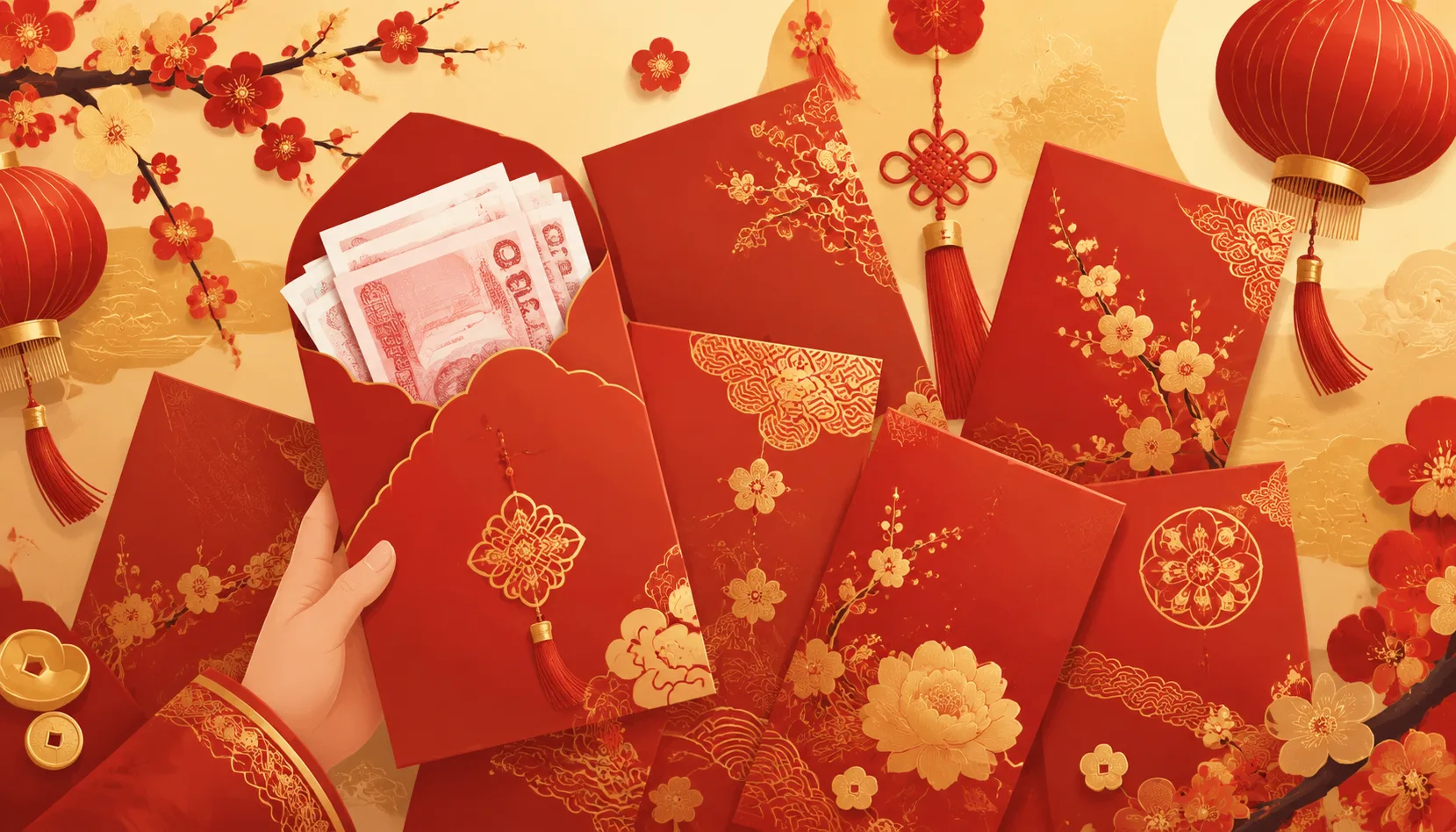
A red envelope (红包, hóngbāo) is a cash gift in a red wrapper given at Chinese New Year, weddings, births, and milestone birthdays. Key rules: always use red (never white), give even amounts (never odd), avoid any number containing 4, and never open it in front of the giver.
What Is a Red Envelope?
A red envelope (红包, hóngbāo — literally "red bag") is China's primary vehicle for gifting cash. Not the most generous vehicle. Not the default vehicle. The correct vehicle, with centuries of symbolic weight behind it.
In Chinese culture, red represents happiness, luck, and the warding off of evil. A gift of cash in red wrapping is not laziness — it is a precise social signal that says: I am wishing you prosperity, and I am doing it correctly.
Get the color wrong (white = funerals), the amount wrong (odd number = mourning), or the number wrong (anything with a 4 = death) and you've transformed a celebration gift into a social disaster.
Beyond Chinese New Year: All the Occasions
Most foreigners associate red envelopes with Chinese New Year, but they are a year-round currency of social connection. The occasions that call for one:
Weddings: The single highest-stakes hongbao occasion. Everyone attends with a red envelope — amount varies by your relationship and city.
Baby's full moon (满月, mǎnyuè): Celebrating a baby's first month. Close friends and family are expected to give; colleagues give smaller amounts.
Milestone birthdays (60th, 70th, 80th): Juniors give to elders. A 60th birthday is a major event.
New home (乔迁, qiáoqiān): Close friends bring a hongbao for a housewarming.
Hospital visits: A small hongbao (¥100–300) with recovery wishes is common among close friends, not obligatory for acquaintances.
Lunar New Year: Elders give to unmarried and younger family members (压岁钱, yāsuì qián). Married adults give to children.
Knowing which occasion calls for one — and which does not — matters. You do not give hongbao for a colleague's promotion. You might for their wedding. In business contexts, cash red envelopes raise compliance concerns; use physical gifts or hosted dinners instead.
The Color Rule: Red for Celebrations, White for Funerals
This is non-negotiable:
🔴 Red envelope = celebrations (Spring Festival, weddings, births, birthdays) ⬜ White envelope (白包, bái bāo) = funerals and condolence money (帛金, bó jīn)
Giving a white envelope at a wedding or a red envelope at a funeral is not a minor faux pas. It is a significant offense that will be remembered. If you're ever unsure which to bring to an event, ask a Chinese friend first.
Lucky vs. Unlucky Numbers — The Core of Red Envelope Etiquette
The amount inside a red envelope is not arbitrary. Chinese culture reads numbers for their phonetic associations:
6 (顺, shùn) = smooth sailing, everything goes well — excellent choice 8 (发, fā) = prosper, get rich — the best possible number 9 (久, jiǔ) = long-lasting, forever — good for weddings and birthdays 4 (死, sǐ) = death — absolute taboo, never 7 — associated with ghost ceremonies in some regions, best avoided Odd numbers — associated with funerals, never for happy occasions Even numbers (双, shuāng = pair) — required for celebrations
When in doubt: end with 8 or 6. ¥200 is fine. ¥288 is better — it shows thoughtfulness.
Good amounts to know: ¥66 — casual, close friends ¥88 — WeChat gifts, casual occasions ¥188 — colleagues, modest gesture ¥288 — mid-range, colleagues ¥666 — close friends, good times ¥888 — important relationships ¥1,688 — weddings, common tier ¥2,888 — weddings, closer friends ¥8,888 — important weddings, family
Note on ¥666: In Chinese internet culture, "666" means incredibly skilled (from gaming). In gift-giving, it means smooth luck three times. It is entirely appropriate.
How Much by Relationship and City
Amounts reflect your relationship, the city's cost of living, and your financial situation. Guidelines:
Spring Festival (child's lucky money): ¥200–1,000 in tier-1 cities; ¥100–500 in tier-2/3 cities. Good numbers: 200, 288, 666, 888.
Wedding (colleague or distant relative): ¥800–1,500 in tier-1; ¥500–1,000 in tier-2/3. Good numbers: 888, 1,288, 1,688.
Wedding (close friend): ¥2,000–5,000+ in tier-1; ¥1,000–3,000 in tier-2/3. Good numbers: 2,888, 3,888, 5,888.
Baby full moon: ¥500–1,500 in tier-1; ¥300–800 in tier-2/3. Good numbers: 666, 888, 1,288.
Elder's milestone birthday (60th+): ¥500–2,000 in tier-1; ¥300–1,000 in tier-2/3. Good numbers: 666, 888, 1,688.
New home: ¥500–1,500 in tier-1; ¥300–800 in tier-2/3. Good numbers: 666, 888.
These are guidelines. If you're a student or on a tight budget, giving less is acceptable — just be consistent within a social group. Never give an amount that feels like a burden; the gesture matters more than the number.
How to Give a Red Envelope: The Physical Ritual
Use new banknotes. Go to a bank before the festival or occasion and request crisp, new notes. Wrinkled old bills signal insufficient care.
Use an appropriate envelope. Wedding envelopes say 新婚快乐 (Happy Marriage). Spring Festival envelopes say 恭贺新禧 or show the year's zodiac animal. Baby envelopes show children or the longevity lock (长命锁).
Give with both hands. Single-handed giving is too casual. Extend with both hands and a slight forward incline.
Say something auspicious. 恭喜发财 (Gōngxǐ fācái — congratulations and prosperity) for Spring Festival. 百年好合 (Bǎinián hǎohé — a hundred years of harmony) for weddings.
How to Receive a Red Envelope
Accept with both hands. One hand looks dismissive.
Do NOT open it in front of the giver. This is the most common Western mistake. In China, opening a red envelope in front of the giver signals you're checking the amount — it's considered vulgar and ungrateful.
Do NOT ask how much is inside.
Say thank you and add a blessing back: 谢谢!祝您新年快乐/身体健康 is always right.
The Social Obligation: Reciprocity and Renqing
Receiving a hongbao is not a one-way transaction. It creates an implicit social debt (人情, rénqíng) that you are expected to repay in the future.
If someone gives you a hongbao at their child's wedding, you will be expected to give a comparable amount when your child marries. If you receive one at a birthday, give one at theirs.
Chinese people mentally track these exchanges over years and decades. The ledger is not written down, but it is accurate.
If you're a foreigner, locals may not hold you to strict reciprocity — but showing that you understand the custom, and making genuine attempts to reciprocate, builds immense goodwill. Ignoring the obligation entirely (not reciprocating when the occasion arises) damages the relationship without the other party ever explaining why.
When Refusing is Acceptable — and How to Do It
Sometimes you may want to refuse a hongbao — the amount is too large, or you feel you haven't earned it. Refusing is possible, but it must be done delicately.
Always refuse at least once. Chinese social convention expects a token resistance before accepting. "Oh, I couldn't possibly" followed by accepting on the second or third offer is the normal flow — not rude.
If you genuinely want to refuse: say you're not comfortable accepting (不好意思,我不能收) and express appreciation warmly. Do not make it about the amount.
Never refuse in a way that implies the giver was wrong to offer. The gesture came with goodwill; reject the gift, not the goodwill.
If you do accept, always use both hands to receive the envelope. This shows respect regardless of the amount inside.
WeChat Red Envelopes: The Digital Version
In 2014, WeChat launched its digital red envelope feature. It changed everything. Today, Chinese people send billions of digital red envelopes every Spring Festival — far more than physical ones.
The digital version works identically in terms of amount conventions, lucky numbers, and etiquette. The key difference: you can also send "lucky draw" group red envelopes where the amount is randomized and the fastest finger wins.
WeChat individual cap: ¥200 per send. For larger amounts, use a direct bank transfer or physical envelope.
For formal occasions (weddings, visiting elders), physical envelopes are still expected. Digital is appropriate for casual gifting and group moments among friends.
WeChat hongbao are less formal but still carry the spirit of generosity. A small digital envelope can strengthen relationships just as much as a physical one.
The 7 Mistakes Foreigners Make With Red Envelopes
🚫 White envelope at a celebration — this is a funeral offering.
🚫 Odd-numbered amount — odd numbers are associated with mourning.
🚫 Any amount containing 4 — 40, 140, 400, 444 all signal death.
🚫 Opening it in front of the giver — wait until you're alone.
🚫 Using coins — red envelopes use paper notes, not coins.
🚫 Saying "this is what I owe you" — a red envelope is a blessing, not a debt repayment.
🚫 Giving cash red envelopes in business contexts — use physical gifts instead to avoid compliance concerns.
What Chinese People Actually Say
恭喜发财 (gōngxǐ fācái) — "Wishing you wealth and prosperity." Traditional New Year greeting when giving or receiving red envelopes.
红包拿来 (hóngbāo nálái) — "Hand over the red envelope." Playful phrase children use to ask elders for red envelopes.
压岁钱 (yāsuì qián) — "Lucky money." Formal term for red envelopes given to children to ward off evil.
百年好合 (bǎinián hǎohé) — "A hundred years of harmony." Said when giving a wedding red envelope.
恭贺新禧 (gōnghè xīnxǐ) — "Congratulations on the New Year." Written on Spring Festival envelopes.
不好意思,我不能收 (bùhǎoyìsi, wǒ bù néng shōu) — "I'm embarrassed, I can't accept this." Polite refusal phrase (say it, then usually accept anyway).
2026 Reality Check
Traditional hongbao rules are fading but not dead.
Gen Z vs. older generations: Younger Chinese increasingly skip cash for digital red packets via WeChat/Alipay, and many view large sums as 压力 (pressure). However, elders still insist on 红包 for weddings, Lunar New Year, and birthdays — refusing can cause family drama.
Tier-1 cities vs. smaller cities: Tier-1 cities see more digital-only exchanges and modest amounts (¥200–500). Smaller cities and rural areas still favor cash, with amounts often tied to local 行情 (market rate) — expect ¥500–2,000 for weddings.
Bottom line: Digital is now normal, but the social obligation hasn't changed. The form shifts; the weight of the gesture does not.
Frequently asked questions
Can I give a red envelope digitally or does it have to be physical cash?
Digital red envelopes via WeChat or Alipay are extremely common in China, especially for small amounts and convenience. However, for formal occasions like weddings or Lunar New Year visits to elders, physical red envelopes are still expected. If you're invited to a wedding, bring a physical envelope—digital is seen as less thoughtful.
What if I don't have Chinese currency—can I give foreign cash in a red envelope?
Avoid foreign currency. Chinese people expect RMB, and foreign bills are inconvenient and often seen as thoughtless. Exchange your money beforehand. In major cities, ATMs and bank branches are everywhere. If you're in a pinch, ask your Chinese friend to lend you cash and transfer them back digitally.
Is it rude to give a red envelope to a child of a friend I just met?
No, it's actually a warm gesture. Giving a small envelope (like 50–100 RMB) to a friend's child during Chinese New Year is appreciated and shows respect for the culture. Just hand it to the parents or directly to the child with both hands. Don't worry about the amount—it's the thought that counts.
Can I give a red envelope to my boss or supervisor in China?
Never give a red envelope to a boss or supervisor—it's seen as bribery and could damage your professional reputation. Red envelopes flow downward: from seniors to juniors, bosses to employees, and married to unmarried. If you want to show appreciation, a small gift or a thank-you note is more appropriate.
What should I do if someone gives me a red envelope—do I have to open it in front of them?
No, never open it in front of the giver. That's considered extremely rude and implies you're checking the amount. Instead, thank them warmly, place it in your pocket or bag, and open it later in private. If you want to reciprocate, you can give one back at a later time, but it's not mandatory.
Is there a difference between red envelopes given at weddings versus Chinese New Year?
Yes, the rules differ. At weddings, the amount should be larger (typically 300–1000+ RMB depending on your relationship) and must cover your meal cost. At Chinese New Year, smaller amounts (50–200 RMB) are fine, especially for children. Wedding envelopes should be given at the reception, often at a designated table, while New Year envelopes are handed personally.
Try our tools
Related guides
Laba Festival: China's Fragrant Start to New Year Season
Laba Festival (腊八 Là Bā) falls on the 8th day of the 12th lunar month, marking the start of Chinese New Year preparations. The key tradition is eating Laba cong…
Read the guide →
Chinese New Year Red Envelopes (红包): A Foreigner's Guide
A red envelope (红包, hóngbāo) contains cash — it's the primary gift mechanism during Spring Festival. When you receive one: take it with both hands, say "谢谢,祝您身体…
Read the guide →
Chongyang Festival: China's Day for the Elderly Explained
The Chongyang Festival (重阳节 Chóngyáng Jié) falls on the 9th day of the 9th lunar month (usually October). It's China's day for respecting elders, marked by clim…
Read the guide →