What is the Laba Festival and how can foreigners in China participate?
Quick answer
Laba Festival (腊八 Là Bā) falls on the 8th day of the 12th lunar month, marking the start of Chinese New Year preparations. The key tradition is eating Laba congee (腊八粥 Là Bā zhōu), a symbolic porridge made with 8+ ingredients. As a foreigner, accept any Laba congee offered with enthusiasm, and consider making your own to share with neighbors—it's a perfect way to build community.
What is Laba Festival?
Laba Festival (腊八 Là Bā) falls on the 8th day of the 12th lunar month, which usually lands in mid-to-late January. In 2024, it falls on January 18. This day marks the official beginning of the Chinese New Year preparation season—a time when families start cleaning, shopping, and planning for the biggest holiday of the year.
The name 'Laba' combines 'là' (腊), referring to the 12th lunar month, and 'bā' (八), meaning 'eight'. So it literally means 'the eighth day of the twelfth month'. For many Chinese, this is the day when the festive atmosphere begins to build, and you'll notice a shift in mood: markets become busier, red decorations appear, and conversations turn to travel plans and family reunions.
As a foreigner, seeing Laba Festival arrive is your signal that Chinese New Year is about three to four weeks away. It's the perfect time to start preparing your own red envelopes (红包 hóngbāo), gifts, and travel arrangements if you plan to join the celebrations.
The Star of the Show: Laba Congee
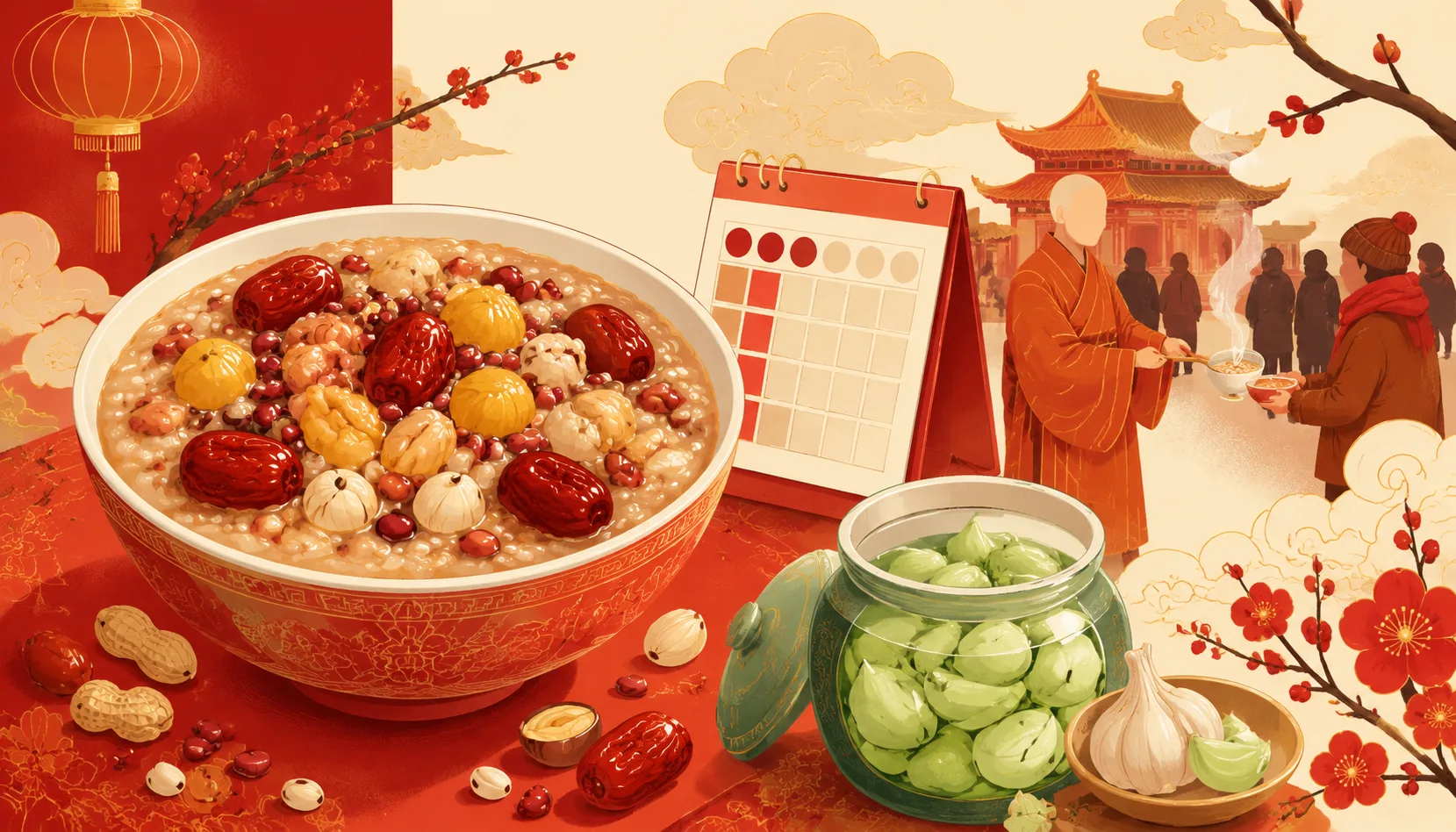
The signature tradition of Laba Festival is eating Laba congee (腊八粥 Là Bā zhōu), a rich and hearty porridge made from eight or more ingredients. While recipes vary by region and family, the classic mix includes glutinous rice, red beans, lotus seeds, longans, chestnuts, peanuts, dates, and walnuts. Each ingredient carries symbolic meaning:
| Ingredient | Chinese | Symbolism |
|---|---|---|
| Glutinous rice | 糯米 nuòmǐ | Sticky togetherness, family unity |
| Red beans | 红豆 hóngdòu | Warding off evil, good fortune |
| Lotus seeds | 莲子 liánzǐ | Fertility, harmony |
| Longans | 龙眼 lóngyǎn | Wealth and prosperity |
| Chestnuts | 栗子 lìzi | Strength and vitality |
| Peanuts | 花生 huāshēng | Longevity |
| Dates | 红枣 hóngzǎo | Early success, sweetness |
| Walnuts | 核桃 hétáo | Wisdom and intelligence |
The congee is slow-cooked for hours, often overnight, until it becomes thick and creamy. It's usually sweetened with sugar or rock sugar, though some northern versions are savory. Tip: If you're invited to share Laba congee, accept with both hands and say '谢谢' (xièxie) — it's a gesture of warmth and community.
Buddhist Roots and Temple Traditions
Laba Festival has deep Buddhist origins. It commemorates the day Siddhartha Gautama attained enlightenment under the Bodhi tree, traditionally believed to have happened on the 8th day of the 12th lunar month. Before his enlightenment, he had nearly starved himself through ascetic practices; a village girl offered him a bowl of rice porridge, which restored his strength and allowed him to meditate to enlightenment.
To honor this, Buddhist monasteries began cooking and distributing congee to the poor and needy on this day. The practice spread to laypeople, and by the Song Dynasty (960–1279), it had become a widespread folk custom. Today, many temples and monasteries across China still offer free Laba congee to the public, and the tradition has become a major community event.
In Beijing, some of the most famous distributions happen at temples like Yonghegong (雍和宫 Yōng Hé Gōng, the Lama Temple) and Tanzhe Temple (潭柘寺 Tán Zhè Sì). People queue for hours to get a bowl, believing it brings good luck and blessings. If you're in a city with a temple distribution, it's a wonderful cultural experience—just go early, as crowds are massive. Practical tip: Bring your own bowl and spoon if you can; some places provide disposable ones, but it's more eco-friendly and respectful.
Laba Garlic: A Northern Specialty
In northern China, especially in Beijing and surrounding areas, Laba Festival is also the day to make Laba garlic (腊八蒜 Là Bā suàn). This is a simple but fascinating tradition: raw garlic cloves are peeled and placed in a jar of vinegar, then sealed and left to pickle until Chinese New Year's Eve.
Over the weeks, the garlic undergoes a chemical reaction with the vinegar and turns a vivid emerald green. The flavor becomes milder and slightly sweet, with a tangy kick. On New Year's Eve, the garlic is served alongside dumplings (饺子 jiǎozi) — the vinegar is used as a dipping sauce, and the garlic cloves are eaten with the dumplings. It's believed to symbolize a fresh start and good health for the coming year.
As a foreigner, you can easily try this at home. Here's how: peel about 10 cloves of garlic, place them in a clean glass jar, fill with rice vinegar (or any mild vinegar), seal tightly, and store in a cool, dark place. By New Year's Eve, you'll have your own green garlic to enjoy. It's a fun conversation starter and a great way to impress Chinese friends with your cultural know-how.
Modern Celebrations and Community Spirit
Today, Laba Festival is as much about community as it is about tradition. While many families still make Laba congee at home, the festival has evolved into a day of sharing and neighborliness. It's common for people to cook a large pot and distribute bowls to neighbors, colleagues, and even strangers on the street. This act of giving is believed to spread good fortune and strengthen social bonds.
In recent years, some communities and companies have organized Laba congee events, where volunteers hand out free congee to passersby. In cities like Beijing, you might see long lines at temple gates or community centers. For foreigners, this is a perfect opportunity to engage with local culture. If a Chinese colleague or neighbor offers you Laba congee, accept it enthusiastically—it's a sign of friendship and inclusion. You can reciprocate with a small gift, such as fruit, pastries, or even a simple 'thank you' card. The gesture matters more than the value.
If you want to participate actively, consider making your own Laba congee and sharing it with your community. It's a wonderful way to build relationships and show appreciation for Chinese culture. You can find all the ingredients at any local supermarket or wet market. Tip: Soak the beans and grains overnight to reduce cooking time, and don't be afraid to experiment with your own ingredient combinations.
What Should Foreigners Do on Laba Festival?
As a foreigner in China, Laba Festival is a fantastic opportunity to immerse yourself in local customs without any pressure. Here are practical steps to make the most of it:
- Try Laba congee: If you're invited to eat it, say yes! It's delicious and nutritious. If not, visit a local temple or community center where free congee is often distributed.
- Make your own: Buy the ingredients and cook a pot at home. It's a fun weekend project, and you can share it with friends or neighbors.
- Prepare Laba garlic: Start your own jar of pickled garlic—it'll be ready by New Year's Eve.
- Learn the phrase: Say '腊八快乐' (Là Bā kuàilè, 'Happy Laba') to greet people. It's not as common as 'Happy New Year', but it will earn you smiles.
- Start your New Year prep: Use this day as a reminder to plan for Chinese New Year—buy red envelopes, book travel, and think about gifts.
Remember, the essence of Laba is warmth and sharing. Whether you're eating congee at a temple, making garlic at home, or simply acknowledging the day with colleagues, you're participating in a tradition that has connected Chinese people for centuries. Embrace it with an open heart, and you'll find your own place in the community.
Laba as Your New Year Countdown Signal
For expats and long-term visitors, Laba Festival serves as the unofficial countdown to Chinese New Year. Once you see Laba congee appearing in shops, offices, and homes, you know the big holiday is roughly three to four weeks away. This is your cue to:
- Book travel early: Train and flight tickets sell out fast during the Spring Festival rush (春运 chūnyùn). If you plan to travel, book immediately after Laba.
- Prepare red envelopes: Have cash ready in small denominations for giving 红包 (hóngbāo) to children, staff, or service workers.
- Buy gifts: If you're visiting Chinese friends or family, start thinking about appropriate gifts—fruits, tea, or quality liquor are always safe.
- Plan your schedule: Many businesses close for a week or more during New Year. Make sure you have enough supplies and know your local services' holiday hours.
By understanding Laba's significance, you not only appreciate a beautiful tradition but also gain a practical tool for navigating the busiest season in China. So when you see that first bowl of fragrant congee, smile—it's your invitation to join the celebration.
What Chinese People Actually Say
Laba Festival (腊八 Là Bā) falls on the 8th day of the 12th lunar month, marking the start of Chinese New Year preparations. The key tradition is eating Laba congee (腊八粥 Là Bā zhōu), a symbolic porridge.
What Chinese People Actually Say
- 腊八粥 (Là Bā zhōu) – "Laba congee" – used when talking about the traditional dish served on the festival.
- 吃腊八粥 (Chī Là Bā zhōu) – "eat Laba congee" – phrase used to remind family to prepare the porridge.
- 腊八节快乐 (Là Bā jié kuàilè) – "Happy Laba Festival" – greeting exchanged on the day.
- 过了腊八就是年 (Guò le Là Bā jiù shì nián) – "After Laba, it's the year" – saying that Laba marks the start of the Chinese New Year period.
2026 Reality Check
2026 Reality Check: In tier‑1 cities, Gen Z is re‑imagining Laba. They order congee via delivery apps, post short‑video “Laba moments” on Douyin, and mix traditional ingredients with trendy toppings like matcha or cheese. Older generations still gather at home, but they now join video calls with relatives in other provinces, blending ritual with tech. In tier‑2 and tier‑3 towns, the picture is more traditional. Seniors dominate the kitchen, cooking the classic garlic‑and‑rice porridge, while many younger residents still rely on family‑run markets. Yet even here, smartphone penetration is rising: about 60 % of 20‑somethings use group‑buy platforms to source specialty nuts, and a growing share watch live‑streamed Laba tutorials. The generational gap remains stark—city youth treat Laba as a social‑media event, while rural elders view it as a solemn precursor to the New Year. The result is a layered celebration: modern convenience in the east, enduring tradition in the west.
Frequently asked questions
When is Laba Festival on the Gregorian calendar in 2025?
In 2025, Laba Festival falls on January 7th. Since it follows the lunar calendar (8th day of the 12th month), the date shifts yearly—usually landing between early January and mid-February. Check a Chinese lunar calendar app or ask local friends for the exact date each year.
What ingredients are traditionally used in Laba congee?
There's no single recipe, but common ingredients include glutinous rice, red beans, peanuts, lotus seeds, jujube dates, dried longan, walnuts, and goji berries. Southern regions often add chestnuts or taro, while northerners may use millet or sorghum. The key is at least eight ingredients, symbolizing abundance and good fortune.
Can I eat Laba congee if I have dietary restrictions or allergies?
Yes, with planning. Most Laba congee is naturally vegan and gluten-free, but it often contains nuts and peanuts. If you have allergies, politely decline by saying 谢谢,我对坚果过敏 (thank you, I'm allergic to nuts). Alternatively, bring your own simple rice porridge to share—people will appreciate the gesture regardless.
Is Laba Festival a public holiday in China?
No, Laba Festival is not an official public holiday. Schools and businesses operate normally. However, many Buddhist temples hold ceremonies and offer free congee, and some workplaces serve it as a treat. If you want to participate, plan around your work schedule—most activities happen in the morning.
Why do people in northern China soak garlic in vinegar for Laba?
Northerners prepare Laba garlic (腊八蒜) by soaking peeled garlic cloves in rice vinegar from Laba until Chinese New Year. The garlic turns emerald green, and the vinegar is used for dumpling dipping sauce. It's a practical tradition—the garlic is ready just in time for New Year dumplings, and the process is believed to have antibacterial benefits.
What should I do if my Chinese neighbor invites me to eat Laba congee at their home?
Accept enthusiastically—it's a genuine gesture of goodwill. Bring a small gift like fruit or pastries, and offer a compliment on the congee. It's polite to finish your bowl, as leaving food may seem wasteful. After eating, offer to help with dishes. This simple interaction can build lasting community ties.
Try our tools
Related guides
Chinese New Year Survival Guide for Foreigners (2026)
Spring Festival is China’s biggest holiday, a family reunion that dwarfs Western celebrations. If invited to New Year’s Eve dinner, arrive early, bring fruit or…
Read the guide →
Mid-Autumn Festival 2026: Mooncakes & Gift Etiquette Guide
Mid-Autumn Festival is China’s second-biggest gift-giving event, blending Thanksgiving’s warmth with Christmas’s pressure around a full moon. Expect three days …
Read the guide →
Dragon Boat Festival China 2026: Zongzi & What to Know
Dragon Boat Festival (端午节, Duānwǔ Jié) falls on the 5th day of the 5th lunar month. Eat zongzi (sticky rice dumplings wrapped in bamboo leaves), watch or join d…
Read the guide →