Is walking while looking at your phone rude in China?
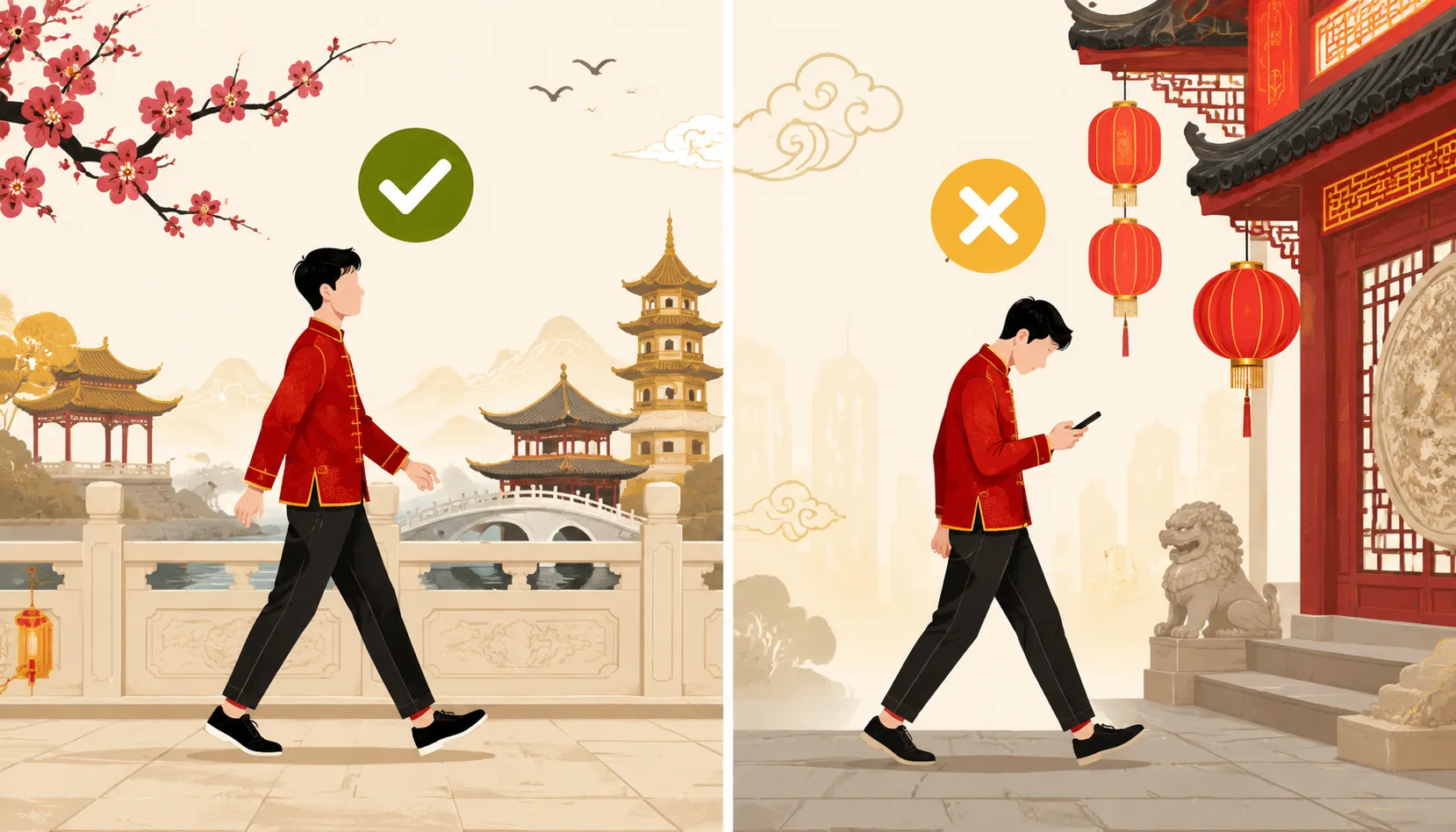
Quick answer
It is increasingly frowned upon. Walking with your head up, eyes forward, and at a steady pace is the culturally correct way to move through public spaces.
Why This Rule Matters
The Chinese folk saying 'zǒu xiàng bù zhèng xīn yǎn wāi' (走相不正心眼歪, crooked walking means a crooked heart) reflects traditional belief that posture reveals character. Phone-staring while walking is a modern issue — Chinese cities have even introduced 'phone-free walking lanes' in some places.
What You Should Do
- Walk with your eyes forward and head up
- Maintain a steady, unhurried pace in most situations
- When approaching an elder or senior, walk toward them more quickly to show respect — then slow down when leaving them
What You Shouldn't Do
- Walk while staring at your phone (called 'dītóuzú' 低头族, phone-staring tribe)
- Shuffle, drag your feet, or walk with a hunched back
- Walk with your arms swinging excessively or erratically
Practical Tips for Foreigners
This expectation matters most in formal settings, around elders, and in traditional northern neighborhoods, while in first-tier hubs like Shanghai and Shenzhen younger professionals often scroll while walking—so match your posture to your audience. When in doubt, watch what your Chinese host or senior colleague does and follow their lead. Breaking this rule once is forgivable — breaking it repeatedly signals a lack of cultural awareness.
The Unspoken Hierarchy of the Pavement
In Chinese cities, the sidewalk operates on an unspoken hierarchy: elderly first, then working adults, then children. Walking with your head down signals you've checked out of this social order. In Beijing's hutongs or Shanghai's busy metro corridors, locals read your posture as either respect or obliviousness. A foreigner shuffling phone-first past an elderly person isn't just rude — it's a breach of the subtle seniority system that governs <a href="/customs/chinese-zodiac-in-daily-life/">daily life</a>. Especially in northern cities like Tianjin or Qingdao, where older generations hold strong influence, this misstep can sour first impressions faster than a language mistake.
Real Scenes, Real Consequences
- An American project manager in Shenzhen walked through a factory floor checking emails on his phone. The Chinese supervisor later told his colleague: 'He doesn't respect the workers — he can't even look at them.' The manager never learned why his requests suddenly met resistance.
- In Chengdu, a British teacher strolled through a park, head buried in her phone, and nearly bumped into an elderly man practicing tai chi. He didn't scold her — he just sighed loudly and shook his head. Other locals noticed, and the teacher found herself oddly excluded from neighborhood greetings for weeks.
- A German expat in Guangzhou learned the hard way: while walking with his Chinese girlfriend's parents, he kept checking his phone for directions. Her father pulled him aside and said, 'In China, we walk with our elders, not with our screens.' The relationship survived, but the awkwardness lingered.
Regional Generational Divide You Can't Ignore
The rule isn't uniform. In first-tier hubs like Shanghai and Shenzhen, younger professionals (post-90s) often scroll while walking — it's tolerated, even common. But cross into second-tier cities like Xi'an or Harbin, or any area with a strong older demographic, and the judgment sharpens. In the northeast (Dongbei), walking head-down is seen as weak or sneaky — people there value directness in posture and speech. In Fujian and Guangdong, older generations link head-down walking to dishonesty, echoing the folk saying about crooked walking meaning crooked intentions. Match your posture to your audience: in business districts, a brisk, head-up pace projects competence; in traditional neighborhoods, it projects respect.
The Phone Zombie Label Sticks
The term 'dītóuzú' (低头族) isn't just descriptive — it's mildly derogatory. Call someone a phone zombie and you're implying they're disconnected, immature, and lacking self-awareness. For foreigners on work visas, getting tagged with this label by colleagues or neighbors can harm your reputation. It suggests you're not adapting to Chinese social norms, which casts doubt on your cultural fit. One fix: when walking between meetings or through office lobbies, keep your phone in your pocket or bag. Pull it out only when you've stopped moving. This small habit signals you're present, engaged, and worth trusting.
What Chinese People Actually Say
- 低头族 | dītóu zú | "bowed-head tribe" | Use to describe people constantly glued to their phones
- 刷手机 | shuā shǒujī | "to scroll/swipe phone" | Common phrase for mindlessly browsing phone
- 手机依赖症 | shǒujī yīlài zhèng | "phone addiction syndrome" | Refers to compulsive phone usage behavior
2026 Reality Check
In 2026, the "head up" rule exists mostly on posters. Reality: most Chinese still walk glued to their phones. The "phone zombie" phenomenon hasn't disappeared—it's evolved.
Gen Z vs older generations: Young people are actually more aware of the etiquette but follow it less. They know it's "rude" but scroll anyway. Older generations (40+) are worse—many now use phones aggressively while walking, especially in metro stations.
Beijing/Shanghai vs smaller cities: Tier-1 cities show slight improvement. Dedicated "phone zones" at crosswalks and metro platforms help. Smaller cities? No change. Downtown Guangzhou and Chengdu now match Beijing's behavior—chaotic sidewalk scrolling.
Bottom line: The rule survives as public service messaging only. Enforcement is zero. Cultural shift? Not yet.
Frequently asked questions
Is it considered rude to walk while looking at your phone in China?
Yes, it is increasingly frowned upon. Walking with your head up and eyes forward is seen as respectful and attentive in public spaces.
What is the culturally correct way to walk in public in China?
Walk with your head up, eyes forward, and at a steady pace. This shows awareness and respect for others around you.
Why is 'phone zombie' behavior discouraged in China?
It can cause collisions and disrupt the flow of foot traffic, especially in crowded areas. Staying alert helps maintain harmony and safety in public spaces.
Can I use my phone briefly while walking in China?
It's best to stop in a safe spot if you need to check your phone. Brief glances are okay, but avoid prolonged use while moving.
Are there any specific places where looking at your phone is especially bad?
Yes, in busy areas like subway stations, crosswalks, and shopping streets, it's particularly discouraged due to high foot traffic and safety risks.
How can I politely use my phone while walking in China?
Step aside to a less crowded area before using your phone. This shows consideration for others and keeps the walkway clear.
Try our tools
Related guides

10 Social Mistakes Foreigners Commonly Make in China
The most common mistakes cluster around face (publicly correcting or disagreeing with someone), physical greeting norms (hugging or back-patting people who are …
Read the guide →
China Social Situations Quick Guide: 6 Scenario Cheat Sheets
This quick-reference guide covers the six situations foreigners encounter most often: meeting someone new, visiting a Chinese home for dinner, drinking at a Chi…
Read the guide →
Public Behavior in China: What Is and Isn't Acceptable
Chinese cities have their own public behavior logic: noise levels are higher than Western norms in some contexts and strictly controlled in others, personal spa…
Read the guide →