Is pointing at someone with a finger rude in China?
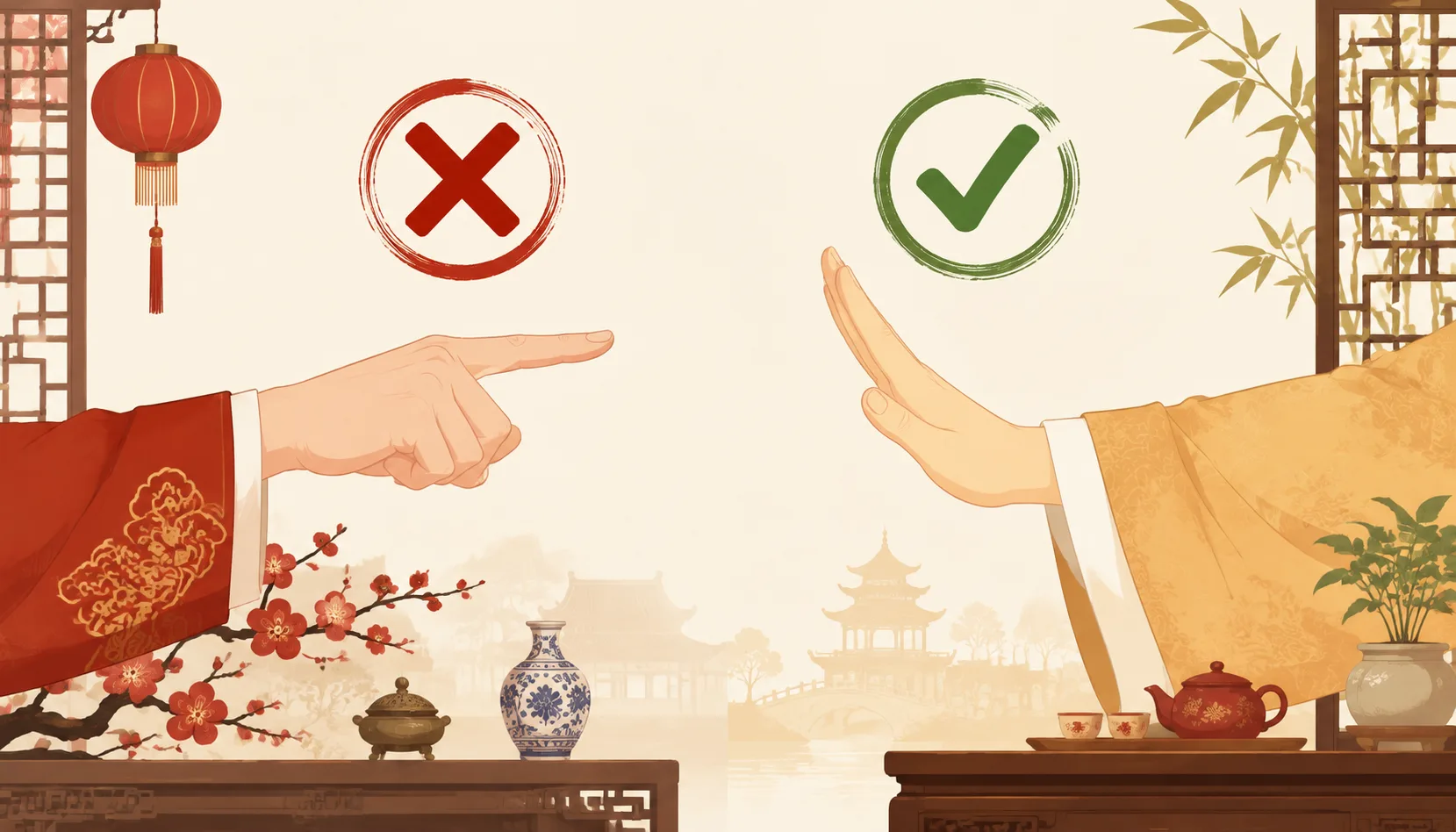
Quick answer
Yes. Pointing at a person with your index finger is seen as aggressive and disrespectful, regardless of your status or the context. Use an open hand gesture instead.
Why This Rule Matters
Finger-pointing carries the implicit message of 'I am judging you from above.' The Chinese saying notes: when you point at someone with one finger, the other three fingers are pointing back at you. In Chinese culture, this gesture is associated with accusation, confrontation, and disrespect — it appears in the phrase '用手指指着鼻子骂' (pointing-at-the-nose scolding).
What You Should Do
- Point at objects or directions with your whole open hand, palm up
- Use a slight forward tilt of the open hand when indicating people or directions
- Keep hands relaxed and non-confrontational when gesturing
What You Shouldn't Do
- Point directly at a person with your index finger
- Point at someone while speaking angrily or making a point in an argument
- Use your finger to 'poke' the air toward someone while talking
Practical Tips for Foreigners
This rule applies in most social and formal settings across China. When in doubt, watch what your Chinese host or senior colleague does and follow their lead. Breaking this rule once is forgivable — breaking it repeatedly signals a lack of cultural awareness.
Why Finger-Pointing Feels Worse in China
In Western cultures, pointing can be casual or even assertive—think of a manager assigning tasks. In China, it lands differently because of how confrontation is handled. Direct accusation is rare; people signal displeasure through tone, silence, or indirect comments. A pointed finger cuts through that subtlety, making the other person feel publicly shamed. Even in heated arguments, Chinese people rarely point—they might raise their voice, but the finger stays down. For foreigners used to gesturing while making a point, this takes conscious effort, especially in meetings or arguments where you feel strongly about being right.
Real Scenarios: When Pointing Backfires
- During a business meeting in Shanghai, a German manager pointed his index finger at a PowerPoint slide to emphasize a data point. His Chinese colleagues interpreted the gesture as aggressive criticism of their work, and the meeting's tone shifted from collaborative to defensive for the remainder of the hour.
- At a bustling restaurant in Chengdu, an Australian tourist pointed across the room to ask a waiter for the menu. The waiter, feeling singled out and disrespected, responded slowly and with visible reluctance, leaving the tourist confused about the sudden change in service quality.
- A Canadian expat in Guangzhou pointed at a taxi driver to indicate he wanted to be picked up. The driver, offended by the gesture, drove past and picked up another passenger instead, forcing the expat to wait another twenty minutes in the heat.
- While negotiating a contract in Xi'an, a French businesswoman used her index finger to point at specific clauses in the agreement. Her Chinese counterpart paused, closed the document, and suggested a recess, later revealing through a mutual contact that the gesture had made him feel 'talked down to' and had nearly derailed the deal.
Regional and Generational Differences
Not all of China reacts identically. In tier-1 cities like Beijing, Shanghai, and Shenzhen, younger professionals under 35—especially those who've studied or worked abroad—are more relaxed about finger-pointing. They might see it as a harmless habit. But in second- and third-tier cities like Chengdu, Wuhan, or Xi'an, or in state-owned enterprises and government offices, the rule holds firmly. Older colleagues, particularly those over 50, view pointing as a direct challenge to their authority. In northern China, people are generally more direct, so pointing might be brushed off in casual settings—but in <a href="/business/chinese-formal-meeting-guide/">formal business</a> or family gatherings, it's still a serious breach.
What Your Chinese Counterpart Thinks
When you point, the Chinese person rarely says anything—but internally they're thinking: 'Why is he attacking me?' 'Does he think I'm stupid?' Or worse, 'He's showing he has no self-control.' They won't correct you, because that would be rude. Instead, they'll distance themselves, become more formal, or simply avoid you. You might never learn what went wrong until a mutual friend explains it weeks later. The silence is not acceptance—it's disappointment.
What Chinese People Actually Say
- 用手指人 | yòng shǒu zhǐ rén | pointing at someone with finger | Avoid in formal settings; describes the action itself.
- 指指点点 | zhǐ zhǐ diǎn diǎn | to point fingers at others; gossip/criticize | Used when someone improperly criticizes or gossips about others.
- 指手画脚 | zhǐ shǒu huà jiǎo | to point and gesture while criticizing | Implies inappropriate meddling or giving unwanted comments.
2026 Reality Check
In 2026, this rule still exists but withering. Most Chinese people still consider pointing a finger rude, but enforcement is casual. You'd get a glare or a "don't do that" from elders, not a scandal.
Gen Z vs Older Generations: Younger Chinese (under 25) care less. They point casually among friends, seeing it as normal. But with elders or in formal settings, they still instinctively avoid it. Boomers and Gen X? They'll call you out immediately. "Wen mian zi" (have you no manners?) still lands.
Big Cities vs Small Cities: Beijing and Shanghai are more relaxed—international exposure, fast-paced, people let it slide. Smaller cities and rural areas? The rule holds tighter. Older locals notice and judge. Point at someone in a Chengdu tea house, and you'll get side-eye.
Bottom line: Rule not dead, but weakening. Age and location matter more than law.
Frequently asked questions
Why is pointing with the index finger considered rude in China?
It's seen as aggressive and disrespectful because it singles out a person in a confrontational way, clashing with the cultural emphasis on harmony and saving face. Even in casual settings, it can be interpreted as a challenge or insult.
What should I use instead of pointing with my index finger?
Use an open hand with the palm facing up or sideways, and gesture toward the person or object with all fingers together. This softer motion is polite and commonly used in Chinese social interactions.
Is pointing at objects or directions also rude in China?
Pointing at objects or directions is generally acceptable, but it's still better to use an open hand or a nod for directions. Avoid pointing at people entirely, as the rule specifically targets interpersonal gestures.
Does this rule apply to foreigners or only to Chinese people?
It applies to everyone in China, including foreigners, as locals may judge the gesture harshly regardless of your background. Using the open-hand gesture shows cultural awareness and avoids unintended offense.
What if I accidentally point at someone—how should I react?
Quickly apologize by saying 'duì bù qǐ' (sorry) and switch to an open-hand gesture. A brief, sincere apology smooths over the mistake, as most people understand it's not intentional for foreigners.
Are there any exceptions where pointing with the index finger is okay?
In very informal settings among close friends, it might be overlooked, but it's still safer to avoid it. For public or professional situations, always use the open-hand gesture to maintain respect and avoid misunderstandings.
Try our tools
Related guides

10 Social Mistakes Foreigners Commonly Make in China
The most common mistakes cluster around face (publicly correcting or disagreeing with someone), physical greeting norms (hugging or back-patting people who are …
Read the guide →
Ancient Chinese Etiquette Rules: The Unwritten Code Every Foreigner Should Know
China has thousands of years of accumulated social rules — many of them "unwritten" but universally understood. These rules cover everything from how you sit, h…
Read the guide →
China Social Situations Quick Guide: 6 Scenario Cheat Sheets
This quick-reference guide covers the six situations foreigners encounter most often: meeting someone new, visiting a Chinese home for dinner, drinking at a Chi…
Read the guide →