What do foreigners need to know about Dragon Boat Festival in China?
Quick answer
Dragon Boat Festival (端午节, Duānwǔ Jié) falls on the 5th day of the 5th lunar month. Eat zongzi (sticky rice dumplings wrapped in bamboo leaves), watch or join dragon boat races if invited, and bring a gift box of branded zongzi when visiting colleagues or clients. It's China's third-largest gift-giving holiday.
What Is Dragon Boat Festival?
Dragon Boat Festival (端午节, Duānwǔ Jié) is one of China's four major traditional holidays — the kind that gets a government-mandated 3-day break and drives a national wave of gift-sending.
The quick Western parallel: think St. Patrick's Day (a national story about a cultural hero) crossed with a specific food everyone eats and a competitive sport people watch. But the emotional weight is closer to a mini Thanksgiving: families gather, food is traditional and symbolic, and gifts flow from juniors to seniors.
The Date
Dragon Boat Festival falls on the 5th day of the 5th lunar month. In the Gregorian calendar, this shifts each year.
| Year | Date |
|---|---|
| 2025 | May 31 |
| 2026 | June 19 |
| 2027 | June 9 |
The government holiday is 3 days. Office gift deliveries typically arrive in the week before the festival.
The Origin: Why This Festival Exists
Around 278 BCE, the poet and statesman Qu Yuan (屈原, Qū Yuán) learned his kingdom had been conquered by the Qin state. In despair, he waded into the Miluo River (汨罗江) and drowned himself on the 5th day of the 5th lunar month.
Locals rushed out in boats to retrieve his body, beating drums to scare fish away. They also threw rice wrapped in bamboo leaves (粽子, zòngzi) into the river to feed the fish — so they wouldn't eat Qu Yuan's body instead.
That's where dragon boats and zongzi come from. The festival is fundamentally about loyalty, patriotism, and collective mourning for a principled person who chose death over compromise.
What Chinese People Do
1. Eat Zongzi (粽子)
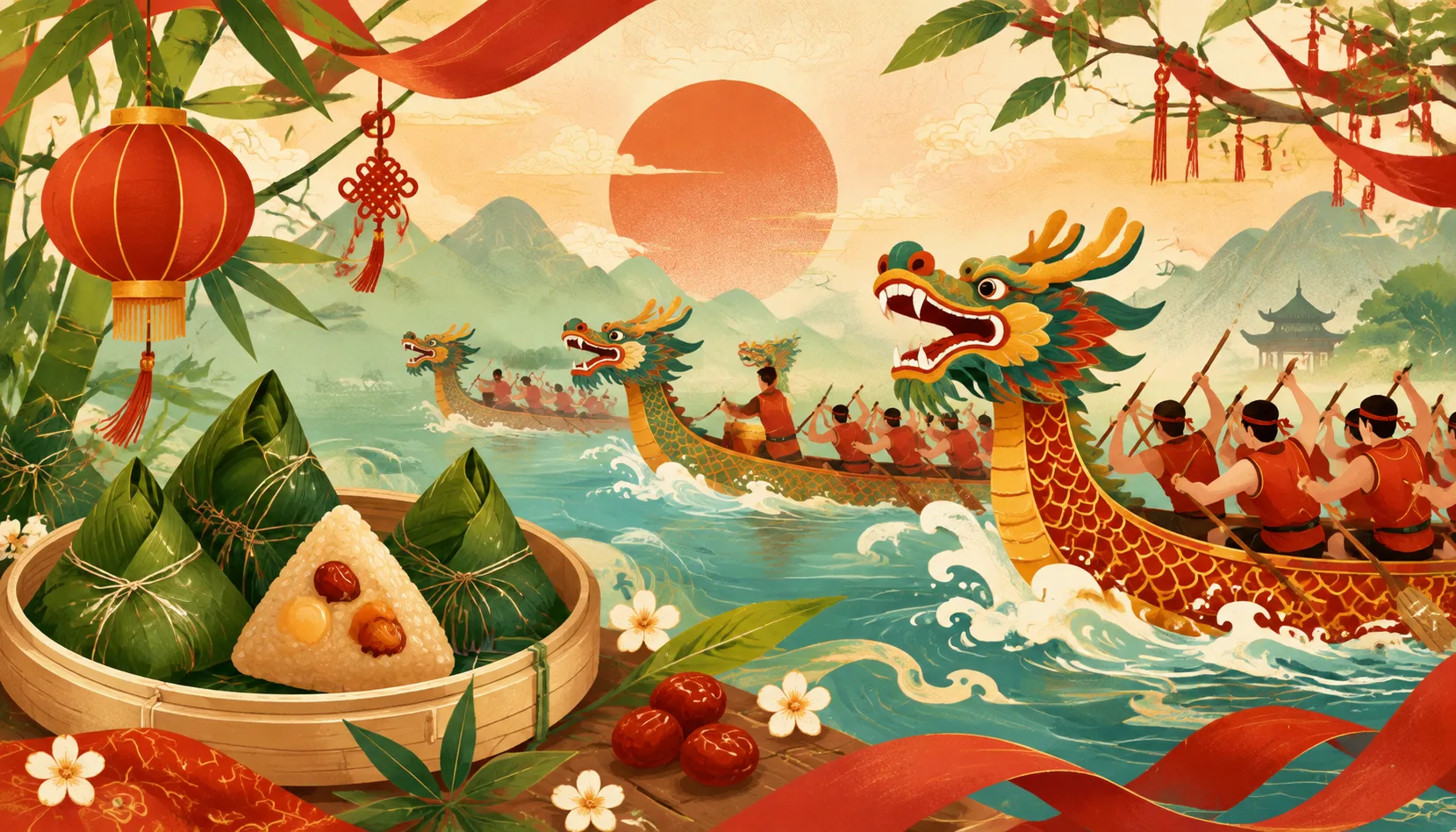
Zongzi are sticky rice dumplings wrapped tightly in bamboo or reed leaves, then boiled or steamed. There are two main types:
| Type | Fillings | Common In |
|---|---|---|
| Sweet (甜粽) | Red bean paste, jujube, lotus paste | Northern China |
| Savory (咸粽) | Pork belly, salted egg yolk, mushroom | Jiangsu, Zhejiang, Shanghai |
When a Chinese colleague offers you a zongzi, eat it. The polite move: unwrap the leaf carefully, eat slowly, and express genuine appreciation — "好吃" (hǎo chī, delicious) is always welcome.
2. Watch Dragon Boat Racing (赛龙舟)
Long narrow boats painted to look like dragons, crewed by 20+ paddlers racing to drums. If you're near Guangzhou, Hangzhou, Hunan, or Hong Kong, find a race — they are genuinely spectacular and foreigners are warmly received as spectators.
3. Hang Mugwort and Calamus (挂艾草菖蒲)
Bundles of mugwort (艾草, àicǎo) are hung above doorways. The smell is believed to repel insects and evil spirits. If your landlord or neighbor hangs something fragrant above the door in June, this is why.
4. Wear Five-Colored Threads (五彩绳)
Children are given bracelets of five-colored threads (五彩绳, wǔcǎi shéng) — red, yellow, blue, white, black — tied on the wrist to ward off bad luck. If offered one, accept it and wear it briefly — it's a kind gesture.
What Foreigners Should Do
- Eat zongzi — both sweet and savory. This is the single most important thing. Refusing food at a cultural moment is a social miss.
- Send gift boxes to your key Chinese relationships 5–7 days before the festival (see gift section below).
- Watch a dragon boat race if geography permits — they're loud, exciting, and fully accessible to outsiders.
- Learn one phrase: 端午节快乐 (Duānwǔ jié kuàilè) — Happy Dragon Boat Festival. Say it to Chinese colleagues on or before the day.
What Foreigners Must NOT Do
- ❌ Dismiss zongzi as "just rice in a leaf" — this minimizes a food with 2,000+ years of cultural weight and the story of a national hero.
- ❌ Microwave a zongzi without adding water — it will explode or turn rock-hard. Steam or boil it.
- ❌ Give a clock as a gift — "送钟" (sòng zhōng) sounds exactly like "attending someone's funeral" (送终). Always a catastrophic gift error.
- ❌ Send gifts after the festival — holiday gifts should arrive before or on the day. Sending them afterwards signals forgetfulness.
Gift-Giving: Dragon Boat Festival Is China's #3 Gift Holiday
After Spring Festival and Mid-Autumn Festival, Dragon Boat Festival drives the third-largest wave of corporate and personal gift-giving in China. If you manage relationships with Chinese clients, partners, or colleagues, not sending a gift is noticeable.
| Recipient | Recommended Gift | Budget (RMB) |
|---|---|---|
| Senior leaders / important clients | Premium zongzi gift set (五芳斋, 稻香村) + salted duck eggs | ¥200–500 |
| Colleagues / team | Small zongzi gift box | ¥50–150 |
| Elders / parents | Zongzi + health supplement gift set | ¥200–400 |
Timing: Send gifts 5–10 days before the festival. The week before Dragon Boat Festival, every office lobby in China fills with stacked gift boxes — you want your gift there, not missing.
Best Places to Experience Dragon Boat Festival
- Guangzhou / Foshan — some of the most elaborate dragon boat races in mainland China
- Miluo, Hunan — the city where Qu Yuan drowned. Most historically significant location.
- Jiaxing, Zhejiang — home of 五芳斋 (Wǔfāngzhāi), China's most famous zongzi brand, and a full zongzi festival
- Hong Kong — international dragon boat races with teams from around the world
What Chinese People Actually Say
- 端午节 | Duānwǔ Jié | Dragon Boat Festival | Use as greeting: "端午节快乐!" (Happy Dragon Boat Festival!)
- 粽子 | Zòngzi | sticky rice dumpling | Say when eating: "我爱吃粽子" (I love eating zongzi)
- 赛龙舟 | Sài lóng zhōu | dragon boat racing | Comment on event: "赛龙舟很精彩!" (Dragon boat racing is exciting!)
2026 Reality Check
Zongzi (Rice Dumplings): Still widely eaten, but homemade has declined. Gen Z prefers convenience—store-bought or delivery. Older generations still make them at home, especially in smaller cities where tradition runs stronger. Beijing and Shanghai youth see it more as a holiday than a ritual.
Dragon Boat Races: Popular in southern China and tourist areas. Big cities have corporate-sponsored events; smaller towns keep community races. Gen Z attends more for social media photos than cultural significance.
Key Etiquette Still Followed: Hanging mugwort and calamus (艾草) remains common, especially in smaller cities where older generations insist on it. Wearing scented sachets (香囊) has faded among Gen Z in big cities but stays popular with elders everywhere.
Reality Check: The holiday is increasingly commercialized. Younger Chinese in megacities treat it as a 3-day vacation; smaller cities and older generations maintain stronger traditional practices. The core—eating zongzi and honoring Qu Yuan's legacy—remains, but the depth of observance varies significantly by age and location.
Frequently asked questions
How do I calculate the exact date of Dragon Boat Festival in 2026?
Dragon Boat Festival always falls on the 5th day of the 5th lunar month. In 2026, that lands on June 19. If you don't have a lunar calendar handy, check Chinese holiday announcements from the State Council or your employer—they publish the official date and the resulting public holiday schedule each year.
Can I join a dragon boat race as a foreigner, or is it only for locals?
Yes, you can join—many cities have open teams, especially in Guangdong, Hong Kong, and Shanghai. Amateur teams often welcome foreigners, but you must be able to swim and commit to 2-3 weeks of evening practice. Ask at local sports clubs or expat groups; some races even have dedicated international teams.
What should I bring if I'm invited to a Chinese colleague's home for the festival?
Bring a box of branded zongzi—think Wufangzhai or Xinghuacun—or a fruit basket. Avoid clocks, pears, or anything in sets of four, as these carry negative connotations. If you're unsure about dietary restrictions, ask beforehand whether they prefer sweet (red bean, jujube) or savory (pork, egg yolk) zongzi.
Is it rude to eat zongzi in public or on the subway during the festival?
No, it's completely fine. Zongzi are portable and commonly eaten on the go. Just be mindful of the bamboo leaves—unwrap carefully and dispose of them properly. Some offices and schools have rules against eating at desks, but public transport and parks are totally acceptable places to enjoy one.
Why do some regions in China have dragon boat races while others don't?
Dragon boat racing is most intense in southern provinces like Guangdong, Fujian, and Hunan, where rivers and lakes are abundant. In northern cities like Beijing, you'll find smaller races in parks, but the focus shifts more to eating zongzi, hanging mugwort, and wearing perfumed sachets. The south treats it as a serious sport; the north treats it as a family holiday.
What happens if I'm in China on the festival day but my office doesn't give me the day off?
If you work for a Chinese company, you're legally entitled to the public holiday unless your contract specifies otherwise. If you're on a foreign contract or working remotely, it's not guaranteed. Check your employment agreement—if you're expected to work, you'll typically receive overtime pay or a compensatory day off later, per Chinese labor law.
Try our tools
Related guides

Mid-Autumn Festival 2026: Mooncakes & Gift Etiquette Guide
Mid-Autumn Festival is China’s second-biggest gift-giving event, blending Thanksgiving’s warmth with Christmas’s pressure around a full moon. Expect three days …
Read the guide →
Chongyang Festival: China's Day for the Elderly Explained
The Chongyang Festival (重阳节 Chóngyáng Jié) falls on the 9th day of the 9th lunar month (usually October). It's China's day for respecting elders, marked by clim…
Read the guide →
Dongzhi in China: Winter Solstice Guide for Foreigners
Dongzhi (冬至), the Chinese Winter Solstice, falls around December 21-22 and is a major traditional festival emphasizing family reunion and special foods. Norther…
Read the guide →