Chinese New Year Red Envelopes (红包): Foreigner's Guide to Giving and Receiving (2026)
Quick answer
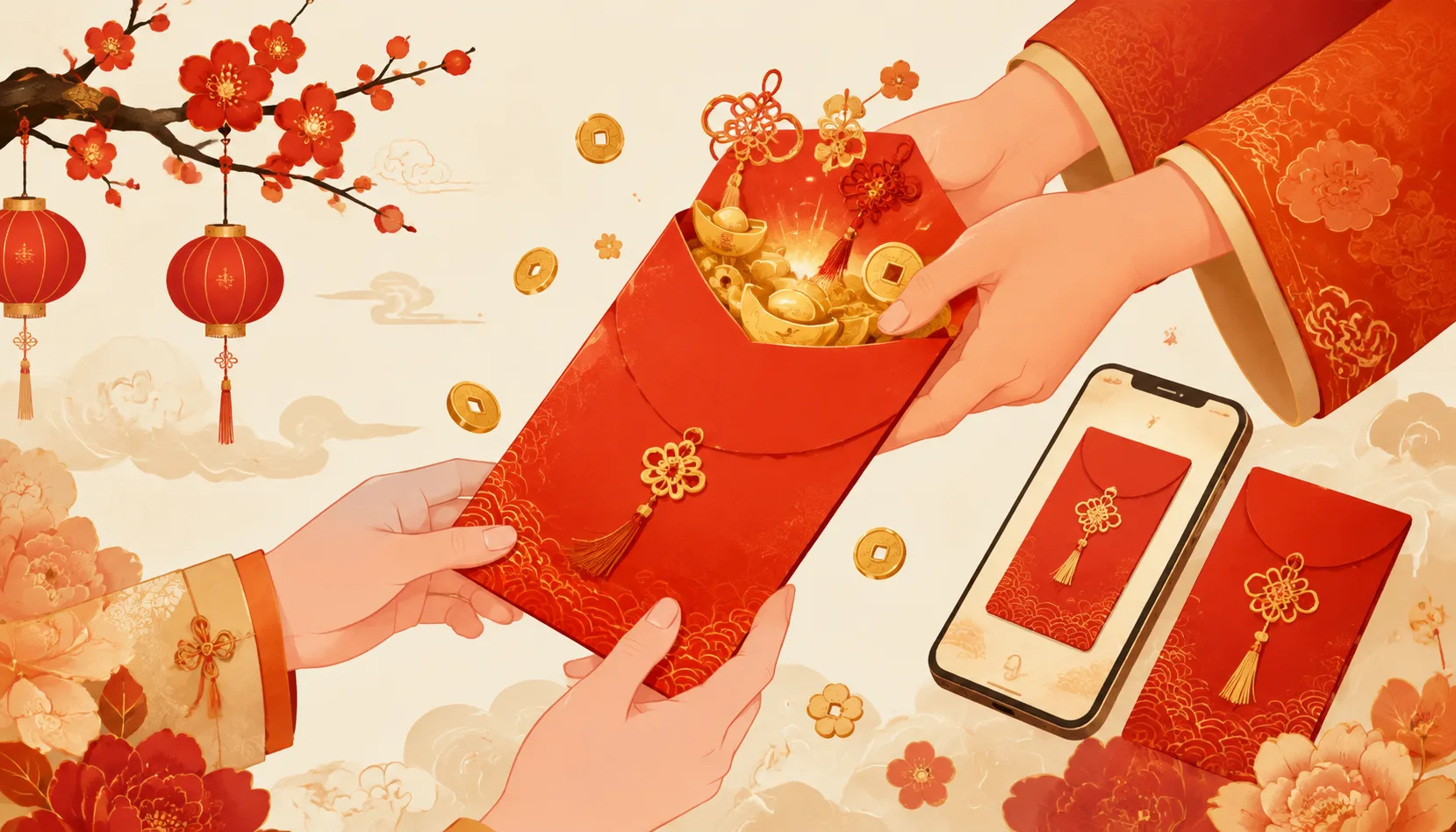
A red envelope (红包, hóngbāo) contains cash — it's the primary gift mechanism during Spring Festival. When you receive one: take it with both hands, say "谢谢,祝您身体健康!", and never open it in front of the giver. As a working adult foreigner, you're expected to give red envelopes to children (¥50–200 per child). Use even amounts (¥100, ¥200, ¥600) and never ¥400 (4 = death).
Quick Answer
A red envelope (红包, hóngbāo) contains cash — it's the primary gift mechanism during Spring Festival. When you receive one: take it with both hands, say "谢谢,祝您身体健康!", and never open it in front of the giver. As a working adult foreigner, you're expected to give red envelopes to children (¥50–200 per child). Use even amounts (¥100, ¥200, ¥600) and never ¥400 (4 = death).
What Is the Red Envelope?
The red envelope (红包, hóngbāo — literally "red package") is a traditional Spring Festival custom. The red color symbolizes luck and good fortune; the cash inside is called 压岁钱 (yāsuìqián, literally "money that presses down the year's evil spirits").
Traditional structure:
- Elders and married adults give red envelopes to children and unmarried young adults
- Bosses give envelopes to employees (on the first workday back — 开工利是)
- Parents give to their children and grandchildren
Modern expansion:
- Digital red envelopes via WeChat Pay have become standard
- Friends send small amounts to each other via WeChat as a fun, game-like exchange
- Companies and brands use digital red envelopes as marketing
Who Gives to Whom
| Giver | Recipients | Context |
|---|---|---|
| Grandparents | All grandchildren | Classic — the grandparent red envelope is the most emotionally significant |
| Parents | Children | Ongoing through adulthood for many families |
| Married adults (any age) | Unmarried peers and children | Traditional expectation — married = "established adult" who gives |
| Boss/manager | Employees | First workday back (开工利是) |
| Couples (joint name) | Children of friends/family | When visiting homes with children during the holiday |
The foreigner's position: As an adult guest in a Chinese home, you are likely to:
- Receive: From elderly family members who want to give to a foreign "guest-child" — this is a sign of warmth
- Give: To any children in the household — this is expected behavior for adult visitors at Spring Festival
Receiving a Red Envelope: The Ritual
What happens: An elder family member hands you a red envelope, probably while saying "拿着,图个吉利" (Ná zhe, tú ge jílì) — "Take it, for good luck" or "新年快乐,给你的压岁钱" (Xīnnián kuàilè, gěi nǐ de yāsuìqián) — "Happy New Year, here's your lucky money."
The Three-Round Ritual:
Round 1 — Decline gracefully: "不用不用,阿姨太客气了!" (Bù yòng bù yòng, āyí tài kèqi le!) — "No need, no need, you're too kind!"
Round 2 — Decline again when they insist: "真的不用,这怎么好意思。" (Zhēn de bù yòng, zhè zěnme hǎoyìsi.) — "Really no need, I'm embarrassed to accept."
Round 3 — Accept when they physically place it in your hands: Accept with both hands, bow slightly forward, and say warmly: "谢谢阿姨!祝您新年快乐,身体健康,万事如意!" (Xièxie āyí! Zhù nín xīnnián kuàilè, shēntǐ jiànkāng, wànshì rúyì!) "Thank you, Auntie! Wishing you a Happy New Year, good health, and all the best!"
Then: Put it in your pocket or bag. Do not open it. Do not look inside. Do not ask how much is inside.
The amount is usually modest (¥100–500) — it is the gesture that matters.
Affiliate placement: → Premium red envelope sets for Spring Festival (traditional designs with auspicious patterns) | Chinese New Year red envelope gift sets (金色/double happiness designs)
What NOT to Do When Receiving
| Mistake | Why It's Bad | What to Do Instead |
|---|---|---|
| Opening it in front of the giver | Implies the money matters more than the gesture | Put it away immediately |
| Refusing more than twice | After 2 rounds of refusal, further declining can feel like rejection | Accept gracefully on Round 3 |
| Accepting immediately with no refusal | Signals eagerness/greed | Do the 2-round push-pull first |
| Saying "how much is inside?" | Invasive and transactional | Never ask |
| Thanking them in English only | Missed warmth opportunity | Deliver thanks in Chinese first |
Giving Red Envelopes: The Rules
Who You Should Give To
Children (children at any home you visit): If you visit a Chinese family during Spring Festival and they have children under 18 present, you are expected to give them red envelopes. Not optional — it's built into the adult-guest social contract.
Your manager/boss: No. Red envelopes flow down hierarchy, not up. Giving your boss a red envelope looks strange.
Your colleagues: Optional but warm. A small amount (¥20–50) via WeChat as a fun gesture is completely appropriate.
Amounts and Rules
Always use even amounts:
- ✅ ¥50, ¥100, ¥200, ¥500, ¥600, ¥800, ¥888, ¥1000
- ❌ ¥40, ¥400, ¥4000 — 4 = death, never give these amounts
- ❌ Odd amounts (¥103, ¥251, ¥707) — odd = mourning. Auspicious amounts are round or even.
Amount by recipient:
| Recipient | Amount | Notes |
|---|---|---|
| Child under 12 (acquaintance's child) | ¥50–100 | Modest and appropriate |
| Child of close friend | ¥100–200 | More substantial |
| Child of family you're staying with | ¥200–500 | You're a long-term guest — be generous |
| Multiple children (whole family) | ¥100–200 per child | Consistency matters — don't visibly differentiate between siblings |
Never give ¥100.01 or any amount that's "off." Amounts ending in 8 (¥188, ¥288, ¥888) are particularly auspicious — 8 sounds like 发 (prosperity).
Auspicious Amounts at a Glance
| Amount | Why It's Auspicious |
|---|---|
| ¥100 | Round number of respect |
| ¥200 | 200 = 二百 = "double hundred" — a pair |
| ¥600 | 六六大顺 — smooth sailing in all things |
| ¥800 | 八 = 发 — prosperity |
| ¥888 | Triple prosperity |
| ¥1000 | Significant round number |
Physical Red Envelopes
Buy proper red envelopes — not just cash in any envelope. Red envelopes are sold at:
- Convenience stores and pharmacies in China (year-round)
- Supermarkets (in stock from December onward)
- Online (Taobao, JD.com for bulk or premium options)
What to write on the envelope:
- The child's name (if you know it — or just 小朋友, xiǎopéngyǒu, "little friend")
- "新年快乐" (Happy New Year)
- Your name
Affiliate placement: → Traditional Chinese red envelope sets for New Year gifting | Premium luxury red envelopes (金色/云纹/double happiness)
The Digital Red Envelope (微信红包, WeChat Red Packet)
WeChat Pay made red envelopes digital — and it's become a social norm for:
- Sending holiday greetings to friends and colleagues
- The "lucky draw" feature (split random amounts among a group chat — whoever grabs first, gets most)
- Corporate marketing during Chinese New Year
As a foreigner: If you have WeChat Pay set up, sending a small WeChat red envelope to your Chinese friends' group chat on New Year's Day is a warmly received gesture. Even ¥20–50 total split among a group chat is fun and appreciated — the "lucky grab" randomness is part of the charm.
Message to send with it:
"新年快乐!大家抢红包!" (Xīnnián kuàilè! Dàjiā qiǎng hóngbāo!) — "Happy New Year! Everyone grab the red envelope!"
The group will scramble to grab their share. You'll be celebrated.
The 开工利是: First Workday Red Envelopes
On the first workday back after Spring Festival, there is a specific red envelope tradition:
- Bosses give to employees (a small amount — ¥20–200, purely symbolic)
- In some regions, married employees give to unmarried ones
- The greeting attached is: "开工大吉!" (Kāigōng dàjí!) — "A prosperous start to work!"
If your boss gives you one: Accept with both hands, say "谢谢[老板/总监]!开工大吉,新年发财!" and put it away. Don't open it. This is purely symbolic and the amounts are small.
If you want to give one as a foreign employee: Optional, but warmly received. A small WeChat red envelope to your team's group chat with "开工大吉!" is a low-effort, high-warmth move.
FAQ
Q: I received a red envelope from my Chinese host family. Should I put money in it and give it back? A: No — returning the envelope on the same visit would be strange. Instead: when you next visit (at another holiday, or when they have a significant life event), bring an appropriate gift or give red envelopes to any children in the family. Reciprocation happens across time, not in the same transaction.
Q: My Chinese colleague sent me a WeChat red envelope. I've never used WeChat Pay. How do I respond? A: Accept it by opening WeChat and tapping the red envelope in the message. Then send one back of similar amount (or slightly larger) with "谢谢!新年快乐!你也发大财!" (Xièxie! Xīnnián kuàilè! Nǐ yě fā dàcái!) — "Thank you! Happy New Year! May you also prosper!" If you can't accept it (WeChat Pay not set up), at minimum reply with "新年快乐!谢谢你的红包!我回头补上!" — "Happy New Year! Thank you for the envelope — I'll make it up to you!" then buy them coffee.
Q: How do I give red envelopes to multiple children in the same family without making one child feel less important than another? A: Give identical amounts to children of the same family. Differential amounts create awkward sibling comparison. If one child is significantly older (teenager vs. toddler), a small difference is fine — but err toward same amount.
What Chinese People Actually Say
- 恭喜发财 | gōng xǐ fá cái | "Wishing you wealth and prosperity" | Say when handing over the red envelope to show good wishes.
- 压岁钱 | yā suì qián | "New Year money" / "luck money" | Traditional term for red envelopes given to children.
- 红包拿来 | hóng bāo ná lái | "Give me the red envelope" | Playful phrase children say when receiving red envelopes.
2026 Reality Check
2026 Reality Check: The core rule remains—never open a red envelope in front of the giver. This is still widely followed, though younger crowds in trendy spots sometimes break it for social media content.
Gen Z vs. Older Generations: elders insist on the "unopened" rule as respect. Gen Z largely follows it with grandparents but openly jokes about it with peers. Digital red packets (微信红包) have normalized quick opens—etiquette purists frown on this, but it's widespread.
Beijing/Shanghai vs. Smaller Cities: Big cities are more relaxed—people open envelopes at restaurants, compare amounts openly. Smaller cities and rural areas still observe stricter protocols: refuse once or twice before accepting, keep the envelope closed, don't discuss amounts.
Frequently asked questions
What should I do if I receive a red envelope from a Chinese coworker?
Accept it with both hands, say a quick thanks, and put it away without opening it. Later, you can open it privately, but never mention the amount. If you feel awkward, reciprocating with a small gift or treating them to lunch is appropriate, though not mandatory.
Is it okay to give a red envelope to a Chinese friend's child even if I'm not married?
Yes, unmarried foreigners are not bound by the traditional rule that only married adults give red envelopes. In modern China, many single people give them to children anyway. If you're unsure, ¥50–100 is a safe, appreciated amount that won't create awkward expectations.
Can I use a digital red envelope on WeChat instead of cash?
Absolutely. WeChat red envelopes are extremely common, especially among younger generations and in urban areas. For children, a physical envelope feels more festive, but digital is perfectly acceptable. Just make sure to send it with a cheerful greeting and during the Spring Festival period.
What if I accidentally give a red envelope with an unlucky amount like ¥400?
Don't panic, but apologize briefly and offer to swap it. If you can't, simply explain you didn't know the custom. Most Chinese people will understand a foreigner's mistake. To avoid this, stick to amounts ending in 6, 8, or 9, which are considered lucky.
Is there a difference in red envelope etiquette between northern and southern China?
Yes, regional variations exist. In northern China, amounts tend to be larger (¥100–200 for children), while southern regions like Guangdong are more modest (¥20–50). Also, in some southern areas, married adults give to unmarried friends of any age, not just children. When in doubt, ask a local colleague.
When is the exact time to give red envelopes during Chinese New Year?
The most common times are during the New Year's Eve dinner (年夜饭), when visiting relatives on the first few days of the new year, or when children greet you with New Year wishes. Avoid giving red envelopes on the street or in public offices—it should feel like a personal, festive gesture, not a transaction.
Try our tools
Related guides
Chinese Red Envelope (红包) Guide: When to Give & How Much
A red envelope (红包, hóngbāo) is a cash gift in a red wrapper given at Chinese New Year, weddings, births, and milestone birthdays. Key rules: always use red (ne…
Read the guide →
Chinese New Year Gift Guide 2026: What to Buy & When to Send
Chinese New Year (春节, Chūnjié) is China's largest annual gift-giving event. The window is the two weeks before the holiday through the first 15 days of the luna…
Read the guide →
Chinese New Year Survival Guide for Foreigners (2026)
Spring Festival is China’s biggest holiday, a family reunion that dwarfs Western celebrations. If invited to New Year’s Eve dinner, arrive early, bring fruit or…
Read the guide →