Chinese New Year Taboos: What You Cannot Do on Spring Festival Day (2026)
Quick answer
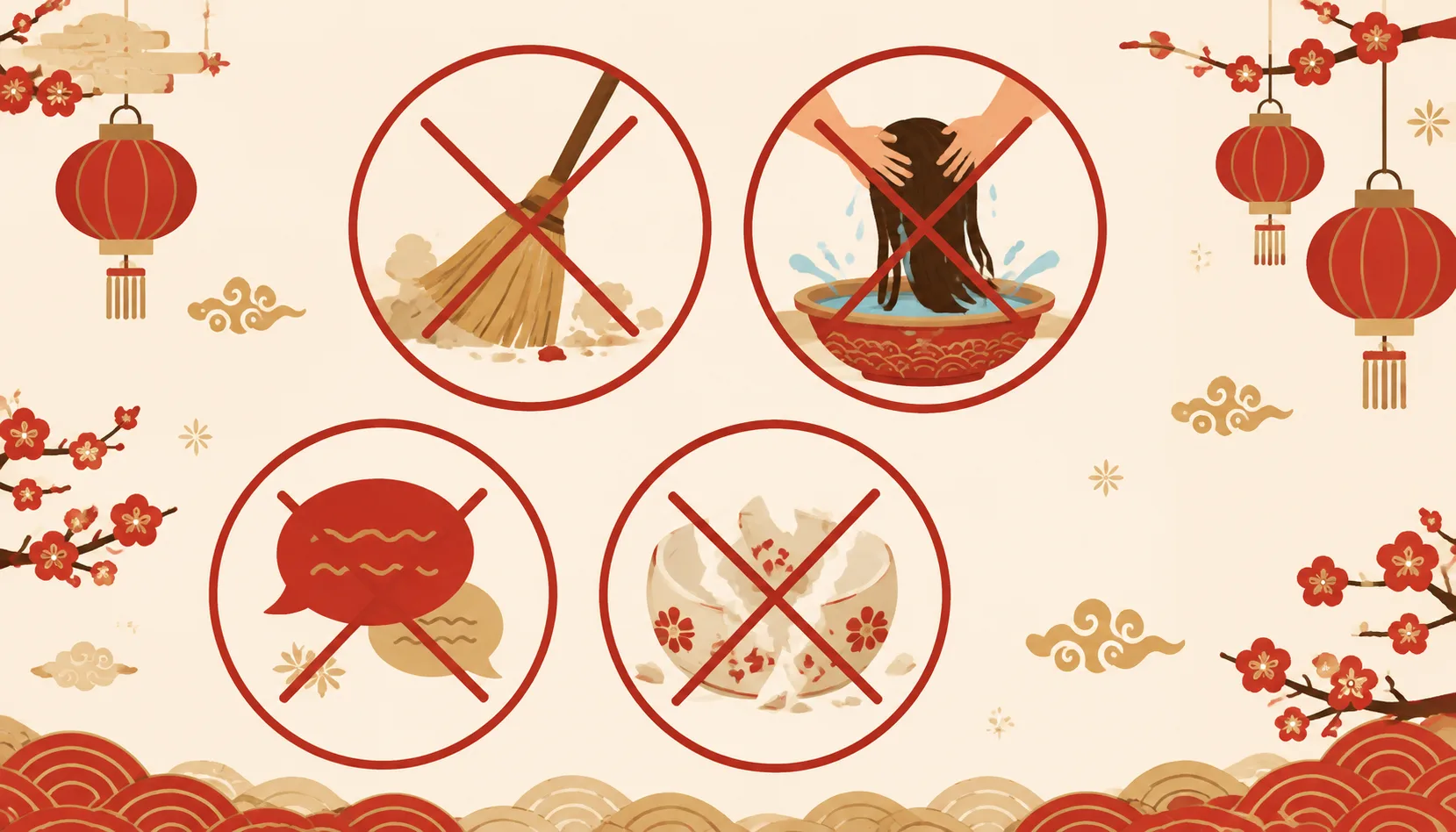
On Chinese New Year's Day (正月初一, Zhēngyuè chūyī), the major rules are: no sweeping, no taking out trash, no using knives or scissors, no washing hair or bathing, and no saying words that mean "death / depleted / broken / none." If you break something, immediately say "岁岁平安!" (Suìsuì píng'ān!) to neutralize it. These rules matter most to traditional families and older generations — younger urban Chinese observe them loosely, but knowing them earns you significant respect.
Quick Answer
On Chinese New Year's Day (正月初一, Zhēngyuè chūyī), the major rules are: no sweeping, no taking out trash, no using knives or scissors, no washing hair or bathing, and no saying words that mean "death / depleted / broken / none." If you break something, immediately say "岁岁平安!" (Suìsuì píng'ān!) to neutralize it. These rules matter most to traditional families and older generations — younger urban Chinese observe them loosely, but knowing them earns you significant respect.
Why These Taboos Exist
The logic is consistent: whatever you do at the start of the year, you'll do all year. And whatever leaves your home at the start of the year, you'll lose.
This isn't superstition to dismiss — it's a coherent folk logic system that Chinese people have internalized across generations. Even young people who don't "believe" it will still avoid these things "just in case." As a foreigner, observing the rules is simple and costs nothing; violating them in a traditional household has real social cost.
The New Year's Day Prohibition List
1. No Sweeping (不扫地)
Why: The first day of the year, your home is full of "fortune" (财运, cáiyùn) that accumulated from all the good luck of the New Year. Sweeping moves it toward the door. Sweeping toward the door and throwing it out = sweeping your wealth out of the house.
What to do instead: The major cleaning happens the week before New Year's Eve. On the 1st, leave any mess where it is until at least the 2nd.
Real scenario: Jack instinctively grabbed a broom after breakfast. His host rushed over: "今天不能扫!" (Jīntiān bù néng sǎo!) — "You can't sweep today!" Jack put it down. His host was visibly relieved.
2. No Taking Out Trash (不倒垃圾)
Why: Same logic — trash removal takes "good things" out of the house with it. Garbage accumulates from New Year's Eve through at least the 2nd or 3rd day.
What to do instead: Leave it. Collect it in a bag and wait for the 2nd.
3. No Using Knives or Scissors (不动刀剪)
Why: Knives and scissors cut things — which is interpreted as cutting your luck, cutting good relationships, and risking injury or conflict that "defines" the year. The folk wisdom is: what you do on the first day, you'll do repeatedly all year.
What to do instead: All food preparation happens before New Year's Eve. On the 1st, the food is pre-prepared and just reheated. If you need to cut something, do it before midnight.
4. No Washing Hair (不洗头)
Why: "Hair" (发, fà) shares a character with "fortune" (发, fā as in 发财, getting wealthy). Washing your hair on the 1st = "washing away your fortune" before the year even starts.
What to do instead: Shower and wash your hair on New Year's Eve night before midnight. On the 1st, skip it.
Note: In modern households this is often observed loosely. If staying at a Chinese family's home, simply be aware — don't volunteer to wash your hair if the family is traditional.
5. No Washing Clothes (不洗衣服)
Why: The 1st and 2nd are the birthday of the Water God (水神). Using water for laundry on these days is considered disrespectful.
6. No Medicine (不吃药)
Why: Taking medicine on New Year's Day implies you'll be sick all year. Non-urgent medications are postponed to the 2nd.
Important exception: Necessary ongoing medication (blood pressure, diabetes, heart medication) is not subject to this rule — health always overrides folk custom. Only "optional" medications (vitamins, supplements, over-the-counter cold medicine) are postponed.
7. No Waking People Up (不催人起床)
Why: If you wake someone up by calling them on New Year's Day, they'll be "rushed" (催, cuī) by others all year long. Let people wake naturally.
What to do instead: Let family members wake on their own. No alarm clocks. No calls to "come down for breakfast" until they appear.
8. No Crying (不哭泣)
Why: Whatever you do on the first day, you'll do all year. Crying on the 1st implies a year of sadness.
Exception: Unavoidable circumstances — this is folk wisdom, not a command to suppress genuine emotion.
9. No Borrowing Money or Paying Debts (不借贷、不还钱)
Why: Borrowing money implies financial deficiency; collecting debts implies the year starts with conflict. All financial business should be settled before New Year's Eve.
The Forbidden Words
During Spring Festival (especially the first 7 days), avoid these words entirely:
| Forbidden Word | Pinyin | Meaning | Why Forbidden | Substitute |
|---|---|---|---|---|
| 死 | sǐ | death | Direct death reference | 去了 (qù le) or avoid |
| 完 | wán | finished/depleted | Implies running out of everything | 好了 (hǎo le) |
| 坏 | huài | broken/bad | Implies things breaking | 有问题 (yǒu wèntí) |
| 没 | méi | none/lack | Implies scarcity | 不多了 (bù duō le) |
| 破 | pò | broken/shattered | Implies things falling apart | 挣了 (zhèng le) for dumpling/crockery |
| 输 | shū | to lose | Implies losing all year | 没赢 (méi yíng) |
| 病 | bìng | sick | Implies illness all year | 不舒服 (bù shūfu — not feeling well) |
| 穷 | qióng | poor | Implies poverty all year | 不宽裕 (bù kuānyù) |
The most common trap for foreigners: Saying "我完了" (wǒ wán le — I'm done / I'm finished) in the casual Western sense ("I'm exhausted," "that was a lot"). At the Spring Festival table, this phrase sounds like an announcement of ruin. Say "我吃饱了" (wǒ chī bǎo le — I'm full) or "太好吃了" (tài hǎo chī le — so delicious) instead.
Emergency Recovery: If You Break Something
This is the most important thing to memorize before any Spring Festival social engagement.
If you break a glass, a bowl, a plate, or any dish during the holiday:
Immediately say, loudly and cheerfully:
岁岁平安!
(Suìsuì píng'ān!)
The wordplay: 碎 (suì, broken/shattered) sounds like 岁 (suì, year). So "碎碎平安" (suìsuì píng'ān) = "shattered shattered peaceful" sounds like "岁岁平安" = "year after year, peace." The family will almost certainly respond "碎碎平安!" and the tension dissolves into laughter.
You can also add: "旧的不去,新的不来!" (Jiù de bù qù, xīn de bù lái!) — "Out with the old, in with the new!" — This phrase reframes the breaking as clearing space for better things.
Real scenario: Mark knocked a teacup off the table at a year夜饭. The room went quiet. He immediately said "岁岁平安!" — the grandmother laughed and said "这孩子懂事!" ("This kid knows what's what!"). The dinner continued warmly.
What Happens If You Break the Rules?
For foreigners: significant grace is extended. Chinese people understand that foreign guests don't know the full system. If you violate a taboo, the typical response is "没关系,外国人不懂正常" (méi guānxi, wàiguó rén bù dǒng zhèngcháng) — "It's fine, foreigners don't know, that's normal."
But: "没关系" is courtesy, not full resolution. In a traditional household, violations are noted. The family doesn't forget them; they just don't say so.
The gap between "they said it's fine" and "they actually feel it's fine" is where your reputation lives. Knowing the rules and following them — or recovering gracefully when you slip — is how you go from "polite guest" to "really understands China."
The principle: You don't need to be perfect. You need to visibly try and recover well.
Relaxed Observations in Modern China
Urban vs. rural: In Shanghai or Shenzhen apartments, younger Chinese people observe these rules loosely. They may wash their hair, check their phone, and order takeout on the 1st.
Traditional families: Grandparents, families in smaller cities, and households that have kept strong regional cultural identity observe these strictly. If you're at a Spring Festival gathering with grandparents or in a second-tier or smaller city, assume full observance.
The foreigner's safe rule: When in doubt, observe. It costs you nothing to not sweep the floor for one day. Breaking the rule in a traditional household costs you social standing you'll need for the rest of the year.
New Year's Day: What You Can Do
The positive side of the prohibition list:
Do:
- Wear your best, most festive clothes (red preferred)
- Go visit relatives and friends (拜年, bàinián — New Year's visits)
- Set off firecrackers (where legal and at appropriate times)
- Watch the Spring Festival Gala (春晚, Chūnwǎn) on TV
- Eat dumplings and the remaining year夜饭 dishes
- Give red envelopes to children
- Accept red envelopes from elders
- Say auspicious greetings to everyone you meet
The Full 15-Day Festival: When Things Change
The prohibitions ease after the first few days:
| Day | What Changes |
|---|---|
| 初一 (Day 1) | All prohibitions in effect |
| 初二 (Day 2) | Trash can be taken out; laundry allowed |
| 初五 (Day 5) | "破五" (Pò Wǔ — Breaking the Five) — most prohibitions lift; many businesses reopen |
| 初七 (Day 7) | 人日 (Rén Rì — Everyone's birthday); official holiday ends |
| 正月十五 (Day 15) | 元宵节 (Yuánxiāo Jié — Lantern Festival); Spring Festival officially concludes |
FAQ
Q: My Chinese colleague said these rules don't matter anymore. Who's right? A: Both, depending on context. Young urban professionals often don't observe them strictly. But even those who say "it doesn't matter" often still don't sweep on the 1st. It's like saying "I'm not superstitious" while still not walking under a ladder. The cultural reflex is deeper than conscious belief.
Q: I accidentally said "坏" (broken/bad) during a Spring Festival dinner. Is the relationship ruined? A: No. Say "哎,我说错了" (āi, wǒ shuō cuò le — ah, I misspoke) and quickly follow with something auspicious: "新年万事如意!" The table will move on. One word doesn't undo the whole relationship.
Q: Is it OK to clean my room privately (in my own apartment) on New Year's Day? A: In your own space, do what you need to do. The taboos have their full social weight when you're in a shared space — your host's home, a family gathering. In your private apartment, use your judgment.
What Chinese People Actually Say
- 打破碗 | dǎ pò wǎn | breaking a bowl | Avoid - symbolizes losing wealth in the new year
- 不扫地 | bù sǎo dì | no sweeping | Don't sweep - sweeps away good luck
- 吃药 | chī yào | taking medicine | Avoid - suggests illness for the whole year
2026 Reality Check
Most Chinese New Year taboos are still observed but with declining strictness. Breaking dishes, sweeping on the day, and saying unlucky words are the big three— elders still enforce them, especially in smaller cities.
Gen Z vs Older Generations: Young people in big cities mostly ignore taboos. They'll sweep, curse, and break things without worry. Older generations, especially grandparents, still insist on no cleaning, no borrowing, and no negative words on CNY day. Parents often quietly obey but roll their eyes.
Beijing/Shanghai vs Smaller Cities: Urban youth treat taboos as folklore. In smaller cities and villages, especially in the south, these rules remain serious. Rural families still won't sweep on the first day—sweeping sweeps away good luck.
Reality Check 2026: Taboos survive as "tradition theater"—people do them to please elders, not from belief. Under-30s in megacities largely don't care. The more traditional the family and location, the more rules still apply.
Frequently asked questions
What happens if I accidentally break a bowl on Chinese New Year's Day?
Don't panic. Immediately say 岁岁平安 (Suìsuì píng'ān), which sounds like 'peace every year' and also echoes the word for 'broken.' Wrap the pieces in red paper and dispose of them discreetly. This phrase is believed to turn the bad omen into good fortune. Traditional families may also add a red envelope to the wrapped pieces.
Can I take out the trash on the morning of the second day of Chinese New Year?
Yes, the no-trash rule applies mainly to the first day (正月初一). From the second day onward, it's generally acceptable to take out trash, though some families wait until the fifth day (破五, pò wǔ) when the 'God of Wealth' is welcomed. If you're unsure, ask your host — they'll appreciate the thought rather than just dumping trash on day one.
Is it really forbidden to wash my hair on Chinese New Year's Day?
In traditional belief, washing your hair or bathing on the first day 'washes away' your good luck for the year, since the word for hair (发, fà) also appears in 'fortune' (发财, fācái). If staying with a conservative host family, skip the morning shower and wash the night before. Urban families rarely enforce this, but it's a safe, respectful choice to avoid.
What words should I avoid saying on Spring Festival Day?
Avoid any words with negative meanings: 死 (sǐ, death), 破 (pò, broken), 穷 (qióng, poor), 没 (méi, none), 病 (bìng, sick), and 输 (shū, lose). Also avoid mentioning ghosts, accidents, or 'last year.' If a child says something unlucky, elders often wipe their mouth with tissue and say '童言无忌' (tóng yán wú jì) to cancel the effect.
Can I use my phone or work on laptops during Chinese New Year's Day?
There's no traditional taboo against technology itself, but heavy phone use is socially discouraged during family gatherings — it signals disrespect and disengagement. Some older generations believe constant phone use on day one 'wastes your luck' for the year ahead. The practical rule: put your phone away during meals and visits, and only check it for essential messages or sending New Year greetings.
Is it okay to visit friends' homes on the first day of Chinese New Year?
Generally, the first day is reserved for visiting senior relatives in your own family, not friends. Visiting friends on day one is seen as rushing or overstepping; the second and third days are better for friends and colleagues. If you're a foreigner invited by a Chinese friend, it's fine to go — but bring a small gift like fruit or sweets, and avoid bringing pears or anything in sets of four.
Try our tools
Related guides
Chinese New Year Survival Guide for Foreigners (2026)
Spring Festival is China’s biggest holiday, a family reunion that dwarfs Western celebrations. If invited to New Year’s Eve dinner, arrive early, bring fruit or…
Read the guide →
Invited to Chinese New Year's Eve Dinner? Etiquette Guide
If a Chinese person invites you to their family's New Year's Eve dinner (年夜饭, nián yèfàn): this is rare, meaningful, and not to be declined. Bring a fruit baske…
Read the guide →
Chinese New Year Red Envelopes (红包): A Foreigner's Guide
A red envelope (红包, hóngbāo) contains cash — it's the primary gift mechanism during Spring Festival. When you receive one: take it with both hands, say "谢谢,祝您身体…
Read the guide →