Invited to Chinese New Year's Eve Dinner? Complete Etiquette Guide for Foreigners (2026)
Quick answer
If a Chinese person invites you to their family's New Year's Eve dinner (年夜饭, nián yèfàn): this is rare, meaningful, and not to be declined. Bring a fruit basket plus wine (¥200–500 total). Wear red or warm colors. Say "恭喜发财!身体健康!" at the door. Wait for the eldest person to pick up chopsticks before you eat. Leave some fish on the plate. Accept any red envelopes with both hands and don't open them in front of anyone.
Quick Answer
If a Chinese person invites you to their family's New Year's Eve dinner (年夜饭, nián yèfàn): this is rare, meaningful, and not to be declined. Bring a fruit basket plus wine (¥200–500 total). Wear red or warm colors. Say "恭喜发财!身体健康!" at the door. Wait for the eldest person to pick up chopsticks before you eat. Leave some fish on the plate. Accept any red envelopes with both hands and don't open them in front of anyone.
What the Invitation Means
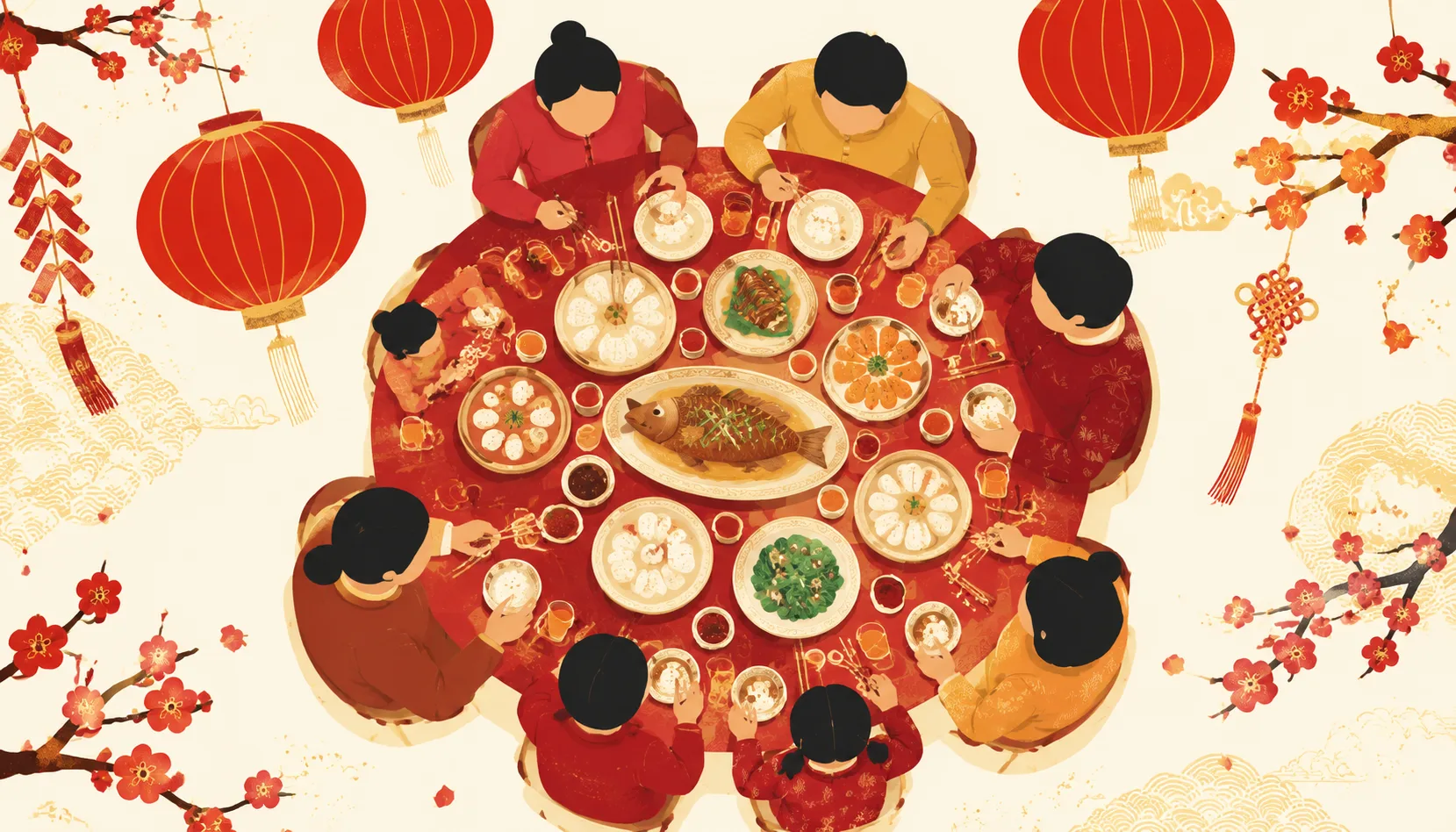
Year夜饭 is the most important meal in the Chinese year — a "blood-level" family gathering. The typical guest list is: immediate family. Sometimes a grandmother or aunt. That's usually it.
Being invited as a foreigner means one of two things:
- The person genuinely considers you family-level close
- The family has decided to show you China from the inside
Either way, this invitation is one of the most meaningful social gestures a Chinese person can extend. They are not inviting you to be polite. They mean it.
Don't bring a plus-one. Never ask if you can bring your flatmate, other foreign colleague, or anyone else. The guest list at a year夜饭 is calculated and non-negotiable. Asking to bring someone marks you as not understanding the significance of the invitation.
Before You Go: The Checklist
The Gift
Never arrive empty-handed. The host has been preparing this meal for days. An empty-handed guest is the social equivalent of arriving late to a job interview.
The reliable combination: Fruit + Alcohol or Tea
| Option | What to Bring | Price Range |
|---|---|---|
| Safe combination | Premium fruit basket + imported wine | ¥200–400 total |
| For older family | Quality tea (龙井, 铁观音) + fruit | ¥200–500 total |
| Health-conscious | Health supplement (bird's nest, ginseng) + fruit | ¥300–600 total |
| Budget-conscious | Quality fruit basket alone | ¥150–250 |
| VIP / senior household | Feitian Moutai or aged Pu'er tea | ¥500–2000+ |
Specific gift taboos for Spring Festival:
- ❌ Pears (梨, lí) — sounds like "separation" (离) — especially wrong at a family reunion occasion
- ❌ Clocks (送钟 = 送终, attending a funeral)
- ❌ Umbrellas (伞 = 散, scattering, parting)
- ❌ Shoes (鞋 = 邪, evil)
- ❌ White or black packaging — mourning colors
- ❌ 4 of anything — 4 = death
- ❌ Green hat (infidelity symbolism)
Affiliate placement: → Premium Chinese New Year fruit baskets (cherry, grape, citrus) | New Year wine gift sets (2-bottle imported sets) | Spring Festival tea gift boxes (Longjing, Tieguanyin)
How to present it: Two hands, slight lean forward, as you greet the host at the door: "叔叔阿姨,新年快乐!一点心意,请笑纳。" (Shūshu āyí, xīnnián kuàilè! Yīdiǎn xīnyì, qǐng xiàonà.) — "Uncle, Auntie — Happy New Year! Just a small token, please accept it kindly."
What to Wear
Wear red. It doesn't need to be a red dress or red shirt. Red socks, a red scarf, a red element somewhere on your body. Walk through the door looking like you understand what day it is.
Safe colors: Red, gold, warm orange, pink, warm purple, festive green
Never wear: White (mourning), Black (mourning), White + Black combination (funeral)
Real scenario: Jack wore a black suit to a year夜饭. Li's grandmother quietly asked Li: "Is this boy's family member sick?" — she thought he was in mourning. Don't be Jack.
At the Door: The First 3 Minutes
The entrance sequence:
- Ring the bell or knock. Wait.
- When the door opens, smile and present your gift with both hands
- Say your greeting — Chinese first:
"叔叔阿姨,新年快乐!恭喜发财!祝您身体健康,万事如意!" (Shūshu āyí, xīnnián kuàilè! Gōngxǐ fācái! Zhù nín shēntǐ jiànkāng, wànshì rúyì!) "Uncle, Auntie — Happy New Year! Wishing you prosperity! Good health and may everything go as you wish!"
- Wait for them to invite you to remove your shoes. They will provide slippers.
- Greet every person in the room — by addressing the eldest first
- For the grandparents specifically: "爷爷/奶奶,新年好!祝您身体健康,长命百岁!" (Yéye/Nǎinai, xīnnián hǎo! Zhù nín shēntǐ jiànkāng, chángmìng bǎisuì!) — "Grandpa/Grandma, Happy New Year! Wishing you good health and long life!"
Why the greetings matter so much: A Chinese person who walks into that room and delivers clear, confident Chinese greetings to the elderly family members will be talked about positively for the rest of the year. The effort reads as profound respect.
At the Dinner Table: The Eight Rules
Rule 1: The Eldest Eats First
Do not touch your chopsticks until the most senior person at the table picks theirs up — or until the host explicitly says "大家吃吧" (Dàjiā chī ba — everyone eat) or "别客气,动筷吧" (Bié kèqì, dòng kuài ba — please, go ahead).
If you pick up your chopsticks first, you haven't eaten before the host has even started. This is a real social error.
What to do while waiting: Keep your hands on your lap. Look at the table admiringly. Compliment what you can see: "这桌子菜太丰盛了!" (Zhè zhuōzi cài tài fēngshèng le!) — "What a magnificent spread!"
Rule 2: The Fish Rule
Year夜饭 always has a whole fish. "Fish" (鱼, yú) sounds like "surplus" (余, yú) — leaving some fish on the plate says "年年有余" (abundance every year). Eating the entire fish symbolizes consuming all your surplus.
What to do:
- Take 2–3 pieces from the fish body
- Leave the head and tail and some meat
- If you want to compliment: "年年有余!" (Niánnián yǒu yú!) while pointing to the fish
What not to do:
- Don't eat the whole fish
- In many Southern/coastal families: don't flip the fish over to get to the bottom side — "turning the fish" implies "capsizing." Eat the top, then strip the flesh from the upper side of the bones to get to the bottom.
Rule 3: The Chopstick Rule
Never stab your chopsticks straight into a bowl of rice and leave them upright. This looks exactly like incense sticks at a funeral altar. It is one of the most immediately jarring table behaviors for Chinese hosts.
Rest chopsticks on the chopstick rest, on the edge of your bowl, or flat beside your plate.
Rule 4: The Rotation Rule
If the table has a lazy Susan (rotating center), never rotate it while someone else is currently picking up food. Wait until they're done.
Rule 5: The Pouring Rule
Pour for others, don't pour for yourself. When you want more tea or wine for yourself, first refill the cup of the person next to you, then your own.
Rule 6: The Toasting Protocol
When someone senior comes to toast you:
- Stand up
- Hold your glass with both hands
- Tilt your glass so the rim is at or below the senior person's glass rim (你的杯比对方低 — your glass lower = you show respect)
- Drink with them
The "I don't drink" situation: For non-drinkers, it's completely acceptable to use tea or juice for toasting. Say: "我不喝酒,以茶代酒,敬您!" (Wǒ bù hē jiǔ, yǐ chá dài jiǔ, jìng nín!) — "I don't drink alcohol, so I'll toast you with tea!" This is respected, especially if you deliver it with warmth.
Rule 7: The Dumpling Coin
Many Northern families hide a cleaned coin in one dumpling. If you bite into it: this is a good omen — you're destined for a prosperous year.
What to do: Make a surprised face, show it to the table: "我吃到了!" (Wǒ chī dào le!) — "I got it!" The whole table will celebrate. This is a shared joy moment, not a private discovery.
Rule 8: The Forbidden Words
Do not say these during the meal — or during the entire holiday:
- 死 (sǐ — death) → say 去世 (qùshì) or simply avoid
- 完 (wán — finished/depleted) → say 好了 (hǎo le) or 好多了 (much more)
- 坏 (huài — broken/bad) → say 有问题 (yǒu wèntí — there's an issue)
- 没 (méi — none/lack) → say 不多了 (not much left)
- 破 (pò — broken) → If a dumpling skin breaks while cooking: say "挣了!" (zhèng le — earned!) instead. Broken = earning money at Spring Festival.
Emergency recovery: If you break a glass or dish, immediately say loudly: "岁岁平安!" (Suìsuì píng'ān!) — the family will likely respond "碎碎平安!" and laugh. Crisis averted.
The Family Interrogation: The Questions Coming Your Way
Chinese family members express care through questions that would be considered intrusive in Western culture. They are not being rude. They are treating you as one of the family.
| Question | How They Say It | Graceful Response |
|---|---|---|
| How much do you earn? | 你一个月赚多少钱? | "Enough to enjoy a great meal like this! Do you have investment advice?" |
| Do you have a partner? | 你有对象了吗? | "Not yet! Do you know anyone you could introduce me to?" |
| How old are you? | 你多大了? | "Old enough to appreciate a meal this delicious!" |
| Why haven't you bought a house? | 买房了吗? | "The market is interesting — what did you think about Beijing/Shanghai prices?" |
| Why aren't you married? | 怎么还不结婚? | "I believe in finding the right person. What makes a good marriage, in your view?" |
| When are you having children? | 什么时候要孩子? | "Taking life one step at a time. Your family is such a beautiful example." |
The core strategy: Never shut down the question with "that's private." In a Chinese family context, that reads as cold and unfriendly. Instead: answer lightly, use humor, and immediately redirect with a question that makes them the expert and main character. They will talk for 10 minutes and forget they asked.
The Red Envelope Ritual
At some point, an older family member may hand you a red envelope (红包, hóngbāo). This is pressure-tested social nicety, and you need to perform both sides:
Your performance:
Round 1: Raise both hands in front of you (refusing position): "不用不用,阿姨太客气了。" (Bù yòng bù yòng, āyí tài kèqi le.) — "No need, no need, you're too kind."
Round 2 (when they insist): Lightly push back: "真的不用,这使不得。" (Zhēn de bù yòng, zhè shǐ bu dé.) — "Really no need, I can't accept this."
Round 3 (when they physically put it in your hands): Accept with both hands, bow slightly, and say warmly: "谢谢阿姨!祝您身体健康,万事如意!" (Xièxie āyí! Zhù nín shēntǐ jiànkāng, wànshì rúyì!) — "Thank you, Auntie! Wishing you good health and may everything go as you wish!"
Then: Put it in your pocket. Do not open it. Do not look inside. Do not ask how much.
The amount is usually modest (¥100–500) — it's the gesture, not the cash.
After you leave: If you decide to reciprocate, the appropriate move is to give red envelopes to any children at the table the next time you visit.
When to Leave
The worst move: Finishing dinner and immediately standing up to go. This signals "I came for the food, not the people."
The best move: After dinner, stay for the seasonal television program (春晚, Chūnwǎn — China's Spring Festival Gala, a 4-hour variety show that runs on New Year's Eve). Watching at least part of it with the family is a meaningful shared experience.
Timing:
- Casual Spring Festival dinner: leave 30–60 minutes after the last dish is cleared
- New Year's Eve specifically: midnight is the natural end point (crossing into the New Year together is the point); leaving around 12:30–1:00am after the midnight moment is ideal
Leaving script: "今天太打扰了!饭菜太好吃了,谢谢叔叔阿姨的款待。改天我请你们吃饭!祝新年快乐,身体健康!"
(Jīntiān tài dǎrǎo le! Fàncài tài hǎochī le, xièxie shūshu āyí de kuǎndài. Gǎitiān wǒ qǐng nǐmen chīfàn! Zhù xīnnián kuàilè, shēntǐ jiànkāng!)
"I've taken too much of your time today! The food was incredible — thank you so much for having me. Next time, dinner is on me! Happy New Year, and wishing you good health!"
The gift-back: The host will likely send you home with something — leftovers, fruit, pastries. Accept it. Refusing is awkward. "那我就不客气了,谢谢!" (Nà wǒ jiù bù kèqì le, xièxie!) — "Then I won't be modest — thank you!"
The Day-After Thank-You
Send a WeChat message the next day — not a template, a real one:
"叔叔阿姨,昨天太感谢了!年夜饭太好吃了,我回家还在回味。祝新年诸事顺利,身体健康!" "Uncle, Auntie — thank you so much for yesterday! The New Year's Eve dinner was amazing — I'm still savoring it at home. Wishing you all the best in the new year, and good health!"
This message costs you 30 seconds and earns you a place in their "he/she really knows how to do things" mental file — permanently.
FAQ
Q: I don't drink alcohol. Will this be a problem? A: No — tell them early and offer to toast with tea. "以茶代酒" (yǐ chá dài jiǔ — substituting tea for alcohol) is a complete understood social move. You will be respected for knowing the phrase.
Q: I have dietary restrictions (vegetarian, halal, allergies). What do I do? A: Tell your friend who invited you 3–5 days before the dinner, not at the door. The host will adjust. If you say it at the door, the host will feel embarrassed that they can't accommodate you.
Q: The family doesn't speak any English. Is this going to be a problem? A: No — it makes your Chinese greetings 10x more impactful. Prepare 5–8 phrases (see the greetings guide), deliver them with warmth, and smile a lot. The family will adore you for the effort alone.
Q: Can I offer to help with dishes or cleaning after dinner? A: Offering is a good gesture — it shows consideration. But don't be surprised if they firmly refuse (guests are not expected to work). Offer once: "我来帮忙洗碗吧!" (Wǒ lái bāngmáng xǐ wǎn ba!) — "Let me help with the dishes!" If they decline, sit down.
What Chinese People Actually Say
- 恭喜发财 | gōngxǐ fācái | Wishing you prosperity | Say when toasting or greeting hosts
- 干杯 | gān bēi | Cheers | Say when raising your glass for a toast
- 年年有余 | nián nián yǒu yú | May you have abundance every year | Say when eating fish (pronounce "yú" carefully)
2026 Reality Check
2026 Reality Check: Most etiquette rules remain appreciated but are becoming more relaxed, especially in major cities.
Gen Z vs Older Generations: Younger Chinese increasingly prioritize comfort over formality. Gen Z may skip the formal greetings and multiple toasts, preferring casual conversations. Older generations still expect the "jia bei" (夹菜) - host filling your bowl - and will feel offended if you refuse. However, even elders have softened: wearing pajamas to family dinners is now quietly accepted in urban households.
Beijing/Shanghai vs Smaller Cities: Tier-1 cities are most flexible - foreigners can often skip traditional rituals without offense. Smaller cities and rural areas (especially in the south) still observe stricter customs. The "neng chi" (能吃) rule - finishing all food - remains important everywhere, but younger hosts in Shanghai now say "bu ke qi" (don't worry) if you leave leftovers.
Bottom line: Show effort, not perfection. A simple "xie Xie" (谢谢) and trying the food goes further than rigid rule-following.
Frequently asked questions
Can I bring my partner or kids if the invitation only mentions me?
No. The invitation is for you alone unless explicitly stated. Showing up with extra people puts enormous pressure on the host — seating, food portions, and red envelope calculations are all pre-arranged. Politely ask beforehand if you'd like to bring someone. If declined, don't take it personally; it's about logistics, not affection.
What if I'm vegetarian or have a food allergy?
Tell your host at least 2–3 days in advance. They will genuinely appreciate the heads-up — it lets them adjust dishes without losing face. However, expect that most dishes will still contain meat or fish broth. Don't ask for special treatment at the table; quietly eat what you can and praise the vegetables enthusiastically.
Is it okay to decline the invitation if I'm nervous?
Declining outright is seen as rejecting the family. Instead, accept and attend — even for 45 minutes. If you truly cannot go, say 'I have a prior family commitment' (family excuses are sacred) and send a gift basket plus a WeChat message on the day. A personal visit within the following week also repairs any awkwardness.
When should I leave the dinner?
Stay until at least 10 PM, but never leave before the fish course is served (usually the second-to-last dish). Leaving right after the meal is rude. The ideal exit window is 30–60 minutes after the table is cleared. Announce your departure to the eldest person first, thank everyone, and don't linger at the door.
What should I do if I don't drink baijiu?
Say '我酒精过敏' (I'm allergic to alcohol) with a smile — this is universally accepted and never questioned. Hold your glass when toasting, touch it lower than theirs, and take a tiny sip for the first toast. After that, switch to tea or juice. Never flip your cup upside down; it's deeply disrespectful.
Is the etiquette different if the dinner is in a restaurant vs. at home?
Yes. At home, bring fruit and help clear plates (but don't wash dishes unless insisted). In a restaurant, the host orders everything — don't request extra dishes. At home, shoes off at the door; in a restaurant, keep them on. Both settings require you to let the host pay, but at home you should offer to help with cleanup once, then accept their refusal.
Try our tools
Related guides
Chinese New Year Survival Guide for Foreigners: What to Do, What Not to Do (2026)
Spring Festival is China’s biggest holiday, a family reunion that dwarfs Western celebrations. If invited to New Year’s Eve dinner, arrive early, bring fruit or…
Read the guide →
Chinese New Year Gift Guide 2026: What to Buy, How Much to Spend, and When to Send
Chinese New Year (春节, Chūnjié) is China's largest annual gift-giving event. The window is the two weeks before the holiday through the first 15 days of the luna…
Read the guide →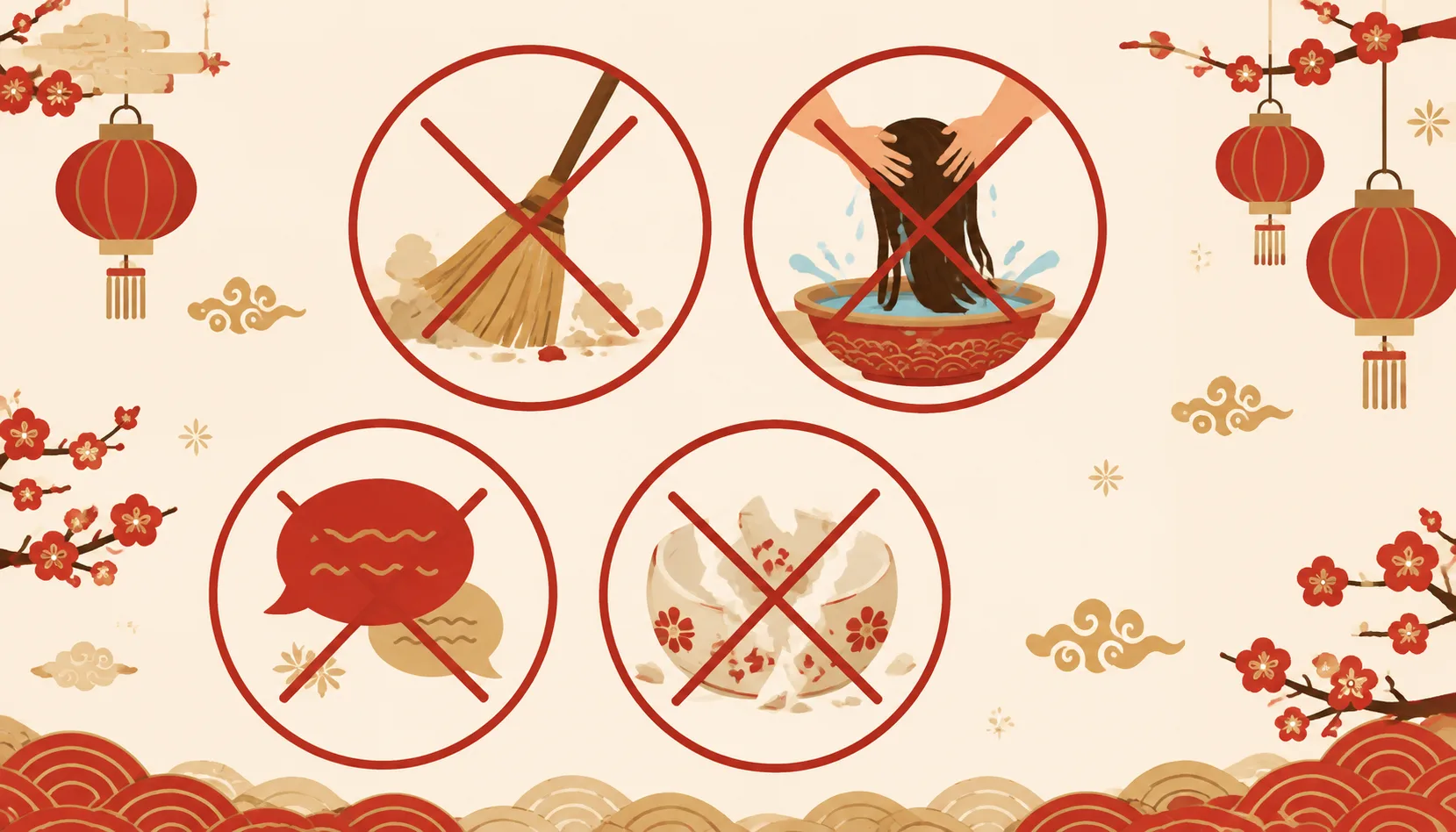
Chinese New Year Taboos: What You Cannot Do on Spring Festival Day (2026)
On Chinese New Year's Day (正月初一, Zhēngyuè chūyī), the major rules are: no sweeping, no taking out trash, no using knives or scissors, no washing hair or bathing…
Read the guide →