Hospital Visit Etiquette in China: What to Bring When Someone Is Sick (2026)
Quick answer
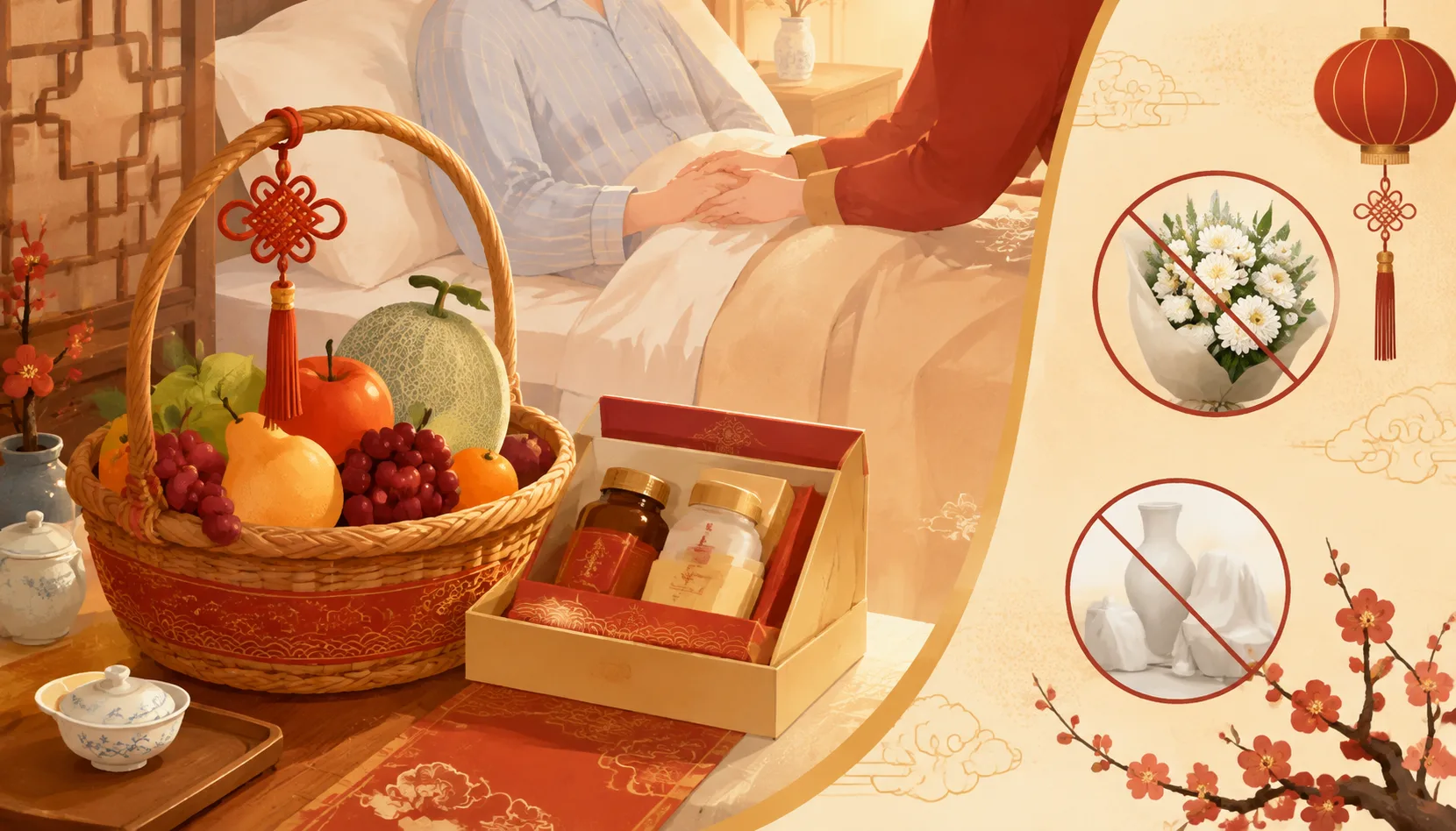
When visiting a sick person in China: bring a fruit basket (apples, oranges, grapes — never pears), or quality health supplements (ginseng, bird's nest, quality protein powder). Never bring white or yellow flowers (funeral flowers), potted plants (the roots "take hold" like the illness), or pears (sounds like "separation"). Stay 15–30 minutes. Leave before you tire them out.
Quick Answer
When visiting a sick person in China: bring a fruit basket (apples, oranges, grapes — never pears), or quality health supplements (ginseng, bird's nest, quality protein powder). Never bring white or yellow flowers (funeral flowers), potted plants (the roots "take hold" like the illness), or pears (sounds like "separation"). Stay 15–30 minutes. Leave before you tire them out.
DO
- Bring something — arriving empty-handed is a clear social failure
- Choose fruit baskets — apple (平安), orange (橙/成功), grape (丰盛) are auspicious; use an even number of pieces (6 or 8)
- Bring health supplements — bird's nest (燕窝), ginseng (人参), quality protein powder, high-quality honey
- Visit in the morning or early afternoon — patients need rest in the evening
- Keep the visit to 15–30 minutes — don't exhaust the patient
- Ask about their condition and medical progress — shows genuine care
- Bring warmth and good news — stories that make them smile, updates about the outside world
- Offer practical help — "Is there anything you need me to bring next time?" or "Can I pick up your children after school?"
DON'T
- Don't arrive without a gift
- Don't bring white or yellow chrysanthemums — these are funeral flowers in China
- Don't bring pears — "梨" (lí) sounds like "离" (to part/leave) — suggesting the person will not recover
- Don't bring potted plants or rooted plants — "生根" (putting down roots) implies the illness will become permanent
- Don't bring flowers that are white-dominant — even non-chrysanthemums carry bad symbolism if predominantly white
- Don't overstay — tired patients can't ask you to leave; be sensitive to their energy
- Don't bring 4 of anything (four = death)
- Don't bring heavy or elaborate food that requires cooking — they need easily digestible things
What to Bring: The Ranked List
Rank 1: Fruit Baskets (Most Common, Always Appropriate)
A neatly arranged fruit basket communicates care without requiring cultural knowledge of what the person likes. The symbolic logic:
- Apple (苹果, píngguǒ) — 平安 (peace and safety): The strongest auspicious fruit. "An apple a day" happens to align perfectly with Chinese gift symbolism.
- Orange (橙, chéng) — 成 (achievement/success): Also visually bright and positive.
- Grape (葡萄, pútao) — abundance: Clusters symbolize plenty.
- Tangerine (橘子, júzi) — 吉祥 (auspicious): Widely used, very safe.
- Banana (香蕉, xiāngjiāo) — general safe choice
Number: 6 or 8 pieces of each type. Total arrangement should look generous but not excessive.
Packing: A proper fruit basket or gift box is much better than a plastic supermarket bag. The presentation matters.
Affiliate placement: → Pre-made fruit gift baskets with Chinese hospital visit appropriate selection | Auspicious fruit basket delivery for same-day hospital visits
Rank 2: Health Supplements (Highly Appreciated, Especially for Serious Illness)
These signal that you're thinking seriously about their recovery:
Bird's nest (燕窝, yànwō): Premium health food in China — associated with vitality and recovery. A quality bird's nest gift set says "your health matters to me enough to give something valuable." Price range: ¥100–1000+ depending on quality.
Ginseng (人参, rénshēn) / American ginseng (花旗参, huāqíshēn): Long-standing Chinese health gift, especially for older patients or post-surgery recovery.
Cordyceps (冬虫夏草, dōngchóng xiàcǎo): Highly prestigious health supplement. Very expensive (quality product starts at ¥500+). For serious illness in a close relationship, this signals maximum care.
High-quality honey (蜂蜜, fēngmì): Practical, widely used, universally appropriate.
Quality protein powder: For patients who need nutritional support; practical and thoughtful.
Affiliate placement: → Bird's nest gift sets for hospital visits | Quality ginseng and health supplement gift boxes | Premium honey gift sets
Rank 3: Practical Items That Help the Stay
These are less glamorous but often most appreciated:
- Quality thermos / insulated bottle (for tea or medicine)
- Comfortable socks or warm slippers (for hospital stay)
- A lightweight blanket or wrap
- Books or magazines (for patients who are alert but bedridden)
- Charging cables, phone holder, or small tech items (for a longer hospital stay)
What Not to Bring (The Avoid List)
| Item | Why | Alternative |
|---|---|---|
| Pears | 梨 = 离 (separation/parting) | Apples, oranges |
| White or yellow chrysanthemums | Funeral flowers | Sunflowers, pink carnations, colorful mixed arrangements |
| Potted plants with roots | "生根" — implies illness takes root | Cut flower arrangements only |
| Heavy oily food | Hard to digest when unwell | Fresh fruit, light soups if appropriate |
| Anything in white/black packaging | Funeral colors | Red or warm-colored gift packaging |
| 4 of anything | 4 = death | 6 or 8 items |
| Clock or watch | Funeral symbolism (送钟 = 送终) | Never for any sick visit |
Timing: When to Visit and How Long to Stay
Best time: Mid-morning (10am–11:30am) is ideal — patients have rested from the previous day, not yet tired from the day's activities, and lunch hasn't started.
Avoid: Evenings (patients are tired), mealtime (nurses need access), and very early morning (disrupts the patient's most important rest time).
Duration: 15–30 minutes is the appropriate window.
How to read the signals:
- Patient looks tired → 15 minutes or less
- Patient is engaged, talking, has energy → you may extend to 30–40 minutes
- Family members start tidying up, handling meals → time to leave
- Patient's eyes begin to close → leave immediately
Leaving gracefully: "I don't want to tire you out — I'll let you rest. Is there anything I can do for you or bring you next time?" Then stand up, say your goodbye to both the patient and any family members present, and leave.
What to Say: Phrases That Help
Opening:
- "怎么样了,好一点了吗?" — (Zěnme yàngle, hǎo yīdiǎn le ma?) — "How are you feeling? Any better?"
- "大夫说什么了?" — "What did the doctor say?"
Bringing the gift:
- "这是给您带的,一点小心意,希望您早日康复。" — (Zhè shì gěi nín dài de, yìdiǎn xiǎo xīnyì, xīwàng nín zǎorì kāngfù.) — "I brought this — just a small gesture. I hope you recover soon."
Encouraging:
- "养好身体是最重要的,别着急。" — "Getting well is the most important thing — don't rush."
- "您这点小问题,很快就能出院了。" — "With something minor like this, you'll be out of the hospital soon."
Leaving:
- "我不打扰您休息了,下次再来看您。" — "I won't disturb your rest any longer — I'll come see you again soon."
- "有什么需要的话,随时告诉我。" — "If you need anything at all, please just let me know."
The golden phrase for recovery wishes:
- "早日康复!" (Zǎorì kāngfù!) — "Speedy recovery!" — Always appropriate, always warmly received.
For Serious Illness or Surgery
When the situation is more serious, the expectations increase:
Multiple visits: A single visit is courteous; multiple visits during a long hospital stay shows deeper care. Bring something fresh each time (new fruit, a new book, an updated supplement).
Red envelope: For a serious illness involving a close relationship, sending a WeChat red envelope (¥200–500) with a message "Use this for whatever you need" is increasingly common and genuinely practical. Many patients use such contributions toward hospital costs or supplements.
Coordinating with family: If you're close to the family, ask if there are specific things they need (meals brought in, help with logistics, collecting something from their home). Practical help during a serious illness is often more valuable than any gift.
If You Can't Visit in Person
WeChat is appropriate. Send a warm voice message or video call — seeing a familiar face and hearing a caring voice has genuine value.
Flower delivery: Same rules apply — warm colors, no white or yellow chrysanthemums, no potted plants. A curated colorful cut flower arrangement delivered to the hospital room is thoughtful.
Food delivery: In China, many hospitals allow food to be delivered. Arrange a nourishing meal from a clean restaurant to be delivered to the ward — this is a practical, meaningful gesture.
FAQ
Q: I'm visiting an acquaintance, not a close friend. How much should I spend on the gift? A: ¥80–150 is appropriate for a basic fruit basket or a quality supplement set for an acquaintance. The presence of a gift matters more than the size for this relationship tier.
Q: Is it okay to visit without calling ahead? A: Always call or message first. Hospitals have visiting hours, and the patient or family needs to prepare mentally and practically. An unannounced visit creates stress for people who are already stressed.
Q: My Chinese colleague told me not to bring flowers at all. Is that right? A: For very traditional families, yes — the floral category is just too associated with mourning to navigate safely. Fruit and supplements are simpler and universally safe.
Q: What about bringing food I've cooked myself? A: Homemade food is a beautiful gesture for close friends and family. For acquaintances and business relationships, stick to commercially packaged items — homemade food requires the family to evaluate food safety and storage, which adds cognitive load during an already stressful time.
What Chinese People Actually Say
- 早日康复 | zǎo rì kāng fù | "Wishing you a speedy recovery" | Say this when leaving to show you care about their health.
- 带点水果 | dài diǎn shuǐguǒ | "Bring some fruit" | Common practical gift; apples and oranges are popular choices.
- 好好休息 | hǎo hǎo xiū xī | "Have a good rest" | Tell the patient this to show you want them to recover.
2026 Reality Check
2026 Reality Check: Traditional hospital visit etiquette in China persists but has softened. The core rule—never bring sharp objects like knives or scissors—remains widely observed, especially among older generations.
Gen Z vs. Older Generations: Seniors still prefer fruits,营养品 (nutritional supplements), and cash envelopes. Gen Z opts for delivery apps, sending flowers, or digital red packets via WeChat. The younger crowd sees traditional gifts as "outdated" but respects them when visiting elders.
Beijing/Shanghai vs. Smaller Cities: Tier-1 cities have embraced minimalist approaches—many hospitals now discourage flowers due to allergy concerns. Smaller cities and rural areas stick more closely to tradition: whole fruits, eggs, and practical cash gifts remain standard.
Verdict: The rule survives but adapts. Context matters more than strict adherence.
Frequently asked questions
What should I bring if I can't find a good fruit basket near the hospital?
If fresh fruit is hard to find, head to the hospital's gift shop or a nearby pharmacy. They stock safe, pre-packaged options like milk boxes, yogurt, or quality protein powder. Avoid anything unsealed or homemade, as hygiene standards are strict. A gift card to a supermarket is also acceptable, though less personal.
Is it okay to give money instead of a gift when visiting a sick person in China?
Yes, giving a red envelope (hongbao) with cash is common, but it's more typical for close family or after surgery. If you do, use crisp new bills, avoid amounts with the number 4 (sounds like death), and hand it over discreetly. For colleagues or acquaintances, a physical gift is usually safer and more thoughtful.
Can I bring flowers if I avoid white and yellow ones?
Even red or pink flowers can be tricky. Many hospitals discourage all flowers due to allergy and hygiene concerns, and potted plants are outright taboo because roots symbolize the illness taking hold. If you insist on flowers, choose a small, bright bouquet like sunflowers or carnations, but expect that it might not be allowed in the ward.
What if the sick person is a child or a teenager?
For kids, skip the fruit and supplements. Bring a small toy, a picture book, or a puzzle instead. For teenagers, a phone charger, a power bank, or a streaming service gift card is a hit. Just check with the parents first—some toys can be choking hazards, and hospitals may restrict certain items.
How long should I stay if the patient is a close friend or family member?
Even for close friends, keep it under 30 minutes unless they insist you stay longer. For colleagues or acquaintances, 15 minutes is plenty. Watch for signs of fatigue—if they close their eyes, stop talking, or look at the door, wrap up quickly. Your presence matters more than the duration.
Is there a difference in etiquette between visiting in Beijing versus a smaller city?
In tier-1 cities like Beijing or Shanghai, etiquette is more relaxed—gifts are smaller and visits shorter. In smaller cities or rural areas, traditions are stricter: avoid the number 4, never give clocks, and expect longer, more formal visits. When in doubt, ask a local colleague or the patient's family what's appropriate.
Try our tools
Related guides

Chinese Gift-Giving Guide 2026: Rules, Taboos, and What Actually Works
In China, gift-giving is not about the gift. It's about the relationship. The right gift, delivered at the right time with the right words and two hands, commun…
Read the guide →
Visiting a Chinese Home: Complete Etiquette Guide for Foreigners
Bring a small gift, arrive 5 minutes late (never early), remove shoes at the door, wait for the host to assign your seat, and let the eldest eat first. Follow t…
Read the guide →
14 Chinese Gift Taboos: The Complete Forbidden List (With Salvage Tips)
Most Chinese gift taboos come from homophones — words that sound identical to something unlucky. "送钟" (giving a clock) sounds exactly like "送终" (attending a fun…
Read the guide →