14 Chinese Gift Taboos: The Complete Forbidden List (With Salvage Tips)

Quick answer
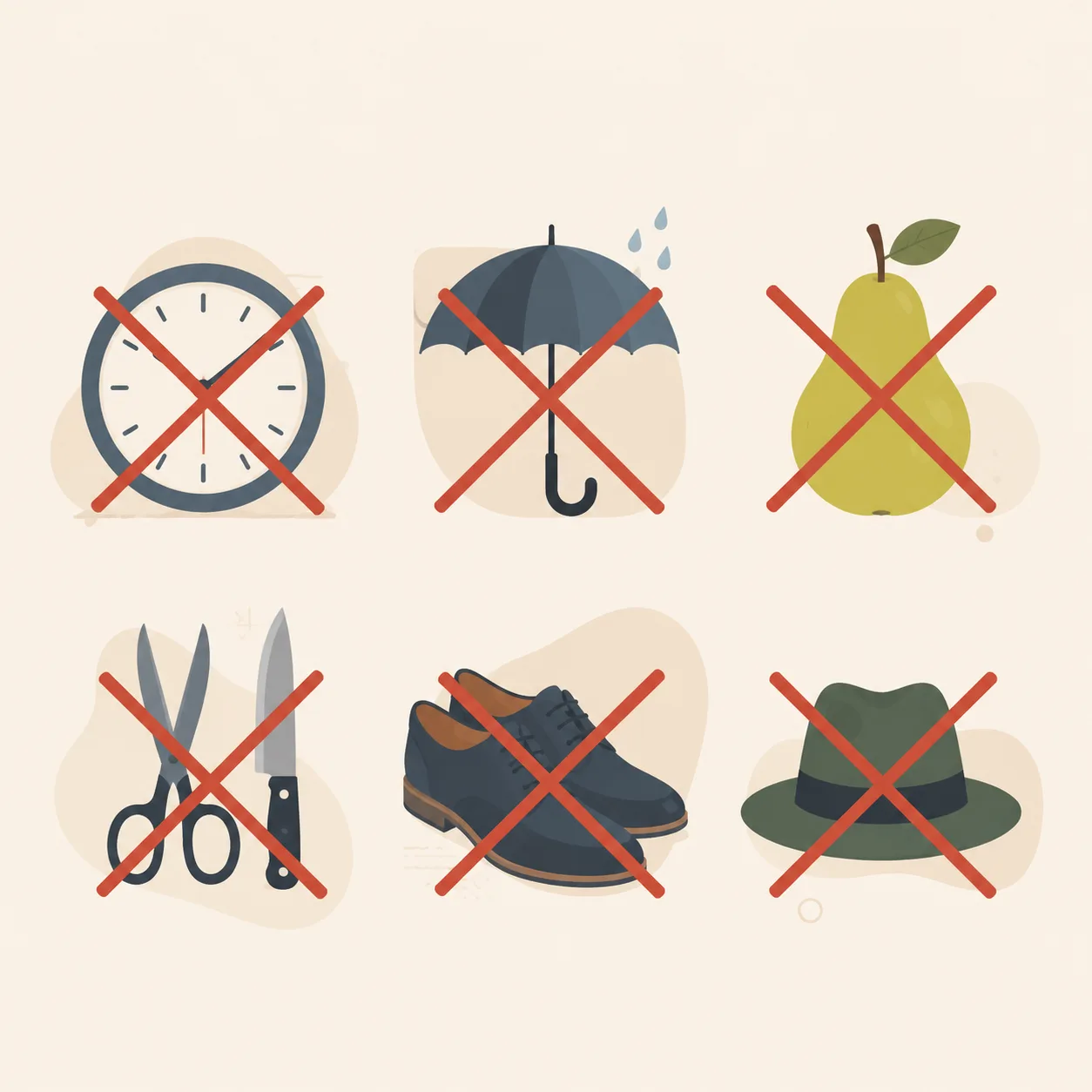
Most Chinese gift taboos come from homophones — words that sound identical to something unlucky. "送钟" (giving a clock) sounds exactly like "送终" (attending a funeral). "梨" (pear) sounds like "离" (separation). "伞" (umbrella) sounds like "散" (breakup). You don't need to memorize the Chinese linguistics — you just need the list. Here it is.
Quick Answer
Most Chinese gift taboos come from homophones — words that sound identical to something unlucky. "送钟" (giving a clock) sounds exactly like "送终" (attending a funeral). "梨" (pear) sounds like "离" (separation). "伞" (umbrella) sounds like "散" (breakup). You don't need to memorize the Chinese linguistics — you just need the list. Here it is.
The Master Recovery Move (Read This First)
Before the list: here is the universal repair for accidentally giving a taboo gift.
Three-step salvage:
- Acknowledge immediately and genuinely: "I truly didn't know this rule — I'm so sorry." Genuine ignorance is almost always forgiven in Chinese culture. The person will reassure you.
- Let them "buy" it for ¥1: This is a real, widely practiced Chinese custom. If you give them a knife or any cutting implement, the recipient gives you a single coin to symbolically "purchase" the item. This formally converts the gift from "given" to "bought," dissolving the cutting/separation curse. It works for knives, scissors, and similar items. Many Chinese people know this custom — if you don't have a coin, ask if they do.
- Follow up with something auspicious: A small, positive gift (apples, a tea box, anything in red packaging) completes the "reset." The bad symbolism is countered.
Now: the list.
Taboo #1: Clocks and Timepieces — The Worst Possible Gift
The forbidden item: Wall clocks, desk clocks, grandfather clocks. Watches are slightly safer for younger generations, but avoid giving any watch to anyone over 50.
Why: "送钟" (sòng zhōng — giving a clock) sounds phonetically identical to "送终" (sòng zhōng — attending a dying person's final moments / performing funeral rites for a parent). This is the #1 most serious Chinese gift taboo, universally recognized.
Cultural significance: Giving a clock to an elder says "I am marking the time until you die." To a business partner it says "this relationship has an expiry date." To anyone: it is simply ominous.
Salvage: If the gift has been accepted, use the ¥1 purchase conversion immediately. If they won't take a coin, apologize sincerely and commit to replacing the gift with something auspicious.
What to give instead: A quality pen set, a leather notebook, a premium tea box, a desk item that isn't time-related.
Taboo #2: Umbrellas — The Breakup Gift
The forbidden item: Any umbrella, rain or sun, travel or full-size.
Why: "伞" (sǎn — umbrella) sounds like "散" (sàn — to scatter, break apart, end). Giving an umbrella implies "our relationship is about to dissolve." Giving one to a romantic partner is essentially a breakup announcement. Giving one to a business partner signals the end of cooperation.
Salvage: The ¥1 purchase conversion works here too. Or, with humor in the right relationship: "This isn't an umbrella — it's a 保护伞 (protective shield)! For our friendship!" But humor only works with people who know you well enough.
What to give instead: A quality pen holder, a decorative item, anything that isn't umbrella-shaped.
Taboo #3: Pears — The Separation Fruit
The forbidden item: Pears, individually or in a basket as the main item.
Why: "梨" (lí — pear) sounds like "离" (lí — to leave, separate, part ways). Additionally: never split a pear with a Chinese friend — "分梨" (fēn lí) sounds like "分离" (fēnlí — to be separated). This applies to romantic partners especially.
Salvage: If pears are already in a fruit basket alongside other fruit, you can laugh it off: "This pear is here to remind us not to 分离!" with friends who know you well. Giving pears as a standalone gift is much harder to recover.
What to give instead: Apples (苹果, píngguǒ — "peace" soundalike), oranges (橙 chéng — sounds like "achievement"), or grapes (葡萄 — auspicious abundance).
Taboo #4: Green Hats — The Worst Insult for Men
The forbidden item: Any green hat, cap, or hat-shaped object. Even green packaging on a hat-adjacent gift.
Why: "戴绿帽子" (dài lǜ màozi — wearing a green hat) is one of the most well-known Chinese idioms for marital infidelity. Giving a man a green hat tells him his partner is cheating on him. This is among the most severe personal insults in Chinese culture.
Salvage: There is no good recovery from this one. The only path is a genuine, immediate apology, followed by a completely different gift as soon as possible.
What to give instead: Hats in any other color. Items in any other color. Just avoid green hats entirely, forever.
Taboo #5: Shoes — Sending Someone Away
The forbidden item: Any type of shoes.
Why: "鞋" (xié — shoes) sounds like "邪" (xié — evil, wickedness). Additionally, in Chinese culture, shoes are associated with sending someone away — "giving you shoes so you can walk out of my life."
Cultural note: This is somewhat loosened among close friends and younger generations, particularly for athletic shoes between peers. But for business contexts, elders, and formal relationships: never.
Salvage: ¥1 purchase conversion. In casual friendship: "These are to walk toward good fortune, not away from me!" — but read the relationship carefully first.
Taboo #6: Knives and Sharp Objects — Cutting the Relationship
The forbidden item: Kitchen knives, Swiss Army knives, scissors, box cutters, letter openers with blades. "A precise and beautiful kitchen knife set" is still a knife set.
Why: Sharp implements symbolize "一刀两断" (yī dāo liǎng duàn — severing in one cut). The metaphor is relationship termination.
Salvage: The ¥1 conversion is the traditional and highly effective solution for knives. Many Chinese people will proactively hand you a coin if you give them a knife — they know the custom. If yours doesn't know, suggest it yourself: "I hear you're supposed to give me a coin to 'buy' this — that breaks the symbolism."
Taboo #7: White or Yellow Chrysanthemums — Funeral Flowers
The forbidden item: White chrysanthemums, yellow chrysanthemums. White lilies are borderline. Any flower arrangement dominated by white.
Why: In China, chrysanthemums (especially white and yellow) are the flower of mourning, used at funerals and grave-sweeping (清明节 Qīngmíng). Giving them to a living person, especially when visiting someone who is ill, can cause real distress.
Salvage: If you've shown up with a white flower bouquet, apologize immediately. Step out and find a replacement if at all possible.
What to give instead: Red roses (for romantic contexts), pink carnations (for elders and mothers), yellow roses (friendship), sunflowers (optimism), or mixed arrangements in warm colors.
Taboo #8: White or Black Gift Packaging
The forbidden item: White wrapping paper, black wrapping paper, white-and-black combination boxes.
Why: Both white and black are the colors of mourning in Chinese tradition. A gift wrapped in white or black is unconsciously (and sometimes consciously) associated with death and funerals.
Salvage: If the gift is already wrapped, re-wrap it immediately if possible. A red shopping bag over the original packaging is an acceptable quick fix.
What to use instead: Red (always safe), gold (prestige), warm colors. The packaging communicates before the gift is opened — make it joyful.
Taboo #9: The Number 4 (Four of Anything)
The forbidden item: 4 apples, ¥400 red envelope, a 4-piece set, anything in groups of 4.
Why: "四" (sì — four) sounds like "死" (sǐ — death). This is why many Chinese buildings skip the 4th floor and go straight to the 5th. Why hospital rooms avoid the number. Why gift sets should never come in fours.
Salvage: Add one more item immediately if you realize you've given 4 of something. "Let me add one more to make it 5 — that's better." Or give 6 (顺 — smooth) or 8 (发 — prosper).
What to give instead: Groups of 2 (double luck), 6 (everything goes smoothly), 8 (prosperity), or 9 (longevity).
Taboo #10: Empty Wallets or Purses
The forbidden item: A wallet or handbag given without anything inside.
Why: A wallet is a "财库" (wealth repository). An empty one symbolizes empty fortune — you're wishing the recipient will have no money. This is unconscious but potent symbolism.
Salvage: Before giving, put something inside — any coin, any banknote, even a ¥1 bill. The symbolism is now "filled with wealth." If you forget and the recipient opens an empty wallet, hand them cash or a coin immediately: "Something needs to go in here for good luck."
What to do: Always fill any wallet/purse gift with at least one coin before presenting it.
Taboo #11: Candles (Especially Decorative Scented Candles)
The forbidden item: Decorative candles, scented candles, birthday candles as a standalone gift.
Why: In Chinese tradition, candles are used in ancestral offerings and funeral ceremonies. A set of beautiful aromatherapy candles may read as "altar supplies" to an older or more traditional recipient.
Salvage: Frame the context strongly: "These are very popular in Europe for relaxation — it's a lifestyle gift." For younger, cosmopolitan Chinese recipients, this is largely a non-issue. For traditional or older recipients, avoid.
What to give instead: Quality skincare products, tea sets, decorative items without the altar association.
Taboo #12: Mirrors
The forbidden item: Any mirror as a gift.
Why: Mirrors in Chinese tradition have ambiguous spiritual power — they can reflect and trap spirits. Additionally, "破镜难圆" (pò jìng nán yuán — a broken mirror cannot be made whole again) is a phrase for irreparable relationships. Mirrors also break easily, and broken glass carries bad omens.
Salvage: Acknowledge the oversight and offer a replacement. No clever workaround exists for this one.
Taboo #13: Handkerchiefs
The forbidden item: Handkerchiefs as a standalone gift.
Why: In Chinese tradition, handkerchiefs are associated with weeping and farewell. They were historically given as parting gifts when people separated. Giving a handkerchief says "I see a tearful goodbye in your future."
Salvage: A quality silk scarf is completely fine — different item, different association. Frame a handkerchief as "a luxury accessory" if you must, but it's simpler to swap it out.
Taboo #14: Books for Business People
The forbidden item: Books given to business people, gamblers, or in competitive contexts.
Why: "书" (shū — book) sounds like "输" (shū — to lose). For business people who care about winning/losing or competitive outcomes, a book can be read as "I'm wishing you a loss." This is a mild taboo compared to the others, but real.
Salvage: Works perfectly for academics, teachers, creative types, and readers — the taboo is context-specific. For business people: the ¥1 purchase trick, or a quip "this book is about winning strategies — so I'm wishing you wins." If in doubt, add a tea box alongside it to balance the symbolism.
The Bonus Taboo: Plants Rooting in Hospitals
The forbidden item: Potted plants with visible roots when visiting a sick person.
Why: "生根" (shēng gēn — taking root) — the colloquial fear is that the plant will "take root" just like the illness. Cut flowers without roots are fine (avoiding white/yellow). Pre-made fruit baskets are the ideal hospital gift.
Quick Taboo Decoder by Occasion
| Occasion | Never Give |
|---|---|
| Elder's birthday | Clocks, shoes, umbrellas, pears, anything in white |
| Hospital visit | Pears, white flowers, yellow chrysanthemums, potted plants |
| Wedding | Anything in odd amounts, clocks, shoes, scissors |
| Business partner | Clocks, umbrella, empty wallet, white/black packaging |
| Home housewarming | Clocks, umbrellas, pears |
| Baby full moon | Clocks, scissors, anything sharp |
| Any occasion | Number 4, green hat for a man |
What Chinese People Actually Say
- 送钟 | sòng zhōng | giving a clock (sounds like "attending funeral") | Never give clocks as gifts; "zhōng" sounds like "zhōng" (death/end)
- 送梨 | sòng lí | giving pears (sounds like "separation") | Avoid giving pears; "lí" sounds like "lí" (to leave/separate)
- 送伞 | sòng sǎn | giving umbrellas (sounds like "breakup") | Never give umbrellas; "sǎn" sounds like "sàn" (to separate)
2026 Reality Check
2026 Reality Check: Most Chinese gift taboos still matter, but enforcement varies wildly by context and audience.
Gen Z vs Older Generations: Younger Chinese (18-30) largely ignore symbolic taboos like avoiding clocks, white flowers, or number 4 in gifts—they see them as "superstition." However, they'll still avoid obvious offensive items (like green hats) to avoid embarrassment. Older generations (50+) remain strict, especially in business settings where "face" still dictates proper gifting.
Beijing/Shanghai vs Smaller Cities: Tier-1 cities are more relaxed—young professionals exchange gifts casually without obsessing over symbolism. Smaller cities and rural areas maintain stronger traditions; elders still frown upon wrapping gifts in white or giving pears (分离 = separation).
The Bottom Line: Taboos persist in business, formal occasions, and with older relatives. Casual social gifting among peers? Increasingly irrelevant. Know your audience.
Frequently asked questions
What should I do if I already gave a clock as a gift in China?
Don't panic, but act fast. Immediately follow up with a small red envelope (hongbao) containing an odd amount like 88 or 66 yuan, paired with a verbal explanation that you meant to symbolize 'time together' or 'a long life together.' This counteracts the death connotation. If it was for a wedding, add a pair of items to symbolize unity.
Can I give a green hat to someone in China as a fashion item?
Absolutely not. A green hat (lǜ mào) is the ultimate insult in Chinese culture, implying your wife or girlfriend is cheating on you. Even as a joke, it's deeply offensive and can permanently damage relationships. Avoid green hats entirely, regardless of fashion trends, and also be cautious with green-colored headwear at parties or events.
Is it okay to give a knife or scissors to a close friend in China?
No, even among close friends. Knives, scissors, and other sharp objects symbolize cutting off the relationship. If you must give one, the classic fix is to give a symbolic coin (like 1 yuan) in exchange, turning it into a 'purchase' rather than a gift. This breaks the bad luck and is widely understood.
Why are pears considered bad luck when giving gifts to Chinese people?
Pears (lí) sound exactly like the word for 'separation' (lí). Giving a pear implies you want to part ways with the recipient. This is especially critical for couples, business partners, or anyone you want to keep close. If you're bringing fruit, choose apples (píng) for peace or oranges (chéng) for success instead.
What gifts are safe to give to a Chinese boss or senior colleague?
Stick to items that symbolize status and respect without taboo associations. Premium tea, quality liquor (especially baijiu), branded pens, or calligraphy sets are excellent. Avoid clocks, shoes, umbrellas, and anything in sets of four. Also, always present the gift with both hands and downplay its value to show humility.
Can I give flowers in China, or are there flower taboos too?
Flowers are generally fine, but avoid white flowers (associated with funerals) and yellow chrysanthemums, which are exclusively for mourning. Never give a single flower, as it implies 'you are the only one' in a romantic way. Safe choices are red roses for romance, sunflowers for cheer, or orchids for respect. Always give an even number of stems, as odd numbers are for funerals.
Try our tools
Related guides
Gifts to Avoid in China (and What to Give Instead)
The classic gifts to avoid are clocks and watches, pears, umbrellas, shoes (especially around holidays), wallets, and cigarettes for elders’ birthdays — most of…
Read the guide →
Chinese Gift-Giving Guide 2026: Rules, Taboos, and What Actually Works
In China, gift-giving is not about the gift. It's about the relationship. The right gift, delivered at the right time with the right words and two hands, commun…
Read the guide →
How to Give a Gift in China: Two Hands, Three Rounds, and What to Say
Two hands. Eye contact. Slight forward lean. Say "一点小心意" (a small token). When they refuse, persist twice — then place it in their hands. This is the script. De…
Read the guide →