Chinese Baby Gifts and the Full Moon Ceremony (满月): Complete Gift Guide 2026
Quick answer
In China, the key baby gifting event is the 满月 (mǎn yuè — full moon ceremony), held 30 days after the baby is born. Give gold jewelry (金饰, jīnshì) for the baby, red envelopes (现金, cash), or high-quality practical items. Budget: ¥200–600 for friends, ¥600–2000+ for close family. Never give shoes (for babies under 1), never give 4 of anything, and always use red packaging.
Quick Answer
In China, the key baby gifting event is the 满月 (mǎn yuè — full moon ceremony), held 30 days after the baby is born. Give gold jewelry (金饰, jīnshì) for the baby, red envelopes (现金, cash), or high-quality practical items. Budget: ¥200–600 for friends, ¥600–2000+ for close family. Never give shoes (for babies under 1), never give 4 of anything, and always use red packaging.
The Full Moon Ceremony: What It Is
满月 (Mǎn yuè, literally "full moon") marks the baby's 30th day of life — the traditional milestone when both mother and child are considered stable and safe. In Chinese tradition, the newborn and mother observe a 30-day postpartum recovery period (坐月子, zuò yuèzi) with restricted visitors and activities.
The full moon ceremony breaks that isolation with a celebration:
- Family and close friends gather for a banquet (满月酒, mǎnyuè jiǔ — "full moon wine")
- The baby is formally introduced and receives gifts
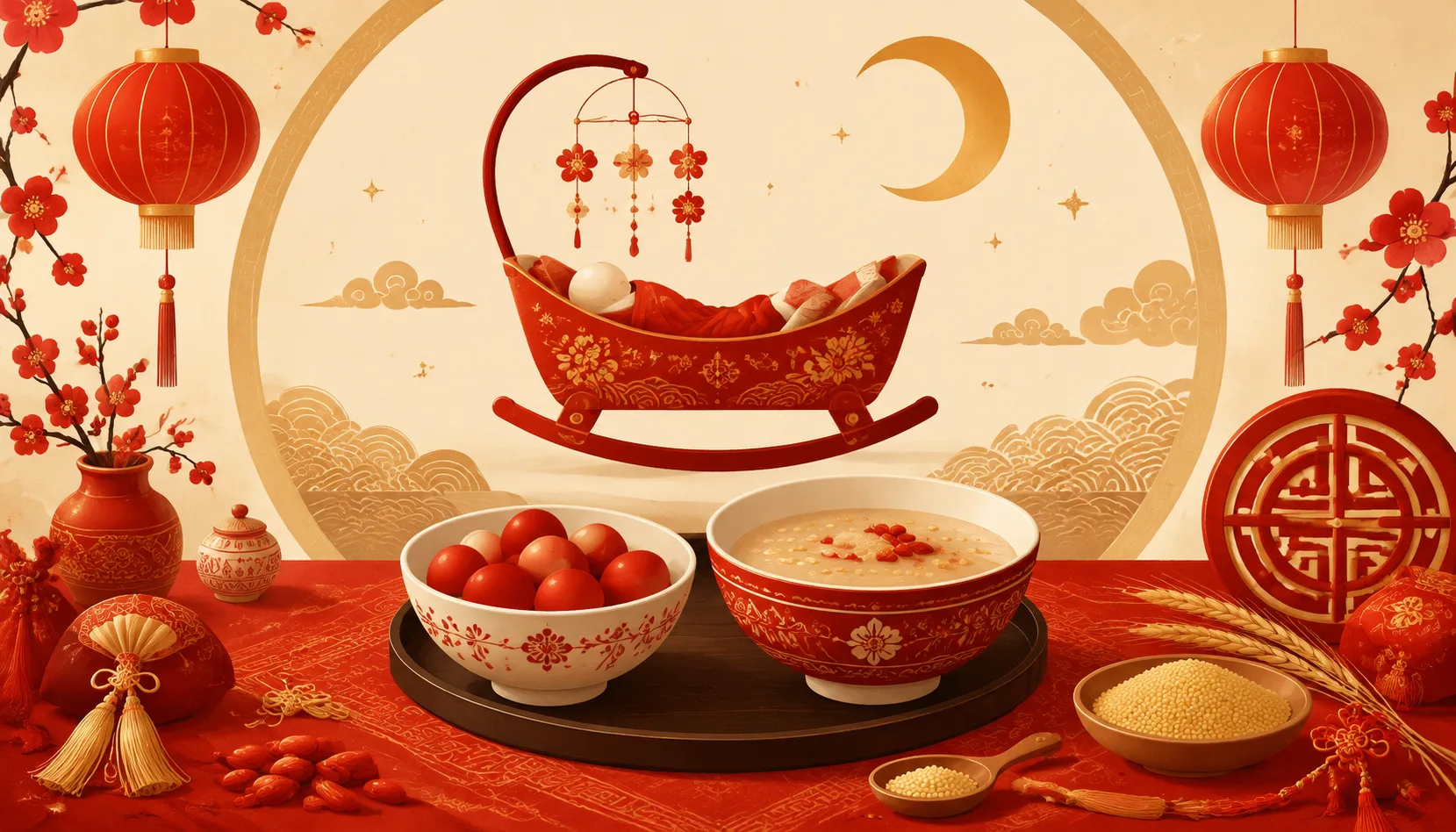
- The host family distributes 红鸡蛋 (hóng jīdàn — red hard-boiled eggs) and 小米糕 (xiǎomǐ gāo — millet cake) to guests as symbols of blessing
Important: In China, there is no tradition of a Western-style "baby shower" before birth. Pre-birth gifts are considered bad luck in traditional families (don't count your blessings before the baby arrives). Gifts happen after birth, and the full moon ceremony is the focal point.
The Gift Framework: What's Expected
Gold Jewelry (金饰, jīnshì) — Highest Status, Most Auspicious
Gold jewelry for the baby is the single most culturally significant gift category. It's not just a gift — it's a blessing. Common items:
- Gold bracelet (金手镯, jīn shǒuzhuó): The most traditional gift — a small solid gold bangle that the baby wears
- Gold pendant/necklace (金吊坠, jīn diàozhuì): Often features an auspicious character (福, 寿) or animal (tiger, rabbit)
- Gold "lock" (金锁, jīnsuǒ): A traditional amulet — a gold lock symbolizes locking in the baby's health and fortune
Who gives gold jewelry: Grandparents, close relatives, and very close family friends. For a foreigner, gold jewelry for the baby is a perfectly appropriate and deeply appreciated gift for any close relationship.
Price range: ¥300–3000+. Gold purity (24K, 18K) and weight determine price. A simple 24K gold bracelet for a baby starts around ¥300–500; more elaborate pieces range higher. Buy from established gold retailers (中国黄金 Zhōngguó Huángjīn, 老凤祥 Lǎofèngxiáng, 周大福 Chōwdaaifūk).
Affiliate placement: → Baby gold bracelet gifts for full moon ceremony | Auspicious baby gold lock pendants (金锁) for newborns | Chinese baby gold jewelry gift sets
Red Envelopes (现金, Cash) — Universally Appropriate
A red envelope with cash is accepted and appreciated for any relationship tier:
Amounts and relationship tiers:
| Relationship | Amount |
|---|---|
| Casual colleague | ¥200–400 |
| Regular friend | ¥300–600 |
| Close friend | ¥600–1200 |
| Very close friend / relative | ¥1000–2000+ |
Auspicious amounts: ¥600, ¥800, ¥888, ¥1000, ¥1314, ¥1688 Never: ¥400 (4 = death) or any odd amount
What to write on the envelope:
- "百岁平安" (Bǎi suì píng'ān — Peace for a hundred years)
- "健康快乐" (Jiànkāng kuàilè — Health and happiness)
- Your name
Practical Baby Items — Well-Received If Chosen Well
Clothing:
- Quality baby clothing sets in red, yellow, or warm colors (never white — white is a mourning color in China)
- 100-day or 1-year outfits — celebratory milestones have specific outfit traditions
- Traditional Chinese baby clothing (虎头帽, tiger-head hats) — very appreciated by traditional families
Health and care:
- Premium baby skincare sets (known brands)
- Quality feeding sets (bottles, sterilizer)
- A quality baby monitor or safety item
Educational and developmental:
- Quality wooden toys and building sets
- Picture books (dual Chinese-English for cosmopolitan families)
What to be careful about:
- Baby shoes before the baby walks — in some regional traditions, giving shoes to a baby who can't walk yet is inauspicious (implies rushing fate)
- White clothing — use warm colors only
Affiliate placement: → Traditional Chinese baby clothing sets (tiger hat, auspicious colors) | Premium baby care gift sets for full moon ceremony | Quality baby feeding and nursery sets
Moon Ceremony Traditional Foods (as Gifts)
If you're a guest at the 满月酒 banquet, bringing traditional foods is appropriate:
- 染红的鸡蛋 (dyed red eggs): Traditionally given by grandparents, but a gift of premium red-dyed eggs in an auspicious box is appropriate for close friends
- 桂圆 (guìyuán — longan): Symbolizes "reunion" and sweetness — a premium dried longan gift box
- 小米 (xiǎomǐ — millet) or red dates (红枣, hóngzǎo): Traditional postpartum health foods that the mother needs; a quality gift set of these is deeply thoughtful for the mother specifically
Affiliate placement: → Traditional Chinese postpartum care gift sets for mothers (red dates, longan, millet)
Gifts for the Mother (Often Overlooked but Important)
In Chinese culture, the mother who has completed 坐月子 (the postpartum confinement period) deserves recognition. Many guests focus only on the baby — but noticing the mother is appreciated:
Health supplements:
- Premium bird's nest (燕窝, yànwō) — the most prestigious postpartum health food in China
- Quality donkey-hide gelatin (阿胶, ējiāo) — traditional blood-building supplement
- Red date and longan packages
Practical recovery items:
- Quality hot water bottle or heating pad
- Premium postpartum herbal tea
Personal care:
- Quality skincare set for new mothers
- A spa or massage gift certificate for when she's recovered
Affiliate placement: → Bird's nest gift sets for new mothers (燕窝) | Premium postpartum care gift sets (red dates, ejiao, longan)
What Not to Give
| Avoid | Why | Alternative |
|---|---|---|
| Baby shoes before walking age | In some traditions, implies rushing fate | Gold bracelet, clothing |
| White or black clothing | Mourning colors | Red, yellow, pink, orange |
| 4 of anything | 4 = death | 6, 8, or other numbers |
| Clock or watch | 送钟 = 送终 | Any other category |
| Pears | 梨 = 离 (separation) | Red dates, longan |
| Toys that are all white | Mourning associations | Colorful wooden toys |
| Sharp items (scissors, knives) | Cutting symbolism for a new life | Any other category |
Timing: When to Give
At the 满月酒 banquet: Bring your gift to the banquet. Present it to the family when you arrive. If it's cash, give the red envelope at the reception/sign-in table.
If you can't attend: Send your gift within the first month. A cash transfer via WeChat with a message "恭喜宝宝满月!" (Congratulations on the full moon!) is appropriate. For physical gifts, arrange delivery to arrive around the 30-day mark.
After the 满月: Gifts are also appropriate at:
- 100 days (百日宴, bǎirì yàn): A second milestone. Less universally celebrated, but common in cities
- First birthday (周岁, zhōusuì): Major celebration. Gold jewelry and red envelopes are again the norm
The Traditional 抓周 (Zhuā Zhōu) at the First Birthday
At the 1st birthday, a special ceremony called 抓周 (zhuā zhōu — "reaching and grabbing") predicts the child's future profession: objects are laid out (books, abacus, stethoscope, brush, etc.) and whichever the baby grabs first indicates their future path.
Gifts for the 抓周: Quality children's books, educational toys, mini versions of professional tools (tiny stethoscope set, mini art set) — these double as both gift and 抓周 prop, which is a thoughtful touch that parents love.
What to Say
At the banquet:
- "宝宝满月快乐!祝宝宝健健康康,聪明伶俐!"
(Bǎobao mǎnyuè kuàilè! Zhù bǎobao jiànjiàn kāngkāng, cōngming línglì!) "Happy full moon for the baby! Wishing the baby good health and great intelligence!"
When presenting the gift:
- "这是给宝宝的,祝宝宝平平安安,快快乐乐地长大!"
(Zhè shì gěi bǎobao de, zhù bǎobao píngpíng ān'ān, kuàikuàilèlè de zhǎngdà!) "This is for the baby — wishing the baby to grow up safe and happy!"
For the mother:
- "恭喜您!辛苦了!祝您身体恢复得棒棒的。"
(Gōngxǐ nín! Xīnkǔ le! Zhù nín shēntǐ huīfù de bàngbàng de.) "Congratulations! You've worked so hard! Wishing you a great recovery."
FAQ
Q: Is it appropriate for a foreigner to give gold jewelry to a Chinese baby? A: Absolutely. Gold jewelry for a baby is a completely gender-neutral, relationship-neutral gift — grandparents give it, friends give it, colleagues give it. A simple gold bracelet from an established retailer is one of the most culturally accurate and deeply appreciated gifts you can give for a Chinese full moon ceremony.
Q: I don't know the baby's gender. What should I give? A: Gold jewelry is gender-neutral. A red envelope is always appropriate. For practical items, yellow, orange, or red clothing (versus gender-coded pink or blue) is safe. Many modern Chinese families actually prefer gender-neutral items.
Q: I'm invited to the full moon banquet but I don't know the family well. How much should I give? A: For a casual acquaintance relationship, ¥200–300 cash in a red envelope is appropriate. For a colleague, ¥300–400. This is the lower end of the relationship tier — your presence is the primary contribution; the gift is supplementary.
Q: What about a Western-style baby shower? A Chinese colleague is having one. A: If the family has specifically organized a Western-style baby shower (increasingly common in cosmopolitan cities), they've signaled that Western gift customs apply. A practical gift from a registry, or a quality baby item set, is appropriate. If you're uncertain, a red envelope (¥200–400) is never wrong in any baby context.
What Chinese People Actually Say
- 满月酒 | mǎnyuè jiǔ | "Full Moon feast" | Serve at the celebration; guests bring gifts to this event.
- 红包 | hóngbāo | "Red envelope" | Gift money in even amounts; avoid 4 (unlucky).
- 长命锁 | chángming suǒ | "Longevity lock" | Give as symbolic protection necklace for the baby.
2026 Reality Check
2026 Reality Check: The Full Moon Ceremony (满月) remains culturally significant, but gift-giving practices are evolving rapidly.
Gen Z vs. Older Generations: Gen Z parents increasingly prefer practical gifts (diapers, baby monitors, cash) over traditional items like gold lockets or red envelopes. Older generations still favor auspicious items—gold jewelry, Xiaomi baby sets, or food gifts—but many now compromise with cash via digital red envelopes (WeChat/Alipay).
Beijing/Shanghai vs. Smaller Cities: Tier-1 cities see more minimalist, Western-influenced registries. Smaller cities and rural areas maintain stronger traditions—food hampers, clothing sets, and in-person red envelope ceremonies remain the norm.
The Bottom Line: Traditional etiquette survives but is loosening. Cash (digital or physical) is the universal fallback across all demographics in 2026.
Frequently asked questions
What happens if I can't attend the full moon ceremony in person?
It's completely fine to send your gift instead. Have a friend or family member deliver it on your behalf, or send it via courier. For red envelopes, WeChat red packets (微信红包) are widely accepted. Just make sure your gift arrives before or on the day of the ceremony — arriving late is considered inauspicious.
Is it okay to give a gift that costs less than ¥200 if I'm a close friend?
For close friends, ¥200 is the minimum expected. Going below this may signal that you don't value the relationship. If money is tight, consider a thoughtful non-cash gift like a high-quality baby blanket or a piece of silver jewelry, which can be meaningful without being expensive. The thought matters more than the exact amount.
Can I give a gift after the full moon ceremony has already passed?
Yes, but it's best to do so within the first 100 days after birth, which is another significant milestone (百天, bǎi tiān). If you miss that window, a small gift for the baby's first birthday is acceptable. Just avoid giving a full moon gift late — it's better to frame it as a 'welcome baby' gift instead.
Why are shoes considered bad luck for babies under one year old?
In Chinese culture, giving shoes (鞋, xié) to a baby under one year is taboo because the word 'shoes' sounds like 'evil' (邪, xié) and also implies 'walking away' from the family. It's believed the baby might not learn to walk properly or could 'walk out' of the family's good fortune. Stick to socks or booties instead.
What if the baby's family is from a region with different full moon traditions?
Regional variations exist. In southern China, especially Guangdong, red envelopes with cash are more common, while northern families often prefer physical gifts like gold. Some families in Shanghai celebrate at 12 days, not 30. Ask the parents directly or a mutual friend about their specific customs — they'll appreciate your effort to get it right.
Is it appropriate to give a gift that's not red or gold in color?
While red and gold are the safest and most auspicious choices, other colors are acceptable if the item itself is practical. Avoid white, black, and blue (which can symbolize mourning in some contexts). Pastel pinks, yellows, and greens are fine for baby clothing or blankets. When in doubt, wrap any gift in red paper or a red gift bag.
Try our tools
Related guides

Chinese Gift-Giving Guide 2026: Rules, Taboos, and What Actually Works
In China, gift-giving is not about the gift. It's about the relationship. The right gift, delivered at the right time with the right words and two hands, commun…
Read the guide →
Chinese Lucky and Unlucky Numbers: Why 8 is Gold and 4 is Catastrophic
In China, 8 is the luckiest number (sounds like 'prosper'), 6 means smooth sailing, and 9 means longevity. The number 4 is avoided like death — because it sound…
Read the guide →
Chinese Wedding Gift Money (份子钱): How Much to Give and Exactly How to Do It
At Chinese weddings, guests give cash in red envelopes (份子钱, fènzi qián). The amount must be even — never odd. The minimum for a colleague in a tier-1 city is t…
Read the guide →