How much money should I give at a Chinese wedding and what are the rules?
Quick answer
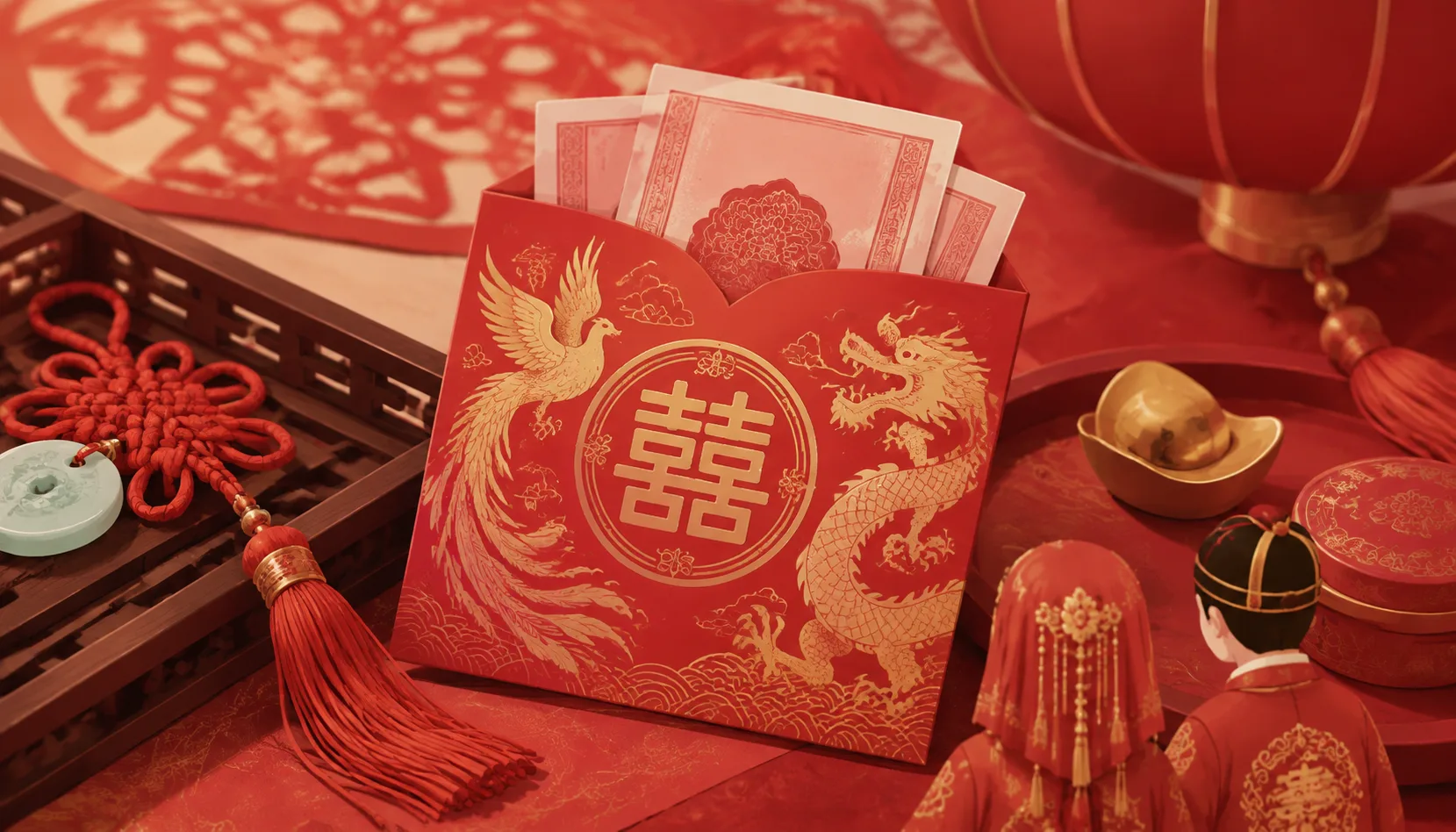
At Chinese weddings, guests give cash in red envelopes (份子钱, fènzi qián). The amount must be even — never odd. The minimum for a colleague in a tier-1 city is typically ¥800–1,000; close friends give ¥2,000–5,000+. Avoid any amount containing 4. Use a red envelope with wedding imagery, give with both hands, and don't open it in front of anyone.
What Is 份子钱 (Fènzi Qián)?
份子钱 (fènzi qián) is the cash gift that guests bring to Chinese weddings. The word 份子 (fènzi) means "one's share" — the concept being that the wedding is a community event and each guest contributes a portion of the hosting costs.
Unlike Western wedding registries where guests buy specific items, Chinese wedding culture runs almost entirely on cash. The couple uses the pooled money to offset the cost of the wedding banquet — which can run into hundreds of thousands of yuan for large families in major cities.
This is not optional. Attending a Chinese wedding without a red envelope is a serious breach of etiquette.
The Rules in Order of Importance
Rule 1: Always Even — Never Odd
Wedding gift amounts must be even numbers. Odd numbers are used at funerals (白事, báishì). This is an absolute, non-negotiable rule.
- ✅ ¥800, ¥1,000, ¥1,200, ¥1,688, ¥2,000, ¥2,888
- ❌ ¥700, ¥900, ¥1,001, ¥1,500 (these are odd or feel funerary)
Rule 2: No Amount Containing 4
4 sounds like "death" in Chinese. ¥1,400 is one of the worst possible wedding gifts. ¥4,000, ¥2,400, ¥400 — all of these communicate death at a celebration. Avoid any amount where 4 appears as a significant digit.
Rule 3: Red Envelope Only
Wedding gift money goes in a red envelope (红包, hóngbāo), not a white envelope (that's for funerals), not a plain envelope, and not handed over as loose cash. Specialty wedding envelopes are available everywhere — they print "新婚快乐" (happy new marriage) or "百年好合" (a hundred years of harmony).
Rule 4: New Banknotes
Ask a bank for crisp, new, unfolded notes before the wedding. Wrinkled or worn bills signal that you didn't prepare — that you grabbed whatever was in your wallet.
How Much to Give: The Honest Guide
The amount that is expected depends on three factors: your relationship with the couple, the city where the wedding takes place, and local customs.
Important caveat: these figures are 2024–2025 benchmarks for the mainland. hong kong, China Taiwan, and overseas Chinese communities have different norms.
| Your Relationship | Tier-1 City (BJ/SH/GZ/SZ) | Tier-2/3 City | Recommended Amount |
|---|---|---|---|
| Colleague / classmate you're not close to | ¥800–1,200 | ¥500–800 | ¥888, ¥1,000, ¥1,200 |
| Regular friend | ¥1,200–2,000 | ¥800–1,500 | ¥1,288, ¥1,688, ¥2,000 |
| Close friend | ¥2,000–5,000 | ¥1,500–3,000 | ¥2,888, ¥3,888, ¥5,888 |
| Best friend / family | ¥5,000–10,000+ | ¥3,000–8,000 | ¥5,888, ¥8,888, ¥10,000 |
| Your boss/ leader invites you | ¥1,500–3,000 | ¥800–1,500 | ¥1,688, ¥2,888 |
The minimum principle: Your gift should cover at least the "cost per head" at the wedding banquet, which in tier-1 cities is typically ¥600–1,000 per person for mid-range venues. Giving less than the meal costs is considered embarrassing for both the giver and the couple.
If you genuinely don't know the local standard: ask a Chinese friend who knows the couple, the city, and the type of wedding. Getting this input is entirely normal — Chinese people ask each other too.
How to Present the Wedding Red Envelope
- Look for the gift table — Chinese weddings typically have a dedicated reception desk where guests hand over envelopes and sign a guest book. This is called the 礼桌 (lǐ zhuō) or 签到台 (qiāndào tái).
- Hand the envelope with both hands. Always both hands. Not one.
- Say a short blessing: "恭喜恭喜,百年好合" (Gōngxǐ gōngxǐ, bǎinián hǎohé — Congratulations, may you have a hundred years of harmony).
- Sign the guest book — usually a large decorated book where guests write their name and a blessing message.
- The couple will not open envelopes in front of you — this is done privately after the wedding. You will not see acknowledgment of the amount.
The Reciprocity System
Chinese gift-giving operates on long memory. The couple (or their families) keep records of who gave what. When your wedding, child's birth, or milestone birthday comes around, the amounts given to you become the baseline expectation for what you'll receive back — with interest, adjusted for inflation and the passage of time.
This is not transactional in a cold sense. It is a mutual support system that has functioned for centuries. Giving generously now is investing in a network that will support you later.
If You're Invited but Can't Attend
In China, if you receive a wedding invitation but cannot attend, you are still expected to send a gift. The standard approach:
- Send a WeChat red envelope or bank transfer in a lucky even amount before the wedding day
- Message the couple directly with congratulations
- The amount is typically slightly less than you'd give in person — ¥500–1,000 depending on closeness
Doing nothing because you "couldn't go" is not an acceptable option in Chinese social accounting.
Wedding Red Envelope Dos and Don'ts Summary
| ✅ Do | ❌ Don't |
|---|---|
| Use a red wedding envelope | Use white or plain envelopes |
| Give an even amount | Give odd amounts |
| Avoid all numbers containing 4 | Give ¥400, ¥1,400, ¥4,000 |
| Use new, crisp banknotes | Use worn or folded bills |
| Give with both hands | Hand over with one hand |
| Ask a local friend if unsure | Guess an amount without context |
| Send something even if not attending | Ignore the invitation entirely |
What Chinese People Actually Say
- 随份子 | suí fènzi | to give gift money at a wedding | Use when referring to the act of giving money
- 封红包 | fēng hóngbāo | to give money in a red envelope | Use when describing the physical act of presenting money
- 随礼 | suí lǐ | to give a gift (money or item) for an occasion | Use as a general term for giving wedding gifts
2026 Reality Check
2026 Reality Check: The tradition remains strong, but cracks are appearing. Younger couples increasingly reject the "payback" mindset, viewing gifts as genuine祝福 rather than financial transactions.
Gen Z vs. Older Generations: Gen Z prefers digital red envelopes (微信红包) with smaller amounts ($20-50) or no cash at all—some opt for group gifts or experiences. Boomers and Gen X still expect $100-500 minimum, especially in traditional families.
Beijing/Shanghai vs. Smaller Cities: Tier-1 cities see more flexibility—wedding websites list "no gifts please" options. Smaller cities and rural areas still treat 份子钱 as obligatory, with amounts tied to relationship closeness and family face.
The Bottom Line: The rule survives but is softening. Urban youth are rewriting it; traditional families still enforce it. Context matters more than ever.
Frequently asked questions
Can I give money at a Chinese wedding if I'm not attending?
Yes, it's common to send fènzi qián even if you can't attend. You can transfer the money via WeChat or Alipay with a polite message, or have a mutual friend deliver a red envelope. The amount should match what you'd give if attending, though some deduct 20–30% for absence. Always confirm the couple's wedding date so your gift arrives on time.
What happens if I accidentally give an odd amount or a number with 4?
An odd amount or one containing 4 (which sounds like 'death') is seen as bad luck. If you realize your mistake before presenting, quickly swap the envelope. If it's already given, don't panic—just discreetly mention it was a mistake or add a small top-up amount in a new envelope. Most couples will overlook it, but it's best to avoid it altogether.
Is it okay to give a gift instead of cash at a Chinese wedding?
Cash is strongly preferred, especially in urban areas, because couples use it to offset wedding costs. However, a thoughtful physical gift is acceptable for very close friends or family, but it must be presented in a red envelope or wrapped in red paper. Avoid giving clocks, umbrellas, or sharp objects—all carry negative symbolism. In rural areas, physical gifts are more common but still secondary to cash.
How much should I give if I'm a foreigner and don't know the couple well?
If you're a colleague or acquaintance, start at ¥500–800 in a tier-1 city, or ¥300–500 in smaller cities. This matches the 'cover your meal' baseline. If you're a friend of a friend, ask the mutual contact what they're giving and match it. Never give less than what the wedding banquet costs per head, which is usually ¥400–600 in urban venues. It's better to slightly over-give than under-give.
Can I give money via a digital red envelope at the wedding itself?
Yes, but it's less traditional. If the couple has a digital wedding invitation or a QR code at the venue, you can scan and transfer. However, many couples still expect physical red envelopes for the ceremony. To be safe, bring a physical envelope with cash, and you can also send a small digital top-up as a congratulatory gesture. Always write your name on the physical envelope so the couple can record your gift.
Is there a difference in gift money etiquette between northern and southern China?
Yes, amounts and customs vary. Northern cities like Beijing tend to have higher baseline amounts (¥800–1,000 for colleagues), while southern cities like Guangzhou or Shenzhen are slightly lower (¥600–800) but with more emphasis on even numbers. In rural areas, amounts are lower but the red envelope is more ceremonial. In some southern regions, the couple may return a small portion of the gift money as a gesture of thanks—don't be surprised if they hand back a few bills.
Try our tools
Related guides

Chinese Gift-Giving Guide 2026: Rules, Taboos, and What Actually Works
In China, gift-giving is not about the gift. It's about the relationship. The right gift, delivered at the right time with the right words and two hands, commun…
Read the guide →
Chinese Red Envelope (红包) Complete Guide: When to Give, How Much, and What NOT to Do
A red envelope (红包, hóngbāo) is a cash gift in a red wrapper given at Chinese New Year, weddings, births, and milestone birthdays. Key rules: always use red (ne…
Read the guide →
Chinese Gift Budget Guide: How Much to Spend on Gifts in China (2026 Price Breakdown)
The safe zone for most situations: ¥100–500 RMB (~$15–$70 USD). For important business relationships at major holidays: ¥300–1500. For close friends at signific…
Read the guide →