Chinese Gift-Giving Guide 2026: Rules, Taboos, and What Actually Works

Quick answer
In China, gift-giving is not about the gift. It's about the relationship. The right gift, delivered at the right time with the right words and two hands, communicates that you understand your place in the social fabric — and that you take it seriously. The wrong gift (a clock, an umbrella, anything in white packaging) sends the opposite message, often without anyone telling you what you did wrong. This hub covers everything you need to know before you give, receive, or decline a gift in China.
Quick Answer
In China, gift-giving is not about the gift. It's about the relationship. The right gift, delivered at the right time with the right words and two hands, communicates that you understand your place in the social fabric — and that you take it seriously. The wrong gift (a clock, an umbrella, anything in white packaging) sends the opposite message, often without anyone telling you what you did wrong.
This hub covers everything you need to know before you give, receive, or decline a gift in China.
The Three Laws Behind All Chinese Gift-Giving
Before you pick a single product, internalize these three ideas. They explain 90% of Chinese gift behavior.
Law 1: "礼轻情意重" Is Not What It Sounds Like
The phrase means: "the gift may be light, but the sentiment is heavy." Foreigners hear this and think: "Good, they don't care about price." Wrong.
This phrase is what the giver says to be modest. It is not a statement about what the receiver actually expects. In practice, the weight of the gift directly signals the depth of the relationship. A ¥50 gift for a close partner says: "You're worth ¥50 to me." That is a message people remember.
Western analogy: This is like being invited to a Michelin-starred dinner and bringing McDonald's as your contribution and saying "it's the thought that counts."
Law 2: The Push-Pull Ritual Has a Script
When you offer a gift in China, the recipient will almost certainly refuse it at least once. Maybe twice. This is not rejection — it is a mandatory social performance with a specific script and a specific end state.
| Round | You | Recipient |
|---|---|---|
| 1 | Present the gift | "No need, you're too kind!" (虚拒 — polite refusal) |
| 2 | "Please, it's just a small token — you must accept it" | "I really can't…" (half-yielding) |
| 3 | Place it in their hands / leave it on the table | "Well, thank you so much." (收下 — accepted) |
Three purposes: it tests your sincerity (if you give up at Round 1, you never really wanted to give); it lets them maintain face (accepting too eagerly looks greedy); it gives both parties an exit if the gift is genuinely unsuitable.
Key: The only time refusal is real is when the person's tone is firm, they say "this is a matter of principle," or they are a government official. Read the room. Three rounds of cheerful back-and-forth = normal. Serious, repeated, formal refusal = actually stop.
Law 3: Chinese Gifts Are Relationship Calibrators, Not Surprises
Western gift culture: "I picked this because I know you love jazz — I found the perfect rare record." The message is: I see your unique self.
Chinese gift culture: "I selected this because it matches our relationship level and the occasion." The message is: I know where we stand, and I honor it.
This is why "硬通货" (hard currency gifts) dominate in Chinese social circles — premium tea, Moutai, quality wine, brand-name pens. These have transparent market values that the receiver can read instantly. The gift communicates the relationship tier precisely, like a code everyone has agreed to.
Implication: Don't try to be creative before you've been correct. A standard, appropriate gift executed well outperforms a brilliant but unfamiliar one every time.
The 8 Occasions When You Must Give a Gift
Miss these occasions and the relationship cools — often without anyone explaining why.
1. First Visit / Meeting
The first time you visit someone's home or office: bring something. Always. This is the 见面礼 (jiànmiànlǐ — first-meeting gift). It doesn't need to be lavish; it needs to exist. Something from your home country is ideal — it says you brought part of your world to the encounter.
→ What to bring on a first visit to a Chinese home
2. Spring Festival (Chinese New Year)
The biggest gift-giving season of the year. Senior relationships, important clients, key partners — all receive gifts in the two weeks surrounding Chinese New Year. The gift should land before the holiday. Showing up with a gift after January 15th of the lunar calendar feels like an afterthought.
Classic choices: premium tea, quality baijiu, nuts and dried food gift boxes (年货礼盒), health supplements.
Affiliate placement: → Premium Chinese New Year gift box recommendations
→ Full Chinese New Year gift guide
3. Mid-Autumn Festival
The second-biggest gift season. Mooncake gift boxes are the standard currency — but what matters is the brand and packaging. A generic ¥50 mooncake says "I went through the motions." A Peninsula Hotel limited-edition mooncake says "you are a priority relationship."
Affiliate placement: → Premium mooncake gift box recommendations
→ Mid-Autumn Festival gift guide
4. Major Life Events (Weddings, Births, Housewarmings, Significant Birthdays)
For weddings: cash only, in a red envelope (红包 hóngbāo), in an auspicious amount. No appliances, no experiences, no wine. The amount is calculated by relationship depth and local going rates — and it's tracked. Ask a local colleague for the standard.
For births (满月 full moon ceremony), housewarmings, and milestone birthdays: follow the occasion-specific rules. All have gift taboos.
Affiliate placement: → Auspicious red envelope sets for weddings
→ Full wedding red envelope guide | Baby full-moon gift guide | Housewarming gift guide
5. Asking a Favor / Expressing Gratitude
Critical rule: give after, not before. Giving before someone helps is bribery. Giving after is gratitude. The timing is everything.
A lawyer friend who reviewed your contract for free, a contact who made a key introduction — these people deserve proper thanks. A quality specialty food from your home country plus a meal is the gold-standard combination.
6. Hospital Visits
Never empty-handed. Never white or yellow flowers (funeral colors in China). Never pears (sounds like 离 — separation). The safe formula: a fruit basket (apples, oranges, grapes), plus a quality health supplement (bird's nest, ginseng, quality protein).
Affiliate placement: → Fruit basket delivery options
→ Hospital visit gift guide: what to bring when someone is sick in China
7. Home Dinners (Being Invited to Someone's House)
When a Chinese person invites you home for dinner, this is a social promotion — more intimate than any restaurant meal. Arriving empty-handed is not acceptable, even if the host says "don't bring anything." That is the script talking, not an actual instruction.
Safe formula: fruit + something to drink (wine or quality juice) + a sweet/dessert item. Bonus: bring something small for their child if they have one. You will win the whole family in 30 seconds.
→ What to bring to a Chinese home dinner
8. Returning From Travel
The 伴手礼 (bànshǒulǐ — hand gift): something you bring back from travel to colleagues and friends. It doesn't need to be expensive — its value is in signaling "I thought of you while I was away." Local specialty foods from your home country or travel destination are perfect.
The Price Calibration System
The hardest part for foreigners: how much? The answer is not an absolute number — it's a calculation based on relationship depth and the occasion's stakes.
| Relationship Tier | Typical Range (RMB) | Signal |
|---|---|---|
| Acquaintance / casual colleague | ¥50–150 | "I'm polite" |
| Regular friend / colleague | ¥150–400 | "I value you" |
| Close friend / key client | ¥500–1000 | "You matter to me" |
| Family / lifelong friend | ¥1000+ | "You're part of my inner circle" |
The ¥300 law: ¥100–300 is the universal safety zone for first-time or uncertain situations. It's substantial enough to show respect, light enough that the recipient doesn't feel they owe you something uncomfortable.
The danger of over-gifting: A ¥3000 gift to someone you've known for three weeks creates immediate pressure. The recipient now owes you a ¥4000 return gift. Their response is often to quietly create distance — the opposite of what you wanted.
The danger of under-gifting: A ¥30 gift for an important relationship communicates that you value them at ¥30. This is remembered.
→ Full Chinese gift budget and price calibration guide
The 14 Gift Taboos (Quick Reference)
Never give any of the following. Each one carries symbolic associations that will undermine the relationship silently.
| Gift | Why Forbidden | Salvage Move |
|---|---|---|
| Clocks / timepieces | "送钟" sounds like "送终" (attending a funeral) | Immediately offer to "buy" it back for ¥1 — this breaks the curse |
| Umbrellas | "伞" sounds like "散" (separation / breakup) | ¥1 purchase trick; or pivot to another gift |
| Pears | "梨" sounds like "离" (parting, leaving) | Swap for apples (平安 — peace) |
| Green hats | "Green hat" = "your partner is unfaithful" | No salvage; never give this to a man |
| Shoes | "鞋" sounds like "邪" (evil) | ¥1 purchase trick |
| Knives / scissors | Symbolize "severing the relationship" | ¥1 purchase trick (widely understood) |
| White or black packaging | Funeral colors in China | Re-wrap in red or gold immediately |
| White / yellow chrysanthemums | Funeral flowers | Replace with red, pink, or orange flowers |
| Anything in groups of 4 | "四" sounds like "死" (death) | Swap for 6 (顺), 8 (发), or 9 (久) |
| Empty wallets or purses | "Empty wallet = empty fortune" | Add any coin or note before giving |
| Candles | Associated with ancestral offerings | Describe as "Western lifestyle décor" — still risky |
| Mirrors | Easily broken; "破镜难圆" (broken mirror can't be fixed) | Collect and replace with something else |
| Handkerchiefs | Traditional farewell/grief gift | Replace with a quality scarf — different symbolism |
| Dolls / figurines (for adults) | Associated with attracting bad spirits | Fine for children; for adults, frame as collectible |
→ Full 14-taboo guide with detailed cultural explanations and salvage scripts
The Packaging Rules: Color, Number, Wrapping
Packaging communicates before the gift is even opened.
Colors:
- ✅ Red — universally safe; joy, luck, celebration
- ✅ Gold — prestige, wealth; ideal for senior recipients
- ✅ Pink / warm colors — friendly, appropriate for personal occasions
- ❌ White — funeral association; never use for any gift
- ❌ Black — mourning; avoid
- ❌ White + black combination — doubly bad
Numbers:
- ✅ 6 — 六六大顺 (everything flows smoothly)
- ✅ 8 — 发 (prosperity) — the most commercially auspicious number
- ✅ 9 — 久 (long-lasting) — ideal for relationship-cementing gifts
- ❌ 4 — 死 (death) — never 4 of anything
- ✅ Even numbers for joyful occasions; odd numbers for condolences
Always remove the price tag. Leaving it on reads as a reminder of what you spent, which shifts the gift from "token of relationship" to "invoice for a debt."
→ Full gift wrapping and packaging rules guide
How to Give: The Physical Ritual
Two hands. Always. One hand supporting the base, the other steadying the side. Slight forward lean. Eye contact. Smile.
Single-handed gift presentation is the equivalent of a limp handshake — it says the gesture is happening without your full attention.
When to present: For home visits, within the first few minutes after arrival — not on your way out. For business settings, before sitting down or at the conclusion of the meeting.
What to say:
- "一点小心意,不成敬意。" (Yìdiǎn xiǎo xīnyì, bù chéng jìngyì.) — "Just a small token, not worthy of your respect."
- "这是我家乡的特产,请您尝尝。" — "This is a specialty from my hometown — please try it."
- "谢谢您一直以来的照顾。" — "Thank you for all your support."
The push-pull: Three rounds, then place it in their hands. If they take it: success. If they genuinely don't (rare, usually government/compliance context): collect with grace and offer to bring something else next time.
→ Full guide to the gift-giving ritual and how to handle every scenario
When You Receive a Gift
Chinese recipients do not open gifts immediately in front of the giver. This is not indifference — it's restraint. Opening immediately signals greediness; setting it aside signals class.
Your script when receiving:
- Accept with both hands
- Say: "谢谢您,您太客气了!" (Thank you, you're too kind!)
- Set it aside
- Within 24 hours: photograph it and send a WeChat message — "Just opened your gift — I love it. Thank you so much."
- At the next significant occasion: reciprocate with something of similar value
The 礼尚往来 (reciprocity) rule: receive → appreciate → return at the right moment. The cycle is never complete without the return.
What Always Works (The Universal Safe List)
When you're not sure what to give, any of these will land well:
Premium tea gift box — Pu'er, Tieguanyin, Longjing, Da Hongpao. Elegant, universally appreciated, no taboos, wide price range. This is the single most versatile gift in Chinese culture.
Quality wine from your home country — Not the cheapest, not the most expensive. A bottle with a story and a provenance. The "from my world" quality makes it memorable.
Specialty foods from your country or region — Artisanal chocolate, premium biscuits, regional nuts. The foreignness is the value.
Auspicious number fruit basket — 6 or 8 pieces, in a quality gift box. Apples (平安 peace), oranges (成 achievement), grapes.
Brand-name stationery — Quality pen (not a clock), leather notebook. Practical, no cultural minefields.
Affiliate placement: → Shop curated safe-gift sets for Chinese business relationships | Premium tea gift boxes on Amazon | Specialty food gift sets
The 30-Second Rule You Can't Forget
If you're in doubt and have 30 seconds to apply one rule:
Two hands. Red packaging. Even number. Say: "一点小心意" (yìdiǎn xiǎo xīnyì — just a small token). Persist through two polite refusals.
This covers 80% of all Chinese gift situations.
FAQ
Q: My Chinese colleague said "don't bring anything" when inviting me to dinner. Should I bring something? A: Yes. "Don't bring anything" is Round 1 of the script. Arrive without a gift and you'll be the only person there without one.
Q: Can I give cash instead of a gift? A: Only in red envelope form, for specific occasions (weddings, births, lunar new year for children). Loose cash as a thank-you gift reads as payment, not appreciation.
Q: What if I give something taboo by mistake? A: The universal salvage: "I truly didn't know — I'm so sorry." Genuine ignorance is almost always forgiven. Then offer to bring something else. The ¥1 "purchase" trick (letting them buy the item from you for a coin) formally breaks the bad symbolism — many Chinese people know this custom and use it themselves.
Q: Is it okay to give a gift card? A: Generally no for personal relationships — it reads as impersonal and possibly too close to cash. For business, small-value gift cards from well-known brands can work but check compliance first.
Page Navigation: Gift Sub-Topics
- Chinese New Year Gift Guide — Spring Festival gift recommendations, timing, budget
- Mid-Autumn Festival and Mooncake Gift Guide — The mooncake economy explained
- 14 Chinese Gift Taboos: The Complete Forbidden List — Every taboo with cultural backstory and salvage plan
- The Push-Pull Ritual: How to Give and Receive Gifts in China — The script, the body language, the three-round rule
- Chinese Gift Wrapping Guide: Colors, Numbers, Packaging Rules
- What to Bring to a Chinese Home Dinner
- How to Visit Someone Sick in China
- Chinese Housewarming Gifts (乔迁)
- Chinese Baby Gift Guide: Full Moon Ceremony (满月)
- Chinese Wedding Red Envelope Guide (份子钱)
- Chinese Gift Budget Guide: How Much to Spend for Every Relationship
The return half of 礼尚往来 is where the exchange actually lives or dies, so for the fuller playbook on what to do after someone gives you a gift — timing the return, matching value, and resetting the ledger, that is the next layer.
What Chinese People Actually Say
- 薄礼 | báo lǐ | modest gift (humble term) | Use when presenting a modest gift to show humility
- 不成敬意 | bù chéng jìngyì | just a small token (polite) | Use when giving a gift to show it's not enough but from the heart
- 请笑纳 | qǐng xiào nà | please accept this (polite) | Use when giving a gift to show respect and request acceptance
2026 Reality Check
Chinese gift-giving etiquette in 2026 is a mixed picture. Traditional rules still matter, but younger generations are rewriting them.
Gen Z vs. Older Generations: Boomers and Gen X still observe the "never give clocks or white items" taboo and insist on even numbers (except 4—avoid it). Gen Z? They largely ignore these rules. Digital red envelopes (hongbao via WeChat/Alipay) have replaced physical cash for younger people, and many don't know or care about the old taboos.
Beijing/Shanghai vs. Smaller Cities: Tier-1 cities are more relaxed—international influence and younger populations mean Western-style gifts (wine, electronics) are fine. Smaller cities and rural areas still hold tighter to tradition. Avoiding the number 4, giving even amounts, and wrapping in red still matter significantly.
The Reality: The core rule survives—it's the thought that counts, and relationships still require reciprocity. But the rigid rituals are fading fast in urban China.
Frequently asked questions
Is it okay to give a clock to a Chinese friend if it's a really nice antique one?
No. A clock (song zhong) sounds like 'attending to one's death' in Chinese. Even an exquisite antique carries the same phonetic curse. If someone gives you one, hand them a symbolic coin or a small amount of money immediately to 'buy' it back, neutralizing the bad luck. Just don't give one in the first place.
What if I receive a gift I don't want — can I refuse it politely?
Yes, but only once or twice, and always with a reason. Say 'Ni tai keqi le' (you're too kind) while gently pushing it back. If they insist a third time, accept it with both hands. Refusing more than that becomes an insult, implying you find their gift worthless or their status beneath you.
Why do Chinese people sometimes give gifts with both hands and sometimes with one?
Both hands signals deep respect and is mandatory for elders, bosses, and anyone of higher status. One hand (with the other supporting your elbow) is acceptable for close friends or peers your own age. Never use only your left hand — it's considered unclean in traditional Chinese culture. When in doubt, use both.
Can I give red envelopes (hongbao) instead of a physical gift for a birthday?
Yes, but context matters. Red envelopes are standard for weddings, Lunar New Year, and babies. For an adult's birthday, cash feels impersonal unless it's for a grandparent (where it's customary). For friends, pair the hongbao with a small personal item. For business contacts, never give cash — it reads as a bribe.
How much should I spend on a gift for a Chinese colleague's wedding?
It depends on your relationship and city. In tier-1 cities like Shanghai or Beijing, close colleagues often give 500–1,000 RMB; casual coworkers give 200–500 RMB. In smaller cities, drop those numbers by 30–50%. Never give amounts with 4 (sounds like death) — 8 (fortune) is always safe. Check with local coworkers if unsure.
Is it a mistake to give a gift in white wrapping paper if the gift itself is safe?
Yes, a major one. White is the color of mourning and funerals in China. Even a perfectly safe gift wrapped in white instantly signals death and disrespect. Red, gold, and pink are universally safe. If you've already wrapped it in white, re-wrap it before giving — or apologize and explain it was an honest foreigner mistake.
Try our tools
Related guides

14 Chinese Gift Taboos: The Complete Forbidden List
Most Chinese gift taboos come from homophones — words that sound identical to something unlucky. "送钟" (giving a clock) sounds exactly like "送终" (attending a fun…
Read the guide →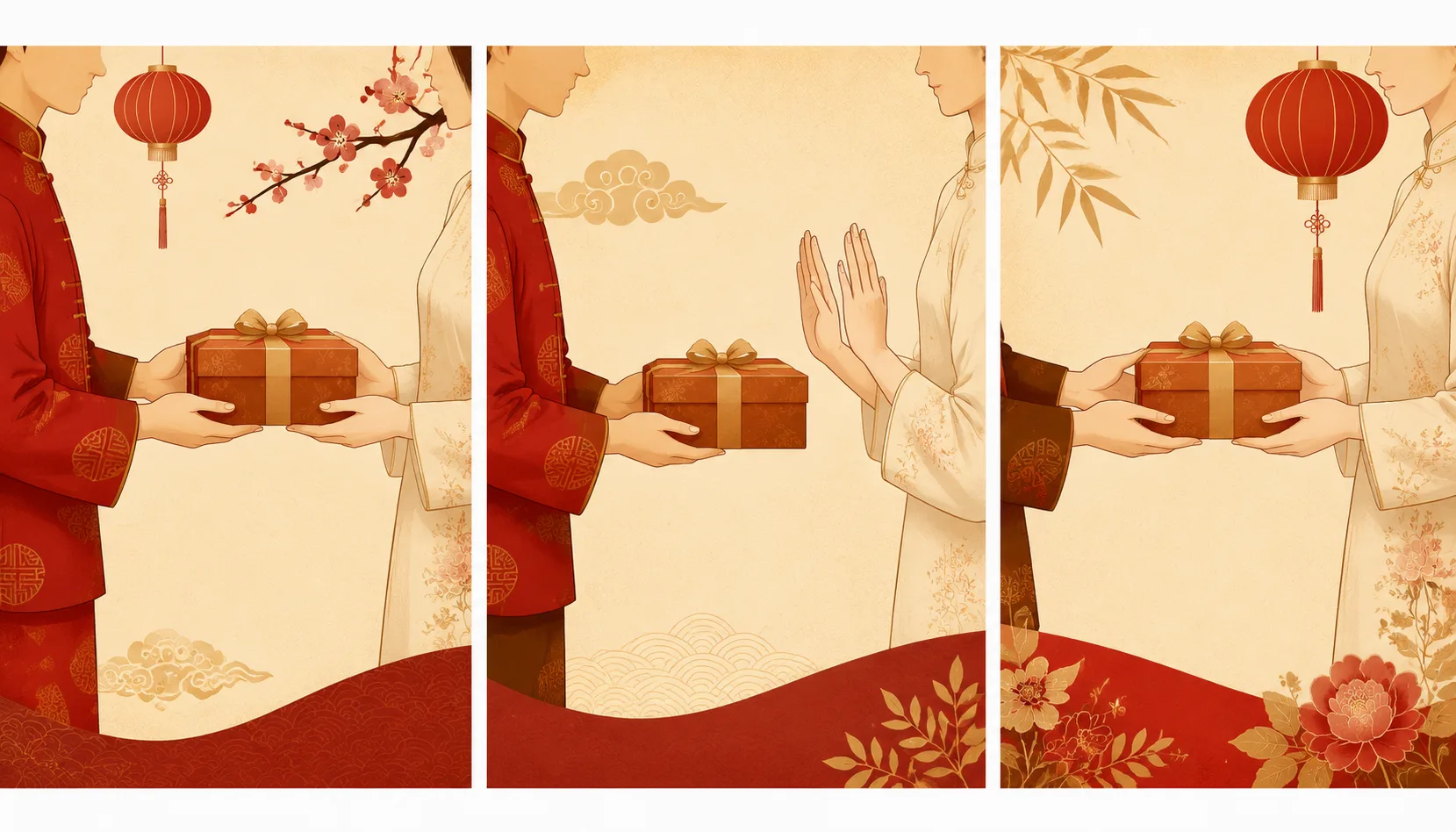
How to Give a Gift in China: Two Hands, Three Rounds
Two hands. Eye contact. Slight forward lean. Say "一点小心意" (a small token). When they refuse, persist twice — then place it in their hands. This is the script. De…
Read the guide →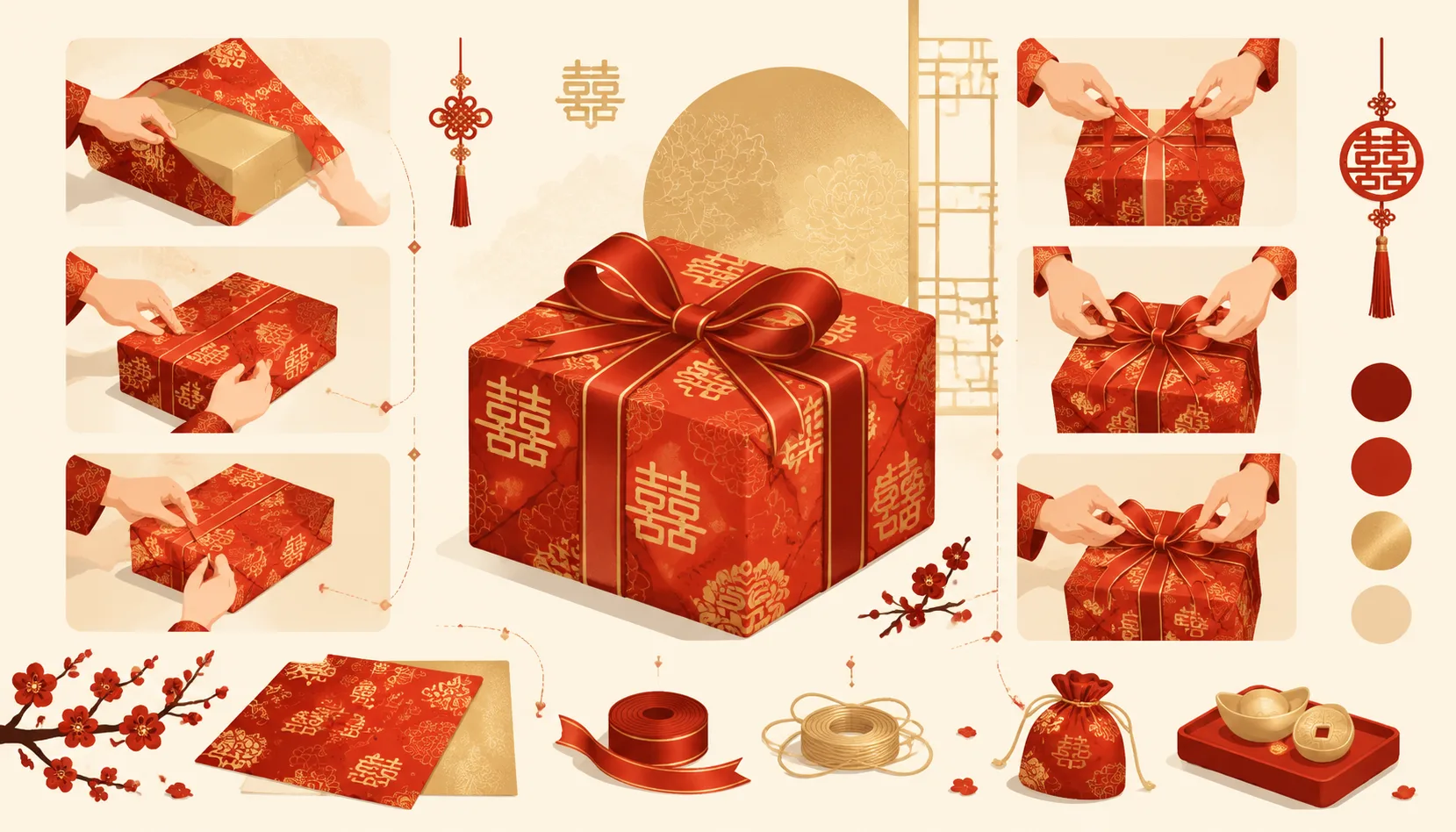
Chinese Gift Wrapping: Colors, Lucky Numbers & Taboos
In China, the packaging communicates before the gift is opened. Red and gold are always safe — they signal joy and prosperity. White and black are funeral color…
Read the guide →