Chinese Gift Wrapping Rules: Colors, Lucky Numbers, and the Packaging Taboos You Need to Know
Quick answer
In China, the packaging communicates before the gift is opened. Red and gold are always safe — they signal joy and prosperity. White and black are funeral colors — never use them. Remove price tags. Use even numbers (6, 8, 9 are auspicious; 4 is forbidden). A handwritten card in Chinese or with a few Chinese characters adds disproportionate goodwill.
Quick Answer
In China, the packaging communicates before the gift is opened. Red and gold are always safe — they signal joy and prosperity. White and black are funeral colors — never use them. Remove price tags. Use even numbers (6, 8, 9 are auspicious; 4 is forbidden). A handwritten card in Chinese or with a few Chinese characters adds disproportionate goodwill.
The Color Code
Always Safe
Red (红色, hóngsè): The gold standard of Chinese gift packaging. Red signals celebration, luck, happiness, and good fortune. For any joyful occasion — New Year, birthday, wedding, housewarming, business relationship — red packaging is universally appropriate. When in doubt, go red.
Gold / Yellow-Gold (金色, jīnsè): Second most universally safe. Gold signals wealth, prestige, and honor. Particularly appropriate for gifts to senior people, business contacts, or any situation where you want to communicate elevated respect.
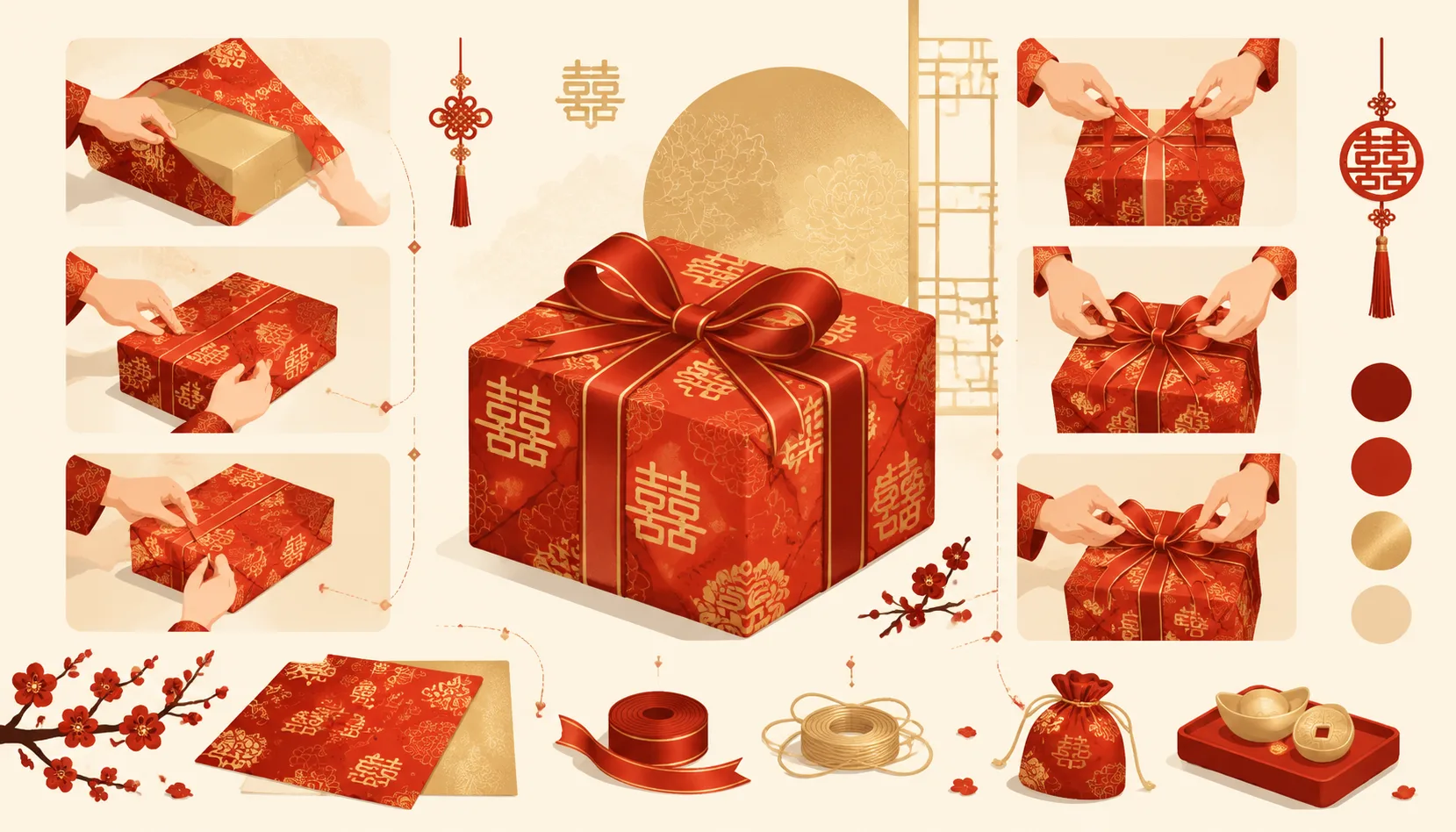
Red + Gold Combination: The single most auspicious packaging combination in Chinese culture. Used for weddings, Spring Festival, and significant gifts to important people. If you can only choose one packaging style to master for China, this is it.
Affiliate placement: → Red and gold gift bags, wrapping paper, and ribbon sets for Chinese gifting
Use With Some Thought
Pink (粉色, fěnsè): Warm, friendly, feminine. Safe for personal occasions (birthdays, home visits) and for gifts to women. Slightly casual — not ideal for formal business gifting.
Orange (橙色, chéngsè): Warm and celebratory. Safe for most occasions. Less traditional than red but increasingly common.
Purple (紫色, zǐsè): Historically associated with royalty and nobility in China. Elegant and appropriate. Good for sophisticated gifts to refined recipients.
Blue (蓝色, lánsè): Generally acceptable, but use warmer or richer blues rather than pale or steel blue. Some older recipients in certain regions associate pale blue with mourning — safe choice is to add red accents if using blue.
Green (绿色, lǜsè): Generally fine as a packaging color. Avoid green hat-shaped gifts (see: taboo list), but green packaging for a tea gift box is fine. The sensitivity around green is specifically for hats and hat-adjacent items.
Avoid Completely
White (白色, báisè): White is the primary mourning color in China. White wrapping paper, white gift boxes, white ribbon against white background — all carry funeral associations. This is the most important packaging rule to internalize. Never use white as the primary packaging color for any gift to a Chinese person.
Exception: some modern, cosmopolitan brands package in white as an international aesthetic. Younger urban Chinese understand this context. But when in doubt, wrap it in red anyway.
Black (黑色, hēisè): Same funeral association as white. Black gift boxes, black wrapping paper — avoid for any positive occasion.
White + Black Combination: Doubly bad. This is what Chinese funeral envelopes look like. Using this color scheme for a gift is one of the most jarring errors you can make.
The Number Code
Numbers of items in a gift carry as much symbolic weight as the items themselves.
Auspicious Numbers
2 (二, èr) — 成双成对 (pairs are auspicious): "Good things come in pairs" (好事成双, hǎoshì chéng shuāng). Two matching items, two bottles, two boxes = doubled luck. Particularly good for weddings and romantic occasions.
6 (六, liù) — 六六大顺 (everything flows smoothly): The most universally auspicious number for gifts. Six bottles, six pieces, six items. The phrase "六六大顺" (smooth sailing in all things) makes this a particularly strong number for business contexts.
8 (八, bā) — 发 (prosperity): "Eight" sounds like "to prosper" (发, fā, as in 发财 fācái — to become wealthy). The most commercially auspicious number in Chinese business culture. Eight mooncakes, eight tea canisters, ¥888 red envelopes. Premium product bundles often come in sets of 8 for this reason.
9 (九, jiǔ) — 久 (long-lasting): Nine sounds like "long" or "enduring" (久, jiǔ). Ideal for gifts intended to celebrate a long-term relationship or wish someone longevity. Nine-piece gift sets, ¥999.
Forbidden Number
4 (四, sì) — 死 (death): Four sounds like "death" (死, sǐ). Never give 4 of anything. Not 4 apples, not 4 bottles, not a ¥400 red envelope. If your gift set happens to come in 4, add one more item to make it 5, or find a different set.
Odd numbers generally: Odd numbers (1, 3, 5, 7) are neutral in gift contexts. For celebratory occasions, even numbers signal doubling of good fortune. Single items are fine (one bottle of Moutai, one premium tea box) — the taboo is specifically around 4.
Wrapping Mechanics: What Good Packaging Looks Like
Chinese gift packaging culture emphasizes presentation. A beautifully wrapped gift says "I put time into this." A gift in a plastic bag says "I grabbed this on the way."
The hierarchy:
- Branded gift box from a known brand (most prestigious — the box itself signals quality)
- Quality gift bag with tissue paper and a ribbon
- Wrapped box with quality wrapping paper
- Gift bag with minimal decoration (acceptable, especially for informal situations)
- Plastic bag (avoid for any situation with social stakes)
Key details:
- Remove all price tags. Leaving a price tag on says "I want you to know exactly what I spent" — which reads as either boasting or invoicing for a debt.
- Tissue paper inside bags: If using a gift bag, fill it with red or gold tissue paper. An empty bag with just the gift looks unfinished.
- Ribbon: Red ribbon on any gift is always a positive touch. Gold ribbon on red packaging = ideal.
- The bag handle should face the recipient: When handing over the gift, position the opening toward them so they can take it by the handles without awkward repositioning.
The Gift Card: What to Write
A small card adds significant warmth. Chinese people notice and appreciate the effort of a handwritten note — especially from a foreigner who has taken the time to write even a few characters.
Card format:
- Small, quality card stock (not a Post-it note)
- Recipient's name (using their appropriate title: 王总、李老师)
- A brief auspicious phrase
- Your name and company (for business contexts)
Safe phrases for cards (Chinese + transliteration + meaning):
| Chinese | Pinyin | Meaning | Best For |
|---|---|---|---|
| 恭喜发财 | Gōngxǐ fācái | Wishing you prosperity | Chinese New Year |
| 万事如意 | Wànshì rúyì | May everything go as you wish | General / New Year |
| 身体健康 | Shēntǐ jiànkāng | Good health | Elders, recovery occasions |
| 合作愉快 | Hézuò yúkuài | Happy cooperation | Business partners |
| 心想事成 | Xīn xiǎng shì chéng | May your wishes come true | Birthdays, general |
| 大展宏图 | Dà zhǎn hóngtú | May your great ambitions succeed | Business / career contexts |
| 阖家幸福 | Héjiā xìngfú | Happiness for your whole family | Holiday, home occasions |
| 生日快乐 | Shēngrì kuàilè | Happy birthday | Birthdays |
If you write in English: That's completely fine. Add just one Chinese phrase — even if your handwriting isn't perfect, the effort is deeply appreciated.
Packaging for Specific Occasions
| Occasion | Ideal Colors | Ideal Numbers | Card Phrase |
|---|---|---|---|
| Chinese New Year | Red + Gold | 2, 6, 8 | 恭喜发财 / 万事如意 |
| Wedding | Red + Gold | 2, 8 | 百年好合 (báinián hǎohé — a hundred years of harmony) |
| Birthday (general) | Red, Pink, Warm colors | 6, 8, 9 | 生日快乐 / 心想事成 |
| Birthday (elder) | Red + Gold | 9 (longevity) | 身体健康 / 福如东海 |
| Housewarming | Red | 6, 8 | 乔迁之喜 (qiáoqiān zhī xǐ — joy of the new home) |
| Business signing | Gold, Red | 6, 8 | 合作愉快 / 大展宏图 |
| Hospital visit | Warm colors (not white) | 6 | 早日康复 (zǎorì kāngfù — speedy recovery) |
| Mid-Autumn Festival | Red, Gold, Moon-themed | 6, 8 | 中秋快乐 (Zhōngqiū kuàilè — Happy Mid-Autumn) |
Wrapping International Gifts
If you're bringing something from abroad — a bottle of wine from your home country, a specialty food item in its original foreign packaging — you don't need to completely re-wrap it. But:
- Put it in a red gift bag as the outer layer
- Add a red or gold ribbon
- Include a card
- The foreign original packaging reads as authentically international — which is actually a feature, not a bug
"I brought this from [country] — here's the original packaging so you can see where it came from" is a completely natural thing to say. The red bag signals that this is a gift, not a purchase you're sharing.
Affiliate placement: → Red gift bags in bulk for travel and gifting abroad | Gold ribbon and tissue paper sets
FAQ
Q: Can I use recycled luxury packaging — like an old Hermès bag — as gift packaging? A: Yes, in younger and cosmopolitan urban circles, this reads as chic. For older or traditional recipients, it can be confusing — they may not know the brand or may notice it's not new. Safe choice: use new packaging. The Hermès bag is a bonus for the right recipient, not a replacement for appropriate wrapping.
Q: Is it okay to give a gift without packaging if the item itself is beautiful (like a quality lacquer box)? A: An item that is its own packaging is generally fine — put a red ribbon on it and a card. The goal is "this is deliberate and wrapped with care," which a ribbon achieves.
Q: What about wrapping gifts in newspaper — I've seen this in some artsy Chinese contexts? A: Modern artistic/young urban contexts, yes. For any traditional or business gift occasion: no. Newspaper wrapping signals that you didn't plan ahead.
Q: Silver packaging — is that acceptable? A: Silver is associated with elegance in many modern Chinese brands and is generally acceptable. It doesn't carry the funeral weight that white does. For traditional or older recipients, gold is safer.
What Chinese People Actually Say
- 红包 | hóngbāo | red envelope | Use red envelopes for money gifts; red symbolizes luck and joy.
- 好事成双 | hǎo shì chéng shuāng | good things come in pairs | Always give gifts in even numbers; odd numbers are for funerals.
- 送礼不送钟 | sòng lǐ bù sòng zhōng | never give clocks as gifts | "Clock" sounds like "death" in Chinese—avoid entirely.
2026 Reality Check
Red still dominates, but rules are loosening. Red and gold remain the go-to colors for celebrations—birthdays, weddings, Lunar New Year. White and black are still avoided for festive gifts (associated with mourning). But in 2026, younger urban Chinese increasingly use minimalist packaging in pastels or neutral tones for non-ceremonial gifts.
Gen Z vs. Older Generations: Boomers and Gen X still insist on red envelopes (hongbao) and red wrapping for weddings, holidays, and business gifts. Gen Z treats packaging as aesthetic—many don't know or don't care about color taboos. They'll wrap gifts in black or white if it "looks cool."
Beijing/Shanghai vs. Smaller Cities: Tier-1 cities are more flexible; international influence means Western-style gift wrap is common. Smaller cities and older residents hold tighter to traditional rules—red mandatory, odd numbers avoided (except for 9, which sounds like "long-lasting").
Bottom line: Traditional rules survive in ceremonial contexts, but casual gifting has relaxed significantly—especially among urban youth.
Frequently asked questions
Can I use white gift wrapping if the gift is for a wedding or a birthday?
No. White and black wrapping are strictly reserved for funerals and mourning in China, regardless of the occasion. Even a white gift box with a red ribbon can cause confusion. If you only have white paper, cover it completely with red or gold wrapping or place it inside a colored gift bag.
What if I don't know the recipient's lucky number — is 8 always the safest choice?
Yes, 8 is universally auspicious in China because it sounds like 'fa' (wealth). For gift wrapping, use an even number of items, ribbons, or decorative elements. Six and nine are also good. Avoid 4 entirely — it sounds like 'si' (death). If you're unsure, stick to 8 or 6; they work for every region and occasion.
Is it rude to give a gift in a store bag instead of wrapping it?
Yes, giving a gift in a plain store bag is seen as careless and impersonal. In China, the wrapping shows respect and effort. Use proper gift wrap, a decorative box, or at minimum a branded gift bag with tissue paper. Never hand over a gift in a plastic shopping bag — it signals you didn't value the relationship.
Can I reuse old wrapping paper or gift bags for a Chinese gift?
It's best not to. Used or wrinkled wrapping suggests the gift is secondhand or that you didn't invest in the relationship. Fresh, crisp wrapping is a sign of respect. If you must reuse, ensure the paper is flawless, remove any old tape, and add a new ribbon or a fresh card to make it look intentional.
Does the rule about even numbers apply to the number of gifts or just the wrapping decorations?
Both. If you give multiple gifts, the total count should be even — two, six, or eight items are ideal. For wrapping, use even numbers of ribbons, bows, or decorative stickers. Odd numbers, especially one single item, are fine for a single gift, but never give four of anything, as that number is deeply unlucky.
Is it acceptable to wrap a gift in newspaper or brown kraft paper in China?
Brown kraft paper is neutral and acceptable if it's clean and neat, though it lacks festivity. Newspaper is a definite no — it's seen as cheap and disrespectful, and the content might contain inauspicious words or images. If you use kraft paper, add a red ribbon and a red card to bring in the required auspicious energy.
Try our tools
Related guides

Chinese Gift-Giving Guide 2026: Rules, Taboos, and What Actually Works
In China, gift-giving is not about the gift. It's about the relationship. The right gift, delivered at the right time with the right words and two hands, commun…
Read the guide →
14 Chinese Gift Taboos: The Complete Forbidden List (With Salvage Tips)
Most Chinese gift taboos come from homophones — words that sound identical to something unlucky. "送钟" (giving a clock) sounds exactly like "送终" (attending a fun…
Read the guide →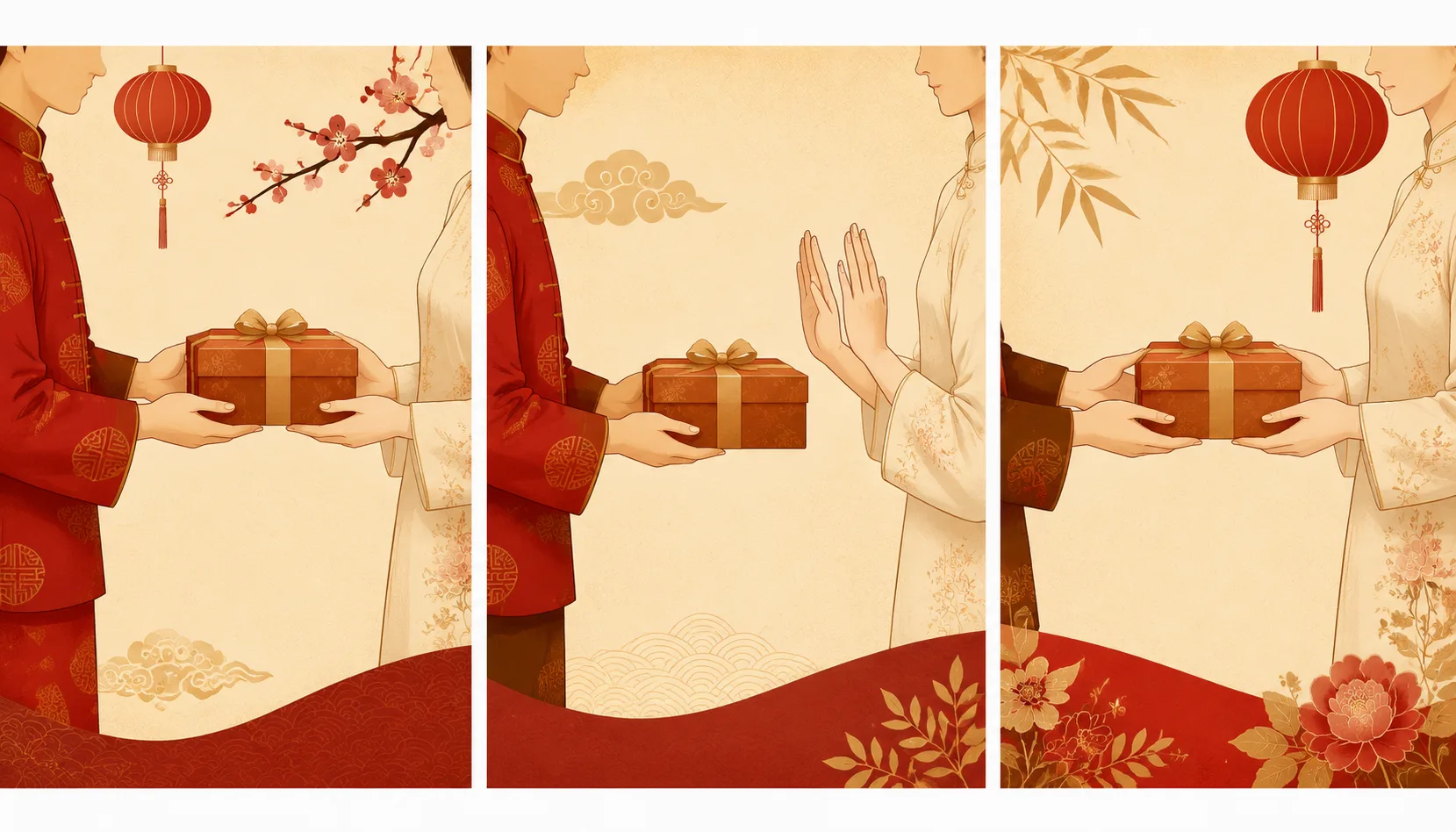
How to Give a Gift in China: Two Hands, Three Rounds, and What to Say
Two hands. Eye contact. Slight forward lean. Say "一点小心意" (a small token). When they refuse, persist twice — then place it in their hands. This is the script. De…
Read the guide →