Business Gift Giving in China: The Complete Guide (Taboos, Timing, and What Actually Works)
Quick answer
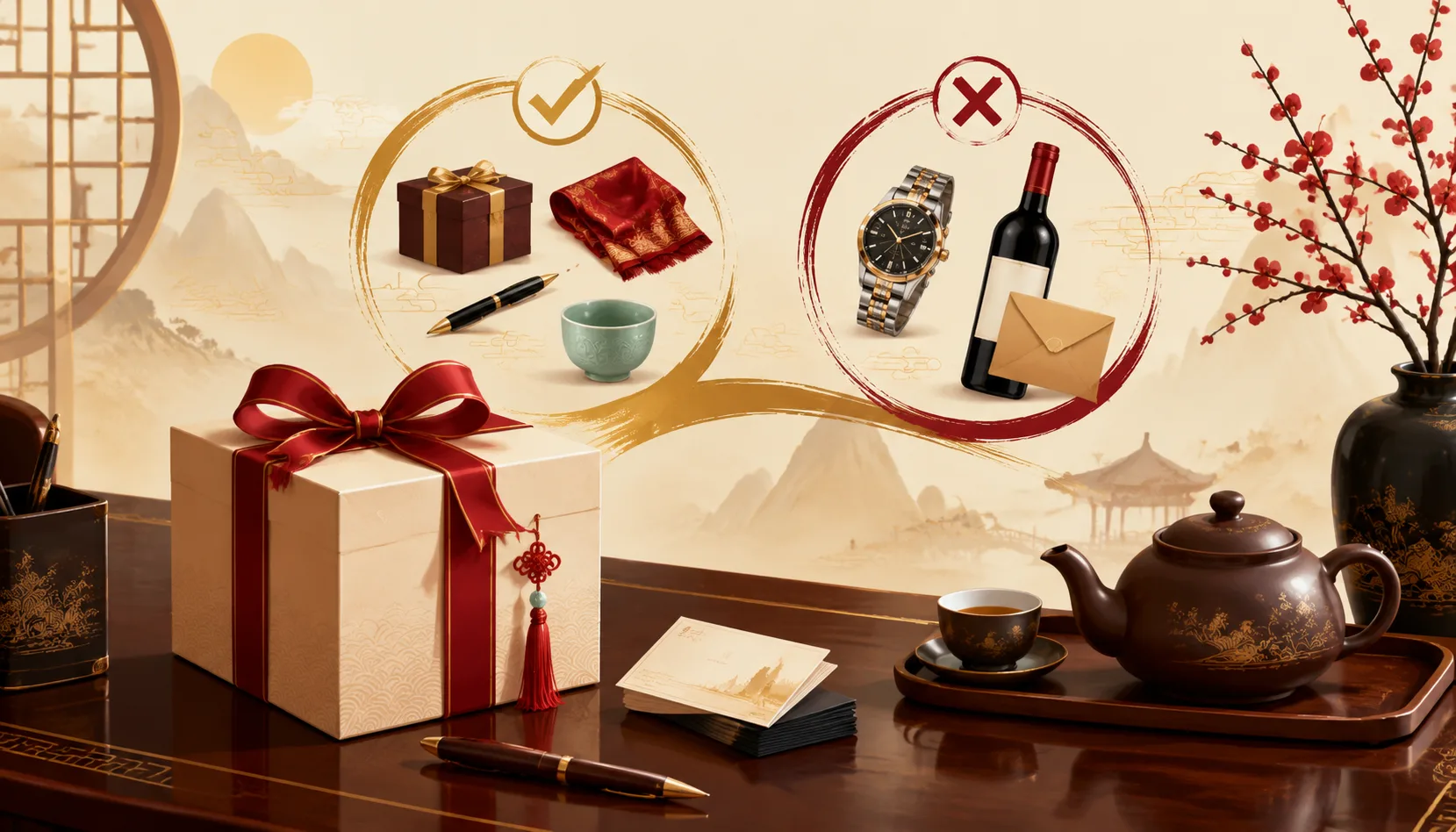
In Chinese business, a well-chosen gift strengthens relationships in ways that contracts cannot. But the wrong gift — a clock, an umbrella, a pear, anything in white packaging — signals catastrophically bad intentions, even when none were intended. This guide covers every taboo, what actually works, the presentation ritual, and the legal compliance line.
Quick Answer
In Chinese business, a well-chosen gift strengthens relationships in ways that contracts cannot. But the wrong gift — a clock, an umbrella, a pear, anything in white packaging — signals catastrophically bad intentions, even when none were intended. This guide covers every taboo, what actually works, the presentation ritual, and the legal compliance line.
The Legal Line: What You Cannot Give
Before anything else: in China, gift-giving to government officials, state-owned enterprise employees, or listed company staff has clear legal boundaries.
Never give:
- Cash, bank cards, prepaid cards, digital red envelopes of significant value
- Luxury watches, designer bags, high-end jewelry, or limited-edition accessories
- Any gift whose value exceeds approximately ¥300-500 RMB per person
These may create legal compliance issues under Chinese law and may also violate your home country's anti-corruption legislation (FCPA for US companies, UK Bribery Act for UK companies).
Before giving anything: Confirm with your company's legal/compliance team. If the recipient's organization explicitly prohibits gifts, respect that rule completely.
The Taboo List: Never Give These
These prohibitions come from Chinese homonyms and cultural symbolism. Most Western professionals have no idea these taboos exist — which is exactly when accidents happen.
| Gift | Why It's Forbidden | Safe Alternative |
|---|---|---|
| Clocks or watches | "送钟" (sòng zhōng) = "送终" — sounds identical to "attending someone's funeral" | Quality pen set, leather notebook |
| Umbrellas | "伞" (sǎn) = "散" — sounds like "separation," "dissolution," "breakup" | Decorative pen holder, quality tea tins |
| Shoes | "鞋" (xié) = "邪" — sounds like "evil." Also symbolizes "walking away from the relationship" | Premium tea gift set, quality coffee kit |
| Pears / cut fruit | "梨" (lí) = "离" — sounds like "separation, parting ways" | Whole fruit basket (apples, oranges, grapes) |
| Knives, scissors, sharp objects | Symbolize "cutting the relationship" — 一刀两断 | Decorative craft items, cufflinks |
| Green hats | Giving a man a green hat implies his partner is unfaithful — major insult | Red, gold, blue, or purple items |
| White or black packaging | White and black are funeral colors in China — gifts wrapped in them are seen as a curse | Red, gold, purple, or deep blue packaging |
| Medications or health supplements | Implies the recipient is unwell — seen as offensive | Premium food gift boxes instead |
| 4 of anything | "四" (sì) = "死" — four sounds like "death" | Choose 6, 8, or 9 items — all auspicious numbers |
| Your own company's branded merchandise | Seen as advertising, not a gift — signals low effort | Custom items branded with their company name |
| Green-colored items (especially green hats/scarves) | Cultural association explained above | Other colors |
What to Give: The Safe List
Premium tea gift box — The gold standard. Pu'er, Tieguanyin, Da Hongpao, Longjing, or Biluochun. Elegant packaging, no cultural minefields, and most Chinese business professionals drink tea daily. Price range ¥100-400 appropriately.
Quality wine or spirits — Quality red wine from a recognized region works well. Avoid overly sweet wines. Local wines from your home country are especially appreciated — they carry the "something special from where I come from" quality.
Specialty foods from your home country — Premium chocolate, artisanal biscuits, quality nuts, or regional specialty foods. Choose items that aren't easily available in China and package them well.
Handcraft items from your home region — Regional artisanal items, cultural objects, local craft pieces. These have strong symbolic value because they say "I brought something from my world to give to you specifically."
Customized office items with their name/company logo — Premium pen engraved with their name, leather notebook embossed with their company name, quality pen holder. Thoughtful, practical, and shows you invested time in personalization.
High-end food gift boxes — Imported chocolates, premium nuts, holiday-season specialty boxes. These are especially appropriate around Chinese New Year, Mid-Autumn Festival, and National Day holidays.
Moutai, Wuliangye, or premium baijiu — For senior-level relationships where you know they appreciate it. High recognition value, but only appropriate when you know the recipient's drinking preferences.
Auspicious Numbers for Gifts
| Number | Why Auspicious | Example |
|---|---|---|
| 6 | Sounds like "流" (smooth, flowing) — symbolizes things going smoothly | 6 bottles of wine |
| 8 | Sounds like "发" (to prosper) — most auspicious number | 8 tins of tea |
| 9 | Sounds like "久" (long-lasting) — symbolizes longevity of the relationship | 9-piece gift set |
Avoid: 4 (death), 7 (sometimes associated with funerals in certain contexts).
When to Give: Timing Matters
Best timing:
- After the business relationship is established and cooperative direction confirmed
- In private — one-on-one or with only close associates present
- At the end of a successful meeting or banquet
- During major Chinese holidays (CNY, Mid-Autumn, National Day)
Never give:
- At your first meeting with no prior relationship (can appear inappropriate or premature)
- During negotiation proceedings (looks like an attempt to influence the outcome)
- In public or with many people present (the recipient feels pressure, associates it with receiving something questionable in front of witnesses)
- During a personnel change at their organization
How to Present: The Ritual
Packaging:
- Wrap beautifully in red, gold, purple, or deep blue packaging
- Include a small handwritten card: your name, their name, a brief auspicious phrase
- If bringing something from abroad, original foreign packaging is fine — but put it in a red gift bag
Presenting:
- Present with both hands — one hand supporting the base, one steadying the side
- Lean slightly forward, smile
- Use humble language: "这是一点小小心意,礼物不贵重,希望您能喜欢" ("This is just a small token, the gift isn't valuable — I hope you'll like it")
- Briefly explain the item's background: "This tea is from our region — it's known for..."
- Don't say "This is valuable" or "I spent a lot on this" — it creates pressure and sounds like you want something
If they decline: The first decline is often polite convention, not a real refusal. Gently offer again. If they decline twice firmly, don't push. Accept with grace: "Of course, no pressure — I'll bring something next time."
How to Receive: What They Expect
When a Chinese counterpart gives you a gift:
- Receive with both hands — always
- Say: "谢谢您,您太客气了" (Xièxiè nín, nín tài kèqi le — "Thank you, you're too kind")
- Don't open it in front of them — this is the Chinese norm. Opening immediately implies eagerness (seen as greedy). Set it aside respectfully.
- After they leave: Photograph the gift and send a WeChat message: "I just opened the gift — I love it. Thank you so much."
- Reciprocate: On the next significant occasion (holiday, follow-up visit), return a gift of comparable value. Never reciprocate with something significantly cheaper.
The Reciprocity Rule
China operates on 礼尚往来 (lǐ shàng wǎng lái) — reciprocity in courtesy. If someone gives you a gift, you're expected to give back at the next meaningful opportunity. The return gift should be:
- Similar in value — not noticeably less (implies disrespect) or more (creates awkward pressure)
- From your world — something with a connection to you, your region, or your culture carries more meaning than something purchased locally
- Timed appropriately — a major Chinese festival is the most natural moment to reciprocate
FAQ
Q: Is gifting a bottle of Moutai appropriate from a foreigner? A: Yes — it signals cultural awareness. Moutai is a prestige gift in China. The downside: it's very expensive and feels obvious. Bringing a quality wine or spirit from your own country is often more memorable because it says "I brought something from my world."
Q: What if I'm not sure what they like? A: Tea is the universally safe answer. It's universally appreciated, has no dietary restrictions, and the range of premium options lets you spend appropriately without guessing personal preferences.
Q: Can I give a gift to their spouse or family? A: Only if you have an established personal relationship with the whole family. Sending gifts to a spouse you've never met feels presumptuous. Once the relationship deepens and you've met the family, seasonal gifts (CNY, Mid-Autumn) for the household are welcomed.
Q: What about alcohol if I don't know whether they drink? A: Don't assume. Tea or a quality food box is safer. If you've been to a banquet with them and seen them drink, you can use that as a guide.
What Chinese People Actually Say
- 意思意思 | yìsi yìsi | "a little something" | Humble way to refer to gifts; avoids appearing boastful
- 不成敬意 | bù chéng jìng yì | "just a small token of respect" | Self-deprecating phrase used when presenting gifts to show humility
- 请笑纳 | qǐng xiào nà | "please kindly accept" | Polite closing phrase when offering a gift; shows respect
2026 Reality Check
2026 Reality Check: Traditional business gift rules in China have softened significantly, especially post-pandemic and amid anti-corruption crackdowns. Cash and luxury items are now risky—many companies ban them outright.
Gen Z vs. Older Generations: Younger professionals (born after 1995) prefer digital gifts, vouchers, or experiential gifts (dinners, travel). Older executives still appreciate high-end tea, wine, or electronics, but even they now accept "light" gifts more readily. The old "gift = favor" mindset is fading in urban corporate circles.
Beijing/Shanghai vs. Smaller Cities: Tier-1 cities follow stricter corporate compliance—gifts often go through HR. Smaller cities and provincial areas retain more traditional practices, though even there, "gift culture" has toned down. The gap is narrowing as younger workers transfer modern attitudes.
Bottom Line: The "envelope culture" isn't dead, but it's on life support in professional settings. Context and relationship matter more than ever.
Frequently asked questions
What happens if I accidentally give a clock as a business gift in China?
A clock is one of the worst gifts you can give because 'sending a clock' (song zhong) sounds like 'attending a funeral' in Mandarin. If it happens, apologize immediately and explain you didn't know the cultural meaning. Offer a replacement gift like fine tea or a fruit basket. The relationship can recover, but the misstep will be remembered, so address it head-on and sincerely.
Is it acceptable to give gifts of alcohol like whiskey or wine in Chinese business settings?
Yes, quality foreign whiskey and red wine are well-received, especially by senior executives. However, avoid gifting baijiu unless you're certain of the recipient's preference — it's a very personal taste. Also, never give a single bottle; always give two of the same item to symbolize good things coming in pairs. Check that the brand is prestigious but not ostentatious.
How much should I spend on a business gift in China without causing embarrassment?
Aim for roughly 300 to 800 RMB (about 0–10) for most business contacts. Spending too little looks cheap, but spending too much creates obligation or can be misinterpreted as a bribe. For close long-term partners, a premium gift up to 1,500 RMB is fine. Always match the gift's value to the recipient's seniority and your relationship depth.
Can I give a gift with a company logo on it, or is that seen as tacky?
Logo-branded corporate merchandise is acceptable but rarely impressive. It works for junior staff or as conference swag, but for key decision-makers, it signals you didn't put thought into the gift. If you must brand it, pair the logo item with something personal, like a quality pen or a local specialty from your home country. The personal touch matters most.
What is the proper way to present a gift during a Chinese business meeting?
Present the gift with both hands, never one hand, and offer it after initial pleasantries — not at the very start. Avoid wrapping in white, black, or blue; use red or gold. If the recipient sets it aside without opening, that's normal; don't insist they open it immediately. This respects the Chinese custom of not appearing greedy.
Is it illegal to give business gifts in China due to anti-bribery laws?
Gifting is legal, but there's a strict line. The 2016 anti-bribery law prohibits gifts that influence business decisions or involve government officials. For private companies, keep gifts modest and transparent, and never give cash, luxury watches, or expensive items tied to a specific deal. When in doubt, declare the gift formally or choose something under 200 RMB for officials — some state entities ban gifts entirely.
Try our tools
Related guides
Chinese Business Etiquette Guide 2026: What You Must Know
Chinese business etiquette is easier to navigate when you watch three recurring patterns: relationship-building (guanxi), protecting dignity in public (mianzi),…
Read the guide →
Chinese Gift-Giving Guide 2026: Rules, Taboos, What Works
In China, gift-giving is not about the gift. It's about the relationship. The right gift, delivered at the right time with the right words and two hands, commun…
Read the guide →
14 Chinese Gift Taboos: The Complete Forbidden List
Most Chinese gift taboos come from homophones — words that sound identical to something unlucky. "送钟" (giving a clock) sounds exactly like "送终" (attending a fun…
Read the guide →