Chinese Formal Business Meeting Etiquette: Seating, Greetings, and the 5-Minute Rule
Quick answer
Chinese formal meetings run on hierarchy: the most senior person enters first, sits facing the door, speaks first on any topic, and leaves first. You wait to be directed to your seat, spend 5-10 minutes on small talk before any agenda item, never interrupt, and send bilingual meeting notes within 24 hours.
Quick Answer
Chinese formal meetings run on hierarchy: the most senior person enters first, sits facing the door, speaks first on any topic, and leaves first. You wait to be directed to your seat, spend 5-10 minutes on small talk before any agenda item, never interrupt, and send bilingual meeting notes within 24 hours.
Before the Meeting: Preparation Checklist
- Know the full attendee list with titles — email your contact beforehand: "Could you share who will be attending and their roles?" Address everyone by title + surname.
- Prepare bilingual business cards — the exchange happens at the start of formal meetings.
- Arrive 5-10 minutes early — never late. If you're running late, notify in advance.
- Dress conservatively — dark suit, subdued colors. No visible casual elements.
- Know your own company hierarchy — your senior person should enter and sit parallel to their senior person. Mismatched seniority levels in a meeting are noticed and can signal that you don't consider this meeting important.
Seating: The "Face the Door" Rule
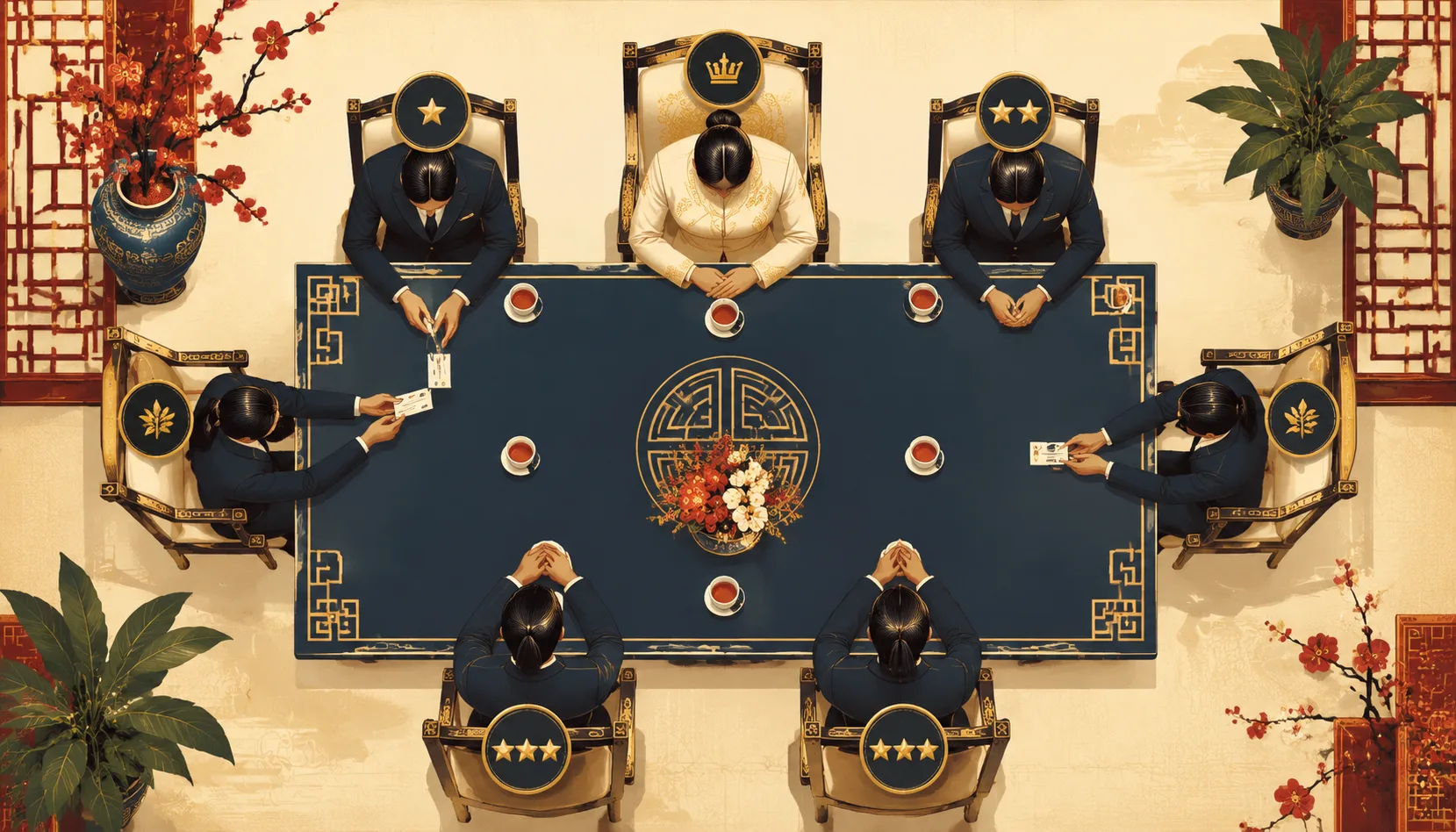
Chinese formal meeting rooms are arranged on a strict seniority map.
The principal rule: 面门为上 — "Facing the door is the position of honor"
The most senior person on the hosting side sits facing the door (主位 — host seat). This position allows them to see everyone entering and exiting — it's a position of control and respect.
The second-most senior position (主宾位 — guest of honor seat) is to the right of the host.
| Position | Who |
|---|---|
| Facing the door | Most senior host |
| Right of most senior host | Guest of honor (your most senior person) |
| Left of most senior host | Second-ranking host |
| Right of guest of honor | Second-ranking guest |
| Toward the door | Junior staff / note-takers |
What you do: Wait. Do not choose your seat. Your host or their assistant will direct you to the appropriate position. Follow their guidance without question.
If no one guides you: stand slightly behind the available chairs and wait to be invited. Watch where your Chinese counterpart's senior person sits — the position directly across from them (facing door) or beside them is yours.
DO
- Wait to be directed to your seat
- Enter in rank order — your most senior person first
- Have business cards ready for the exchange at the start
- Make small talk for 5-10 minutes before raising any agenda item
- Let the most senior Chinese person speak first when a new topic opens
- Listen without interrupting — wait for a complete pause before responding
- Take notes — it signals you're taking the meeting seriously
- Follow the host's lead on pacing throughout the meeting
DON'T
- Don't choose your own seat
- Don't launch into the agenda without 5-10 minutes of small talk
- Don't interrupt anyone who is speaking
- Don't speak before the most senior person on their side has spoken on a topic
- Don't use your phone during the meeting (silent, face down, or pocket)
- Don't initiate leaving — follow the host's lead on closing
- Don't skip the meeting notes — they are expected
The Opening Sequence: What Happens in the First 10 Minutes
- Parties arrive, enter in rank order — senior person first on each side
- Initial greetings — brief handshake with the host's senior person first, working down
- Business card exchange — present to most senior first, receive and read, place on table in front of you
- Everyone is directed to seats
- Tea or water is served — accept it
- Opening remarks — the host's senior person opens: brief, expressing appreciation for the visit, stating the general purpose
- Small talk (5-10 minutes): safe topics are industry trends, the city, the weather, the host company's recent public achievements. Avoid politics, personal finances, and sensitive industry news.
- Transition to agenda — the host will signal when it's time to begin
The Pre-Meeting Prep Documents
Chinese formal meetings involving significant proposals usually include:
- A brief meeting agenda (sent 1-2 days before, in both languages if possible)
- Company introduction deck (your side presents this, in Chinese where possible)
- Proposal document (if relevant to this meeting's purpose)
Bring printed copies for all attendees. Digital-only in formal Chinese meetings is still less common than in Western tech contexts.
During the Meeting: Communication Protocols
Who speaks when:
- Host's senior person opens and closes topics
- Subordinates from the host side add supporting detail
- Your senior person responds
- Your team adds technical detail when invited
Questions: Frame questions as open and collaborative. "I'd love to understand more about how your team approaches X" rather than "Why do you do X that way?"
Disagreement: Never in the meeting. If a proposal doesn't work, say "that's an interesting point — we'll need to review it from our side and come back to you." Save the real negotiation for a follow-up setting.
Silence: Allow it. Don't fill silence with new offers or qualifications.
The Business Card Table Protocol
During a multi-person meeting, business cards received at the start should be:
- Placed on the table in front of you in the order of seating
- Used as reference when addressing people by name
- Collected carefully at the end of the meeting, not left behind
This arrangement serves a practical function: you can glance down and confirm titles before addressing someone, which prevents the embarrassing name-blank moment.
Closing the Meeting
Don't initiate leaving. Your host will signal the close — usually by:
- Standing up
- Saying "今天就先聊到这里吧" (Let's wrap up here for today)
- Handing over to assistants for logistic coordination
When the close is signaled:
- Offer a brief summary: "Today we covered X and Y — we'll follow up on Z by [date]"
- Express appreciation: "Thank you for your time and hospitality — this has been very valuable"
- Business cards go back in your card case
- Everyone stands
- Brief farewell to all attendees (not just your primary contact)
- Senior person from your side exits first
After the Meeting: The 24-Hour Rule
Within 24 hours, send:
A bilingual meeting summary (Chinese + English) covering:
- Meeting date, attendees, and company names
- Topics covered
- Points agreed or confirmed
- Points still open
- Next steps and responsible parties
- Tentative next meeting date if discussed
This document does three things: confirms your reliability, creates a paper trail for future reference, and demonstrates that you're serious about the follow-through.
Also send: A brief, warm WeChat to your primary contact. Not business — just gratitude. "Thank you for today — I really enjoyed the conversation. Looking forward to working together."
When Translation Is Involved
Large formal meetings often use interpreters. If you're working through an interpreter:
- Speak in short segments — 2-3 sentences, then pause. Don't dump paragraphs on the interpreter.
- Look at the Chinese counterpart while speaking, not the interpreter. The relationship is with them.
- Speak at a measured pace — 20% slower than normal
- Don't ask the interpreter to translate private Chinese team conversations — this is inappropriate and will be noticed
If you have someone bilingual on your side who isn't designated as interpreter, brief them beforehand: they should not translate conversations overheard in Chinese.
FAQ
Q: What if I arrive before my Chinese counterpart and I'm shown to the meeting room first? A: Wait for your host. Don't start moving chairs or rearranging. Sit in a neutral position away from the head/honor seats and let them direct the room when they arrive.
Q: How important is matching seniority in meetings? A: Very. If you're sending a junior manager to meet a Chinese VP, the VP may see it as an insult — implying this deal isn't important enough for you to send appropriate seniority. Match or slightly exceed their level when possible.
Q: Should I have a Chinese speaker on my team for formal meetings? A: Strongly recommended for significant meetings. Having a bilingual Chinese colleague (not just a hired interpreter) signals long-term commitment to the Chinese market.
Q: What if I need to take a phone call during the meeting? A: Set your phone to silent before entering. If something genuinely urgent comes up, excuse yourself briefly: "I'm sorry — I need to step out briefly. Please excuse me." Return quickly and apologize again on re-entry. This is far better than taking a call at the table.
What Chinese People Actually Say
- 请坐 | qǐng zuò | Please sit | Use when directing senior guests or clients to their designated seats
- 您好,请多指教 | nín hǎo, qǐng duō zhǐ jiào | Hello, please give me your guidance | Formal greeting showing humility; say upon meeting senior colleagues
- 会议开始 | huì yì kāi shǐ | The meeting begins | Announce formally to signal the 5-minute grace period has ended
2026 Reality Check
The 5-minute rule still exists but wither flexibility. In 2026, most professionals aim to arrive 5-10 minutes early out of habit, though tight schedules and traffic in major cities make it more aspirational than strict.
Gen Z vs Older Generations: Younger workers (under 30) treat punctuality more casually, viewing it as situational. Older generations (40+) still see the 5-minute early arrival as basic respect, especially in state-owned enterprises or with senior leadership.
Beijing/Shanghai vs Smaller Cities: Tier-1 cities have softened the rule due to chaotic traffic and remote work—being "on time" is now acceptable. Smaller cities and regional hubs still uphold the tradition more rigidly; showing up early signals seriousness, especially in hierarchical business cultures.
The rule isn't dead, but it's evolving. Respect still matters—timing just matters slightly less in modern urban contexts.
Frequently asked questions
What happens if I sit in the wrong seat at a Chinese business meeting?
Don't panic, but quietly move if possible. The seat facing the door is reserved for the highest-ranking person, and the seat next to them is for the second-highest. If you've already sat down, apologize briefly and ask where you should sit. Your host will usually redirect you without making a scene, so stay calm and follow their lead.
Can I start talking business during the small talk phase?
No, never bring up the agenda during the initial 5-10 minute small talk. This time is for building rapport and showing respect, not for rushing into business. If you force the topic, you'll seem impatient and disrespectful. Wait for your host to transition to business matters, which is a clear signal that the meeting has officially begun.
How do I greet a senior Chinese executive if I don't speak Mandarin?
Use a standard handshake with a slight nod and a smile. Avoid a firm, pumping handshake — a gentle one is more appropriate. Address them by their title and surname (e.g., 'Director Wang'). If you're unsure of their title, 'Mr.' or 'Ms.' plus surname works. Never use first names unless invited to do so.
Is the 5-minute rule flexible for video conference meetings?
Yes, but not by much. For virtual meetings, the small talk window is often shortened to 2-3 minutes, but it's still expected. Start with a polite greeting and a brief personal question like 'How is the weather there?' before jumping into the agenda. Skipping it entirely will still feel abrupt and rude.
What if a junior colleague speaks before the senior leader?
This is a serious breach of protocol. In a formal meeting, the most senior person speaks first on every topic. If a junior colleague jumps in, they will likely be subtly corrected or ignored. As a foreigner, never take advantage of this — always defer to the senior person and wait for them to invite others to speak.
When should I send meeting notes, and in what language?
Send them within 24 hours, ideally the same day. Write them bilingually — Chinese and English — to avoid any miscommunication. Structure the notes clearly with action items, owners, and deadlines. This shows professionalism and respect for the hierarchy, and it ensures everyone is aligned, especially if translators were involved during the meeting.
Try our tools
Related guides
Chinese Business Etiquette Guide 2026: What Western Professionals Must Know
Chinese business culture runs on three invisible engines: Guanxi (relationships), Mianzi (face), and Hierarchy (rank order). Get these right and deals follow. G…
Read the guide →
Chinese Business Card Etiquette: How to Exchange Cards in China (2026 Guide)
In China, the business card is not a contact-sharing tool. It is a formal introduction of your identity and position. Present it with both hands, Chinese side f…
Read the guide →
Chinese Business Titles and Forms of Address: How to Address Chinese Colleagues Correctly
In Chinese business settings, you address people by job title + surname, not by first name. "Director Li" (李总监), "Manager Wang" (王经理), "President Zhang" (张总). U…
Read the guide →