Chinese Business Card Etiquette: How to Exchange Cards in China (2026 Guide)
Quick answer
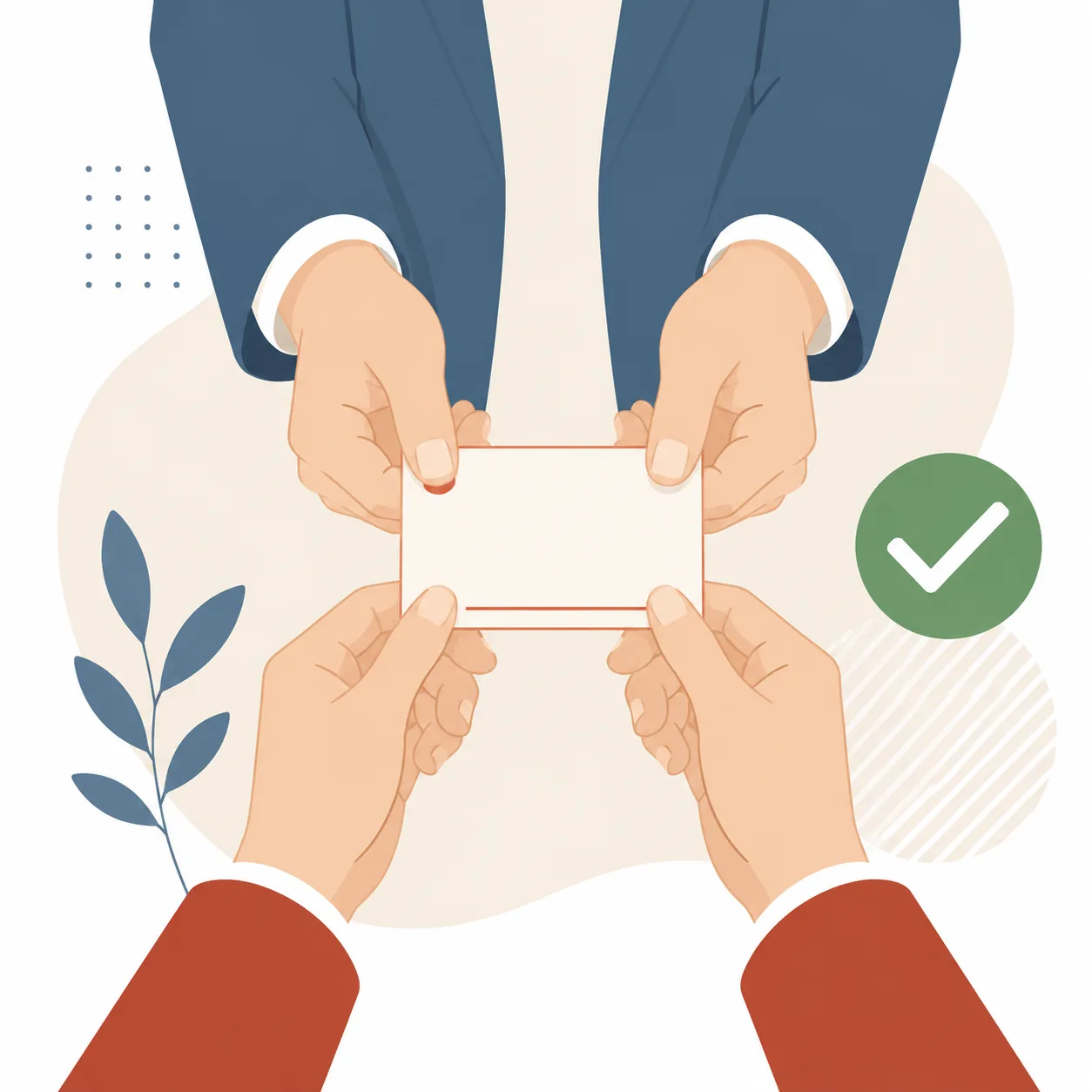
In China, the business card is not a contact-sharing tool. It is a formal introduction of your identity and position. Present it with both hands, Chinese side facing the recipient, with a slight bow. Receive their card with both hands, read it carefully, and place it respectfully on the table or in a card holder. Never write on it. Never stuff it in your back pocket.
Quick Answer
In China, the business card is not a contact-sharing tool. It is a formal introduction of your identity and position. Present it with both hands, Chinese side facing the recipient, with a slight bow. Receive their card with both hands, read it carefully, and place it respectfully on the table or in a card holder. Never write on it. Never stuff it in your back pocket.
DO
- Prepare bilingual cards — Chinese on one side, English on the other. Quality printing on heavyweight card stock.
- Present with both hands — thumbs and forefingers holding the sides, Chinese side facing the recipient, slight forward lean
- Say your name and company as you present: "I'm [Name] from [Company]"
- Receive with both hands — accept the card the same way it's given
- Read it immediately — look at it for 3-5 seconds, note their title and company
- Place it on the table in front of you during a meeting, in order of seating arrangement
- Store it respectfully — in a card holder or the front pocket of a briefcase after the meeting
- Present to the most senior person first, then proceed by rank downward
DON'T
- Don't present with one hand — this is the most common and most damaging mistake
- Don't pocket the card immediately without reading it
- Don't write on someone's card in front of them — this is seen as defacing something that represents them
- Don't place it carelessly under a coffee cup or in a back trouser pocket
- Don't stack multiple received cards in a pile without reading them
- Don't forget to bring cards — arriving without business cards signals lack of preparation
- Don't present a damaged, creased, or handwritten card
WHY This Matters
The business card ritual mirrors the cultural logic of the entire business relationship. When you present a card with both hands, you're communicating:
- "I respect you enough to present this formally"
- "I understand Chinese protocol"
- "I take this meeting seriously"
When you receive someone's card and immediately pocket it without reading, the message received is: "Your identity doesn't matter enough for me to acknowledge." In China, where business is built on relationship trust, that impression can quietly end a relationship before it starts.
The two-hand rule extends throughout Chinese business culture — receiving anything from a senior person or in a formal context (gifts, documents, a cup of tea) with two hands signals respect for the exchange.
Step-by-Step: The Full Card Exchange Sequence
Before the meeting:
- Prepare your cards. Get them professionally printed with Chinese on one side. Keep them in a card case — not loose in your bag or pocket.
- Know the attendees in advance. You'll present cards in seniority order.
At the meeting:
- When introductions begin, take out your card case.
- Present to the most senior person first. Hold the card by both sides with thumbs and forefingers, Chinese side facing them, slight forward lean.
- State your name and company: "I'm [Name], [Title] at [Company]."
- They will present their card. Receive with both hands.
- Read it. Briefly acknowledge their title: "Thank you — I see you're the [title]."
- Place it in front of you on the table during the meeting.
- Continue around the room in seniority order.
After the meeting:
- Collect the cards carefully. Place them in your card case or a folder, not loose.
- When reviewing later: write context notes (date, meeting topic) on a separate paper, not on the card itself.
The Bilingual Card: What to Get Right
If you don't have a Chinese-side card yet, here's what matters:
Translation quality: Use a professional translator or a native speaker. Machine translation of names and titles often produces awkward results that Chinese counterparts notice immediately.
Name in Chinese characters: Your name should be transliterated into Chinese characters (not just pinyin). Your Chinese colleagues can help with this — many foreigners have a chosen Chinese name (中文名) that sounds similar to their English name.
Title accuracy: Job titles translate awkwardly. "Marketing Manager" becomes "市场经理." "Partner" at a law firm is "合伙人." Get these right — they signal your actual rank.
Font and quality: Avoid glossy cards (hard to write on during a meeting). Heavyweight matte stock signals quality.
Real Scenario: What Happens When You Get This Wrong
An American executive at a joint venture negotiation presented his card with one hand while scrolling his phone with the other. He received the Chinese counterpart's card and set it down without reading it, then placed his phone on top of it during the meeting.
The meeting continued normally. No one said anything. The deal did not proceed. Three months later, through an intermediary, the executive learned that the Chinese team had characterized him as "not serious about the relationship."
The card exchange had lasted less than 30 seconds. The impression lasted for months.
Digital Business Cards and WeChat in China
WeChat has largely replaced email in Chinese business communication, and QR code contact sharing is now common. But this has not eliminated the physical card ritual:
- Physical cards are still expected at formal first meetings
- WeChat exchange happens after the card exchange, not instead of it
- Save their WeChat contact with their company and title noted
- Following up on WeChat (not email) is the expected next step in building the relationship
→ See: WeChat Business Etiquette in China
FAQ
Q: What if I run out of cards at a meeting? A: Apologize and offer to send a card afterward. "I'm sorry — I've just run out of cards. I'll have one sent to you today." This is better than presenting a damaged card or none at all. Follow through immediately.
Q: What if I'm receiving cards from a group and don't have enough of my own? A: Present to the most senior members first and explain that you'll send cards to others afterward. In a large group meeting, card exchange sometimes happens at the end rather than the start — follow the local group's lead.
Q: Can I scan the card with an app right there? A: Not while the person is watching. Scan it privately later. Pulling out your phone to scan during introductions signals that the physical card (and the person) isn't worth keeping.
Q: Should my title on my card match my actual authority? A: Yes — but consider erring on the side of seniority if you are the decision-maker. Chinese counterparts use your card to determine who they should be directing key conversations to. If your card says "Manager" but you're the regional head, they may route senior-level conversations past you.
What Chinese People Actually Say
- 请多指教 | qǐng duō zhǐjiào | "Please give me your guidance" | Say when presenting your business card to show humility.
- 幸会 | xìng huì | "Nice to meet you" | Use when receiving someone's card and responding politely.
- 久仰大名 | jiǔ yǎng dà míng | "I've long heard of your great name" | Appropriate when meeting a senior or well-known contact.
2026 Reality Check
2026 Reality Check: Traditional business card etiquette still matters in China, but it's evolving. The two-handed exchange with a slight bow is now rare outside of very formal meetings or with senior executives.
Gen Z vs Older Generations: Younger professionals (born after 1995) treat business cards more casually—they'll take the card with one hand, glance at it, and slip it into a pocket. Older generations still expect the respectful two-handed exchange and careful examination. However, Gen Z will comply when meeting clients or executives who expect formality.
Beijing/Shanghai vs Smaller Cities: Tier-1 cities like Beijing and Shanghai maintain stricter formality in foreign-invested companies and traditional industries. Smaller cities and tech startups are far more relaxed—cards are often exchanged with a quick nod and immediately photographed or scanned.
Bottom line: Always carry cards. Always present them with your right hand. The detailed ritual is fading, but basic respect for the card itself remains essential.
Frequently asked questions
What should I do if the business card I receive is printed only in English?
If the card is in English only, still receive it with both hands and study it briefly. Ask politely about the person's role or company if anything is unclear. Never comment negatively on the card's format. The respect you show matters more than the language on the card.
Can I hand over my business card with just my right hand if my left hand is holding something?
No. In Chinese etiquette, using one hand — even the right — signals low regard for the recipient. If both hands are occupied, briefly set down your items, then present the card with both hands. A momentary pause is far better than committing a subtle faux pas.
What happens if I accidentally write notes on a business card during a meeting?
Writing on a Chinese business card is considered disrespectful because the card represents the person's identity. If you must jot notes, do it discreetly on a separate notepad. If you've already written on the card, apologize briefly and avoid doing it again with that person's card.
Is it okay to put a received business card in my wallet or back pocket?
No. Placing a card in your back pocket, where you sit on it, is a severe insult. Use a dedicated card holder or place it flat on the table in front of you for the meeting's duration. Never fold, bend, or stuff it away casually.
How should I exchange cards with a group of people in China?
Always exchange cards one-on-one, never by tossing cards across a table or handing them out like a deck. Start with the highest-ranking person present and work down. Present and receive each card individually with both hands, and acknowledge each person's card before moving to the next.
What if the other person offers their card with one hand? Should I still use both hands?
Yes. Your etiquette should not depend on theirs. If they use one hand, they may be a foreigner or younger and less formal. Respond with both hands to model correct behavior. This shows your knowledge of Chinese customs and earns respect, regardless of their approach.
Try our tools
Related guides
Chinese Business Etiquette Guide 2026: What Western Professionals Must Know
Chinese business culture runs on three invisible engines: Guanxi (relationships), Mianzi (face), and Hierarchy (rank order). Get these right and deals follow. G…
Read the guide →
Chinese Formal Business Meeting Etiquette: Seating, Greetings, and the 5-Minute Rule
Chinese formal meetings run on hierarchy: the most senior person enters first, sits facing the door, speaks first on any topic, and leaves first. You wait to be…
Read the guide →
Chinese Workplace Culture: The Complete Guide for Foreigners
Chinese workplaces run on three hidden pillars: 先做人后做事 (build relationships before doing business), 面子 mianzi (public face and dignity), and 关系 guanxi (relation…
Read the guide →