Why do Chinese business meetings start with 30-60 minutes of small talk, and how should Westerners use this time strategically?
Quick answer
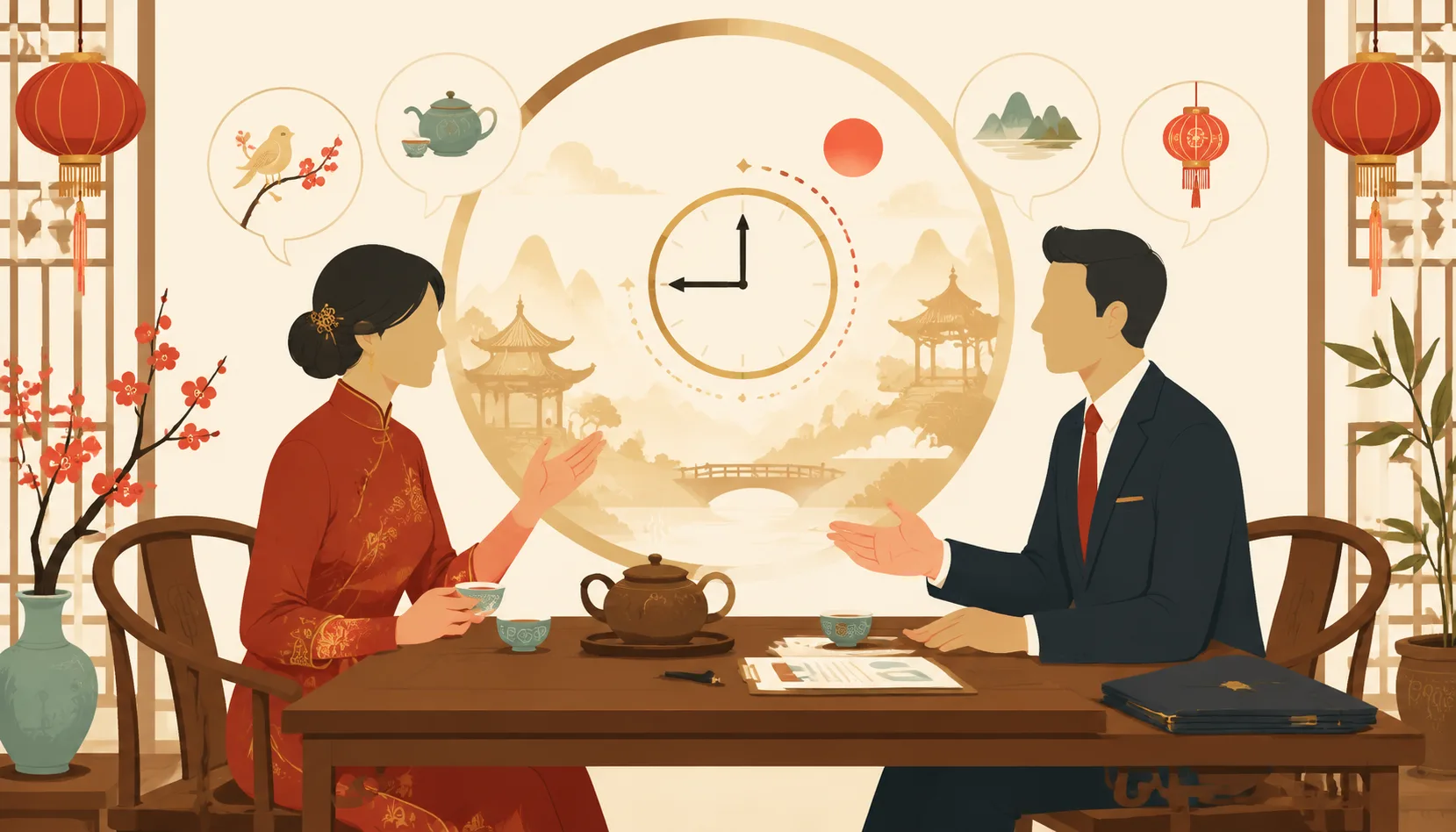
In China, the extended small talk phase at the start of a business meeting is the first round of negotiation. It's when your Chinese counterparts assess your patience, collect competitive intelligence, and test your urgency. Treat it as a critical business tool: actively engage, never check your watch, and never mention price first.
The Western Instinct vs. Chinese Reality
If you're from the US or Europe, your instinct in a business meeting is to get down to brass tacks. You've flown 14 hours, you have a packed agenda, and the tea is being poured for the third time. You think: When does the real meeting start?
The Chinese reality is that the small talk phase IS the real meeting. It's not a delay; it's the opening move. In China, business is built on relationships, and the first 30-60 minutes are designed to assess whether you're someone worth doing business with. Your patience, your attitude, and your genuine interest in them are being evaluated as much as your product specs.
Consider this: a Western executive once told me he tried to skip the small talk by saying, "Let's get to the contract." The Chinese side smiled, nodded, and then spent the next hour discussing the weather. The contract was never signed. He had failed the test.
Key tactic: Reframe your mindset. Instead of enduring the small talk, treat it as the most important part of the meeting. Your goal is to pass the unspoken test and move from 'outsider' to 'trusted partner'.
The Four Functions of Small Talk
Small talk in China isn't random. It serves four distinct purposes, and understanding them will help you play the game effectively.
- Reading the person: Your hosts are observing your patience, your arrogance, and your real attitude toward China. If you show frustration or condescension, you're marked as difficult.
- Collecting intelligence: Casual questions like "Who are your European clients?" are not innocent. They're probing for competitive information. Be careful what you reveal.
- Building 'us' feeling: The goal is to move you from 'outsider' to 'someone we can do business with'. This is the foundation of guanxi (关系) — the network of trust that makes deals smoother.
- Testing urgency: If you keep checking your watch, they conclude "he needs this deal more than we do" — and you'll lose leverage on price and terms.
Key tactic: Treat every casual question as a strategic probe. Answer with enough detail to be helpful, but not so much that you give away your hand. And never show impatience — it's the fastest way to lose respect.
How to Actively Extend (Not Endure) the Small Talk
Instead of waiting for the small talk to end, actively engage and extend it. This is your chance to build rapport and show genuine interest. The best way is to bring specific compliments about their business.
For example, if you're visiting a factory, say: "Your automation line is impressive — when did you upgrade it?" This shows you're observant and care about their operations, not just your order.
Here are some phrases to use:
| Chinese | Pinyin | English |
|---|---|---|
| 你们的工厂管理得很好。 | Nǐmen de gōngchǎng guǎnlǐ dé hěn hǎo. | Your factory management is excellent. |
| 你们的产品质量给我留下了深刻的印象。 | Nǐmen de chǎnpǐn zhìliàng gěi wǒ liúxià le shēnkè de yìnxiàng. | Your product quality left a deep impression on me. |
| 你们公司的发展速度真快。 | Nǐmen gōngsī de fāzhǎn sùdù zhēn kuài. | Your company is growing very fast. |
Key tactic: Prepare two or three specific compliments or questions about their business before the meeting. This shows you've done your homework and turns small talk into a productive exchange.
Never Be First to Mention Price
In the small talk phase, whoever mentions numbers first reveals their anxiety. If you bring up price or deadlines before your hosts do, you signal that you're eager and possibly desperate. This gives them the upper hand in negotiations.
I once saw a Western buyer blurt out, "So, what's your best price on the 10,000 units?" during the tea phase. The Chinese sales director smiled and said, "Let's discuss after lunch." The buyer spent the rest of the day in a weak position — the final price was 15% higher than expected.
Instead, let the conversation flow naturally. When the time is right, the Chinese side will signal the shift to business. They'll say something like "Let's talk about the details" or "Now, let's discuss our cooperation." Wait for that cue.
Key tactic: If you're asked about your budget, deflect politely: "We can discuss that later. First, I'd like to understand more about your capabilities." This keeps the power balance in your favor.
Your Body Language Is Being Translated
During small talk, your body language is being closely observed and translated into internal assessments. Are you easy to work with? Difficult? Worth a long-term relationship? Chinese business culture places a premium on harmony and face (面子, miànzi). Any sign of disrespect or impatience can be fatal.
Here's what to avoid:
- Checking your watch or phone — signals you're not committed.
- Crossing your arms — signals defensiveness.
- Looking at the door — signals you want to escape.
- Interrupting — signals arrogance.
Instead, adopt an open posture, lean slightly forward, and maintain steady eye contact. Nod to show you're listening. Accept tea refills — it's a sign of hospitality, and refusing can be seen as rejecting their goodwill.
Key tactic: Practice 'active listening' body language. When your host speaks, nod and say "是的,我明白" (shì de, wǒ míngbái) — "Yes, I understand." This builds trust and shows respect.
Practical Tips for Mastering the Small Talk Phase
To turn small talk into a strategic advantage, follow these practical tips:
- Prepare two conversational questions about their industry or business. For example: "How has the recent market trend affected your sector?" or "What are the biggest challenges your company faces this year?"
- Accept tea refills — it's a sign of respect. If you don't want more, leave the cup partially full.
- Be genuinely curious — ask about their company's history, their personal journey, or their vision. People open up when they feel you care.
- Use the time to gather intelligence — listen for clues about their priorities, constraints, and competitors.
Here's a real scenario: A European machinery buyer used the small talk to ask about the factory's recent automation upgrades. The Chinese host proudly explained the new robotic line. The buyer later used this knowledge to negotiate a better price, citing the increased efficiency as a reason for a discount. The small talk had given him leverage.
Key tactic: Treat small talk as a two-way street. You're not just being assessed; you're also assessing them. Use this time to gauge their trustworthiness, their company culture, and their negotiation style.
What Chinese People Actually Say
- 吃了吗?| Chī le ma? | "Have you eaten?" | Use as warm greeting to build rapport before diving into business.
- 最近怎么样?| Zuìjìn zěnmeyàng? | "How have you been lately?" | Safe, versatile opener for both new and existing business contacts.
- 辛苦了!| Xīnkǔ le! | "You've worked hard!" | Shows appreciation; appropriate after presentations or deal closures.
2026 Reality Check
2026 Reality Check: The " Guanxi" rule still matters, but it's evolving. Older generations (40+) still expect warm-up conversation before business—skip it and you're seen as rude or naive. Gen Z? They're compressing it. Quick "Ni hao" + weather, then straight to the point. They view excessive small talk as inefficient.
Geography matters: Beijing and Shanghai business culture has become more international and fast-paced. Younger professionals—especially in tech—often skip formal small talk. Smaller cities and state-owned enterprises? The old rules still dominate. Relationship-building remains currency.
The verdict: The rule isn't dead, but it's contextual. Know your audience. Ignore small talk with a 50-year-old Shanghai exec at your peril. Skip it with a 28-year-old startup founder and you'll look normal.
Frequently asked questions
Why is small talk at the start of a Chinese business meeting so long?
It's a deliberate phase where your counterparts gauge your patience, trustworthiness, and negotiation style. Rushing it signals weakness or desperation, so treat it as part of the deal.
What topics are safe for small talk in a Chinese business meeting?
Stick to neutral, positive topics like your travel experience, local food, or general business trends. Avoid personal questions about family, income, or any political subjects.
How should a Westerner respond when small talk drags on beyond 30 minutes?
Stay engaged, ask follow-up questions, and show genuine interest. Never check your watch or phone, as this signals impatience and can damage your credibility.
Can I mention price or business details during the small talk phase?
No, avoid bringing up price or specific terms until your Chinese counterparts initiate it. Mentioning them early shows eagerness and weakens your negotiating position.
What is the purpose of the small talk from the Chinese side?
It's used to collect competitive intelligence, test your urgency, and build a personal relationship. Your responses help them decide how to structure the negotiation.
What should I do if I feel the small talk is wasting my time?
Reframe it as an investment: use the time to learn about their company culture and priorities. If you must move things along, do it subtly by asking about their business goals, not by rushing.
Try our tools
Related guides

Chinese Business Negotiation: The Rules Westerners Miss
Chinese business negotiation runs on three rules that Western counterparts routinely miss: indirect refusal (never a direct "no"), strategic patience (silence i…
Read the guide →
Chinese Indirect Communication in Business: Read the Signs
In Chinese business culture, direct disagreement, direct refusal, and direct criticism are all rare. Ambiguous language, extended silence, sudden topic changes,…
Read the guide →
Chinese Business Communication Style: Indirect Signals
Chinese business communication is high-context: what matters is often what's not said — the tone, the timing, who said it, and what was conspicuously omitted. W…
Read the guide →