What are the practical things foreigners need to know when dating a Chinese man or woman?
Quick answer
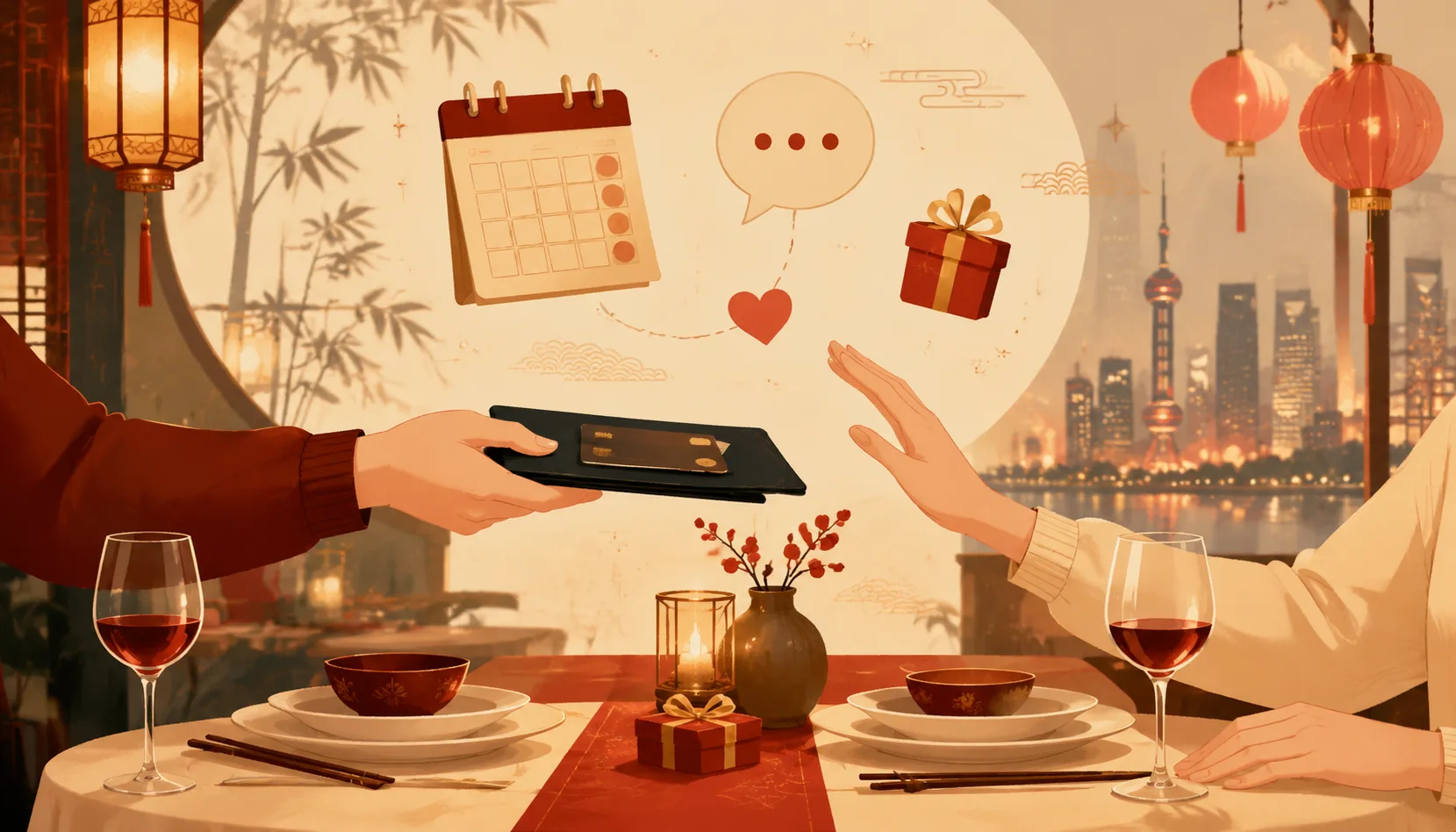
The biggest practical differences: who pays (men are still often expected to, though modern couples split more), how jealousy shows up (indirectly, through observation rather than accusation), how "no" is expressed (rarely directly), and how love is communicated (through care and action, not declarations). Understanding these patterns prevents most early misunderstandings.
Who Pays on a Date in China?
The traditional expectation in China is that men pay — for dates, meals, gifts, and relationship-related expenses. This is often summarized as AA制 (AA zhì — splitting the bill) being the exception, not the norm in romantic contexts.
In practice, this varies:
- Older or more traditional couples: The man pays, almost always. Offering to split might even be taken as a slight — it could imply the man cannot or should not provide.
- Younger urban couples (especially post-2000s): More likely to split or alternate, especially if both work and earn similar incomes. The woman may insist on paying her share as a matter of independence.
- Cross-cultural couples: Usually negotiated based on both partners' comfort, but do not assume Western norms apply without a conversation.
If you are a foreign man dating a Chinese woman: being willing to pay is generally expected and appreciated, especially in the early stages. If you are a foreign woman dating a Chinese man: he will likely insist on paying — gracefully accepting this is often easier than insisting on splitting, which can create awkwardness.
How Chinese Jealousy (吃醋) Actually Shows Up
吃醋 (chīcù) — literally "eating vinegar" — is the word for romantic jealousy in Chinese. Understanding how it manifests prevents many unnecessary arguments.
Western jealousy: often verbalized. "I'm jealous." "I don't like that you talk to her." Direct, confrontational.
Chinese jealousy: often indirect, expressed through observation and questions.
Examples of indirect jealousy signals:
- "You two seem really close." (你跟他/她关系很好啊)
- "You went out last night? Who with?"
- "Oh, you're still in touch with your ex?"
- Suddenly becoming quieter or less warm after they see you with someone
If you dismiss these as "just making conversation," you will miss the signal. The correct response is not to get defensive — it is to address the underlying concern: "Are you worried about something? Let me explain the situation."
This approach works because the real concern is almost never the specific person — it is whether you are holding the relationship boundary the same way your partner is.
How to Hear "No" When It Isn't Said
Direct refusal in Chinese culture is less common than in Western communication. Saying "no" outright can feel rude or harsh. Instead, you will often hear:
- "Maybe" or "We'll see" (再说吧, zài shuō ba): Often a polite no.
- "It might be inconvenient" (可能不太方便, kěnéng bú tài fāngbiàn): Frequently means no.
- Changing the subject: Sometimes means the topic is unwelcome.
- "I'm a bit tired" when asked to do something: May mean they don't want to but don't want to disappoint you.
This is not dishonesty — it is a communication style that prioritizes harmony and avoids putting the other person in an awkward position. Learning to hear "not quite yes" as a form of no will save you from misreading situations repeatedly.
Spending Habits: Saving vs. Enjoying
A common friction point: you want to spend on experiences (travel, restaurants, activities). Your Chinese partner is uncomfortable with what feels like waste.
This often reflects a generational wealth context. For many Chinese families — especially those who grew up before China's economic boom — frugality is a virtue, not a flaw. Spending freely can trigger genuine anxiety, not just preference.
How to navigate it:
- Frame spending around value, not indulgence: "This trip will give us memories that last" lands better than "It's fine, I can afford it."
- Respect their savings instinct — it often comes from a place of protecting the future, which is actually aligned with relationship goals.
- Have a direct conversation about financial values early, rather than letting it build into resentment.
The flip side: some Chinese partners may feel deeply uncomfortable if you seem financially careless, because financial stability is genuinely connected to relationship security in many families. Showing that you are responsible, not just earning, matters.
Communication Rhythms: What Is Normal?
Chinese couples — particularly in the early stages — typically maintain high-frequency communication. Daily good morning and good night messages are standard. Going a full day without any contact may be interpreted as coldness or distance.
This is not clinginess in the Western sense — it is the ongoing maintenance of connection that Chinese relationship culture expects. If you are someone who values independence and space between communications, have an honest conversation about it early. Frame it as your personal style, not rejection.
Similarly: if your Chinese partner goes quiet, it usually means something is wrong. The Western instinct to "give them space" may make it worse. A simple check-in — "Are you okay? You seem quieter than usual" — is almost always the right move.
What Chinese People Actually Say
- 买单 | mǎidān | to pay the bill | Offer to pay on dates; it's seen as courteous in Chinese dating culture.
- 相亲 | xiāngqīn | blind date / arranged meeting | Common way to meet potential partners through family or matchmakers.
- 表白 | biǎobái | to confess love / declare feelings | Express your romantic interest directly; timing matters in Chinese dating.
2026 Reality Check
2026 Reality Check: Traditional Chinese dating rules have softened significantly, especially in major cities. The "must marry by 30" pressure still exists but Gen Z increasingly prioritizes personal choice over family expectations.
Gen Z vs Older Generations: Young Chinese (under 25) now date more casually—apps like Tinder and Bumble are mainstream. Older generations (40+) still prefer introductions through family or friends ("介绍对象"). However, even parents have adapted, using WeChat groups to set up their kids.
Beijing/Shanghai vs Smaller Cities: Tier-1 cities are very modern—splitting bills, dating multiple people, and living together before marriage are common. In smaller cities and rural areas, traditional expectations remain stronger: marriage timelines are tighter, family approval matters more, and "门当户对" (family status matching) still influences relationships.
Bottom line: Urban Gen Z dates like Westerners. Everyone else? Slowly changing but still more traditional.
Frequently asked questions
How should I handle paying the bill on a first date in China?
On a first date, the man is generally expected to pay, regardless of who initiated. If you're a woman dating a Chinese man, offering to split (AA制) is polite but he'll likely refuse; let him pay to avoid awkwardness. If you're a man dating a Chinese woman, she may offer to pay for something small like tea or snacks—accepting that gesture is fine. Modern urban couples increasingly split, but always offer graciously.
What does it mean if my Chinese partner is quiet and doesn't say 'I love you' often?
Chinese people typically express love through actions—cooking for you, remembering small preferences, or sacrificing time—rather than verbal declarations. If your partner rarely says 'I love you' but consistently shows care, that's their way of loving. Don't interpret silence as coldness. Instead, notice the practical things they do daily. Over time, they may mirror your verbal expressions, but don't force it.
Why does my Chinese partner get jealous but never directly confront me?
In Chinese dating culture, jealousy often shows as subtle observation—checking your phone, asking about your day with extra interest, or going quiet—rather than direct accusations. Confrontation is considered immature and face-losing. If you notice this, proactively reassure your partner about your commitment and whereabouts. Ask gentle, non-accusatory questions like 'You seem a bit off, is something on your mind?' to open dialogue without forcing them to admit jealousy.
How do I know if my Chinese partner is saying 'no' when they say 'maybe' or stay silent?
Direct refusal is uncommon in Chinese communication. 'Maybe' (可能吧), 'I'll think about it' (我考虑一下), or a vague 'let's see' often means no or hesitation. Silence after a suggestion usually signals discomfort. If you're unsure, ask a clarifying question: 'Would you prefer to do something else?' or 'Is this not a good idea?' This gives them a face-saving way to decline without saying 'no' directly.
Is it normal for my Chinese partner to introduce me to their parents very early in the relationship?
Yes, this is common. Meeting parents often signals serious intent, not just casual dating. In China, family approval is crucial, so early introductions (even within a few months) mean your partner sees long-term potential. Be prepared for questions about your job, income, and family background—these are standard. Show respect by bringing a small gift (fruit, tea, or health supplements) and addressing the parents formally. Don't panic; it's a positive sign.
Can I split expenses 50/50 with my Chinese partner without offending them?
Yes, but it depends on the situation and region. In first-tier cities like Shanghai or Beijing, splitting is increasingly common, especially among younger professionals. However, in smaller cities or with older partners, the man paying is still expected. A safe approach: let the man pay for major expenses (dinners, travel) but you pay for smaller items (movies, snacks) or treat him to a meal occasionally. This balances modernity with traditional expectations.
Try our tools
Related guides

Chinese Dating Culture: What Foreigners Need to Know
Chinese dating skips the casual "seeing each other" phase and moves directly toward a defined relationship. There is no long ambiguous gray zone — couples are e…
Read the guide →
Meeting Your Chinese Partner's Parents: A Foreigner's Guide
Meeting Chinese parents is a major milestone — it signals the relationship is marriage-track. Bring a quality gift (¥300–800), expect interview-style questions …
Read the guide →
Chinese Love Language: Why Partners Show Love Differently
Chinese partners typically express love through actions rather than words. "I saved food for you," "let me know when you get home," and "don't eat that, your st…
Read the guide →