Why doesn't my Chinese partner say 'I love you', and how do Chinese people actually express affection?
Quick answer
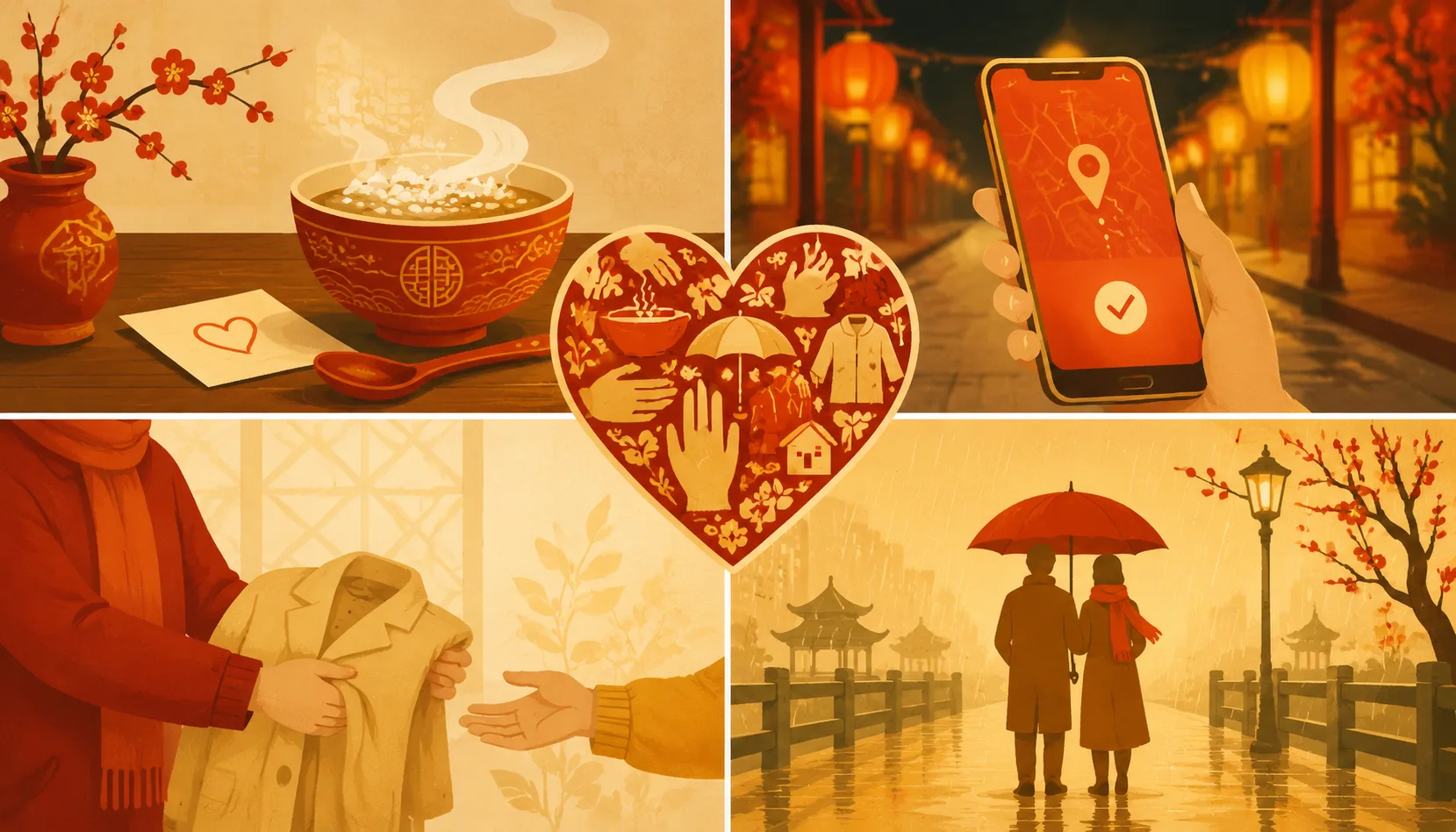
Chinese partners typically express love through actions rather than words. "I saved food for you," "let me know when you get home," and "don't eat that, your stomach is sensitive" are all forms of I love you in disguise. Verbal declarations exist but are rarer — learning to read action-based love is the key to feeling genuinely cared for in a Chinese relationship.
Why "I Love You" Sounds Different in Chinese
In English, "I love you" is practically a daily phrase — used between romantic partners, friends, family members, even for things like coffee. In Chinese, the equivalent:
我爱你
(wǒ ài nǐ)
"I love you"
...carries considerably more weight. It is reserved for serious, significant moments — not casual affirmation. Saying it casually can feel hollow or even performative to a Chinese partner.
A softer expression is far more common:
我喜欢你
(wǒ xǐhuan nǐ)
"I like you" / "I have feelings for you"
But even this is said less than Westerners might expect. The dominant love language in Chinese relationships is not words of affirmation — it is acts of service and quiet attention.
How to Read Hidden "I Love You" Moments
Here are the most common action-based expressions of love that Chinese partners use, and what they actually mean:
| What they say | Translation | What it means |
|---|---|---|
| 你到了告诉我 (nǐ dào le gàosu wǒ) | "Let me know when you arrive" | I worry about you and need to know you're safe |
| 给你留了饭 (gěi nǐ liú le fàn) | "I saved food for you" | You were on my mind all evening |
| 你胃不好,别吃那么辣 (nǐ wèi bù hǎo, bié chī nàme là) | "Your stomach is sensitive, don't eat that" | I pay attention to your body and health |
| 吃饭了吗 (chī fàn le ma) | "Have you eaten?" | Classic daily check-in; Chinese equivalent of "I'm thinking of you" |
| 多穿点 (duō chuān diǎn) | "Wear more clothes" | I care about your comfort and wellbeing |
If your Chinese partner texts you every morning and evening, remembers that you don't like cilantro, and orders your favorite dish without asking — that is love. It just doesn't come with a soundtrack.
Gifts and Spending: Why the Amount Matters (and Doesn't)
Gift-giving in Chinese relationships follows an unspoken logic that confuses many foreigners. Spend too much and you hear: "你太浪费了" (nǐ tài làngfèi le — you're so wasteful). Spend too little and you get: "你怎么这么抠?" (nǐ zěnme zhème kōu? — why are you so cheap?).
The sweet spot is not a dollar amount — it is about visible effort relative to the occasion and the relationship stage. A thoughtful small gift on an ordinary day can land better than an expensive one on Valentine's Day that feels obligatory.
Key Chinese gifting occasions to know:
- Qixi Festival (七夕节, Qīxì jié): The Chinese Valentine's Day, on the 7th day of the 7th lunar month. Gifts, flowers, and a nice dinner are expected.
- Birthday: A genuine personal gift matters more than a generic expensive one. Taking the time to know what they want reads as love.
- Random "thinking of you" gifts: Bringing back a local snack, food, or trinket from a trip shows daily attentiveness — often valued more than big occasion gifts.
Chinese women who say "don't spend money on me" often mean "don't be wasteful" — not "I genuinely don't want anything." Context and your relationship history will tell you which it is.
Couple Outfits: Why Do Chinese Partners Dress the Same?
If you have spent time in China, you will have noticed couples in matching outfits — same colors, same patterns, sometimes identical clothing. This is called 情侣装 (qínglǚ zhuāng — couple outfits), and it is a mainstream, not quirky, expression of couplehood.
The logic: wearing matching clothes publicly announces "we are together" and creates a visible sense of unity. For many Chinese couples, it is not about fashion — it is about belonging and mutual identification.
If your Chinese partner suggests matching outfits, it means they are proud to be seen with you and want the relationship to be publicly visible. It is a form of social declaration. You are not obligated to agree — but understanding what the gesture means helps you respond to it honestly rather than dismissively.
Public Affection: Where Is the Line in China?
Public affection norms in China are more conservative than in many Western cities, though this varies significantly by location and generation.
Generally acceptable in urban China:
- Holding hands
- Walking arm in arm
- Brief hugs or forehead kisses in casual settings
- Sitting close together
Generally draws attention or discomfort:
- Extended kissing in public spaces (especially in smaller cities or around older generations)
- Very physical affection in shopping malls, parks, or restaurants where families are present
The guideline is: what you would do in front of your Chinese partner's parents is roughly what is appropriate in public. In major cities like Shanghai or Beijing, younger couples push this considerably, but defaulting to the more conservative baseline is rarely wrong.
What Chinese People Actually Say
- 心疼 | xīn téng | to feel heartache for someone; to dote on | Shows care through worrying about your partner's well-being
- 体贴 | tǐ tiē | considerate; thoughtful | Express love by noticing and meeting your partner's needs
- 牵挂 | qiān guà | to miss and worry about someone | Demonstrates emotional connection through constant thought
2026 Reality Check
In 2026, traditional Chinese love languages—cooking for you, saving you a seat, doing chores without being asked—still exist, but Gen Z expresses them differently. Younger couples favor verbal affirmation and "bonding moments" (eating together, traveling) over silent acts of service. Older generations (40+) still value practical care: making soup when sick, giving money, helping with concrete tasks.
Regional gaps persist. Beijing and Shanghai youth mirror Western dating trends—dating apps, "situationships," splitting bills. Smaller cities and rural areas still favor family introduction, practical suitability, and visible commitment (buying a house, giving betrothal gifts).
The rule isn't dead—it's evolving. Love is still shown through action, but the definition of "action" expanded. The core remains: Chinese love often speaks through practical care, not just words.
Frequently asked questions
How do I know if my Chinese partner loves me if they never say it?
Look for daily actions: they save food for you, check if you've eaten, remind you to wear a jacket, or ask for your location when you travel. These are love in action. If they introduce you to friends or bring you home for family meals, that's a major commitment signal. Actions carry more weight than words in Chinese relationships.
What does it mean when a Chinese person buys you couple outfits (情侣装)?
Wearing matching clothes is a public declaration of relationship status. It signals you're taken and that your partner is proud to be seen with you. Accepting and wearing them shows you accept the relationship. It's a social marker that helps prevent misunderstandings with other potential suitors.
Is it normal for Chinese couples to never say 'I love you' after years together?
Yes, especially among older generations. Many couples go decades without saying the phrase. Instead, they show love through practical care—cooking meals, managing finances, or taking care of each other's parents. If your partner shows consistent care but doesn't say the words, don't interpret silence as lack of feeling.
Can I say 'I love you' to my Chinese partner without making them uncomfortable?
You can, but start gradually. Say it in private first, not in front of friends. Some partners may respond awkwardly or deflect with a joke—that's normal. Don't pressure them to say it back. Instead, ask what makes them feel loved and mirror that. Over time, they may become more comfortable with verbal expression.
What are the public displays of affection rules for couples in China?
Holding hands and linking arms are fine in most cities. Kissing in public is rare and may draw stares, especially outside major cities. Avoid heavy physical affection in conservative areas or around older people. Instead, express closeness through shared activities—eating from the same plate, walking close together, or adjusting each other's collars.
What gifts do Chinese partners actually expect in a relationship?
Gifts are usually practical or symbolic rather than extravagant. Red envelopes (红包) on Valentine's Day or birthdays are common. Flowers are appreciated but not expected weekly. The most valued gift is often your time—accompanying them to family dinners, helping with errands, or taking them to eat at places they mentioned liking.
Try our tools
Related guides

Chinese Dating Culture: What Foreigners Need to Know
Chinese dating skips the casual "seeing each other" phase and moves directly toward a defined relationship. There is no long ambiguous gray zone — couples are e…
Read the guide →
Meeting Your Chinese Partner's Parents: A Foreigner's Guide
Meeting Chinese parents is a major milestone — it signals the relationship is marriage-track. Bring a quality gift (¥300–800), expect interview-style questions …
Read the guide →
Dating a Chinese Person: Practical Tips for Foreigners
The biggest practical differences: who pays (men are still often expected to, though modern couples split more), how jealousy shows up (indirectly, through obse…
Read the guide →