Chinese Business Card Etiquette: How to Exchange Cards in China (2026 Guide)
Quick answer
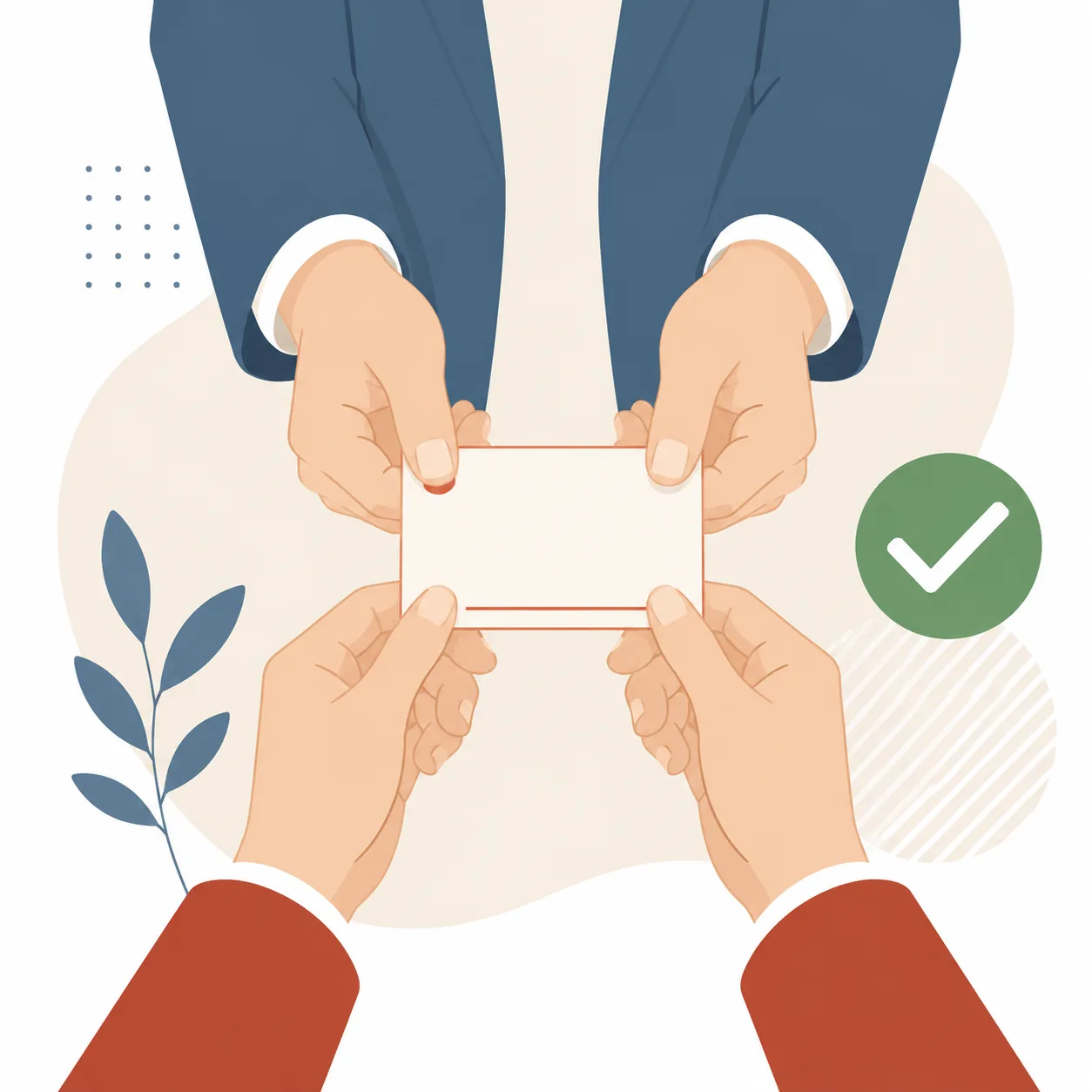
In China, the business card is not a contact-sharing tool. It is a formal introduction of your identity and position. Present it with both hands, Chinese side facing the recipient, with a slight bow. Receive their card with both hands, read it carefully, and place it respectfully on the table or in a card holder. Never write on it. Never stuff it in your back pocket.
On the thirty-eighth floor of a Shenzhen office tower, two men rise from their chairs at the same moment. One produces a small rectangle of cardstock and offers it with both hands, thumbs resting along the top edge, the printed side turned toward the other man — the way you might rotate a photograph so someone can see it. The second man receives it with both hands. Then he does the thing that startles first-time visitors: he simply stands there, reading. Five seconds. Ten. Nobody speaks.
In a country where you can order noodles, pay rent, and see a doctor without ever touching paper, the business card still commands a ceremony.
Why Two Hands? The Cultural Logic
The choreography is precise. Cards are presented and received with both hands, text facing the recipient so it can be read the instant it arrives. There is often a small nod, sometimes a shallow bow. The logic becomes visible once you look for it: two hands signal undivided attention. A one-handed pass — the kind common at networking events in London or New York — reads here as a casual flick, the body language of someone tossing over a napkin.
Offering a card with both hands says, wordlessly: for this moment, I am doing nothing else.
This is lǐ (礼) — ritual propriety — in miniature. The Confucian tradition holds that small, repeated courtesies are not decoration on social life; they are its load-bearing structure. And hierarchy in Chinese organizational culture is not an awkwardness to be smoothed over but a map everyone openly consults. The card exchange is the first entry on that map: before any negotiation begins, each person's professional identity is formally presented and formally acknowledged as worthy of attention.
What you are meant to read, above all, is the title. In a Western firm, "manager" is often a generic label. In China, where a single company may employ tens of thousands, the precise rank — deputy director, senior engineer, general manager of the eastern region — is a coordinate. It tells you where this person sits, who reports to them, and, by extension, how they expect to be addressed.
There is also a harder-edged reason titles carry such weight. In a labor market of hundreds of millions of people, a title is a compressed account of a climb — years of exams, postings, and competition distilled into a few characters. Reading the card carefully, even repeating the title aloud ("Ah, Director Chen"), tells its owner that you have registered not just a name but an achievement. Asking a question about the card — where the company is based, what a character in the name means — is better still. It turns data into conversation.
The Prohibitions
Then come the prohibitions, and every experienced China hand has a story about them.
Do not write on someone's card in front of them. Do not fold it, flick it across the table, or park your teacup on it. Above all, do not slide it into a back pocket — the etiquette guides are blunt about this, because it means you are about to sit on someone's identity.
During a meeting, cards are laid on the table, often arranged to mirror the seating order so they function as a chart of who is who. Afterwards, they go into a card case — a real one, not wedged between receipts.
The concept underneath all of this is miànzi (面子) — face. The card is treated as a physical extension of the person, so handling the object carelessly reads as handling the person carelessly. And because the entire system is engineered to avoid open confrontation, no one will ever correct you. The penalty arrives silently.
Step-by-Step: The Full Card Exchange
Before the meeting: Prepare your cards. Get them professionally printed with Chinese on one side. Keep them in a card case — not loose in your bag or pocket. Know the attendees in advance. You will present cards in seniority order.
At the meeting: When introductions begin, take out your card case. Present to the most senior person first. Hold the card by both sides with thumbs and forefingers, Chinese side facing them, slight forward lean. State your name and company: "I'm [Name], [Title] at [Company]." They will present their card. Receive with both hands. Read it. Briefly acknowledge their title: "Thank you — I see you're the [title]." Place it in front of you on the table during the meeting. Continue around the room in seniority order.
After the meeting: Collect the cards carefully. Place them in your card case or a folder, not loose. When reviewing later: write context notes (date, meeting topic) on a separate paper — never on the card itself.
The Bilingual Card: What to Get Right
If you don't have a Chinese-side card yet, here's what matters:
Translation quality: Use a professional translator or a native speaker. Machine translation of names and titles often produces awkward results that Chinese counterparts notice immediately.
Name in Chinese characters: Your name should be transliterated into Chinese characters (not just pinyin). Many foreigners have a chosen Chinese name (中文名) that sounds similar to their English name — your Chinese colleagues can help with this.
Title accuracy: Job titles translate awkwardly. "Marketing Manager" becomes "市场经理." "Partner" at a law firm is "合伙人." Get these right — they signal your actual rank.
Font and quality: Avoid glossy cards (hard to write on during a meeting). Heavyweight matte stock signals quality.
What Happens When You Get It Wrong
Mark Delaney, the founder of an Australian electronics startup, learned this at a trade fair in Dongguan. A factory general manager named Zhao offered his card with both hands and a small bow. Mark, mid-sentence about unit pricing, took it one-handed, glanced at it, and slipped it into the back pocket of his jeans.
Nothing happened — which is exactly what happened. The tea was poured; the smiles held. But the factory tour Mr. Zhao had mentioned "might be difficult this week," and Mark's follow-up email received a courteous two-line reply three weeks later.
A Chinese colleague finally explained, gently: "You put his twenty-year career in your back pocket. Then you sat on it."
In a respect-first culture, the door does not slam. It simply never opens.
What Getting It Right Looks Like
Priya Raman, a British sourcing consultant on her first China trip, was meeting the deputy director of procurement at a Ningbo appliance manufacturer. When his card came across the table, she set down her pen, received it with both hands, and read it.
"Deputy Director of Strategic Sourcing," she said. "That sounds like an enormous remit — how many factories does that cover?"
He talked for four minutes. His card stayed on the table in front of her, aligned with his seat, for the entire meeting. Afterwards, it went into a slim card case.
Two weeks later, Priya's firm was the only foreign supplier invited to tour the plant — and it was the deputy director himself who walked her down the assembly line. His assistant later told her: "He said you knew how to receive a card." What he meant was that she knew how things worked.
Digital Cards and WeChat
WeChat has largely replaced email in Chinese business communication, and QR code contact sharing is now common. But this has not eliminated the physical card ritual: physical cards are still expected at formal first meetings, WeChat exchange happens after the card exchange — not instead of it, and following up on WeChat (not email) is the expected next step.
Here is the puzzle: China leapfrogged the business card technologically years ago. Yet among senior people, the paper card persists — and it is almost always exchanged before anyone reaches for a phone. The resolution is simple once you see it: the card was never primarily a delivery system for information. Contact details can travel digitally; the ritual cannot. The two-handed exchange is a ten-second, wordless negotiation of status and respect — remarkably efficient social technology for a vast market in which strangers must constantly size each other up, quickly and without offense.
2026 Reality Check
Traditional business card etiquette still matters in China, but it is evolving.
Gen Z vs. older generations: Younger professionals (born after 1995) treat business cards more casually. They will take the card with one hand, glance at it, and slip it into a pocket. A growing number exchange QR codes via WeChat and view paper cards as optional. Older generations still expect the respectful two-handed exchange and careful examination. That said, Gen Z will comply when meeting clients or executives who expect formality.
Tier-1 cities vs. smaller cities: Beijing and Shanghai maintain stricter formality in foreign-invested companies and traditional industries. Smaller cities and tech startups are far more relaxed — cards are often exchanged with a quick nod and immediately photographed or scanned.
The hybrid approach: For cross-generational deals, offer a QR code while also presenting a high-quality paper card. It respects traditional norms while signaling that you are also forward-looking.
Bottom line: Always carry cards. Always present with both hands as the default. The detailed ritual is fading with younger professionals, but basic respect for the card itself remains non-negotiable with anyone over 40 in a formal setting.
What Chinese People Actually Say
请多指教 (qǐng duō zhǐjiào) — "Please give me your guidance." Say when presenting your business card to show humility.
幸会 (xìng huì) — "Honored to meet you." Use when receiving someone's card and responding politely.
久仰大名 (jiǔ yǎng dà míng) — "I have long heard of your great name." Appropriate when meeting a senior or well-known contact.
不胜荣幸 (bù shèng róng xìng) — "I feel greatly honored." Said when accepting a card from a senior or prestigious partner, expressing humility.
恭敬不如从命 (gōng jìng bù rú cóng mìng) — "Respect is best shown by following your lead." When receiving a card, indicating deference.
请问贵公司… (qǐng wèn guì gōngsī…) — "May I ask about your esteemed company…" Opening a polite question about their card or company.
Frequently asked questions
What should I do if the business card I receive is printed only in English?
If the card is in English only, still receive it with both hands and study it briefly. Ask politely about the person's role or company if anything is unclear. Never comment negatively on the card's format. The respect you show matters more than the language on the card.
Can I hand over my business card with just my right hand if my left hand is holding something?
No. In Chinese etiquette, using one hand — even the right — signals low regard for the recipient. If both hands are occupied, briefly set down your items, then present the card with both hands. A momentary pause is far better than committing a subtle faux pas.
What happens if I accidentally write notes on a business card during a meeting?
Writing on a Chinese business card is considered disrespectful because the card represents the person's identity. If you must jot notes, do it discreetly on a separate notepad. If you've already written on the card, apologize briefly and avoid doing it again with that person's card.
Is it okay to put a received business card in my wallet or back pocket?
No. Placing a card in your back pocket, where you sit on it, is a severe insult. Use a dedicated card holder or place it flat on the table in front of you for the meeting's duration. Never fold, bend, or stuff it away casually.
How should I exchange cards with a group of people in China?
Always exchange cards one-on-one, never by tossing cards across a table or handing them out like a deck. Start with the highest-ranking person present and work down. Present and receive each card individually with both hands, and acknowledge each person's card before moving to the next.
What if the other person offers their card with one hand? Should I still use both hands?
Yes. Your etiquette should not depend on theirs. If they use one hand, they may be a foreigner or younger and less formal. Respond with both hands to model correct behavior. This shows your knowledge of Chinese customs and earns respect, regardless of their approach.
Try our tools
Related guides
Chinese Business Etiquette Guide 2026: What You Must Know
Chinese business etiquette is easier to navigate when you watch three recurring patterns: relationship-building (guanxi), protecting dignity in public (mianzi),…
Read the guide →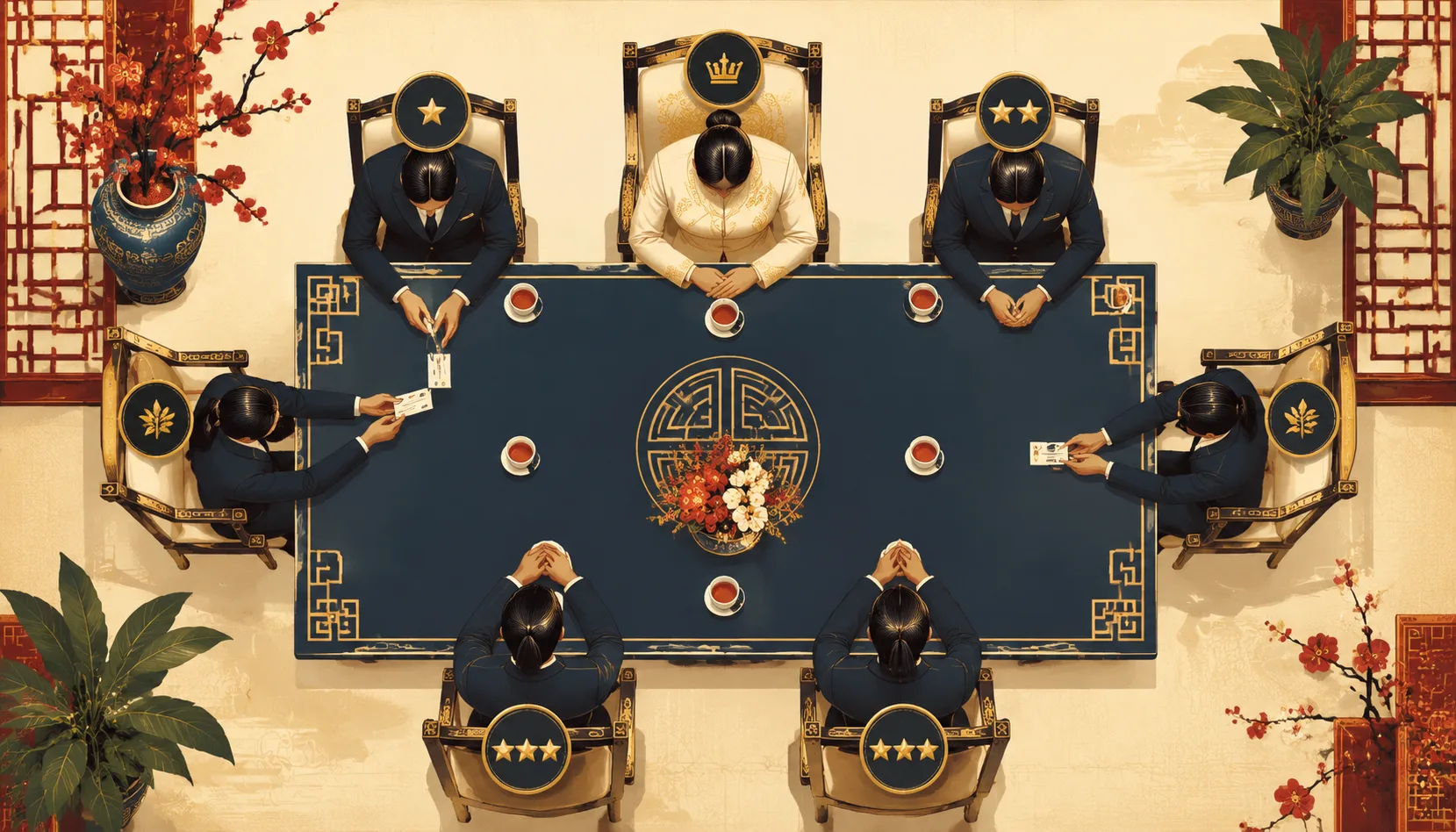
Chinese Formal Meeting Etiquette: Seating & Greetings
Chinese formal meetings run on hierarchy: the most senior person enters first, sits facing the door, speaks first on any topic, and leaves first. You wait to be…
Read the guide →
Chinese Workplace Culture: The Complete Guide for Foreigners
Chinese workplaces run on three hidden pillars: 先做人后做事 (build relationships before doing business), 面子 mianzi (public face and dignity), and 关系 guanxi (relation…
Read the guide →