Does the number of items in a Chinese gift matter?
Quick answer
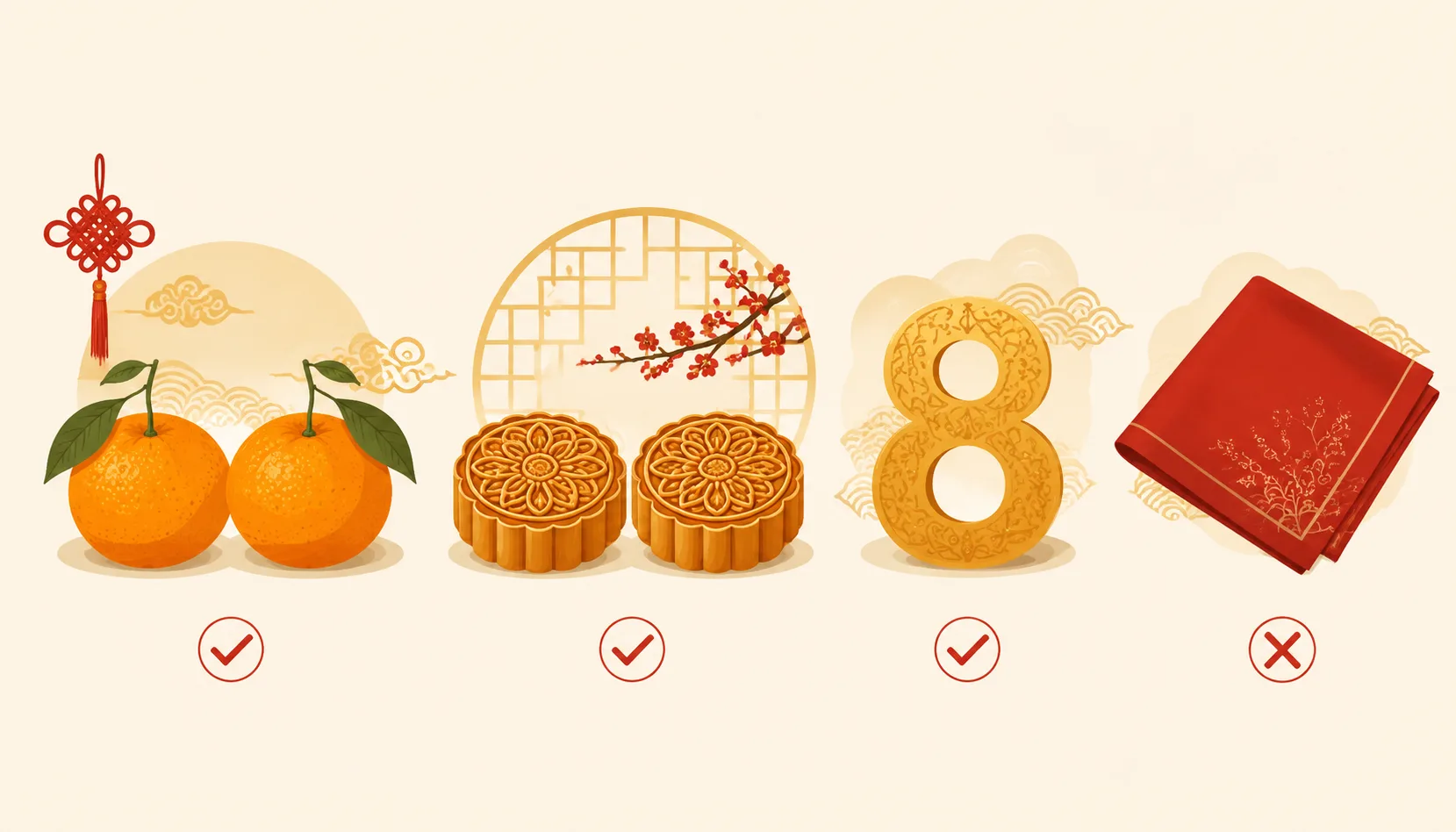
Yes. Gift quantities should be even numbers. Even numbers carry the meaning 'good things come in pairs' (好事成双), while odd numbers can feel incomplete or unlucky.
Why This Rule Matters
The Chinese expression 'hǎo shì chéng shuāng' (好事成双, good things come in pairs) reflects deep cultural belief that even numbers bring completion, happiness, and harmony. Odd numbers can feel unfinished or inauspicious. This is especially true for gifts to elders.
What You Should Do
- Give gifts in pairs or even quantities (2, 4, 6, 8)
- When giving multiple items, count them to ensure an even number
- The number 6 (liù) means smooth and lucky; 8 (bā) means prosperity
What You Shouldn't Do
- Give gifts in odd quantities (1, 3, 5, 7)
- Give a single fruit, single flower, or single item unless it's a symbolic one-of-a-kind object
- Give 4 of anything — '4' (sì) sounds like 'death' (sǐ) and is the worst number
Practical Tips for Foreigners
This even-number rule matters most for formal gifts, red envelopes, weddings, and business occasions with older recipients—especially in Shanghai, Fujian, and Guangdong—while younger people in first-tier cities often ignore it for casual gifts. When in doubt, watch what your Chinese host or senior colleague does and follow their lead. Breaking this rule once is forgivable — breaking it repeatedly signals a lack of cultural awareness.
Why the Number 4 Matters More Than You Think
While even numbers are generally safe, avoid anything containing the digit 4 (sì), which sounds like 'death' (sǐ). This is especially critical in Cantonese-speaking regions like Guangdong and Hong Kong, where the taboo is stronger. A foreigner in Shenzhen once gave a mainland colleague four精美 tea tins for a housewarming—the colleague's mother refused to let them inside. Even numbers like 6 (liù, smooth sailing) and 8 (bā, wealth) are far better choices. In northern cities like Beijing, some younger professionals shrug off the 4 taboo, but elders and business partners in the south still take it very seriously.
Real Scenarios Where Numbers Backfired
- A British expat in Shanghai brought a single bottle of expensive whiskey to a colleague's birthday — the room went quiet, and the host's wife quickly added a second glass to 'complete the pair'.
- An American manager in Guangzhou gave his team leader three boxes of mooncakes for Mid-Autumn Festival; the leader thanked him but later complained to HR that it felt like a '断交' (broken friendship) signal.
- A French teacher in Chengdu gifted five pears to her landlord's family during Spring Festival; the landlord's grandmother muttered that five sounds like '无' (nothing) and nearly refused the gift.
- In Beijing, a German engineer gave two bottles of wine to a client and was praised — but when he added a third as a 'bonus,' the client's smile froze, and the deal never closed.
Regional and Generational Differences
The even-number rule isn't uniform across China. In Shanghai and other Yangtze River Delta cities, the rule is strict for formal gifts like red envelopes and tea sets, but casual gifts like snacks are more flexible. In Northeast China (Dongbei), odd numbers are sometimes acceptable for informal occasions because people prize pragmatism over superstition. However, in Fujian and Guangdong, where business culture is deeply tied to Cantonese and Hokkien traditions, even numbers are non-negotiable, especially for weddings and business launches. Millennials in first-tier cities may roll their eyes at the rule, but your boss's 60-year-old mother will not. When in doubt, stick to even — it costs nothing.
Quick Cheat Sheet for Gift Numbers
2 = safe and standard (pairs). 6 = lucky (smooth). 8 = best (wealth). Avoid 4 at all costs, especially in the south. Odd numbers like 1, 3, 5, 7 are risky — 3 sounds like 'separate' (sàn) in some contexts, and 5 can imply 'nothing.' For cash in red envelopes, always use even amounts, but never 4 or anything ending in 4 (like 40 or 400). If you're unsure, ask a local colleague discreetly — they'll appreciate that you care enough to check.
What Chinese People Actually Say
- 好事成双 | hǎo shì chéng shuāng | Good things come in pairs | Use when explaining why even-numbered gifts are auspicious
- 送双不送单 | sòng shuāng bù sòng dān | Give even numbers, not odd | Direct rule used to remind others of the etiquette
- 成双成对 | chéng shuāng chéng duì | Form pairs and couples | Use when describing items that should be given in pairs (e.g., tea cups, chopsticks)
2026 Reality Check
2026 Reality Check: The "even numbers only" rule is fading but still matters in formal contexts. It's not dead—elderly relatives and business settings still expect even numbers for luck. However, younger Chinese increasingly ignore it, especially for casual gifts.
Gen Z vs. Older Generations: Boomers and Gen X still insist on even numbers, especially for weddings, funerals, and Lunar New Year. Gen Z treats it as "superstition" in most cases— they'll send 99 roses or 520 (I love you) red packets without hesitation. They care more about the gesture than the number.
Beijing/Shanghai vs. Smaller Cities: Tier-1 cities are more relaxed; international influence and younger populations dilute the rule. Smaller cities and rural areas still follow it more strictly, particularly for traditional occasions. The divide is narrowing but exists.
Frequently asked questions
Why do even numbers matter for gifts in China?
Even numbers symbolize 'good things come in pairs' (好事成双), bringing harmony and completeness. Odd numbers, especially 4, are avoided as they can feel unlucky or incomplete.
What even number is safest for a gift quantity?
Two is the safest and most common choice, as it directly represents pairing and good fortune. Six or eight are also excellent, as 8 is associated with wealth and prosperity.
Are there any exceptions to the even-number rule?
Yes, avoid 4 as a quantity because it sounds like 'death' (死) in Chinese. Also, odd numbers are acceptable in some contexts, like giving 7 items for a birthday, but stick to even for general gifts.
Does the even-number rule apply to all gift types?
It applies mainly to countable items like fruit, pastries, or tea packets. For single items like a bottle of wine or a watch, the rule is less relevant, but you can add a small even-numbered extra like two cookies.
What if I accidentally give an odd number of items?
If you notice, discreetly add one more item to make it even, or apologize lightly and explain it was a mistake. Most Chinese hosts will understand, but correcting it shows respect for the custom.
Can I give 10 items as a gift, or is that too many?
Ten is perfectly fine and even, symbolizing perfection and completeness. However, avoid 14, as it contains 4, and keep quantities practical—10 small items like oranges or candies work well.
Try our tools
Related guides

Chinese Gift-Giving Guide 2026: Rules, Taboos, What Works
In China, gift-giving is not about the gift. It's about the relationship. The right gift, delivered at the right time with the right words and two hands, commun…
Read the guide →
14 Chinese Gift Taboos: The Complete Forbidden List
Most Chinese gift taboos come from homophones — words that sound identical to something unlucky. "送钟" (giving a clock) sounds exactly like "送终" (attending a fun…
Read the guide →
How to Give a Gift in China: Two Hands, Three Rounds
Two hands. Eye contact. Slight forward lean. Say "一点小心意" (a small token). When they refuse, persist twice — then place it in their hands. This is the script. De…
Read the guide →