What are the etiquette rules for visiting a Chinese family's home?
Quick answer
Bring a small gift, arrive 5 minutes late (never early), remove shoes at the door, wait for the host to assign your seat, and let the eldest eat first. Follow the host's lead on every major action.
When a Chinese friend or colleague says, "Come to my place for a simple meal this weekend," don't be fooled by the word simple. Being invited into a Chinese home is a social milestone — it means you've broken through the outer social layer and entered someone's inner trust circle. This is not just dinner. It's an unwritten performance of manners, emotional intelligence, and cultural awareness.
This guide walks you through the complete A-to-Z of visiting a Chinese home, from leaving your house to sending the follow-up message that evening.
Before You Leave: The Pre-Visit Checklist
1. Never Arrive Empty-Handed
No matter how sincerely your host says "Don't bring anything — just come!", showing up with nothing is considered rude in Chinese culture. It labels you as someone who doesn't understand social courtesy (méi lǐ mào — 没礼貌). Always bring something.
Safe gift choices for a casual visit (¥100–300):
- A box of premium seasonal fruit — buy imported cherries or grape clusters in a proper gift box, not in a plastic supermarket bag
- A quality box of red or green tea (Eight Horses Tea, Premium Longjing)
- A French red wine if you know they drink
- A beautifully packaged box of imported chocolates for families with children
For holiday visits, bring holiday-specific items: mooncakes at Mid-Autumn, nut gift boxes at Lunar New Year. See our gift guide for visiting Chinese homes for detailed recommendations.
2. Your Socks Matter More Than Your Shirt
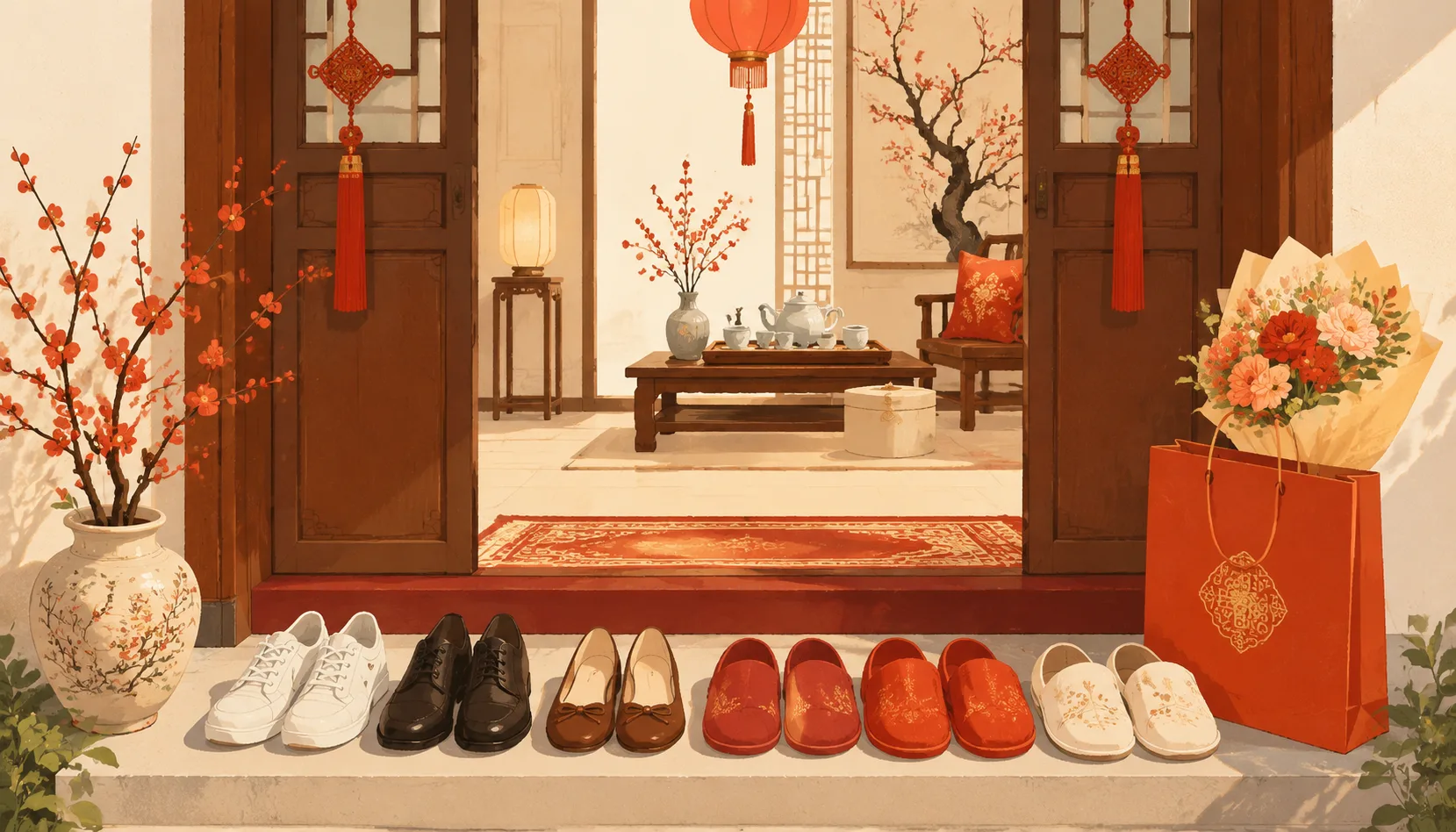
99% of Chinese homes require you to remove shoes at the door. Your socks will be on full display for the entire evening. Before leaving home, check:
- Are your socks clean with no holes?
- Are your shoes easy to slip on and off? Avoid 18-eyelet boots that require a 3-minute untying session in front of everyone.
Dress smart-casual overall — not formal dinner wear, not gym clothes.
3. The Right Arrival Time: Be 5 Minutes Late
In the West, arriving on time or slightly early shows respect. In Chinese homes, arriving early is a disaster. Your host has been cooking since afternoon. If you ring the doorbell 20 minutes early, you'll catch them in a sweaty apron with dishes still on the stove — embarrassing for everyone.
The sweet spot: arrive 3–5 minutes after the agreed time. This gives the host that final buffer to plate the last dish and change clothes. If you'll be more than 15 minutes late, send a WeChat message in advance.
4. Bringing a Partner or Children
Always inform your host in advance if you're bringing anyone extra. Chinese hosts are generous, but they plan food quantities and seating carefully. Showing up with an unannounced guest is disruptive. Simply ask: "Is it okay if I bring my wife/husband too?"
Entering the Home: The Critical First Five Minutes
1. Shoes Off — But Greet First
The safe sequence: smile and greet the host as the door opens, then look down and ask where to put your shoes. Don't dive for your shoes before acknowledging the people standing in front of you.
Even if the host says "No need to change shoes, come right in!" — still look for the slippers and ask where to leave your shoes. It signals you respect their home's cleanliness standards.
2. Your Opening Line
When the host opens the door and says "Welcome, welcome!" (欢迎欢迎 — Huānyíng huānyíng), reply with:
打扰了,谢谢邀请! (Dǎ rǎo le, xiè xie yāo qǐng!)
"Sorry to impose — thank you for the invitation!"
The phrase 打扰了 (dǎ rǎo le) literally means "I'm disturbing you" — it's a polite expression of humility, not an apology. Using it immediately signals cultural awareness.
3. The Slipper Protocol
Your host will offer guest slippers. If they're too small for your feet (a common issue for taller Westerners), politely say:
我的脚太大了,我只穿袜子可以吗? (Wǒ de jiǎo tài dà le, wǒ zhǐ chuān wà zi kě yǐ ma?)
"My feet are too big — is it okay if I just wear my socks?"
Never walk barefoot on the floor; always keep socks on.
4. Give the Gift Immediately
The right moment: as soon as you've changed shoes and exchanged greetings, present the gift with both hands. Don't wait until you're leaving.
Say: 给你们带了一点水果,希望你们喜欢。
"Brought some fruit for you — hope you enjoy it."
Your host will immediately protest: "Aiya, you really didn't need to bring anything!" This is called the refusal-acceptance ritual — do NOT take the gift back. Smile and keep extending it: "一点心意,一点心意。" (Just a small token, just a small token.) They will accept after one or two rounds of gentle refusal.
5. Compliment the Home
Chinese people take great pride in their homes, especially since real estate is expensive. After you enter, immediately compliment something:
- On a large space: 你们家真大,真宽敞! (Your home is so big and spacious!)
- On the décor: 装修得真漂亮,很有品味。 (The decoration is beautiful — very tasteful!)
- On a cozy smaller space: 收拾得真干净,太温馨了。 (So clean and cozy!)
At the Dinner Table
1. Never Choose Your Own Seat
Chinese dining tables have a hierarchy. The seat directly facing the door is the master seat reserved for the eldest person or most important guest. If you sit there by accident, you've just displaced someone's grandfather. Instead, stand near the table and ask: 我坐哪里比较好? (Where would be best for me to sit?)
2. Wait for the Signal to Eat
Two rules: (1) wait for the host to say "大家动筷子吧" (Everyone, please use your chopsticks) or "开动吧" (Let's begin); (2) if there are elders present, wait for them to take the first bite. This is called 尊老 (zūn lǎo) — respecting elders.
3. When the Host Won't Stop Serving You
The host may use their own chopsticks to place food on your plate — this is the highest form of hospitality in Chinese culture. Even if it feels unhygienic, do not refuse or show disgust. Hold your bowl up to accept it and say:
谢谢,我自己来就好,您也吃!
"Thank you — I can serve myself, please eat too!"
4. Handling Unfamiliar Food
If something intimidating appears — chicken feet, pig brain, unfamiliar offal — you have two graceful options:
Strategy A (recommended): Try a small bite. If you can handle it: 味道很特别,很好吃。 ("The taste is very unique — delicious!")
Strategy B (polite refusal): Never say "that's disgusting." Instead: 看起来很好吃,但我对这个过敏。我还是多吃点这个青菜吧!
("It looks delicious, but I'm allergic. I'll have more of these vegetables — they're amazing!")
Key technique: When declining one dish, immediately praise another dish enthusiastically. It gives the host a face-saving exit.
Conversation: Safe Topics and Minefields
Always Safe
- Praising the food: 这个菜是怎么做的?太好吃了! ("How did you make this? It's amazing!") — this is the highest compliment to the person who cooked
- Travel (especially Chinese cities you've visited)
- Their children's achievements
- Your home country's food and culture
Avoid Completely
- Politics, territorial disputes, or human rights
- Asking anyone's salary, home price, or mortgage
- A woman's age
- Saying "our country does this better than China"
Classic Compliment Traps
Host: "Your Chinese is so good!"
Don't say "Yes, I studied for 5 years." Instead show humility:
哪里哪里,还在学,说得不好。 ("Not at all — I'm still learning, I speak poorly.")
Host: "You use chopsticks so well!"
因为中国菜太好吃了,我必须得学会! ("Because Chinese food is so delicious, I had to learn!")
This reliably produces smiles around the table.
Leaving: How to Read the Signs
Chinese hosts will never directly tell you it's time to leave. They will sit with you until 3am before saying "you should go." You need to read the signals:
- Signal 1 — The Fruit Platter: When the host brings out a tray of sliced watermelon or a platter of fruit, this is the cultural equivalent of a last-call bell. It means: "This is the last thing for tonight."
- Signal 2: Conversations have long silences; the host keeps glancing at their phone
- Signal 3: Children are sent to bath or bed
- Signal 4: The host starts clearing empty dishes
When you see 2+ signals, stand up and initiate the goodbye yourself. Your host will protest — "Aiya, it's so early, stay a little longer!" — but this is courtesy. Start walking toward the door while saying 下次再聚! (Let's get together next time!)
Your exit speech: 今天实在太感谢了,菜太好吃了。时间不早了,不打扰你们休息了,我先回去了。
"Thank you so much for today — the food was amazing. It's getting late, I shouldn't disturb your rest any longer. I'll head back now."
The Endless Goodbye
When you reach the elevator, your host will escort you. Don't be surprised if they walk you to the lobby or the building exit. This is 送客 (sòng kè) — the send-off ritual. At the elevator, turn around and say firmly:
请留步,别送了,快回去休息吧!
"Please stop here — no need to see me out. Go back and rest!"
This one phrase signals exceptionally high cultural fluency and will impress your hosts enormously.
After the Visit: The Follow-Up Text
That same night, send a WeChat message. This is the final 10% that separates a memorable guest from a forgettable one:
我到家了。今天非常开心,菜太好吃了,期待下次再聚!早点休息。
"I'm home safely. Today was wonderful — the food was amazing. Looking forward to next time! Rest well."
This message closes the loop, shows you're safe, expresses genuine gratitude, and opens the door for a future invitation.
The Reciprocity Rule: 礼尚往来
Chinese social culture is built on 礼尚往来 (lǐ shàng wǎng lái) — courtesy demands reciprocity. Within 1–2 months, find an opportunity to return the hospitality: invite them to a restaurant (and settle the bill discreetly before the meal ends — never split the bill), or cook a Western meal for them at your place.
What Chinese People Actually Say
- 请进 | qǐng jìn | Please come in | Say when host opens door; shows respect upon arrival
- 打扰了 | dǎ rǎo le | Sorry to bother you | Say when entering; polite acknowledgment
- 谢谢招待 | xiè xiè zhāo dài | Thank you for your hospitality | Say when leaving; shows gratitude
2026 Reality Check
Gift-giving: Still expected, but Gen Z in Beijing/Shanghai often prefer practical items or digital red envelopes over traditional fruit/tea. Smaller cities remain more traditional—always bring something.
Shoes: Universally followed in homes with tatami or carpet. Urban apartments with hardwood floors see younger hosts saying "it's fine" more often. Still polite to ask and wait for guidance.
Chopstick rules: Younger generations care less about upright chopsticks or opening gifts immediately. Older generations in smaller cities still notice and may comment.
Timing: Beijing/Shanghai professionals value punctuality; smaller cities still favor arriving 10-15 minutes late. Gen Z nationwide are more relaxed about formal visiting rituals overall.
Frequently asked questions
Can I bring flowers as a gift when visiting a Chinese home?
Yes, but avoid white flowers, chrysanthemums, or any even number—these are associated with funerals. A potted plant or fruit basket is safer. If bringing flowers, choose bright, auspicious colors like red or pink, and present them with both hands as a sign of respect.
What should I do if the host insists I eat more than I want?
Politely decline once or twice, then accept a small portion. Refusing too firmly can seem rude, as the host's insistence is a sign of hospitality. Leave a tiny bit on your plate when finished—this signals you're full without offending. Never finish every grain of rice, as it implies you're still hungry.
Is it okay to wear shoes inside if the host says 'no need to take them off'?
This is a common courtesy trap. Even if the host says it's fine, always remove your shoes unless they explicitly insist multiple times after you've offered. Watch what family members do at the door. If you see slippers provided, use them. When in doubt, ask, 'Are you sure? I'm happy to take them off.'
When is the best time to leave a Chinese home after dinner?
Leave about 30-60 minutes after the meal ends, but never immediately after eating—it signals you came only for food. Watch for cues like the host starting to clear dishes or yawning. Announce your departure, then engage in a brief 'goodbye dance' (saying goodbye at the door for several minutes) before actually leaving.
How should I greet elderly family members when I first arrive?
Greet the oldest person first, using their surname plus a title like 'Grandpa Li' or 'Auntie Wang.' A slight bow or nod is appropriate. For very close relationships, a handshake works, but avoid hugging or kissing—this makes most Chinese elders uncomfortable. If they offer a gift, accept with both hands and thank them warmly.
What if I'm invited to a Chinese home but I have a dietary restriction?
Mention it casually when accepting the invitation, not at the dinner table. Say something like, 'I'm so excited—just to let you know, I don't eat beef for health reasons.' If you forget and something is served you can't eat, politely push it aside and praise other dishes. Never make a scene or lecture about your diet.
Try our tools
Related guides

What to Bring to a Chinese Home for Dinner: Guest Gift Guide for 2026
Never arrive empty-handed at a Chinese home dinner. Safe options: a fruit basket, quality packaged pastries or snacks, good quality tea, or imported wine/spirit…
Read the guide →
Chinese Polite Phrases Decoded: What People Really Mean
Chinese social interaction is lubricated by ritual phrases (客套, kètào) that have specific social functions but often do not mean what they literally say. 'Have …
Read the guide →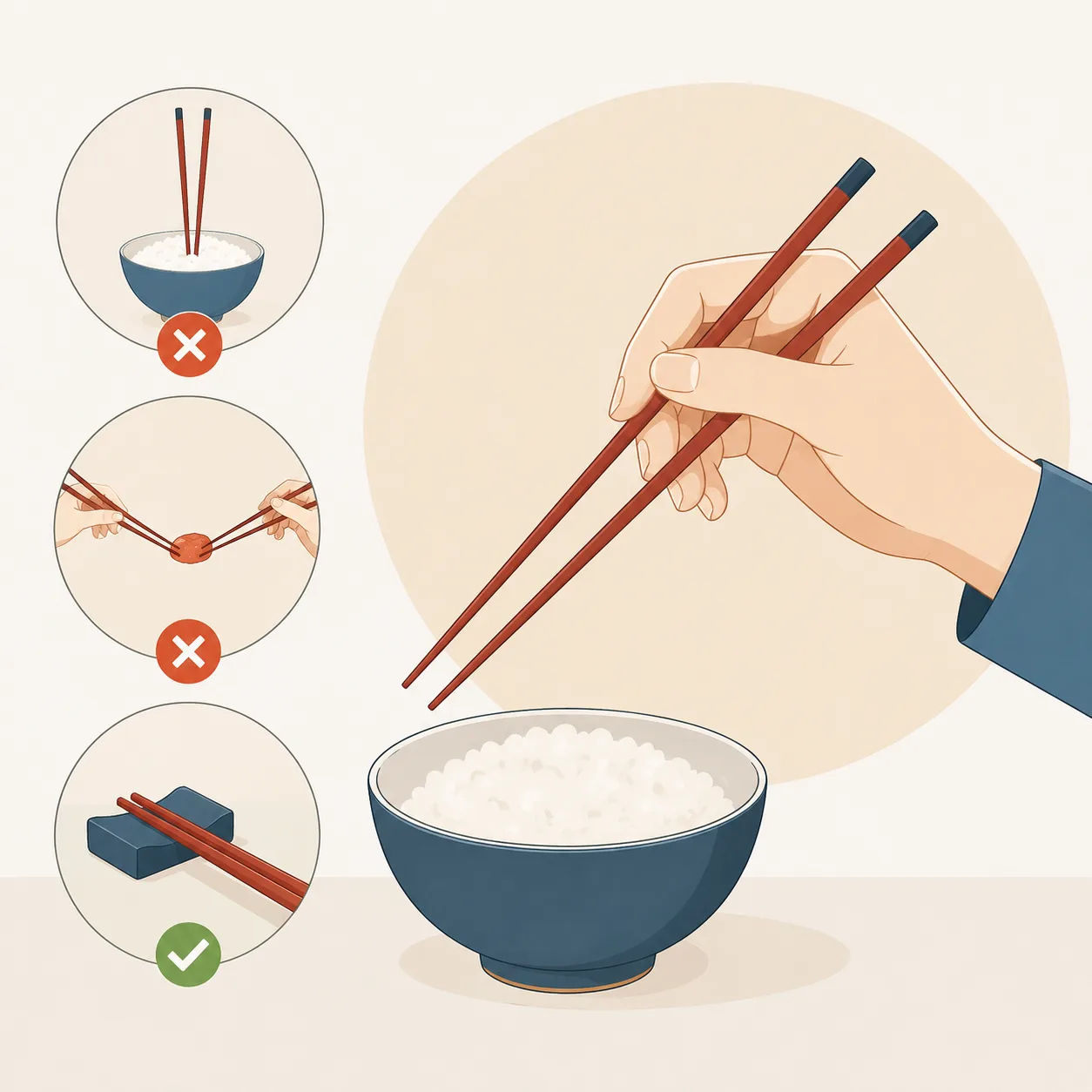
Chopstick Rules in China: What to Do and What to Avoid
The three biggest chopstick taboos in China: never stand them upright in a bowl of rice, never tap your bowl with them, and never dig through shared dishes. Kee…
Read the guide →