What are the chopstick rules in China?
Quick answer
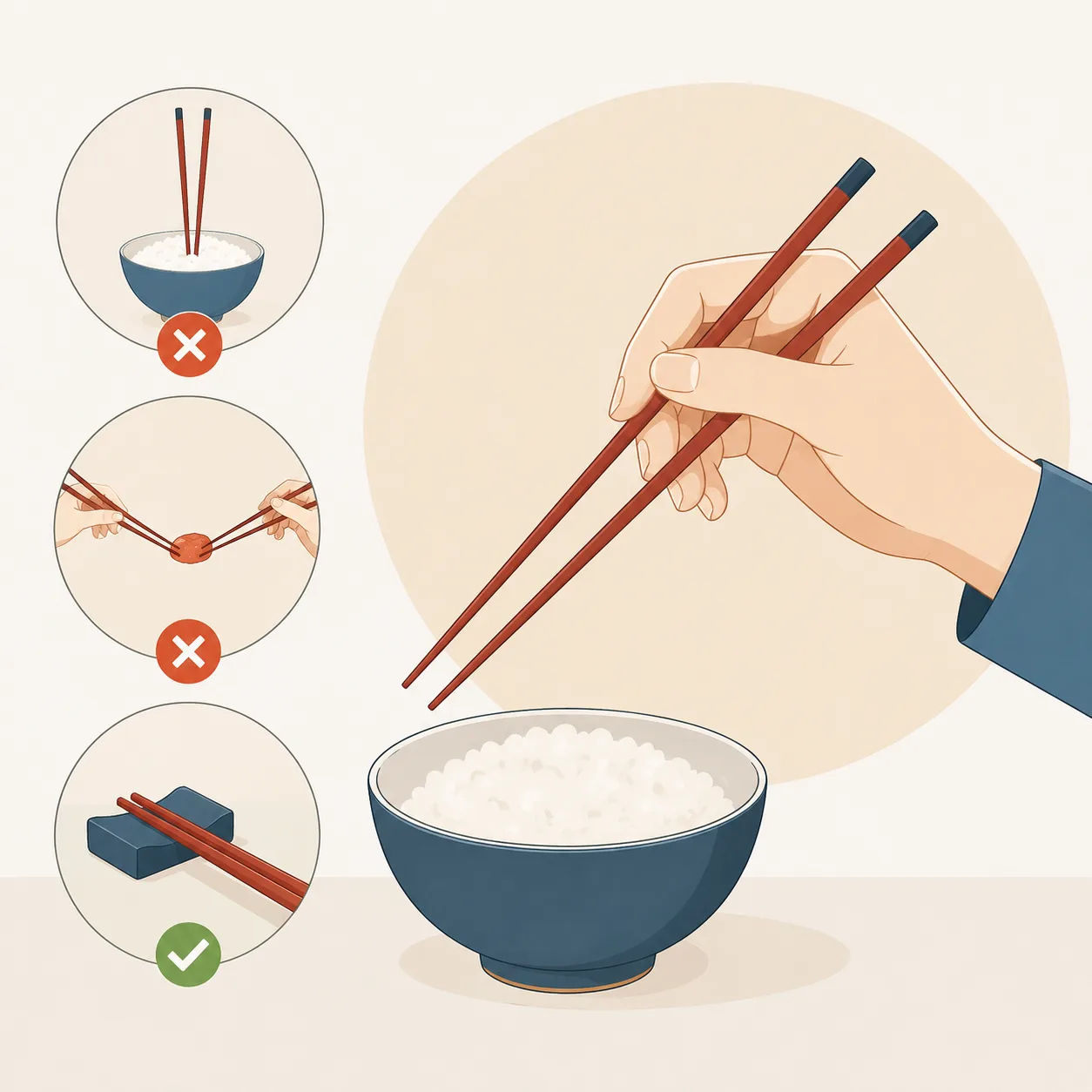
The three biggest chopstick taboos in China: never stand them upright in a bowl of rice, never tap your bowl with them, and never dig through shared dishes. Keep them quiet, aligned, and pointing at no one. Younger Chinese are forgiving of small slips, but at family dinners with elders or business banquets, these habits still get noticed.
Never Stick Chopsticks Upright in a Bowl of Rice
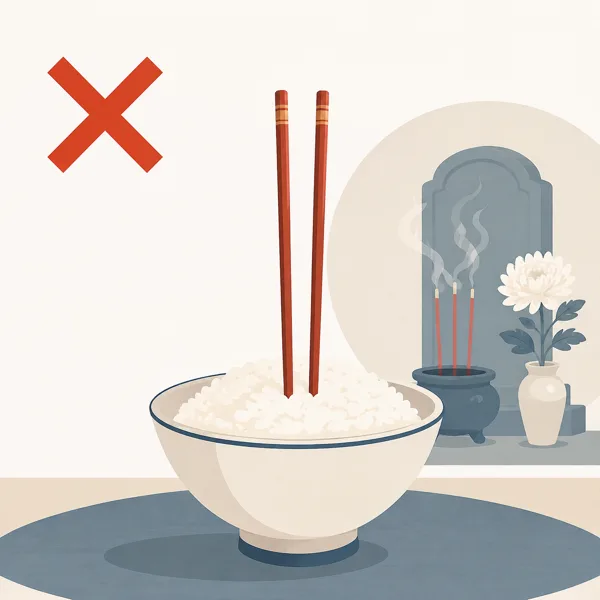
Yes — this is one of the most serious chopstick taboos in China.
Do
- Lay them flat across your bowl
Don't
- Never plant chopsticks into rice
Why it matters
The image resembles incense offered to the dead.
Chinese terms
Don’t Tap Your Bowl With Chopsticks
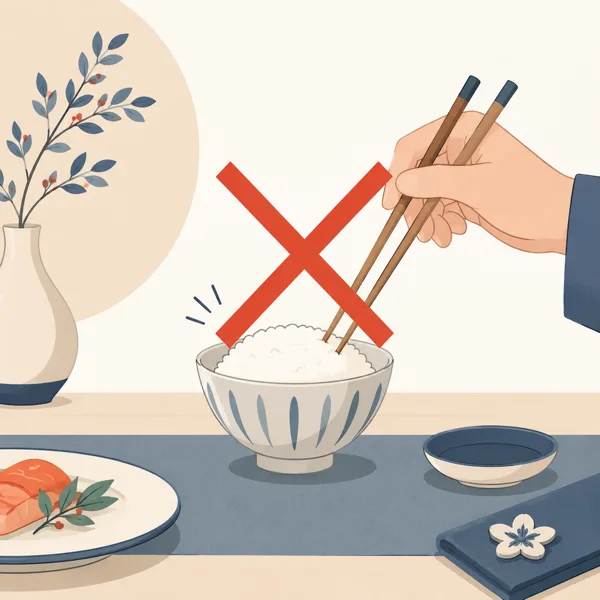
Tapping or drumming on your bowl with chopsticks is traditionally associated with beggars clanging bowls to ask for food, so it is read as both unlucky and ill-mannered — especially by older diners. Keep your bowl and chopsticks quiet while eating.
Do
- Keep your chopsticks and bowl quiet during the meal.
- Set chopsticks down gently when pausing.
- Ask politely (or catch a server’s eye) if you need something.
Don't
- Don’t drum, tap, or clang your bowl, plate, or chopsticks.
- Don’t bang your spoon against your teacup or bowl either.
Why it matters
In the traditional view, the sound of tapping evokes a beggar clanging a bowl to beg for food — the saying 穷得叮当响 (“so poor everything jingles”) describes exactly that sound. For many older Chinese, it reads as inauspicious as well as rude.
Real-life examples
- A child drums on their rice bowl while waiting for food at a family dinner; a grandparent quietly stops them — the sound is associated with begging, and children are taught this rule early.
Traditional vs. modern
Traditional view
Beggars historically clanged bowls to draw attention; polite diners did everything quietly.
Modern reality
In casual restaurants among friends, few people would say anything — but at family occasions with older hosts or formal banquets, keeping the table quiet is still noticed as good breeding.
How much it matters varies
By region and family: Widely recognized across China; reaction strength varies more by age and family than by region.
By generation: Elders and traditional families care most; younger diners are more relaxed.
Chinese terms
Six Classic Chopstick Mistakes
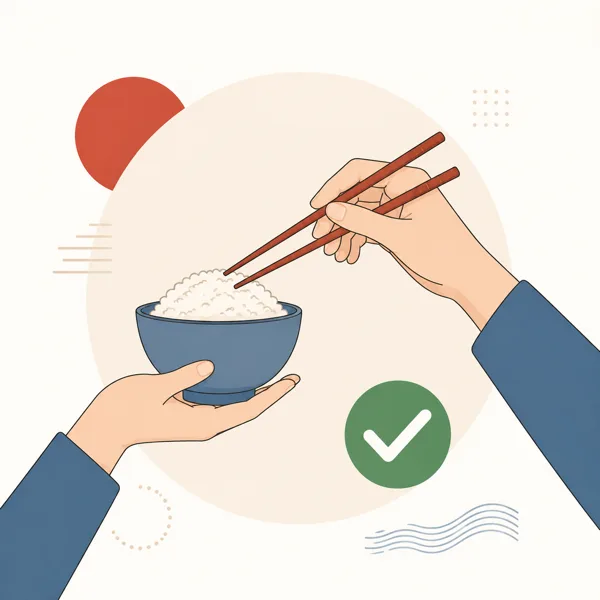
Traditional Chinese table manners single out six chopstick habits: digging through shared dishes, using sticky chopsticks, dripping broth across the table, laying chopsticks crossed, leaving them at uneven lengths, and waving them while talking. None of these will end a friendship — but avoiding them marks you as a well-raised guest.
Do
- Take food from a shared dish decisively — pick a piece and take it.
- Keep your chopstick tips clean while serving yourself.
- Catch drips with your rice bowl held underneath.
- Lay chopsticks neatly parallel when resting them.
Don't
- Don’t rummage through a shared plate choosing the best piece (“dirty chopsticks”).
- Don’t pick up food with chopsticks still sticky with rice.
- Don’t let broth drip across the table (“crying chopsticks”).
- Don’t rest chopsticks crossed in an X.
- Don’t leave them at uneven lengths — the phrase 三长两短 (“three long, two short”) alludes to a coffin.
- Don’t wave chopsticks while talking or point them at people.
Why it matters
Each habit reads as thoughtless toward the other diners: rummaging treats the shared dish as private property, sticky or dripping chopsticks are simply unappetizing, crossed sticks look like a rejection mark, uneven sticks carry the coffin idiom 三长两短, and waving sticks while talking turns cutlery into a pointed weapon. Together they add up to a simple rule: chopsticks are for eating, quietly and tidily.
What to do instead
- Use the serving chopsticks (公筷) provided in many restaurants.
- Hold your rice bowl under food in transit to catch drips.
- When in doubt, set chopsticks down neatly and use your words.
Real-life examples
- A guest hovers over the steamed fish, separating the best morsel with both chopsticks while everyone waits — a textbook “dirty chopsticks” moment that elders notice silently.
- Someone rests their chopsticks unevenly across the bowl rim; a parent quietly squares them up — 三长两短 is why.
Traditional vs. modern
Traditional view
The “six taboos” are a classic list in traditional dining etiquette teaching, tied to older beliefs about luck and respect for shared food.
Modern reality
Most young Chinese know the list even if they can’t name all six; the ones that still draw comment at family meals are rummaging through dishes and waving chopsticks while talking.
How much it matters varies
By region and family: The list is broadly national; sensitivity is highest in traditional families and formal banquets.
By generation: Older diners notice all six; younger company usually notices only the most visibly rude ones.
Chinese terms
Why chopsticks carry so much etiquette
For something so small, chopsticks carry a surprising amount of Chinese table etiquette. One reason is symbolism: traditional teaching says chopsticks are 七寸六分 — seven cun six fen long — standing for the “seven emotions and six desires” of human nature, so handling them well is read as handling yourself well.\n\nThe other reason is simply that Chinese meals are shared: many dishes, one table, everyone reaching. Bad chopstick habits — digging through the shared fish, dripping broth across the table, waving sticks while talking — are noticed precisely because they affect everyone else's food.
Common mistakes foreigners make
- Sticking chopsticks upright in rice while reaching for a drink or a phone — the single most recognizable taboo, evoking incense for the dead.
- Tapping or drumming the bowl to call a server — traditionally associated with beggars; catch a server’s eye or raise a hand instead.
- Hunting through a shared dish for the best piece — pick decisively and take what you touch.
- Pointing at people with chopsticks mid-conversation — put them down first.
A note on using serving chopsticks
Many restaurants and most formal banquets provide serving chopsticks (公筷, gōng kuài) — often a different color — for taking food from shared plates. Using them when provided is noticed and appreciated; it is both hygienic and the modern mark of a well-raised guest.
Regional differences in chopstick strictness
How seriously people take chopstick rules varies a lot by region and generation. In northern cities like Beijing and Tianjin, older generations at family banquets still watch closely — sticking chopsticks upright in rice is genuinely seen as an omen of death. In southern commercial hubs like Shenzhen or Shanghai, younger professionals are far more relaxed and often brush it off with a laugh. But if you're dining with a Fujian or Cantonese elder, especially in a formal setting like a wedding or ancestral ceremony, the old rules are very much alive. The safest approach: follow the strictest version of the rules in any mixed-age group, and you'll never offend.
Real scenarios: when it matters most
- A British expat in Shanghai stuck his chopsticks upright in his rice bowl to answer a work call during a hotpot dinner. His host, a 60-year-old from Shandong, quietly moved the bowl aside and didn't speak to him for the rest of the meal.
- At a business banquet in Beijing, an American manager used his own chopsticks to flip through every dish looking for the best piece of meat. The Chinese executives exchanged glances but said nothing — the deal still closed, but he wasn't invited back to dinner.
- A Canadian teacher in Guangzhou tapped her bowl with chopsticks to get her students' attention at a school lunch. A visiting principal from Hong Kong frowned — tapping bowls is how beggars signal for food. The teacher never knew why the atmosphere stiffened.
- In Shenzhen, a young German expat pointed his chopsticks at a colleague while making a joke. His 30-something coworker just laughed and said, 'Hey, you're pointing at me like a spear!' But at a later family dinner in his colleague's hometown, the same gesture earned a sharp look from the grandmother.
What hosts think but won't say
When you break a chopstick rule, your Chinese host almost never corrects you directly — that would be rude. Instead, they'll go quiet, exchange a glance with a family member, or subtly change the topic. What they're thinking: 'Doesn't this person know this is like praying for a funeral?' or 'Is he really that hungry?' They won't tell you because saving face — yours and theirs — matters <a href="/business/chinese-business-banquet-etiquette/">more than</a> the lesson. This silence is the real trap: you may think everything's fine, while your host has mentally downgraded you from 'polite guest' to 'needs guidance.' If you notice the mood shift, the best move is to ask a younger family member later, in private, what you did wrong.
When rules bend: casual settings
Not every meal is a formal test. At a street noodle shop in Chengdu or a casual BBQ with friends in your 20s and 30s, nobody cares if you rest your chopsticks on the bowl or use them to pick a stray chili. The rules tighten at: (1) family dinners with elders, especially during holidays like Spring Festival or Qingming; (2) business banquets where contracts are discussed; (3) any meal in a home where an altar or ancestor photos are visible. In those spaces, treat chopsticks like fine silverware — deliberate, quiet, and never pointing anywhere but your own plate.
Frequently asked questions
Is it rude to point with chopsticks?
Yes — pointing at people with chopsticks, or waving them while talking, is considered poor manners in most company. If you need to gesture, set your chopsticks down first.
What should I do with my chopsticks when I pause eating?
Lay them flat and side by side across your bowl or on a chopstick rest, tips aligned. Avoid crossing them, leaving them uneven, or sticking them into your food.
Do young Chinese people still care about chopstick rules?
Among friends in casual restaurants, small slips are usually ignored. The rules matter most at family meals with older relatives, formal banquets, and business dinners — occasions where table manners are read as a sign of respect.
Sources
- 《老祖宗留下的规矩》 — Rules Passed Down by Our Ancestors (site owner’s source material)
We mark items based on traditional material and ongoing verification — cultural rules vary by region, family, and generation.
Try our tools
Related guides
Ordering Food at a Chinese Restaurant: The Unwritten Rules
Chinese restaurant culture has specific rules foreigners often miss: seating is hierarchical (best seat faces the door), the host or senior person typically ord…
Read the guide →
Chinese Restaurant Dining Etiquette: During the Meal and Beyond
During a Chinese meal: wait for the host to signal the start, toast with the host before drinking, serve others before yourself, and never leave without a prope…
Read the guide →
Visiting a Chinese Home: Complete Etiquette Guide for Foreigners
Bring a small gift, arrive 5 minutes late (never early), remove shoes at the door, wait for the host to assign your seat, and let the eldest eat first. Follow t…
Read the guide →