Do Chinese people expect family members to announce when they leave and come back home?
Quick answer
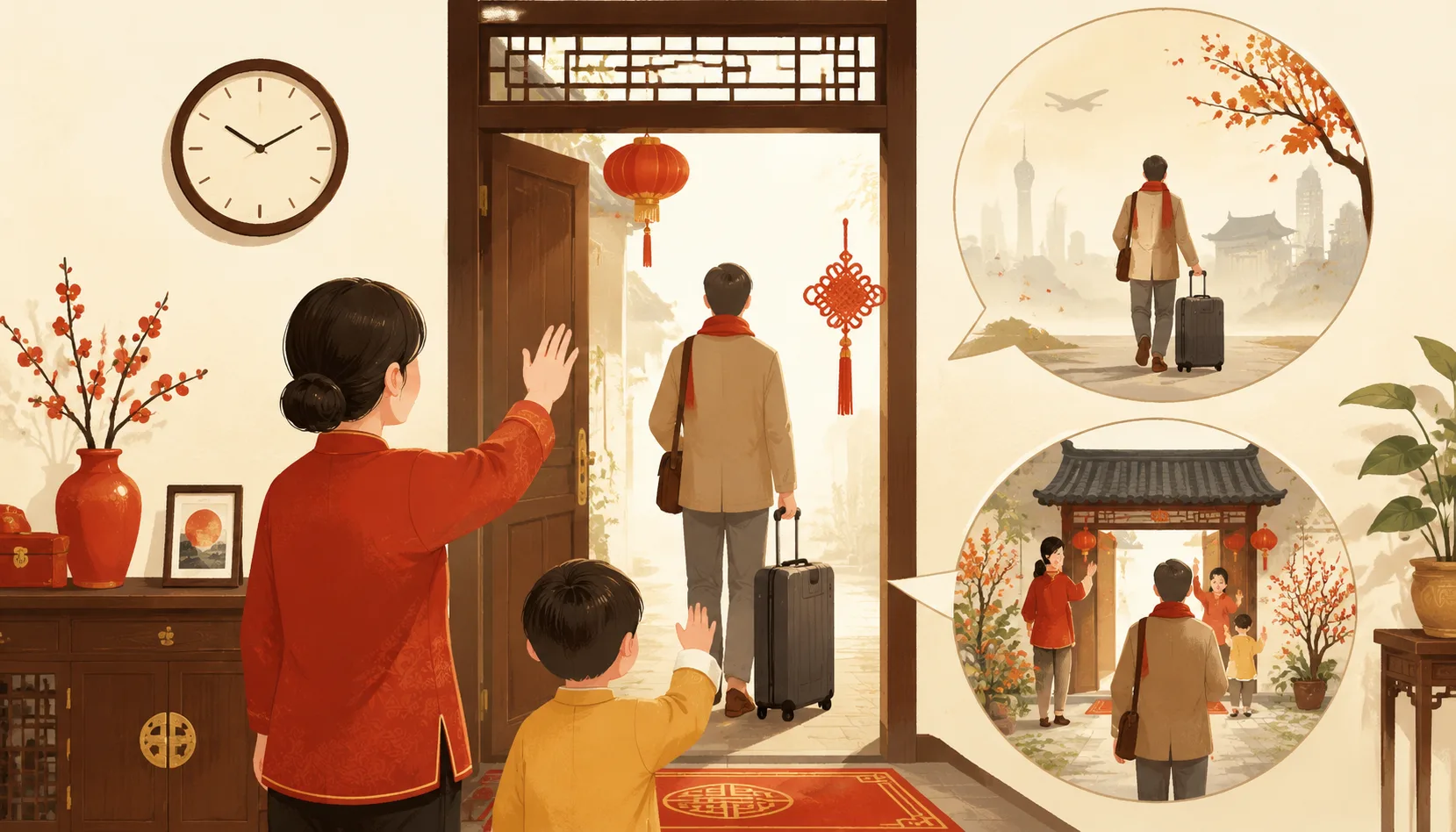
Yes. Announcing your departure and return is a deeply ingrained family respect ritual. Leaving without a word or coming home silently is considered cold and disrespectful to those who care about you.
Why This Rule Matters
This rule comes from the Confucian text 'Dizigui' (弟子规): 'chū bì gào, fǎn bì miàn' (出必告,返必面, when leaving, always inform; when returning, always show your face). It reflects filial piety — the duty of children to respect and reassure their parents of their safety.
What You Should Do
- Say goodbye and tell family where you're going when you leave the home
- Announce your return when you arrive — '我回来了' (wǒ huílái le, I'm home)
- If plans change and you'll be late, notify family proactively
What You Shouldn't Do
- Slip out without saying anything — this is seen as dismissive
- Come home and go to your room without acknowledging family
- Treat this ritual as unnecessary — to Chinese elders, it is fundamental respect
Practical Tips for Foreigners
This rule is about family and household life, especially with parents or elders; if you are staying with a Chinese host, you should announce your own departures and returns too. When in doubt, watch what your Chinese host or senior colleague does and follow their lead. Breaking this rule once is forgivable — breaking it repeatedly signals a lack of cultural awareness.
Why Silence Feels Like Rejection
In China, the home is not just a building — it's a shared emotional space. When you leave without announcing it, the people left behind don't think 'he's busy' — they think 'he doesn't care about us.' This is especially true for parents over 50, many of whom grew up in multi-generational households where every comings and goings were acknowledged aloud. A silent exit reads as emotional withdrawal, not efficiency. The host or parent rarely says anything directly, but you'll notice the atmosphere shift: shorter replies, less warmth at dinner. They're not angry — they're hurt.
Real Scenes of Departure Friction
- A British expat in Shanghai lived with his girlfriend's parents for a month. He'd head out for early gym sessions at 6am without a word. After the third day, his girlfriend's mother started cooking breakfast at 5:30am 'by accident' — she was trying to catch him before he left, because she felt he was avoiding her.
- In Beijing, a German consultant staying with a Chinese colleague's family slipped out for a 7am meeting. When he returned at 10pm, the grandmother had waited up — not to scold him, but to make sure he'd eaten. She later told his colleague, 'He treats this house like a hotel.'
- A young American teacher in Chengdu lived with roommates. She'd text 'gone out' but never said it aloud. Her Chinese roommate finally asked, 'Do you not trust us? You tell your phone but not us.' For her, the spoken announcement was the respect — a text felt like an automated system.
Regional and Generational Differences
This rule is strongest in the north — Beijing, Tianjin, Shandong — where family hierarchy is more formal. In the south, especially Guangdong and Shenzhen, younger professionals in their 20s and 30s are more relaxed; a quick WeChat message often suffices. But elders from Fujian or rural areas still expect the verbal announcement. The divide is generational <a href="/business/chinese-business-banquet-etiquette/">more than</a> geographic: many people over 50 are likely to feel the silence keenly, regardless of city. In Shanghai's expat-heavy districts, locals have adapted to foreign habits, but that tolerance rarely extends to a foreigner living under a Chinese family's roof.
When You're the Host
If Chinese guests are staying with you, the rule flips. You should announce your own departures and returns too — not just theirs. A Chinese guest who hears you leave silently may assume you're upset with them. If you're popping out for groceries, say '我出去一下' (I'm stepping out) — it costs two seconds and saves a week of awkwardness. Equally, when they leave, don't interrogate them — a simple '一路小心' (safe journey) is the expected response.
What Chinese People Actually Say
- 我出去了 | wǒ chū qù le | I'm going out | Say before leaving home; polite and caring
- 我回来了 | wǒ huí lái le | I'm back | Say immediately upon returning; reassures family
- 我走了 | wǒ zǒu le | I'm leaving | Casual goodbye; often said to 爸妈 (parents)
2026 Reality Check
2026 Reality Check: The etiquette of telling family when you leave and return home is still practiced, but with significant generational and regional differences.
Gen Z vs Older Generations: Older generations (50+) strongly maintain this habit—it's considered basic respect and safety awareness. Millennials and Gen Z often skip the formal announcement, especially for short trips, relying instead on WeChat location sharing or quick texts. Parents still insist on it; children increasingly see it as optional.
Beijing/Shanghai vs Smaller Cities: In tier-1 cities, young adults living independently frequently omit the notification, viewing it as unnecessary given constant digital connectivity. In smaller cities and towns, the practice remains deeply rooted—parents expect it, and failing to inform still causes concern or conflict.
Bottom Line: The rule persists as an expectation but is fading in practice among urban youth, while remaining strong in traditional households and smaller cities.
Frequently asked questions
Why is it important to tell my Chinese family when I leave and return home?
It shows respect and care for your family's peace of mind. In Chinese culture, this practice signals that you value their concern and keeps household harmony strong.
What should I say when leaving home in China?
Simply say '我出去了' (wǒ chūqù le) meaning 'I'm going out,' or '我走了' (wǒ zǒu le) for 'I'm leaving.' Add where you're going if comfortable, like '我去超市' (wǒ qù chāoshì) for 'I'm going to the supermarket.'
What should I say when returning home in China?
Announce your arrival with '我回来了' (wǒ huílái le), meaning 'I'm back.' This lets family know you're safe and gives them a chance to greet you, which is a common courtesy.
Is it rude to come home silently without announcing in China?
Yes, it can be seen as cold or disrespectful. Family members may worry about your safety or feel you're ignoring them, so a quick announcement maintains warmth and trust.
Does this rule apply to short trips like going to the store?
Yes, even for brief outings, it's polite to mention you're stepping out and when you'll be back. This habit prevents unnecessary worry and keeps communication open.
What if I'm staying with a Chinese host family as a guest?
Follow the same practice—tell them when you leave and return. It shows you respect their home and care, and it helps them feel comfortable hosting you.
Try our tools
Related guides

Ancient Chinese Etiquette Rules: What Foreigners Must Know
China has thousands of years of accumulated social rules — many of them "unwritten" but universally understood. These rules cover everything from how you sit, h…
Read the guide →
10 Chinese Social Myths — Debunked
Many widely circulated 'rules' about Chinese culture are oversimplified, outdated, or simply wrong. Chewing loudly is not a compliment everywhere. Baijiu does n…
Read the guide →
Chinese Etiquette Self-Assessment: What Level Are You At?
Chinese social fluency develops in stages: survival level (avoiding obvious offenses), intermediate (reading indirect signals and participating in rituals), and…
Read the guide →