Can I put my jacket on the same hook or pile as other people's coats in China?
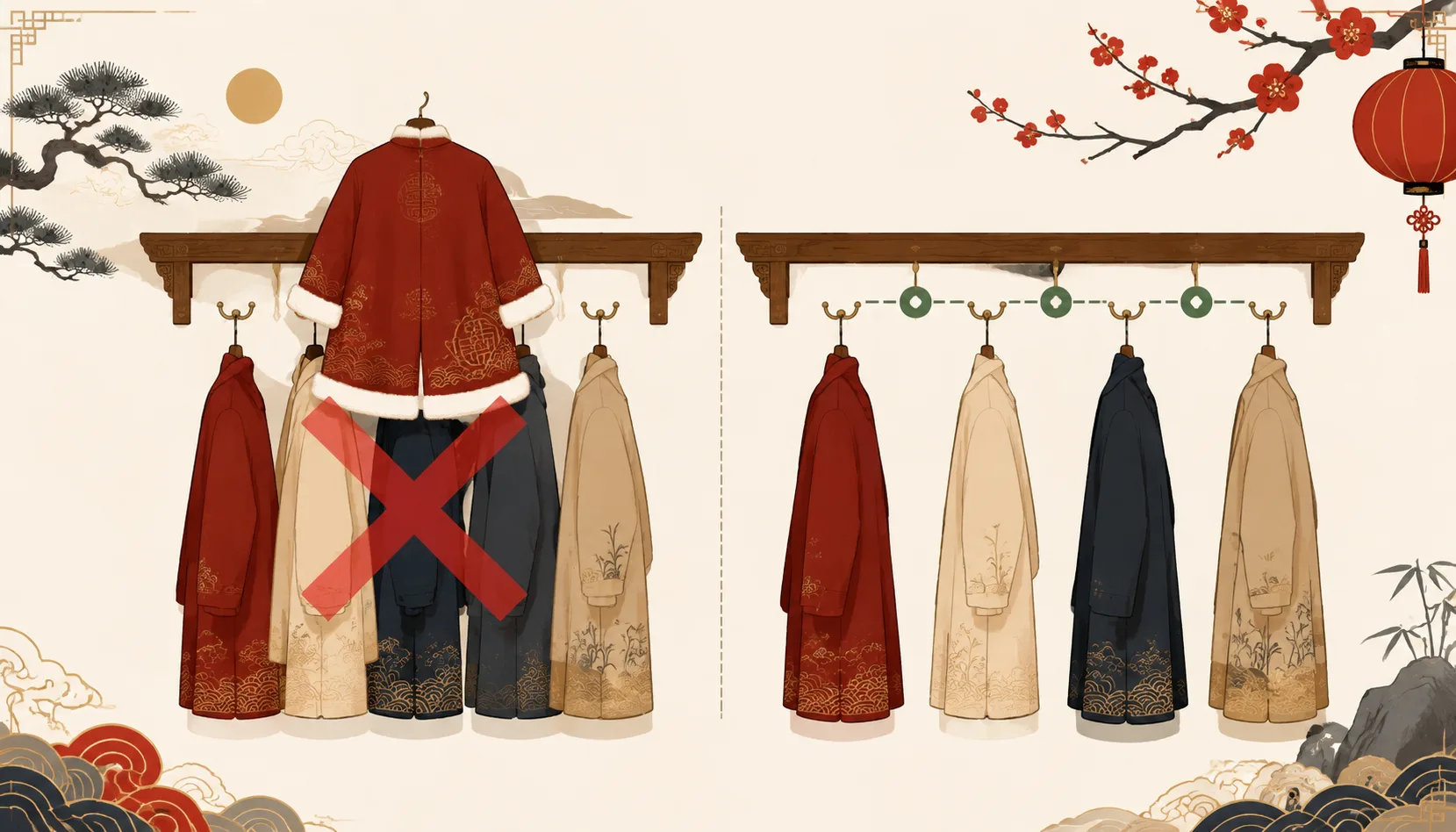
Quick answer
Avoid it. Stacking your coat or hat on top of someone else's is considered unhygienic and disrespectful of personal space.
Why This Rule Matters
Many Chinese people are particular about hygiene and personal space. Placing your clothing directly on others' is seen as invasive and unhygienic — your coat may carry dust, outdoor air, or pet hair that others don't want on their clothing. It also shows inconsideration for others' belongings.
What You Should Do
- Find a separate hook, chair, or space for your coat
- Fold your coat neatly and place it in an open spot not on top of others'
- Ask the host where to put your coat when you arrive
What You Shouldn't Do
- Hang your coat over someone else's coat on the same hook
- Place your hat on top of someone else's hat
- Stack your items on top of a pile of other people's belongings
Practical Tips for Foreigners
This rule applies in most social and formal settings across China. When in doubt, watch what your Chinese host or senior colleague does and follow their lead. Breaking this rule once is forgivable — breaking it repeatedly signals a lack of cultural awareness.
The Unspoken Hierarchy of Shared Hooks
In China, the coat rack isn't just furniture—it's a silent map of social standing. When you drape your jacket over a colleague's, you're unintentionally claiming dominance in a space that has no official rules but plenty of unspoken ones. In Beijing's state-owned enterprises or Shanghai's traditional trading firms, the senior manager's coat always gets the top hook or the most accessible spot. <a href="/holidays/minor-chinese-holidays-guide/">Foreigners often miss</a> this because Western offices treat coat racks as democratic territory. But here, the order of coats mirrors the order of the room. If you're the newest hire and your North Face ends up on top of the director's cashmere overcoat, you've just announced a promotion you haven't earned.
Regional Differences: North vs. South
The strictness of this rule shifts with geography. In northern cities like Beijing and Tianjin, where winters are brutal and heavy coats are a necessity, people are more possessive—your wet, snow-covered jacket touching their dry one is practically an insult. In southern hubs like Guangzhou or Shenzhen, where coats are lighter and rarely worn, the rule relaxes; younger professionals in tech parks often share hooks without a second thought. But don't let that fool you in Guangdong's older business districts or among Fujianese elders who run family trading houses—for them, the rule is ironclad. The safest approach: in the north, treat every coat as sacred; in the south, read the room's age and industry before you risk it.
Real Scenarios: When Coats Cause Conflict
- At a dinner party in Beijing, a Canadian guest draped his coat over the host's expensive wool overcoat on the hallway rack. The host noticed the pressure crease later and quietly moved his coat to the bedroom, but the warmth of the evening cooled noticeably.
- A German businesswoman in Shanghai placed her trench coat directly on top of a colleague's new cashmere coat during a networking event. The colleague removed her coat immediately, folded it over her arm for the rest of the evening, and avoided further conversation with the German.
- During a housewarming in Chengdu, a French guest hung his jacket on the same hook as the host's leather coat, causing the leather to stretch slightly. The host's wife pointedly rearranged the coats in front of everyone, saying 'we need to protect good things,' and the guest felt embarrassed the whole night.
- At a casual gathering in Shenzhen, an Australian visitor tossed his backpack and coat onto a pile of coats on a shared bench. One of the hosts, whose handmade wool scarf was underneath, pulled it out with a frown and said, 'Oh, my scarf is crushed,' leading to an awkward silence.
What Your Host Thinks But Won't Say
If you pile your coat on theirs, your Chinese host or colleague is likely thinking: 'Doesn't he know that's rude?' or 'Is he trying to show he's above me?' But they won't voice it—confrontation is avoided at all costs. Instead, you'll get subtle signals: a pointed glance at the coat rack, a gentle 'Why don't you put that over there?' from a third party, or a cold shoulder that lasts a week. The worst part? You'll never know what you did. So when in doubt, always ask: 'Where should I put this?' It's a small question that saves you from becoming the office pariah without a clue.
What Chinese People Actually Say
- 不要把衣服搭在别人身上 | bù yào bǎ yīfu dā zài bié rén shēn shàng | Don't drape your clothes on others | Say this directly when asking someone to remove their coat from yours
- 礼让 | lǐ ràng | courtesy; yielding to others | Use as a reminder about giving space to others' belongings
- 尊重 | zūn zhòng | respect | Reference this value when explaining why the etiquette matters
2026 Reality Check
2026 Reality Check: This rule exists but is largely fading. Most younger Chinese don't even know it exists.
Gen Z vs. Older Generations: Boomers and Gen X still mutter about it, especially in formal settings. Gen Z? They barely register the concept. With co-working spaces and shared offices, the "don't put your coat on my chair" anxiety has softened. Younger people are more casual about personal space boundaries.
Beijing/Shanghai vs. Smaller Cities: Tier-1 cities are more relaxed—people are used to crowded spaces and shared environments. Smaller cities and traditional workplaces (government, state-owned enterprises) still show more respect for this etiquette. Older women in particular may side-eye anyone draping a coat over their bag or chair.
Bottom line: The rule isn't dead, but it's becoming a generational and regional relic. It's now more about respecting personal space in crowded situations than a strict social rule.
Frequently asked questions
Why is it considered rude to drape my coat over someone else's in China?
It's seen as unhygienic and a violation of personal space, implying your items are 'above' theirs. Always use a separate hook or place your coat elsewhere.
What should I do if there's only one coat hook available and someone's coat is already there?
Wait for the owner to move it, or ask politely if you can hang yours nearby. Never stack yours on top of theirs, even briefly.
Is it okay to put my hat on a pile of coats at a restaurant or gathering?
No, avoid placing hats on any pile of clothing. Use a separate chair, bag, or ask staff for a hanger to keep your items separate.
What if I accidentally drape my coat over someone else's—how should I react?
Apologize immediately and remove your coat, saying 'duì bu qǐ' (sorry). Then find a separate spot to hang it to show respect.
Are there exceptions, like at a casual event or among close friends?
Even with close friends, it's safer to avoid stacking. If you must, ask first—but most Chinese still prefer separate spaces for hygiene.
How can I politely ask someone to move their coat so I can hang mine?
Say 'Qǐng wèn, wǒ kěyǐ bǎ wǒde yīfu guà zài zhèr ma?' (May I hang my clothes here?) and gesture to the hook. Most will happily move their coat.
Try our tools
Related guides

Ancient Chinese Etiquette Rules: The Unwritten Code Every Foreigner Should Know
China has thousands of years of accumulated social rules — many of them "unwritten" but universally understood. These rules cover everything from how you sit, h…
Read the guide →
10 Social Mistakes Foreigners Commonly Make in China
The most common mistakes cluster around face (publicly correcting or disagreeing with someone), physical greeting norms (hugging or back-patting people who are …
Read the guide →
Chinese Office Etiquette: Dress Codes, Nap Culture, and Team Building
Chinese office etiquette has three surprises for most Westerners: dress codes are industry-specific and more formal than you'd expect, the lunch nap (午休) is a r…
Read the guide →