What are the key daily etiquette rules foreigners should follow in a Chinese office?
Quick answer
Chinese office etiquette has three surprises for most Westerners: dress codes are industry-specific and more formal than you'd expect, the lunch nap (午休) is a real and protected cultural institution, and team-building events are social obligations rather than optional activities. Getting these right sets the foundation for everything else.
Day-to-day office life in China has its own rhythms that are often invisible until you accidentally violate one of them. The colleague who sighs when you take a call during noon break. The HR manager who notes that you skipped the team trip again. The unspoken pressure to stay a few extra minutes after the official end of day. These are the texture of Chinese office culture — and understanding them makes working life significantly more comfortable for everyone involved.
Dress Codes: Read the Industry, Not Just the Office
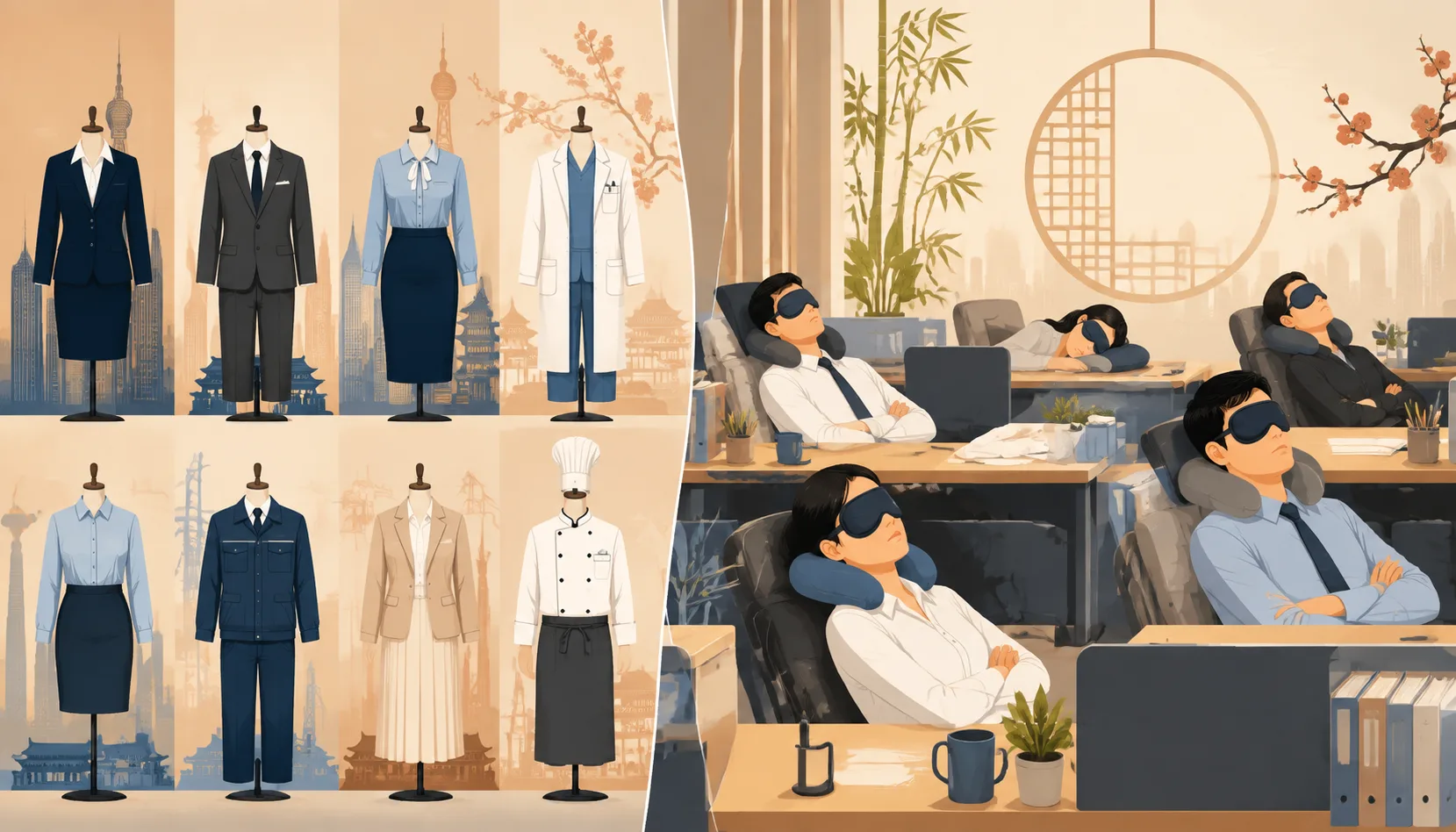
Chinese workplace dress codes are strongly industry-specific. What's appropriate in a Shenzhen tech startup would be out of place in a Shanghai law firm. The most reliable rule: when in doubt, dress one level more formal than you think necessary, then adjust based on what you observe.
| Industry | Expected standard |
|---|---|
| Finance, law, consulting, government-adjacent roles | Business formal: suits, dress shirts, leather shoes for men; business suits or formal dresses for women |
| Internet, tech, startups, advertising | Business casual to casual: jeans and clean t-shirts are fine; athletic wear and flip-flops are not |
| Manufacturing, industrial | Semi-formal: collared shirts and neat trousers; not as strict as finance |
| Education, media, design, culture | Creative but appropriate: personal style is welcome; overly revealing or very casual is not |
Common dress mistakes
- Wearing sandals or flip-flops to any office, including tech companies.
- Clothing that is too revealing by local standards, even in warm months — this generates quiet negative commentary.
- Being significantly more casual than the rest of the team when meeting clients or senior leadership, which reflects poorly on the group.
Strategy: On your first day, dress more formally than you think necessary. Observe for one week, then adjust toward the actual norm.
Why does workplace formality feel like distance to foreigners but read as respect in China? The deeper guide explains the logic behind the dress and demeanor.
The Lunch Nap: 午休 Is Sacred
If you're new to working in China, this scene will arrive eventually: you finish lunch and return to the office at 12:30, and the lights are off. Colleagues are asleep at their desks, some with eye masks, some with folding neck pillows, a few with compact folding cots tucked beside their chairs. The whole floor is silent.
This is 午休 (wǔxiū) — the midday rest — and it is a genuinely protected part of Chinese daily life. Most Chinese offices allow 30 to 90 minutes of lunch rest. The cultural belief behind it: a proper midday rest makes the afternoon productive; skipping it leads to deteriorating focus. This is treated as practical reality, not laziness.
What this means for you
- Do not make noise during afternoon rest. No phone calls, no loud conversations, no impromptu desk meetings. If you must take a call, step outside or into a glass-walled conference room.
- Do not bang on keyboards or shuffle around actively while others are sleeping near you — even if you personally don't nap.
- Do not schedule meetings during 午休 without checking first. A noon meeting request from a foreign colleague will often generate quiet resentment.
- Feel free to nap if you'd like to. It is normal, healthy, and will be positively received. A small folding neck pillow is all you need.
Team Building: Why You Should Show Up
Chinese-style team building — 团建 (tuán jiàn) — often includes activities that Western professionals find genuinely uncomfortable: group outdoor challenges with shouted motivational slogans, mandatory karaoke, company-wide talent shows, elaborate banquet dinners with complex toasting protocols.
Many foreign employees write these off and find reasons to skip. This is understandable, but strategically costly.
Why attendance matters
In many Chinese workplace cultures, participating in group activities — especially ones that require some vulnerability or silliness — signals that you trust the team, value the relationship, and are not positioning yourself as above the group. Repeated absences send the opposite message: that you consider yourself separate, or that you find the team not worth your time. Both interpretations damage your working relationships.
How to attend without suffering too much
- Go with low expectations. You are there to show willing, not to have the best night of your life.
- Participate in whatever is asked. If there's a karaoke segment, singing one English song (any English song, at any quality) will be received with warmth and applause.
- If you genuinely cannot attend, give advance notice — not a same-day cancellation — and cite a specific personal obligation. Saying "I have a prior family commitment" is accepted; "I don't really enjoy these events" is not.
For managers specifically
If you are in a management role, your presence at team-building events carries extra weight. Chinese employees watch whether their manager participates fully, pays for dinners, and is willing to be playful alongside the team. A manager who shows up, pays for a round of drinks, and loses gracefully at a team game earns significant goodwill — far more than the same evening spent working would have produced.
Office Romance: Low Risk Unless High Profile
Chinese companies rarely have formal prohibitions on office relationships, but the social environment around them is quite sensitive — particularly in smaller teams or where there is a hierarchy between the two people involved.
The main risks
- Same team: If the relationship ends, working together becomes extremely difficult. Office gossip in Chinese workplaces is particularly active, and a broken same-team relationship can follow both people for a long time.
- Manager-subordinate: Even where not formally prohibited, this crosses a serious line in most companies. It is viewed as unfair to other team members and creates conflict-of-interest questions around performance reviews, promotions, and project assignments.
- High visibility: Public displays of affection, obvious couple behavior in the office, or being an open secret across the whole floor invites gossip and can be used against you during tense periods.
Practical guidance: If a relationship develops between colleagues at the same level, in different departments, it tends to cause the fewest problems. Discretion is more important than the relationship itself — most Chinese workplaces will quietly tolerate what they don't officially have to acknowledge.
Safe vs. Risky Topics for Office Small Talk
Chinese office social conversation — over tea, during lunch, waiting for a meeting to start — follows an unspoken menu of what works and what doesn't.
Reliable safe topics
- Food and restaurants — an inexhaustible topic in Chinese culture
- Travel, especially domestic trips within China
- Recent TV dramas or films
- Children's education (common among colleagues with families)
- Your hometown or home country's food and geography
- Sports, especially if there's a shared interest
Topics to avoid
Certain subjects carry disproportionate social risk in a Chinese office setting, particularly for foreigners whose cultural position is already somewhat delicate. Political topics — including comments on government policy, governance comparisons between countries, or historical events with contentious interpretations — are best avoided entirely. What feels like casual intellectual discussion in another context can create significant discomfort for Chinese colleagues, who may not know how to respond or may worry about the conversation being overheard.
Similarly, regional jokes or stereotypes about Chinese provinces (common in informal Chinese humor but hazardous for outsiders to participate in), and any critical commentary about Chinese culture or habits presented as though to an audience outside China.
The safest test: if the topic requires someone to defend their country, their culture, or their government's choices — drop it or redirect. The goal of office small talk is connection, not debate.
What Chinese People Actually Say
- 正装 | zhèngzhuāng | formal/business attire | Use when dressing up for important meetings or client visits
- 午休 | wǔxiū | lunch break/nap time | Respect colleagues' nap time; keep noise down
- 团建 | tuánjiàn | team building | Participate actively to build camaraderie with coworkers
2026 Reality Check
Dress Codes: Formal business attire is now rare outside finance and law. Tech and startup culture embraces casual wear—hoodies and sneakers are common even in big cities. Gen Z sees formal dress as outdated; older workers still occasionally wear suits to important meetings.
Nap Culture (午睡): The "desk nap" remains widespread but declining. Younger workers prefer scrolling phones or gaming during lunch breaks. Some companies now offer nap pods, but many offices have eliminated the traditional post-lunch rest period due to open-plan layouts and longer work hours.
Team Building: Mandatory karaoke and heavy drinking dinners are fading in Beijing and Shanghai, especially with Gen Z pushing back. Smaller cities and older management still embrace these traditions. Virtual team-building apps have grown, but face-to-face bonding dinners remain standard.
City Divide: Tier-1 cities are more relaxed and Western-influenced. Tier-2/3 cities and state-owned enterprises retain more traditional formality. Overall, 2026 shows a clear shift toward flexibility, but generational and regional gaps persist.
Frequently asked questions
Can I wear jeans to a Chinese office job if I'm a foreigner?
It depends on your industry. Tech startups and creative agencies accept jeans, but finance, law, and government-related offices expect business formal. When in doubt, observe what your Chinese colleagues wear for the first week. If they wear suits, you should too. Casual Friday is rare outside multinational companies.
What happens if I skip the lunch nap at my Chinese workplace?
You won't be punished, but you'll stand out. Many offices dim lights and close doors between 12:30 and 1:30 PM. If you can't sleep, use this time for quiet reading or a solo walk. Avoid making phone calls or playing loud videos—it's considered disrespectful to colleagues who are resting.
How do I politely decline a team-building activity without offending my boss?
Team building is often mandatory in Chinese companies. If you have a genuine conflict, tell your manager directly and offer an alternative, like helping with logistics. Saying 'I don't like these activities' is seen as rejecting the team. One or two absences are tolerated, but frequent refusals will hurt your performance reviews.
Is it acceptable to date a coworker in a Chinese office?
Unlike in some Western countries, office romance isn't officially banned in most Chinese companies, but it's heavily discouraged. If you date a colleague, keep it completely private. Public displays of affection at work or company events are frowned upon. If the relationship becomes serious, one of you may be expected to transfer departments.
What topics should I never bring up in casual office conversation?
Avoid discussing politics, Taiwan, Tibet, or the Communist Party—even as a joke. Also skip salary comparisons and direct criticism of your boss or the company. Safe topics include food, travel, family, and Chinese history. If colleagues bring up sensitive topics, listen politely and redirect the conversation to something neutral.
Can I wear a suit with a colorful tie or should I stick to plain colors?
Colorful ties are fine in creative industries but risky in traditional sectors like banking or state-owned enterprises. In conservative offices, stick to navy, dark red, or grey ties. Bright patterns can make you look less serious. When in doubt, mirror the style of your senior male colleagues—they set the unwritten standard.
Try our tools
Related guides
Chinese Workplace Culture: The Complete Guide for Foreigners
Chinese workplaces run on three hidden pillars: 先做人后做事 (build relationships before doing business), 面子 mianzi (public face and dignity), and 关系 guanxi (relation…
Read the guide →
Chinese Business Titles: How to Address Chinese Colleagues
In Chinese business settings, you address people by job title + surname, not by first name. "Director Li" (李总监), "Manager Wang" (王经理), "President Zhang" (张总). U…
Read the guide →
Chinese Business Etiquette Guide 2026: What You Must Know
Chinese business etiquette is easier to navigate when you watch three recurring patterns: relationship-building (guanxi), protecting dignity in public (mianzi),…
Read the guide →