How do foreigners build good relationships with Chinese coworkers?
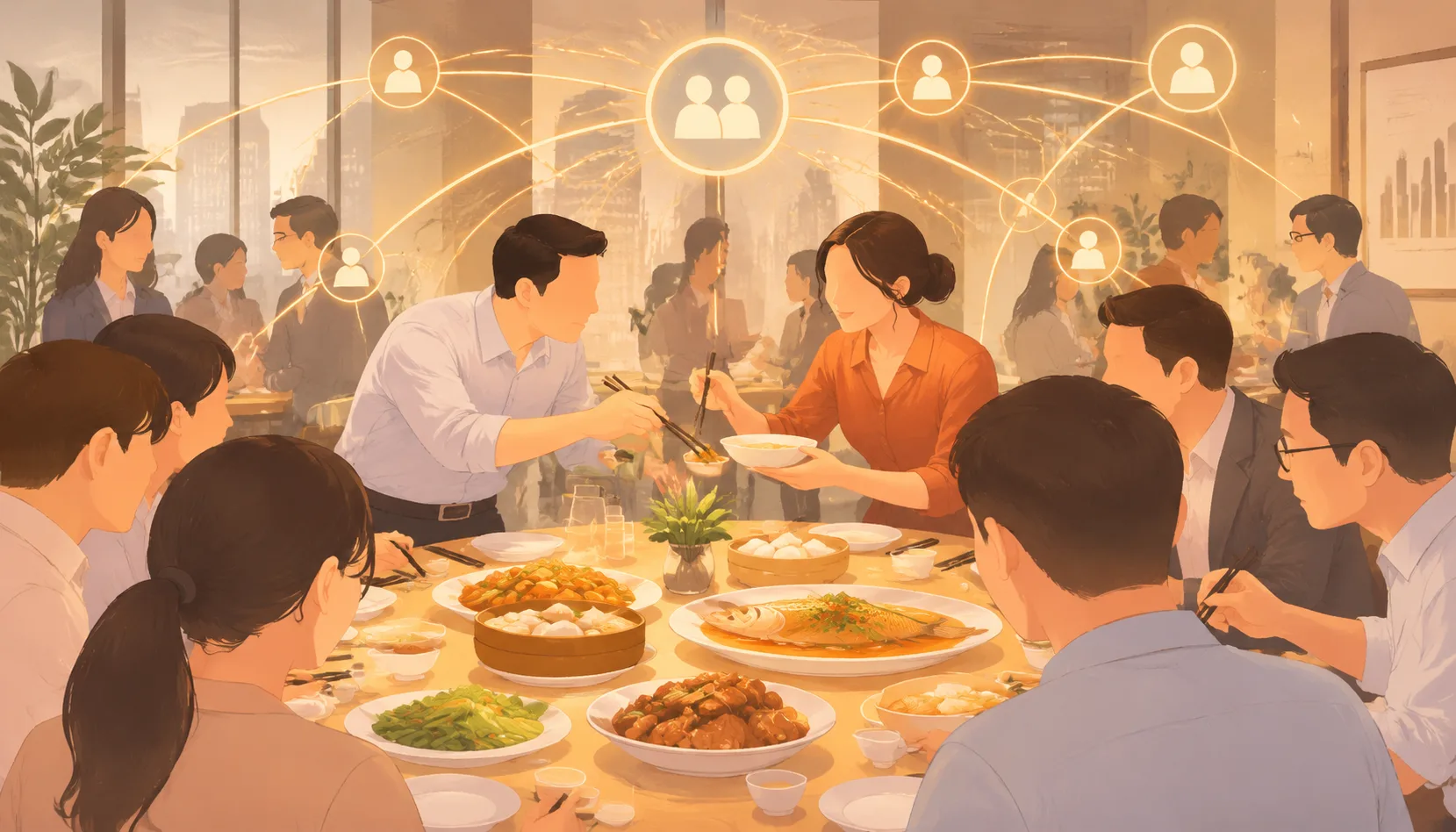
Quick answer
Expect personal questions about salary, age, and relationship status — they signal warmth, not rudeness. Return meal invitations within 1-2 weeks. Choose a 'friendly neutral' position in office cliques rather than picking sides. If colleagues aren't inviting you to lunch, make the first move — they're likely just nervous about English.
Building working relationships in a Chinese office feels different from what most Western professionals expect. The social norms around privacy, reciprocity, and group belonging operate by different rules — and misreading them is surprisingly easy. This guide covers the most common peer-relationship situations foreigners encounter, with concrete approaches that actually work.
Why Colleagues Ask About Your Salary, Age, and Relationship Status
Within the first week of starting a new Chinese job, a colleague will almost certainly ask you how much you earn, whether you're married, or how old you are. If your instinct is to feel that a line has been crossed, it is worth understanding what is actually happening.
In Chinese social culture, these questions are a form of warmth and inclusion — the equivalent of Western small talk about the weekend or the weather. They help people place you in a social context ("are you older or younger than me? should I defer to you or are we peers?") and signal that they are treating you as an insider rather than a formal stranger.
There is no legal or professional prohibition in Chinese workplace culture against asking these questions. The intent is almost always neutral to friendly.
How to respond without awkwardness
- If you don't mind answering: Give a rough range or redirect — "Oh, enough to get by" — and move on.
- If you'd rather not answer: Use deflection with light humor rather than a sharp boundary. "Ha, that's top secret. What about you?" works well and redirects without creating friction.
- What not to do: A cold or sharp response — "That's private information" — will be read as arrogance, even if that's not your intent. The colleague asking usually had no idea they were stepping on a cultural norm.
Case study: An American software engineer, asked about his salary by a friendly colleague, replied firmly that his compensation was private. The message spread through the team that he was standoffish and unfriendly. The colleague had simply been trying to connect. A month later, the engineer noticed he was never included in casual lunch invitations.
Office Cliques: Join, Avoid, or Navigate?
In most Chinese offices, informal subgroups form naturally — the lunch group, the smokers' circle, the gaming friends, the people who all came from the same hometown. These groups share information, cover for each other in small ways, and collectively shape office social life.
The trade-offs
- Joining fully / picking a side: If the group you join falls out of favor — especially if they are aligned with a manager who later loses influence — your career can be collaterally damaged. Deep allegiance to one faction is risky in environments where organizational politics shift.
- Avoiding all groups: Flying completely solo creates an information vacuum. Important things — who's really in charge of what, what's about to change, which project is quietly being defunded — often travel through informal channels before they're formally announced. If you're not in any network, you'll be the last to know.
The recommended approach: friendly neutral
Position yourself as someone who gets along with everyone but has deep allegiance to no specific faction. Accept lunch invitations from different groups. Contribute to informal conversations across different circles. Be pleasant and genuinely interested. This gives you access to information and goodwill from multiple directions, without the political risk of hard alignment.
Meal Reciprocity: The Unwritten Obligation
In Western workplaces, colleagues often split bills or each pay for themselves — no obligation created, no obligation owed. In Chinese workplace culture, meals operate on a different social ledger.
When a Chinese colleague treats you to lunch, they are not just buying food. They are making a social investment, creating a relationship bond, and implicitly expecting reciprocity — not immediately, but within a reasonable window. Accepting repeated meals without ever returning the favor marks you as someone who doesn't "understand" social rules — 不懂事 (bù dǒng shì), literally "doesn't understand how things work."
How reciprocity works in practice
- Timeline: Return a lunch invitation within 1-2 weeks. No need to go immediately — that looks anxious. But do not let it stretch to a month.
- Amount: Match the price range roughly, but going slightly higher is gracious. Going wildly more expensive than what they spent can feel uncomfortable.
- Minimum gesture: If a full lunch isn't practical, a coffee, a milk tea, or a shared snack at the office still counts as acknowledgment. The gesture matters more than the price.
Note: the expectation is for gradual reciprocity, not a transaction. You don't need to buy back every single meal. But a general pattern of give-and-take over time marks you as a trustworthy social participant.
Why Your Colleagues Don't Invite You to Lunch
One of the lonelier early experiences for foreigners in Chinese offices: watching the whole team file out to lunch without a word in your direction. It is easy to interpret this as exclusion or indifference. The actual reason is almost always much simpler.
Your Chinese colleagues are probably nervous about their English. For most of them, a lunch break is a genuine rest — a time to speak their own language, make quick jokes, and stop performing. Inviting a foreign colleague means they will feel obligated to maintain English conversation for an hour, which is tiring. This is not rejection — it is social self-preservation.
How to break this dynamic
- Make the first move yourself. Walk over and say "Mind if I join you?" in a relaxed tone. Once you've done it a few times, it becomes the norm.
- Use a few words of Mandarin. Even broken Mandarin signals "I'm not expecting you to perform English for me." Chinese colleagues find this enormously charming and will relax immediately.
- Express genuine interest in the food. Ask what they ordered. Ask where they're going. Food is a universally comfortable topic in Chinese social settings.
Once you've crossed this threshold a few times, the invitations will come naturally.
内卷 Nèijuǎn: Understanding China's Overtime Culture
"内卷" (nèijuǎn) has become one of the most-used words in Chinese workplaces. It describes a particular kind of exhausting internal competition — where everyone works longer hours not because there is more work, but because they are watching each other and afraid to be the first to leave.
How it shows up in the office
- The manager hasn't left, so no one leaves — even though everyone's work is done.
- People at desks after 8pm are visibly not working — scrolling their phones, reorganizing files — but they're staying to be seen.
- Weekend "optional" attendance at the office is an open secret that isn't really optional.
How to navigate this as a foreigner
- Don't be the first person to leave every single day, especially while your manager is still at their desk. This marks you as someone who doesn't take the team's pace seriously.
- Don't loudly announce your departure. Don't say "I'm done for the day, see you tomorrow" while 20 colleagues are still at their desks. A quiet "you've all worked hard, I'll see you tomorrow" (大家辛苦了,我先走了) is considerate.
- Match the effort at peak periods. Project deadlines, end-of-month crunches, year-end reviews — these are the moments when working late is genuine and expected. Showing up during real crunches gives you the social credit to maintain boundaries during quieter periods.
- Never voice the opinion that "overtime means poor efficiency" out loud in the office. Even if it is sometimes true, saying so out loud alienates everyone around you.
What Chinese People Actually Say
- 做人情 | zuò rénqíng | to do someone a favor; build goodwill | Use when describing helping colleagues to build reciprocal goodwill.
- 给面子 | gěi miànzi | to give face; show respect publicly | Critical in Chinese offices—accept criticism graciously to preserve someone's dignity.
- 搞关系 | gǎo guānxi | to build/manage relationships; network | Essential for career success—invest time in building connections beyond just work tasks.
2026 Reality Check
2026 Reality Check: Hierarchy still matters, but it's softening. Younger workers push back on mandatory after-work drinking and excessive deference to seniors, though older colleagues still expect basic respect.
Gen Z vs. Older Generations: Gen Z prioritizes work-life balance and questions authority openly. They prefer direct feedback over face-savingIndirectness. Millennials and Gen X still value hierarchy and "saving face" in public, but even they now use WeChat for quicker, less formal communication.
Beijing/Shanghai vs. Smaller Cities: Tier-1 cities embrace more Westernized, flat structures—startups especially. Smaller cities and state-owned enterprises still enforce traditional seniority, guanxi (关系), and collective activities like team dinners. Remote work has loosened some rigid office dynamics nationwide.
Bottom Line: The old rules aren't dead, but they're evolving fast in urban, younger workplaces. Guanxi still opens doors; blind obedience is fading.
Frequently asked questions
What should I do when Chinese coworkers ask me how much I earn?
Answer vaguely but cheerfully, like 'enough to get by!' or deflect with a joke. In China, salary questions are small talk showing interest in your wellbeing, not nosiness. You can also flip it: 'What about you?' Most coworkers will accept a light deflection without pressing further.
Is it rude to decline a lunch invitation from a Chinese colleague?
Declining occasionally is fine, but never refuse outright without a reason. Say 'I have plans today, but let's go next week!' — this keeps the relationship warm. If you decline too often, coworkers may stop inviting you, interpreting it as rejection. One accepted invitation per two declined keeps the balance.
Why do my Chinese coworkers keep asking if I've eaten yet?
'Have you eaten?' is a standard greeting, not an actual meal invitation. Reply 'Yes, you?' or 'Not yet!' and move on. It's a cultural habit rooted in times when food was scarce. Don't overthink it — it's the Chinese equivalent of 'How are you?' and requires no detailed response.
Can I skip after-work drinking sessions with Chinese colleagues?
Yes, but attend occasionally — maybe once a month. These sessions build trust and reveal office dynamics. If you skip every time, you'll be seen as aloof. When you do go, order a drink (even juice) and stay for at least an hour. Toasting your boss or team once shows respect.
What if my Chinese coworker gives me a gift I can't reciprocate?
Accept it with both hands and show genuine appreciation. Reciprocate within a month with something of similar value — fruit, snacks, or a small souvenir from your home country. Never open the gift immediately in front of them; that's considered rude. A verbal 'thank you' plus a later return gift maintains balance.
How do I handle being left out of WeChat group chats?
Don't take it personally — it's often oversight, not exclusion. Casually ask a friendly coworker, 'Is there a team group chat? I'd love to join.' If they add you, great. If not, keep building one-on-one relationships. Many groups are for logistics only; important decisions still happen face-to-face.
Try our tools
Related guides

Chinese Workplace Culture: The Complete Guide for Foreigners
Chinese workplaces run on three hidden pillars: 先做人后做事 (build relationships before doing business), 面子 mianzi (public face and dignity), and 关系 guanxi (relation…
Read the guide →
How to Communicate with Your Chinese Boss: A Practical Guide
Never challenge your Chinese boss publicly, even when you're right. Use a three-step private formula — affirm the overall idea, add your suggestion, then lower …
Read the guide →
Chinese Office Etiquette: Dress Codes, Nap Culture, and Team Building
Chinese office etiquette has three surprises for most Westerners: dress codes are industry-specific and more formal than you'd expect, the lunch nap (午休) is a r…
Read the guide →