Chinese Business Etiquette Guide 2026: What Western Professionals Must Know
Quick answer
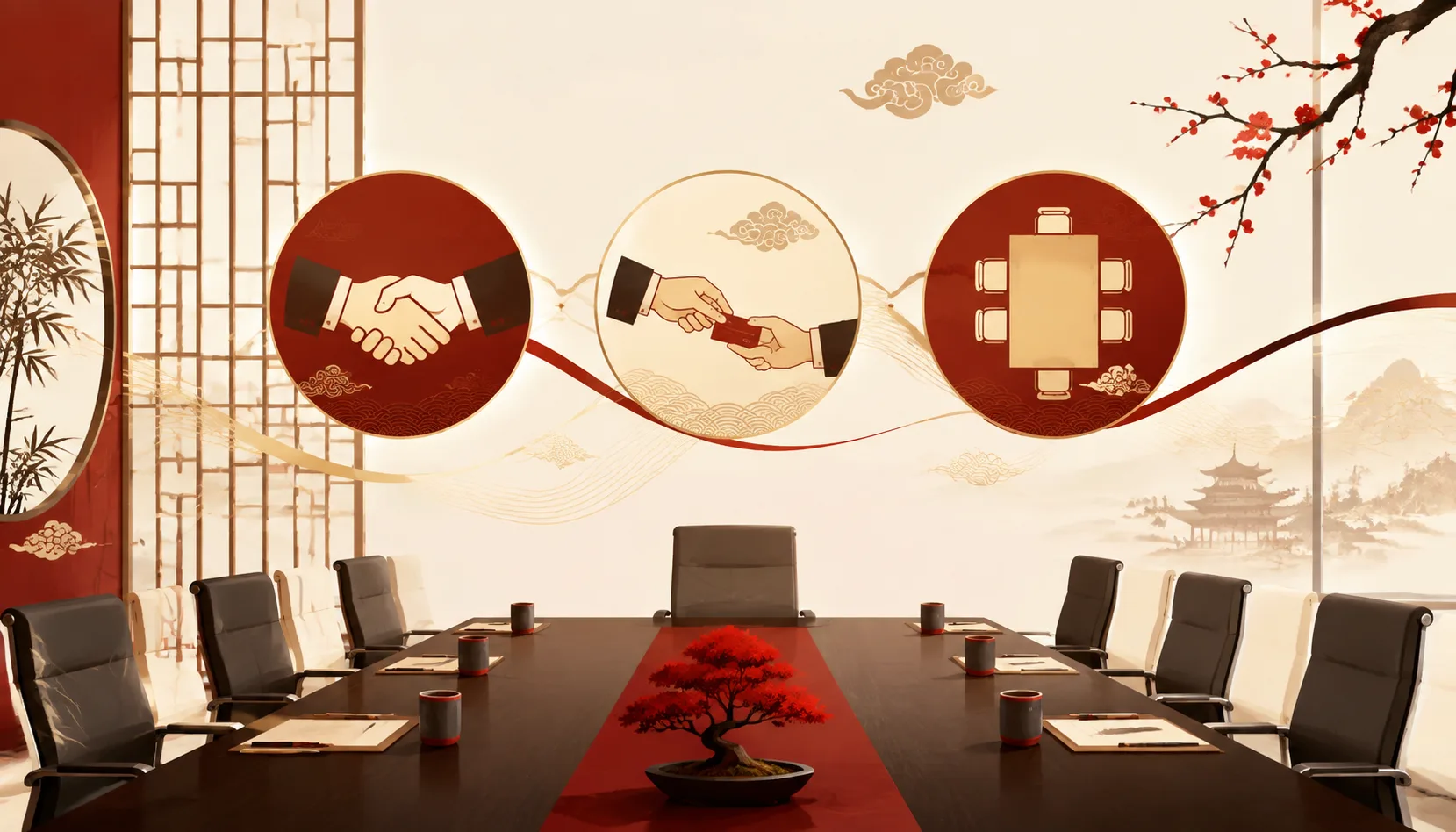
Chinese business culture runs on three invisible engines: Guanxi (relationships), Mianzi (face), and Hierarchy (rank order). Get these right and deals follow. Get them wrong and you may never know why the meeting felt off. This guide covers the complete protocol for every business scenario you'll encounter in China.
Quick Answer
Chinese business culture runs on three invisible engines: Guanxi (relationships), Mianzi (face), and Hierarchy (rank order). Get these right and deals follow. Get them wrong and you may never know why the meeting felt off. This guide covers the complete protocol for every business scenario you'll encounter in China.
The Three Laws You Can't Skip
Before any specific rule, you must understand what's underneath all of them.
Law 1: Guanxi (关系) — Business Is Personal
Pronunciation: gwan-shee
In the West, you close a deal and then build a relationship. In China, you build a relationship and then close a deal. Guanxi is a long-term social contract of mutual obligation. Chinese counterparts want to know: Can I trust this person over time? Are they reliable? Do they understand how things work here?
This is why:
- Banquets come before contracts
- Follow-up WeChat messages matter more than follow-up emails
- Being introduced through a mutual contact is worth more than a cold pitch
Practical translation: Budget time and money for relationship-building that produces no immediate deliverables. It's not wasted — it's the foundation.
Law 2: Mianzi (面子) — Face Is Serious Currency
Pronunciation: myen-dzuh
"Face" in China is not vanity. It is social capital. Mianzi is earned through status, reputation, and public recognition — and it can be destroyed in an instant by public embarrassment.
This means:
- Never correct a Chinese counterpart in front of their team
- Never say "no" directly (use "this may be difficult" instead)
- Never show frustration publicly, even in tense negotiations
- Letting someone save face when a deal fails keeps the door open for next time
Practical translation: Before you speak, ask: "Could this make someone look bad in front of others?" If yes, find another way.
Law 3: Hierarchy — Rank Governs Everything
China operates on clear seniority rules in every setting. Who enters first, who sits where, who speaks first, who gets toasted first — all follow hierarchy. The senior person:
- Gets the seat facing the door
- Receives the first toast
- Initiates conversation topics
- Moves first at every transition point
Practical translation: Know who the most senior person in the room is before you walk in. Address them first. Let them lead.
The Four Business Scenarios
Every Chinese business interaction fits into one of these scenarios. Each has its own rules.
Scenario 1: Formal Meetings
The most structured environment. Seating is assigned, not chosen. You wait to be directed. The agenda proceeds by seniority. → Full guide to formal meeting etiquette
Scenario 2: Client Visits
More personal than a meeting. You are in their space. Different rules apply for entering, conversation length, and when to leave. → How to visit Chinese clients
Scenario 3: Business Negotiations
The slow-play is correct. Direct "no" is wrong. Silence is strategic. Concessions have a specific rhythm. → Chinese business negotiation guide
Scenario 4: Business Banquets
The most important relationship-building event. Seating, toasting sequence, chopstick rules, and who pays — all have a precise protocol. → Chinese business banquet etiquette
Quick Reference: 20 Rules That Cover 90% of Situations
Universal:
- Arrive 5-10 minutes early — never late
- Know everyone's title before you arrive; use 职务 (job title) as their form of address — "Director Wang," not "Wang"
- Dress conservatively: dark suit, subdued colors, nothing flashy
- Prepare bilingual business cards; present with both hands, Chinese side facing them
- Wait for the senior person to initiate any handshake
In Meetings:
- Don't choose your seat — wait to be directed
- Spend the first 5 minutes on small talk before any agenda item
- Never interrupt; wait until they finish speaking
- "We'll need to discuss internally" = polite no; don't push
- Send meeting notes within 24 hours in both languages
At Banquets:
- Don't touch chopsticks or food until the host announces "大家开动"
- Never stick chopsticks upright in rice
- Toast in strict order: most senior first, clockwise
- Hold your glass lower than the person you're toasting
- Don't initiate leaving — wait for the host to stand first
- Never give: clocks, umbrellas, pears, shoes, green hats, knives, or anything in white/black packaging
- Do give: premium tea, quality wine, specialty foods from your home country
- Present with both hands; use humble language ("a small token of appreciation")
- Don't give in public — private settings only
- Follow up with a thank-you message the same evening
Chinese Phrases for Business (Instant Goodwill)
Even broken pronunciation earns massive respect. The effort signals that you take the relationship seriously.
| Situation | Chinese | Pinyin |
|---|---|---|
| Greeting | 您好,很高兴见到您 | Nín hǎo, hěn gāoxìng jiàn dào nín |
| "I've heard a lot about you" | 久仰大名 | Jiǔ yǎng dà míng |
| At a banquet | 感谢您的盛情款待 | Gǎnxiè nín de shèngqíng kuǎndài |
| Toasting | 我敬您一杯,祝您事业蒸蒸日上 | Wǒ jìng nín yībēi, zhù nín shìyè zhēngzhēng rìshàng |
| "I can't drink much" | 我酒量有限,您随意 | Wǒ jiǔliàng yǒuxiàn, nín suíyì |
| After the banquet (WeChat) | 今天非常感谢,受益匪浅 | Jīntiān fēicháng gǎnxiè, shòuyì fěiqiǎn |
| Presenting a gift | 这是一点小小心意,请笑纳 | Zhè shì yīdiǎn xiǎoxiǎo xīnyì, qǐng xiào nà |
| Closing a meeting | 期待我们继续合作 | Qīdài wǒmen jìxù hézuò |
Chinese vs. Western Business: The Core Contrasts
| Area | Chinese Approach | Western Approach |
|---|---|---|
| Deal timeline | Build relationship first, then contract | Contract first, relationship follows |
| Communication | Indirect, high-context — read between the lines | Direct, explicit — say what you mean |
| Saying "no" | Never directly — always a softened alternative | Direct refusal is normal |
| Seating | Strict rank order, assigned | First-come or host suggests |
| Business cards | Two hands, read carefully, store with respect | One hand, glance, pocket |
| Banquet purpose | Relationship deepening, trust-building | Celebration after the deal |
| Gifts | Symbolic language with strict taboos | Straightforward appreciation |
| Follow-up | Same-day WeChat/call expected | Next-day email is fine |
| Silence in negotiation | Strategic patience | Awkward; someone fills it |
| The "no" signal | "This may be difficult" / "We'll consider it" | "That doesn't work for us" |
The Biggest Western Mistakes in Chinese Business
These are what cause deals to quietly fall apart without anyone explaining why:
Mistake 1: Treating the banquet like a dinner The banquet is the most important business meeting. Your behavior there is being evaluated more carefully than in the formal negotiation.
Mistake 2: Going straight to the agenda Starting a meeting with "let's get down to business" signals that you don't value the relationship — only the transaction.
Mistake 3: Saying "no" directly "That price doesn't work for us" ends conversations. "That would be challenging given our cost structure — perhaps we could explore X" keeps the door open.
Mistake 4: Giving your business card with one hand This is like handing someone a formal document with your thumb and index finger. It signals casualness where formality is expected.
Mistake 5: Not following up the same evening A WeChat message or call after a banquet ("Thank you so much for tonight, I learned a lot talking with you") is not optional — it's part of the relationship protocol.
FAQ
Q: How do I address someone I've never met? A: Use their job title + surname: "Director Chen," "Manager Wang," "President Li." Never first names unless they specifically invite it (and even then, the invitation may just be politeness — watch what others do).
Q: What if I can't drink alcohol? A: Tell the host before the banquet starts. Say you're driving, on medication, or allergic to alcohol. Ask for tea or juice. When everyone toasts, raise your non-alcoholic glass and say "以茶代酒" (yǐ chá dài jiǔ — "I toast with tea instead"). This is completely accepted.
Q: Is it rude to decline a gift? A: The first time someone offers, a polite decline is expected — it shows you're not greedy. When they insist again, accept with both hands and humble words. Don't decline three times or they'll take it back.
Q: How long should I wait before asking about the status of a deal? A: A week is the minimum after any significant interaction. In Chinese business culture, urgency signals desperation. Patience signals confidence and long-term commitment.
Q: Do these rules vary by region? A: Yes — significantly. Beijing is more formal and hierarchical. Shanghai is more international and slightly more direct. Guangdong/Shenzhen is more deal-focused but relationship-oriented. Interior cities are more traditional. These are tendencies, not absolutes, but knowing your counterpart's region helps.
Key Chinese Business Terms
| Term | Pinyin | Meaning |
|---|---|---|
| 关系 | Guānxi | Relationship network; social capital |
| 面子 | Miànzi | Face; public reputation and dignity |
| 人情 | Rénqíng | Human feeling; the unwritten obligation system |
| 客气 | Kèqi | Being polite/modest (also: don't be too formal!) |
| 领导 | Lǐngdǎo | Leader — how subordinates refer to any senior |
| 主人 | Zhǔrén | Host |
| 主宾 | Zhǔbīn | Guest of honor |
| 以茶代酒 | Yǐ chá dài jiǔ | "I substitute tea for wine" — the polite non-drinker's phrase |
| 先干为敬 | Xiān gān wéi jìng | "I drink first to show respect" — toasting phrase |
| 商务宴请 | Shāngwù yànqǐng | Business banquet |
What Chinese People Actually Say
- 久仰大名 | jiǔ yǎng dà míng | "I've long heard of your great name" | Use when meeting a senior executive or client for the first time as a respectful compliment.
- 请多指教 | qǐng duō zhǐ jiào | "Please give me your guidance" | Use after presenting your ideas to invite feedback humbly during meetings.
- 合作愉快 | hé zuò yú kuài | "Wishing you pleasant cooperation" | Say when concluding a business deal or signing an agreement.
2026 Reality Check
Business Card Exchange: Still standard in Beijing and Shanghai, especially with older executives. Gen Z often skips physical cards in favor of WeChat QR codes, but handing over a card still shows respect in formal meetings.
Hierarchy & Titles: Still matters in state-owned enterprises and traditional companies. Younger workers in startups are more casual, but addressing seniors as "总" (Zong/Manager) remains expected.
Dinner Etiquette: Toast culture persists, but younger professionals are pushing back on heavy drinking. Smaller cities are more traditional; major tech hubs see more relaxed norms.
Gift-Giving: Still common but less elaborate. Anti-corruption crackdowns have curbed extravagant gifts. Cash in red envelopes at weddings remains standard.
Key Shift: 2026 sees hybrid of old and new—formal protocols remain for important meetings, but day-to-day interactions are more casual, especially in private sector and among younger demographics.
Frequently asked questions
How do I build Guanxi if I'm only visiting China for a short business trip?
Start before you arrive. Ask your Chinese partners or colleagues to introduce you via WeChat, then exchange a few messages ahead of time. During the trip, prioritize relationship-building over agenda-pushing: accept meal invitations, ask about family photos on their desk, and follow up with a personal thank-you message. Even three days of genuine effort beats months of email-only contact.
What should I do if I accidentally offend someone and cause them to lose face?
Never apologize publicly — that draws more attention and deepens the embarrassment. Instead, pull the person aside privately, express your regret sincerely, and show respect for their position. Then let a mutual intermediary smooth things over. In most cases, a private acknowledgment plus a small gesture, like a thoughtful gift or a favor, repairs the damage without anyone losing face.
Can I skip the formal business card exchange if I've already connected on LinkedIn?
No. In China, the physical exchange is a ritual that signals respect and seriousness. Hand your card with both hands, hold it so the Chinese text faces the recipient, and take a moment to study theirs before placing it on the table — never in your back pocket. Skipping it reads as dismissive, regardless of your digital connection.
Is it acceptable to bring my own interpreter to a business meeting in China?
Yes, but only if you flag it in advance. Showing up with an unannounced interpreter can make your hosts feel ambushed, especially if they've arranged their own. If you do bring one, introduce them formally and let them sit beside you. Alternatively, ask your Chinese partner to recommend a trusted interpreter — that also signals you respect their network.
When is the right time to talk about pricing during a negotiation?
Never lead with numbers. The first meeting is for rapport, not price. Expect two to three rounds before money comes up, and even then, discuss it vaguely first. Chinese negotiators often test your patience — pushing too early signals you're transactional and weakens your position. Wait for your host to raise the topic, or until the final session when trust is established.
How should I handle a toast at a Chinese banquet if I don't drink alcohol?
You can decline without offense if you explain upfront and offer a substitute. Say, 'I don't drink for health reasons, but I'd love to toast with tea' — then raise your cup enthusiastically when others toast. Never fake-drink or quietly pour it out. Your hosts will respect honesty, and a sincere tea toast still honors the ritual.
Try our tools
Related guides
WeChat Business Etiquette in China: 10 Unwritten Rules You Must Know
Treat WeChat as your professional lifeline: respond within hours during business time, keep your Moments (朋友圈) professional yet personal, use group chats to sho…
Read the guide →
Chinese Social Debt: How 人情 (Rénqíng) Actually Works
人情 is not a favor to be repaid quickly or equally; it's a long-term relational investment. To build trust, acknowledge the debt warmly, let it 'breathe' for wee…
Read the guide →
Why Chinese People Don't Say No: Reading Indirect Refusals
In Chinese communication, direct 'no' is avoided to preserve face for both parties. Instead, you'll hear vague phrases like 'we'll look into it' (我们研究研究) or 'th…
Read the guide →