What are the unwritten rules of WeChat business etiquette in China and how can foreigners use them to build stronger professional relationships?
Quick answer
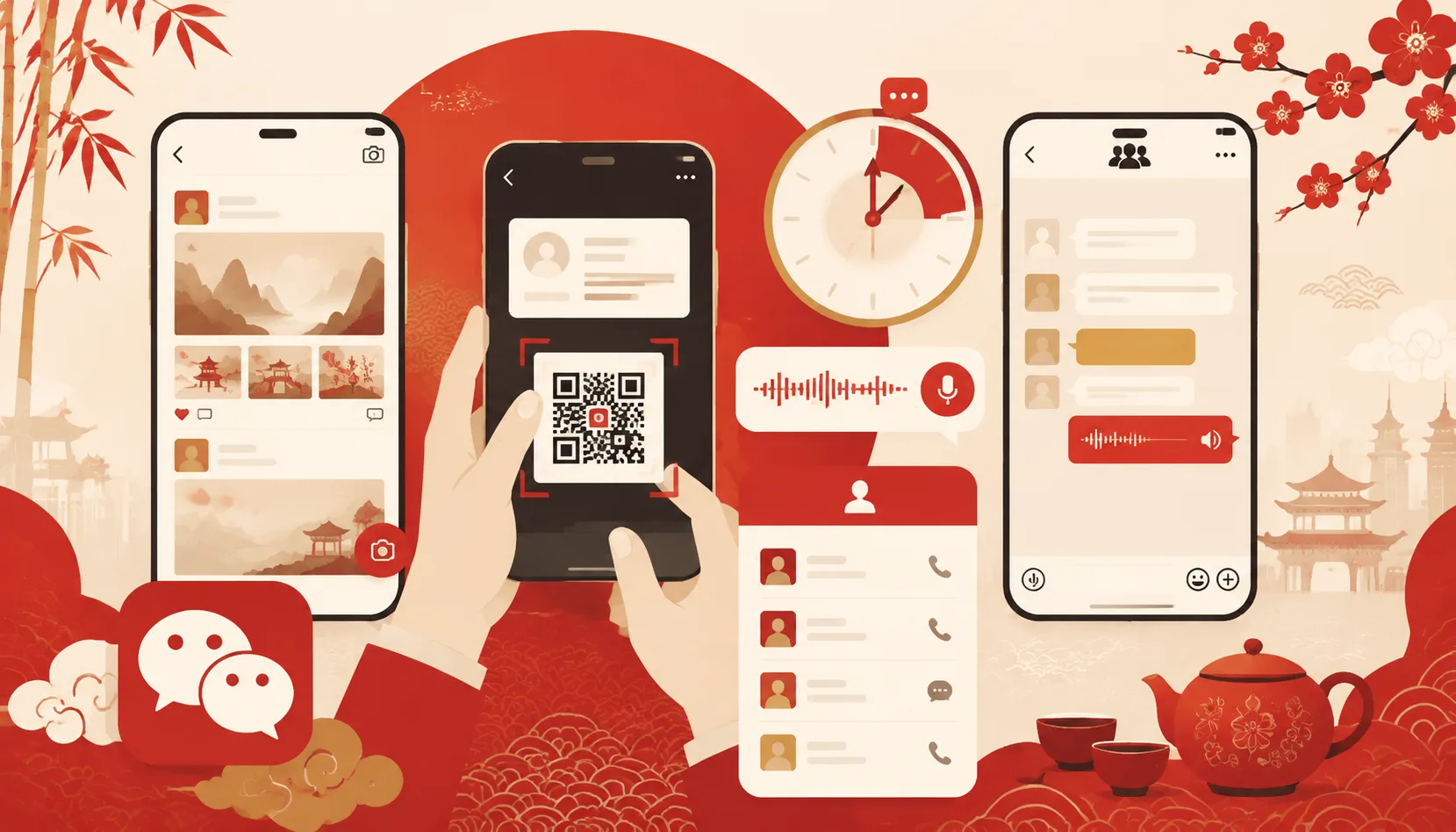
Treat WeChat as your professional lifeline: respond within hours during business time, keep your Moments (朋友圈) professional yet personal, use group chats to show engagement, and always add new contacts via WeChat instead of LinkedIn. Use a real photo and include Chinese characters in your name to be easily recognized.
Why WeChat Is the Heart of Chinese Business Communication
In the West, email is the default for professional communication. In China, that role belongs to WeChat (微信 Wēixìn). It’s not just a messaging app — it’s your CRM, your payment tool, your calendar, and your relationship barometer. When you do business in China, your WeChat presence is as important as your business card — arguably more so.
Chinese professionals expect to communicate with partners, clients, and colleagues primarily through WeChat. Emails are often reserved for formal documentation or follow-ups after a WeChat conversation has already taken place. If you’re not responsive on WeChat, you’re effectively not responsive at all.
Here’s a quick comparison of how WeChat differs from Western tools:
| Aspect | Western Norm | Chinese Norm |
|---|---|---|
| Primary tool | Email / LinkedIn | |
| Response time | 24-48 hours | Within hours (business time) |
| Adding contacts | LinkedIn connection | WeChat QR scan |
| Professional profile | LinkedIn profile | WeChat Moments (朋友圈) |
Core tip: Treat WeChat with the same seriousness as a face-to-face meeting. Your response speed and profile presentation are direct signals of your professionalism and respect for the relationship.
Response Time: The Unspoken Contract
In Chinese business culture, fast responses on WeChat signal respect and seriousness. If a Chinese partner sends you a message during business hours (roughly 9am to 6pm), they expect a reply within a few hours — not the next day. A delay of more than half a day can be interpreted as disinterest or unreliability.
After hours, the rules are more nuanced. Senior Chinese business people often send messages late at night (11pm) or early morning (6am) because they work long hours. They don’t necessarily expect an immediate reply, but they do expect you to acknowledge the message by the next morning. Some, especially in fast-paced industries, do expect quick replies even at odd hours. Read the relationship: if your partner is a night owl, match their pace; if they’re more traditional, a next-morning reply is fine.
Practical tips for response management:
- Set aside specific times to check WeChat (e.g., every 2-3 hours) and reply promptly.
- If you can’t give a full answer, send a short acknowledgment: “收到,我明天上午回复您” (Shōudào, wǒ míngtiān shàngwǔ huífù nín) — “Received, I’ll reply tomorrow morning.”
- Use the “mute” function for non-urgent groups, but check them at least twice a day.
Core tip: When in doubt, reply faster than you think necessary. In China, speed is a form of flattery.
Moments (朋友圈): Your Professional Brand on Display
Your Moments (朋友圈 Péngyǒu Quān) is like a curated window into your life — and Chinese partners will look at it after adding you. It’s not just for friends; it’s a professional branding tool. A blank or overly private Moments can make you seem distant or untrustworthy. A poorly managed one can harm your credibility.
What to post:
- Travel and food — shows you have a life and are relatable.
- Industry insights — positions you as a knowledgeable professional.
- Cultural observations — shows you’re engaged with China, which builds rapport.
What to avoid:
- Political content — even if you’re critical of your own government, it’s risky; Chinese partners may see it as provocative.
- Heavy complaints — about work, life, or anything. It reads as unprofessional.
- Overly personal content — family drama, health issues, or partying photos.
Also, use the “like” and “comment” functions strategically. Liking a partner’s post about a new product or a business trip is a low-effort way to maintain the relationship. A simple “恭喜!” (Gōngxǐ! — Congratulations!) or “太棒了” (Tài bàng le — Awesome!) goes a long way.
Core tip: Post at least once a week, and always keep your content positive and professional. Your Moments is your digital handshake.
Group Chats: Show Engagement, Not Spam
Professional group chats are a staple of Chinese business life. Whether it’s a project team, a client group, or an industry association, you’ll likely be added to several. Ignoring group messages for days reads as disengagement — even if the messages don’t require a direct response.
What to do:
- Check group chats at least once a day and respond when relevant.
- If someone asks a question that applies to you, answer promptly.
- When you have nothing to add, a simple “收到” (Shōudào — Received) or “好的” (Hǎo de — Okay) shows you’re following.
What not to do:
- Don’t spam the group with irrelevant content or excessive emojis.
- Don’t use group chats for one-on-one side conversations — take those to private messages.
- Don’t leave a group without a reason — it can be seen as a snub. If you must leave, send a polite message first.
In group chats, you’ll often see people use “@” to direct a message to someone. If you’re @’d, respond quickly — it’s a direct call.
Core tip: Treat group chats like a shared office space: be present, be polite, and contribute when you have value to add.
Voice Messages: Normal, Not Informal
One thing that surprises many Westerners is the widespread use of voice messages (语音消息 yǔyīn xiāoxī) in Chinese business communication. Chinese professionals often send voice messages instead of typing long texts — it’s faster and more personal. This is completely normal, not informal.
If someone sends you a voice message, you can respond with either text or voice. Both are acceptable. However, if you’re in a meeting or a public place, it’s fine to reply with text and say “我在开会,稍后听” (Wǒ zài kāihuì, shāohòu tīng) — “I’m in a meeting, I’ll listen later.”
Tips for using voice messages:
- Keep them under 60 seconds — long voice messages can be seen as inconsiderate.
- Speak clearly and concisely, just like a phone call.
- If you’re not comfortable sending voice, stick to text — it’s perfectly fine.
Some foreigners worry that voice messages are unprofessional. In China, they’re a sign of efficiency and warmth. Embrace them — it shows you’re adapting to local norms.
Core tip: When in doubt, send a voice message for quick updates or clarifications — it’s the Chinese way of being personable.
Adding Contacts: The New Business Card Exchange
After meeting someone in China — at a conference, a dinner, or a meeting — the immediate next step is to add them on WeChat, not LinkedIn. Exchanging WeChat is the modern equivalent of the business card exchange. It’s a sign that you’re interested in maintaining the relationship.
How to do it:
- Open your WeChat, go to “+” → “Scan” and scan their QR code, or let them scan yours.
- Send a quick introduction message right after adding: “你好,我是[Your Name],很高兴认识您” (Nǐ hǎo, wǒ shì [Your Name], hěn gāoxìng rènshi nín) — “Hello, I’m [Your Name], nice to meet you.”
- If you’re in a group, you can also add them from the group member list, but always send a note on how you got their contact.
Your profile photo and name are crucial. Use a real, clear photo of your face (not a logo or a cartoon). Chinese contacts want to see who they’re talking to. For your name, include your full name in Latin letters, and if possible, add Chinese characters — for example, “John Smith (史密斯)”. This makes it easy for Chinese partners to remember and address you.
Core tip: Always carry your WeChat QR code on your phone’s home screen or in your wallet — you’ll use it more than your business card.
Putting It All Together: Your WeChat Action Plan
Mastering WeChat etiquette is not about following rigid rules — it’s about showing respect and building trust. Here’s a summary action plan to integrate into your daily routine:
| Action | Frequency | Why It Matters |
|---|---|---|
| Reply to business messages within 2-3 hours | Daily | Shows respect and reliability |
| Post on Moments at least once a week | Weekly | Builds your professional brand |
| Like/comment on partners’ Moments | Occasionally | Maintains relationships with low effort |
| Check group chats daily | Daily | Shows engagement and attentiveness |
| Use voice messages when appropriate | As needed | Adds a personal touch |
| Add new contacts immediately | After every meeting | Seals the relationship |
Remember, WeChat is a tool, but the relationship is the goal. By following these unwritten rules, you’ll be seen as a professional who understands Chinese business culture — and that’s a huge advantage.
Final tip: When you’re unsure about a nuance, observe your Chinese colleagues and partners. They’ll show you the way — and they’ll appreciate that you’re trying.
What Chinese People Actually Say
Treat WeChat as your professional lifeline: respond within a few hours during business hours, keep your Moments (朋友圈) professional yet personal, use group chats to show engagement, and always add new contacts.
- 好的,我稍后回复您。 (Hǎo de, wǒ suíhòu huífù nín.) – "Okay, I will reply to you later." – Used when you need time to check before responding.
- 请稍等,我在开会。 (Qǐng shāo děng, wǒ zài kāi huì.) – "Please wait, I'm in a meeting." – Used to excuse a delayed response during a busy schedule.
- 谢谢您的名片,我已添加。 (Xièxiè nín de míngpiàn, wǒ yǐ tiānjiā.) – "Thank you for the name card, I have added (you)." – Used after receiving a new contact to confirm addition.
- 欢迎加入我们的群聊。 (Huānyíng jiā rù wǒmen de qún liáo.) – "Welcome to join our group chat." – Used when inviting a new contact to a business group.
2026 Reality Check
2026 Reality Check: In China's fast‑evolving digital market, generational and city‑tier gaps shape how WeChat is used for business. Gen Z (born after 1997) now accounts for over 30 % of B2B WeChat interactions, preferring short‑form video, mini‑programs, and instant voice notes over long text threads. They expect brands to be authentic, socially responsible, and data‑privacy conscious. In contrast, senior executives (45+) still favor detailed text messages, “red‑envelope” transfers, and formal “you‑hao” greetings.
Tier‑1 cities like Shanghai and Beijing have near‑universal 5G, enabling real‑time video calls and AI‑driven customer‑service bots. Tier‑2/3 cities, while growing rapidly, still rely on low‑bandwidth chat, making concise, text‑heavy content more effective. For success in 2026, tailor your WeChat strategy: adopt quick, multimedia‑rich formats for Gen Z and tier‑1 audiences, while maintaining formal, text‑centric etiquette for older generations and emerging markets.
Frequently asked questions
How quickly should I respond to WeChat messages from Chinese business contacts?
Aim to reply within 1-2 hours during business hours (9am-6pm), even if just saying 'received, will follow up.' Ignoring messages for a full day is seen as disrespectful. For urgent matters, send a brief acknowledgment immediately. Late-night messages can wait until morning, but never leave a business contact hanging overnight without a response.
Can I use WeChat voice messages with Chinese colleagues or should I always type?
Voice messages are common in China, but use them wisely. They're fine for casual updates or when driving, but avoid sending long voice messages to senior executives or new acquaintances. Text shows more formality and creates a record. If you receive a voice message, feel free to reply with one—matching the sender's style builds rapport.
Is it okay to post personal photos on my WeChat Moments if I use WeChat for business?
Yes, but curate carefully. Chinese partners expect some personal content—it builds trust and shows you're a real person. Post about travel, food, family, or hobbies, but avoid politics, complaints about work, or anything controversial. A good ratio is 70% professional content (industry news, achievements) and 30% personal. Set older posts to 'private' before adding new business contacts.
What should I do if a Chinese contact doesn't accept my WeChat friend request?
Don't take it personally. They may have a full contact list or prefer to meet in person first. Try adding them again after a meeting or ask a mutual colleague to introduce you via a group chat. When sending the request, always include a message explaining who you are, how you met, and your purpose—generic requests are often ignored.
When is the right time to move a conversation from WeChat to email or a phone call?
Use WeChat for quick questions, scheduling, and relationship building. Move to email when you need formal documentation, contracts, or detailed proposals. For urgent decisions, a WeChat voice call is acceptable if you've already established rapport. Never send sensitive financial information or legal documents through WeChat—Chinese colleagues will expect email for anything official.
Can I use WeChat group chats to pitch my products or services to Chinese clients?
Never pitch directly in a group chat—it's seen as aggressive and disrespectful. Instead, use groups to share useful industry articles, congratulate members on achievements, or celebrate holidays. Wait for someone to ask a question you can answer, then offer help privately. Building credibility through helpful contributions will earn you more business than any direct pitch ever will.
Try our tools
Related guides

Chinese Business Banquet Protocol: Rules & What Not to Do
A Chinese business banquet is not a meal — it's a trust-building ceremony disguised as dinner. The food is secondary. The goal is to establish that you are a re…
Read the guide →
Why Long Hours Are a Statement as Much as a Schedule in China
It is 8:40 on a Tuesday evening on the twenty-third floor of a Hangzhou office tower, and Li Meng finished her work two hours ago. The quarterly report has been…
Read the guide →
KTV in China Business: Karaoke Etiquette for Foreigners
Treat KTV as a relationship-building ritual, not a performance. Accept the invitation, participate enthusiastically by singing 1-2 songs (one from your home cou…
Read the guide →