What are the rules for posting and engaging with WeChat Moments in China?
Quick answer
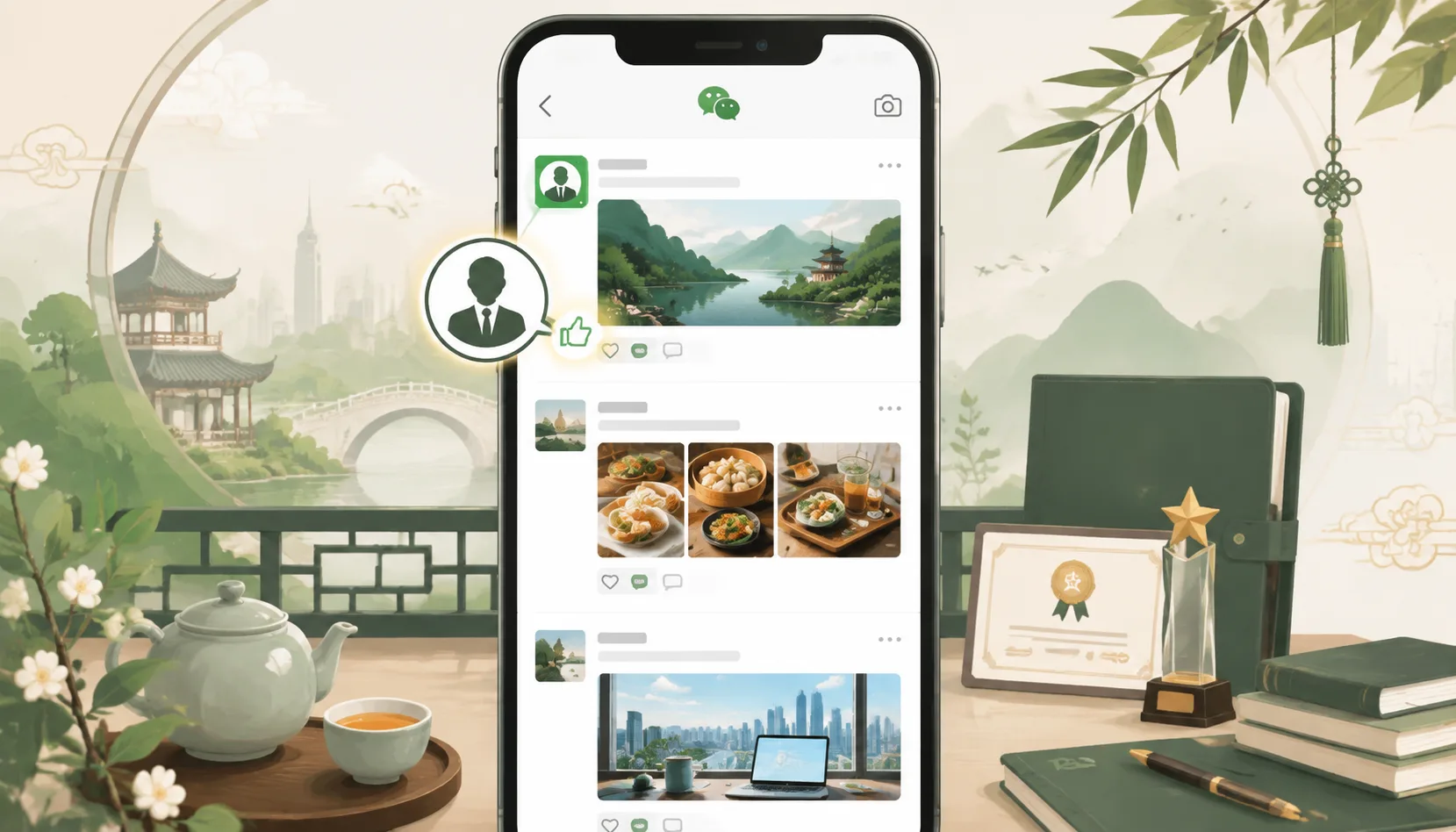
WeChat Moments (朋友圈) is more like a professional-personal hybrid than a pure social feed — your boss, clients, and family all see the same posts. Post 1-3 times per week, keep content positive and appropriate for a mixed audience, and always like or comment briefly when your manager posts something. The privacy group feature lets you control who sees what.
WeChat Moments (朋友圈 péngyouquān) is often compared to Facebook or Instagram — a place to share photos and updates. But the audience dynamics are completely different, and this changes everything about how Chinese users approach it.
On Instagram, most people have at least two audiences: professional contacts and personal friends. Many people manage separate accounts, or simply don't connect work contacts on the platform. On WeChat, almost everyone is in the same pool — your boss, your clients, your college friends, your family, your new colleagues all see your Moments together. This single-audience reality shapes Chinese WeChat Moments culture profoundly.
What to Post: The Mixed-Audience Reality
Because your WeChat Moments audience includes professional contacts, the content that works well tends to be what you'd be comfortable with a senior colleague or client seeing.
Content that works well
- Travel and scenery — conveys a rich life and broad perspective; universally safe
- Food experiences — food appreciation is deeply shared in Chinese culture; photos of good meals get warm responses
- Professional achievements — a completed project milestone, attendance at an industry event, a new certification — in moderation
- Family warmth — children, family gatherings, holiday celebrations (without oversharing)
- Self-improvement signals — fitness, reading, language learning, early morning discipline — well-received in Chinese professional culture
- Thoughtful observations — a brief insight from a book, a quote that resonated — positions you as reflective and substantive
Content that creates problems
- Political commentary of any kind — remember who is in your audience
- Excessive negative venting about work, life, or people
- Photos that are revealing or inappropriate for a professional audience
- Very high-frequency posting (more than 3-4 per day) — rapidly marks you as someone with too much time or a promoter of something
- Mass-promotional content, product marketing, or anything that feels like a sales pitch — will get you quietly muted
Posting Frequency: Quality Over Volume
Chinese professional WeChat culture has an implicit expectation around posting frequency. Both extremes create impressions:
- Never posting: Signals that you don't engage or aren't interested in the social dimension of work relationships. In China, where Moments is a genuine social signal, complete absence can read as standoffish.
- Posting too frequently (5+ times per day): Signals either that you're a micro-business promoter or that you're not busy enough. Either impression is unhelpful professionally.
The sweet spot: 1-3 posts per week. This maintains social presence without overwhelming anyone's feed, and each post gets more attention than it would in a flood of content.
Quality matters: a single well-composed photo with a brief genuine caption performs better socially than five quickly-posted mediocre shots.
Liking and Commenting on Your Boss's Moments
This is one of the small, consistent social rituals of Chinese professional WeChat culture — and one that many Western professionals miss entirely because it seems trivial.
When your manager or a key client posts on their Moments, interacting with it is a low-cost, high-return investment in the relationship. It signals that you're paying attention, that you care about them as a person beyond the work context, and that you value the connection.
Two levels of engagement
- The thumbs-up (basic, always appropriate): Simply like the post. This takes one second and registers as noticed and appreciated by the poster.
- A brief comment (better): A short, warm, specific comment that shows you actually read or looked at the post. Avoid generic "great!" comments — something slightly more specific is more genuine.
Example scenarios
- Boss posts mountain hiking photo: "That view is incredible — great fitness, Manager Li! Which mountain is this?"
- Client shares a child's first day of school: "Lovely moment — they grow up so fast! Congratulations."
- Manager posts a work milestone: "Congratulations to the whole team — well deserved!"
You are not required to like every single post. But being completely absent from their social presence while they can see yours creates a slight asymmetry that is worth avoiding when the professional relationship matters.
Group Visibility: The Privacy Feature You Should Use
WeChat Moments has a powerful but often overlooked feature: you can control who sees each post by creating contact tags and filtering visibility on a post-by-post or contact-by-contact basis.
How it works
You can tag your contacts into groups — "colleagues," "clients," "family," "close friends" — and then when posting, choose which groups can or cannot see a specific Moment. You can also directly block specific individuals from seeing all your Moments.
Why Chinese users rely on this heavily
Because the WeChat audience is so mixed, experienced Chinese users routinely post some content "not visible to boss and clients" while keeping other content fully visible. A photo from a weekend outing might go to everyone; a slightly self-deprecating frustration about a project might go only to close friends; a family photo might include everyone or be kept to family only.
For foreigners
Learning to use this feature from the start saves you from having to police your Moments content so carefully. You don't have to treat every post as if your most conservative professional contact will see it — you can have both a professional-facing and a more personal Moments life, managed thoughtfully within the same account.
What Chinese People Actually Say
- 点赞 | diǎn zàn | to like (a post) | Tap the heart to show you saw and appreciated the update.
- 发朋友圈 | fā péng you quán | to post to Moments | Share photos or thoughts with your WeChat contacts.
- 刷朋友圈 | shuā péng you quán | to browse Moments | Scroll through friends' updates to stay connected.
2026 Reality Check
2026 Reality Check: The "no more than three posts per day" etiquette rule is largely dead. Most Chinese users post freely now, though extreme oversharers still get quietly muted.
Gen Z vs. Older Generations: Young people treat WeChat Moments as a curated highlight reel—maybe 2-3 posts weekly. Older generations (40+) still post daily: weather, food, grandchildren, motivational quotes. They don't understand the "curation" concept.
Beijing/Shanghai vs. Smaller Cities: Tier-1 cities: Minimal posting, heavy Stories use instead. Smaller cities: Daily life updates, longer captions, more "checking in" at locations. Privacy concerns are higher in big cities.
The Real Rule That Remains: Don't post anything politically sensitive. This is followed across all demographics and regions. Self-censorship is now automatic for most Chinese users.
Frequently asked questions
Can I post negative or complaining content on WeChat Moments without consequences?
Technically yes, but practically no. Your boss, colleagues, and clients see everything unless you use the group visibility feature. Complaining about work or life can damage professional relationships, as Chinese workplace culture values face (面子) and harmony. If you must vent, create a private group with only close friends and post exclusively to that group.
How does the group visibility feature actually work in WeChat Moments?
When creating a post, tap 'Who Can See' and select 'Partially Visible' or 'Don't Share To'. You can choose specific contacts or pre-made groups. This is crucial because WeChat doesn't have separate personal and professional profiles. For example, share weekend party photos only with friends, and keep work achievements visible to all.
What happens if I don't like or comment on my boss's WeChat Moments post?
Nothing catastrophic, but it can be noticed. In China, liking your manager's posts is a low-effort way to show engagement and respect. If your boss posts something work-related or personal (like a child's achievement), a quick '👍' or short comment like 'Great!' is expected. Missing it repeatedly might be interpreted as disinterest or even disrespect.
Is it rude to post too frequently on WeChat Moments?
Yes, posting more than once a day is generally seen as excessive and can annoy your contacts. Chinese users typically post 1-3 times per week. Frequent posting, especially of trivial content, may lead people to mute you or think you're self-centered. If you're sharing travel photos, batch them into one album post rather than multiple daily updates.
Can I share political content or news on WeChat Moments as a foreigner?
It's strongly advised against. Even if you're not criticizing the government, sharing sensitive news or political opinions can make your Chinese contacts uncomfortable and may attract unwanted attention. WeChat content is monitored, and your account could be restricted. Stick to neutral, positive topics like food, travel, and hobbies to maintain good relationships.
What should I do if a colleague posts something about me that I don't like?
Handle it privately and calmly. Don't publicly comment or 'unfriend' them, as that causes public embarrassment. Instead, send a direct WeChat message saying something like 'Hey, I saw your post about me—could we keep that between us next time?' Most people will apologize and adjust. In extreme cases, use the 'Don't Share To' feature to hide your posts from them.
Try our tools
Related guides
WeChat Messaging Etiquette in China: Rules Foreigners Usually Miss
Don't send voice messages to colleagues without asking first — text is almost always preferred. Don't message for work matters after 10pm. The 🙂 emoji is not fr…
Read the guide →
WeChat Profile Etiquette: Photo, Name, and How to Add Contacts in China
Use a clear, professional photo of yourself — not a pet or cartoon. Set your display name to something Chinese colleagues can recognize and remember easily. Whe…
Read the guide →
Chinese Business Communication Style: High-Context Culture, Indirect Speech, and Reading Between the Lines
Chinese business communication is high-context: what matters is often what's not said — the tone, the timing, who said it, and what was conspicuously omitted. W…
Read the guide →