What are the unwritten rules of WeChat messaging that foreigners need to know?
Quick answer
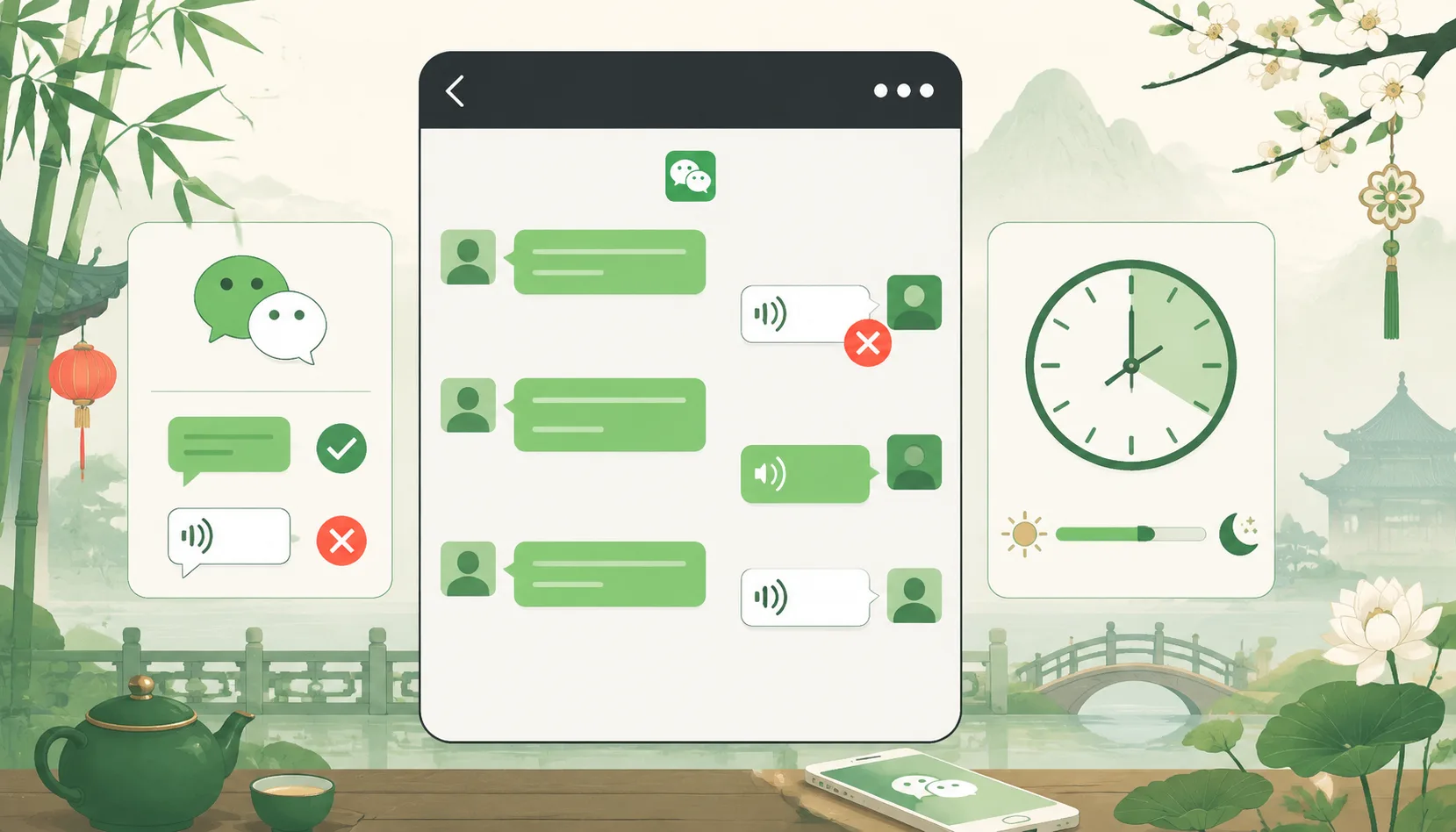
Don't send voice messages to colleagues without asking first — text is almost always preferred. Don't message for work matters after 10pm. The 🙂 emoji is not friendly in Chinese WeChat culture — it signals passive-aggressiveness. And when your colleague replies '好的' vs '嗯' vs '哦', the difference matters more than you'd expect.
WeChat chat looks simple — you type, they type back. But Chinese messaging culture has a rich layer of implicit signals that most foreigners don't notice until they've accidentally offended someone or misjudged a reply. The good news is these rules are consistent once you know them, and following them makes you look both culturally aware and considerate.
When to Send Messages: Time Boundaries
China's workplace culture has a complicated relationship with work-life boundaries in messaging — some industries and companies treat WeChat as always-on, others have clearer norms. But there are consistent time windows that apply broadly.
| Time | Appropriate for work messages? |
|---|---|
| 9:00 AM – 8:00 PM weekdays | Yes — generally safe for work topics |
| 12:00 – 1:30 PM (lunch break) | Avoid unless urgent — many people nap |
| 8:00 PM – 10:00 PM | Gray zone — acceptable in fast-paced industries, avoid in others |
| After 10:00 PM | Only for genuine emergencies. Always open with an apology for the hour. |
| Weekends | Non-urgent topics should wait for Monday; urgent matters with an apology opener |
If you must message outside normal hours
Open with an acknowledgment: "Sorry to disturb you at this hour — no need to reply until tomorrow" or in Chinese: "领导,深夜打扰您,实在抱歉,明天上班处理即可。" This small courtesy makes a significant difference in how the message is received.
Text vs. Voice Messages: The Hierarchy
WeChat makes it extremely easy to send voice messages — you hold a button, speak, release. This feature is used frequently in casual personal chats. In professional contexts, it is widely disliked, even by Chinese users themselves.
Why voice messages create friction in professional settings
- The recipient cannot skim or search them — they must listen in real time from start to finish
- Listening in open offices, meetings, or public transit requires headphones or is impossible
- Voice messages cannot be forwarded as quotes, translated easily, or documented for reference
- Sending a long voice message is implicitly saying "my time matters more than yours" — it takes seconds to record but imposes full listening time on the recipient
The rules
- Default to text for any professional communication
- If a topic is complex and you'd prefer voice: first send a text message asking "Would it be alright if I sent a voice note on this?"
- If you do send voice, keep it under 30 seconds and use it only for genuinely complex or nuanced content
- Never send multiple back-to-back voice messages — text the content instead
Emoji Decoded: What Chinese Colleagues Actually Mean
WeChat emoji carry cultural meanings that are sometimes the opposite of what Western users expect. Several specific emoji have been reinterpreted in Chinese online culture and are now widely understood in their Chinese meaning — which can be significantly different from the literal face value.
| Emoji | What it looks like | What it means in Chinese WeChat culture |
|---|---|---|
| 🙂 | Polite smile | Passive-aggressive or dismissive. "Oh, I see." / "Sure, whatever." Avoid using with colleagues you don't know well, unless you intend this. |
| 😄 😊 😁 | Open smile | Genuinely warm and friendly — safe to use |
| 👍 | Thumbs up | "Got it" / "Acknowledged" / "Good" — standard, safe, professional |
| 🙏 | Praying hands | "Thank you" or "Please" — widely used and positively received |
| 🤝 | Handshake | "Happy to cooperate" — positive and professional |
| 😅 | Nervous laugh | Awkward situation, mild self-deprecating humor — appropriate with people you know well |
The 哈哈哈 and ~ convention
In Chinese WeChat messages, "哈哈哈" (laughter) and the tilde "~" are tone softeners — they signal friendliness and reduce the bluntness of text. "发给我" ("send it to me") sounds like a curt order. "发给我哈~" sounds warm and easy-going. When colleagues add these elements, it signals good mood and positive intent — not silliness. Learning to add them yourself in informal contexts will make your messages feel more natural to Chinese readers.
Group Chat Etiquette
WeChat group chats — 群聊 (qúnliáo) — are the infrastructure of Chinese workplace communication. Being added to a new group and behaving appropriately within it is a small but real social skill.
When you're added to a new group
- Read the group description and first few messages before posting — understand what the group is for
- In a new work group, send one brief introduction: "Hello everyone, I'm Tom from [department]. Looking forward to working together." One message, not several
- In larger company-wide groups, no introduction needed — you can simply observe
Ongoing group behavior
- Don't have side conversations in work-purpose groups — they push important messages off screen
- Don't send voice notes in large groups — they're widely considered inconsiderate
- Don't @ people unnecessarily — it triggers their notification and should be used when genuinely needing their attention
- Respond to group messages with a thumbs-up or brief acknowledgment when your attention is expected
Leaving groups
- Temporary project groups: quietly leave when the project concludes. WeChat does not notify others when you leave.
- Department or client groups: do not leave. Even if inactive, remaining in a group signals continued connection. Leaving is interpreted as ending the relationship.
Reading One-Word Replies: The Warmth Scale
Chinese WeChat replies often come as single characters or short phrases that carry very different levels of warmth and engagement. Foreigners frequently misread these as equivalent, when they signal meaningfully different emotional states.
| Reply | Pinyin | What it signals |
|---|---|---|
| 嗯 / 好 | ēn / hǎo | Neutral acknowledgment — "I received this." Cool but not unfriendly. Often used by seniors responding to juniors. |
| 哦 | ó | Slightly dismissive or indifferent. "Oh, I see." If someone says this to you, they may be mildly unimpressed or distracted. |
| 好的 | hǎo de | Professional and warm. Standard positive reply — "Got it, happy to." Safe and appropriate in all contexts. |
| 好呀 / 好滴 | hǎo ya / hǎo dī | Warm and friendly. The extra syllable adds warmth — signals good mood and genuine willingness. Use with peers and friendly colleagues. |
| 好的哈哈~ | hǎo de hāhā | Very warm. Laughing, relaxed, casual — the person is in a good mood and genuinely comfortable with you. |
In practice: if a colleague who normally replies "好的哈~" starts replying with just "嗯" or "好", that's a signal worth noting — they may be busy, stressed, or quietly unhappy about something.
What Chinese People Actually Say
- 收到 | shōu dào | "Received" | Use to confirm you got the message; more formal than "ok"
- 好的 | hǎo de | "OK/Sure" | Use as polite acknowledgment; warmer than just "ok"
- 不好意思 | bù hǎo yì si | "Sorry/Excuse me" | Use before making requests or to soften a message
2026 Reality Check
2026 Reality Check: Most WeChat etiquette rules still matter, but younger users increasingly ignore formalities. The biggest shift? Read receipts and "已读不回" (leaving messages read but unreplied) are now normalized across all age groups.
Gen Z vs Older Generations: Gen Z treats WeChat more casually—shorter messages, more emojis, less formal greetings. They rarely use "您好" (hello) with friends. Older generations (>40) still prefer complete sentences, proper greetings, and timely responses. Family groups remain the most etiquette-strict environment.
Beijing/Shanghai vs Smaller Cities: Tier-1 cities show more relaxed, Western-influenced messaging styles. Smaller cities and older residents maintain stricter etiquette: avoid calling voice notes in groups, use "收到" (received) to acknowledge, don't send long voice messages without warning. Business contexts still require formal language everywhere.
Frequently asked questions
How late is too late to send a WeChat message to a Chinese colleague?
As a general rule, avoid sending work-related messages after 10pm. While close friends may chat late, messaging a boss or colleague about tasks after this hour is seen as intrusive and disrespectful of their personal time. If it's truly urgent, call instead of sending a text, and apologize for the late contact.
What does the 🙂 emoji actually mean in Chinese WeChat culture?
In Chinese WeChat culture, 🙂 is not friendly or warm. It's often used to convey passive-aggressiveness, sarcasm, or mild disdain. If a Chinese colleague sends you 🙂 in response to a request or apology, they're likely annoyed. Use 😊 or 😄 instead — these are perceived as genuinely positive and polite.
Why do Chinese colleagues reply '嗯' instead of '好的' and does it matter?
Yes, it matters a lot. '好的' (hǎo de) means 'okay, got it' and is a positive, engaged confirmation. '嗯' (èn) is a minimal acknowledgment, often indicating reluctance or that they're busy. '哦' (ò) is the worst — it signals dismissiveness or displeasure. If you receive '嗯' or '哦', consider following up to clarify any concerns.
Can I send voice messages to Chinese colleagues or is it considered rude?
Voice messages are common among friends and family in China, but for work or first-time contacts, they're often seen as lazy or presumptuous. Always ask first, or default to text. If you do send voice, keep it under 30 seconds and apologize for not typing. In formal settings, voice messages are almost always inappropriate.
Is it acceptable to message someone on WeChat without adding them as a friend first?
No. WeChat requires mutual consent for messaging — you must be friends to chat. When you send a friend request, always include a brief introduction: your name, how you know the person, and your purpose. Sending a request without a note is often ignored. Once accepted, start with a polite greeting like '你好' before diving into business.
What are the unwritten rules for WeChat group chats in Chinese workplaces?
In Chinese workplace group chats, always acknowledge messages with a quick '收到' (received) when your boss assigns something. Never @-mention your boss unnecessarily or complain in the group. Avoid sending memes or casual banter in work groups — keep it professional. Also, don't share articles or videos unless they're directly relevant to the group's purpose.
Try our tools
Related guides
WeChat Profile Etiquette: Photo, Name & Adding Contacts
Use a clear, professional photo of yourself — not a pet or cartoon. Set your display name to something Chinese colleagues can recognize and remember easily. Whe…
Read the guide →
WeChat Moments Etiquette: What Foreigners Should Know
WeChat Moments (朋友圈) is more like a professional-personal hybrid than a pure social feed — your boss, clients, and family all see the same posts. Post 1-3 times…
Read the guide →
Chinese Business Communication Style: Indirect Signals
Chinese business communication is high-context: what matters is often what's not said — the tone, the timing, who said it, and what was conspicuously omitted. W…
Read the guide →