What do foreigners need to know about WeChat before coming to China?

Quick answer
WeChat (微信 Wēixìn) is China's operating system for daily life — not a messaging app. It handles payments, work coordination, social media, news, ride-hailing, restaurant ordering, hospital appointments, and money transfers. Without a working WeChat account, foreigners struggle to pay for basic things, communicate with colleagues, and navigate everyday life in China.
A common mistake foreigners make before arriving in China: they install WeChat, notice it looks like a messaging app, and assume it's roughly equivalent to WhatsApp. Within days of arriving, this assumption costs them — they can't pay for breakfast, can't get a taxi, can't communicate with their team, and can't figure out why simple transactions require a QR code and a phone wallet they don't have.
WeChat is not a messaging app that also does some other things. It is a super-app — a single platform that replaces eight to twelve separate apps you might use in the West. Understanding this changes everything about how you approach life in China.
WeChat vs. WhatsApp: A Fundamentally Different Thing
In Western markets, digital services are specialized: WhatsApp for messaging, PayPal or Venmo for payments, Uber for rides, Instagram for photos, Slack for work, your bank's app for transfers. Each tool does one thing well.
WeChat follows a completely different philosophy. One app, all of daily life:
- Social: text, voice notes, video calls, group chats with family and colleagues
- Work: file transfer, project coordination, approvals — many Chinese companies run their entire operation through WeChat groups rather than email
- Payments: street food stalls, restaurants, convenience stores, taxis, electricity bills — all via QR code scan
- Life services: hospital appointment booking, movie tickets, food delivery, hotel reservations, shared bike unlocking, metro card top-up
- Social media: WeChat Moments (朋友圈 péngyouquān), a semi-private photo and update feed
- Information: Official Accounts (公众号 gōngzhònghào) — branded channels where companies, media outlets, and institutions publish articles
- Money transfers and gifts: Red envelopes (红包 hóngbāo) for celebrations, split bills, formal transfers
The practical consequence: a foreigner without WeChat Pay cannot buy a bottle of water at many convenience stores, cannot pay for a taxi, and cannot split a restaurant bill with colleagues. This is not an exaggeration — China's payment infrastructure has moved almost entirely to mobile QR codes.
Setting Up WeChat as a Foreigner
WeChat is available internationally on iOS and Android. The basic messaging features work without a Chinese phone number, but for full functionality — especially payments — you will need to complete a verification process.
Registration
- Download WeChat from the App Store or Google Play
- Register with your phone number (international numbers are accepted)
- You will need an existing WeChat user to verify your account — ask a colleague, friend, or contact in China to scan your verification QR code
Setting up WeChat Pay
Since 2019, foreigners can link international credit cards to WeChat Pay without a Chinese bank account. Accepted cards include Visa, Mastercard, JCB, and Discover.
- Open WeChat → Me → Services → Wallet
- Tap Bank Cards → Add a Card
- Enter your international card number, expiry date, CVV, and billing address
- Complete identity verification using your passport
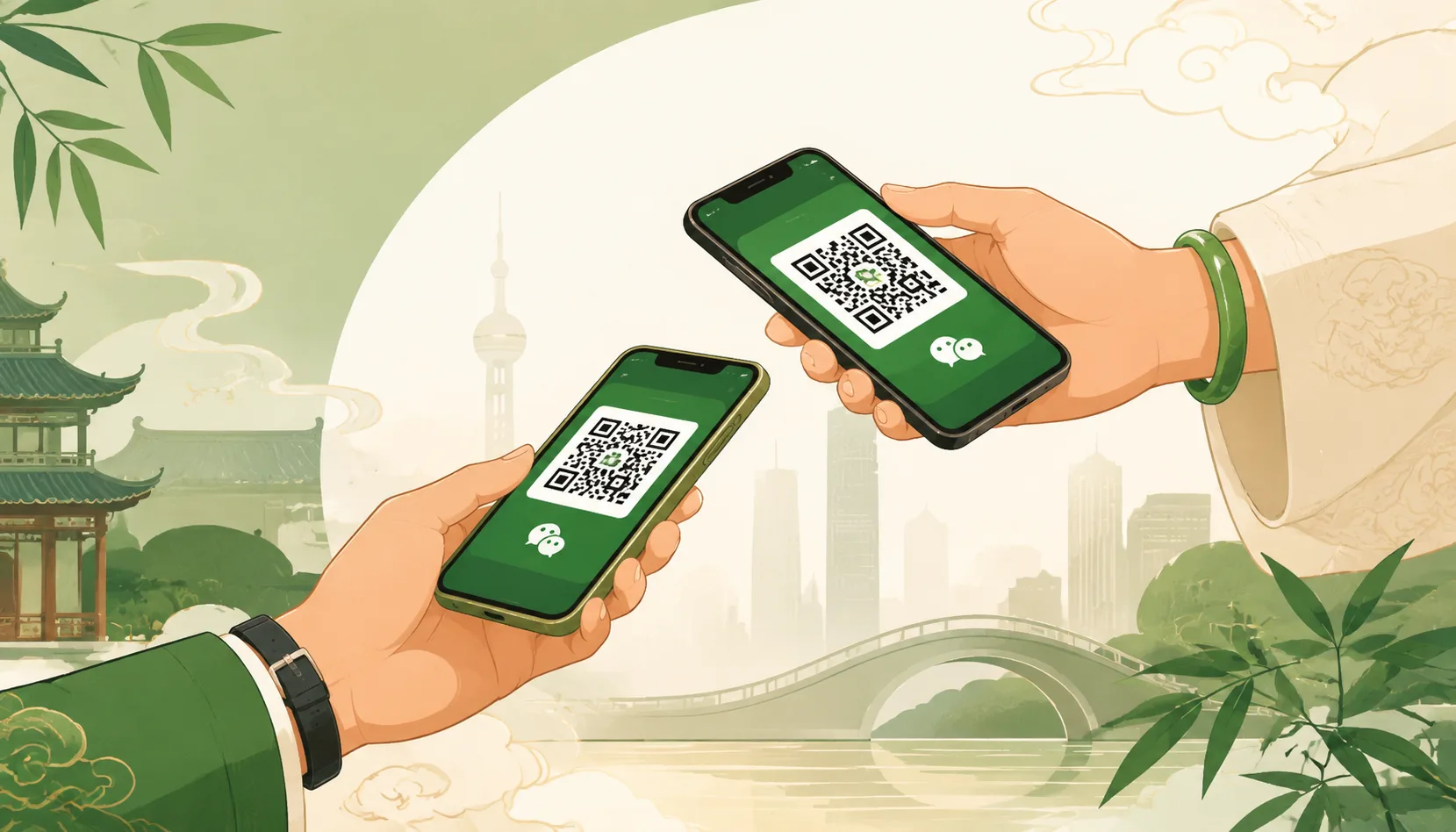
Once set up, you can pay by scanning merchant QR codes or by showing your own payment QR code to be scanned. The transaction completes in under a second.
WeChat at Work: What Foreigners Often Don't Expect
For professionals working in China, one of the biggest surprises is the degree to which WeChat functions as the primary workplace communication tool — often replacing email for day-to-day coordination.
In most Chinese companies:
- Project updates are shared in work group chats, not email threads
- Files, contracts, and documents are sent via WeChat rather than email attachments
- Approvals and sign-offs happen in group chats
- The expectation that you will respond to WeChat messages during work hours is real and strong — and in some industries, the boundary between work hours and off-hours is blurry in the WeChat context (see the chat etiquette guide for how to handle this)
Practical advice: check WeChat as regularly as you would check email. Set up desktop WeChat (available for Mac and Windows) so you don't miss messages. Mute groups that are not urgent so the notification volume stays manageable.
WeChat Official Accounts: China's Content Ecosystem
Beyond personal messaging, WeChat contains a publishing ecosystem called Official Accounts (公众号 gōngzhònghào). These are branded channels run by companies, media outlets, government agencies, restaurants, hospitals, and influencers — essentially a hybrid of newsletters and blog platforms, all inside WeChat.
As a foreigner, you may encounter Official Accounts in several ways:
- Your company or building may have one that posts internal notices
- Restaurants often have Official Accounts for their online ordering or reservation system
- Hospital systems use Official Accounts for appointment booking
- News organizations and interest-based communities publish long-form articles through them
You can follow Official Accounts by scanning their QR code or searching by name, and their posts appear in a separate reading area within WeChat — not mixed into your personal messages.
Quick Cultural Rules for WeChat in China
- WeChat contact is personal. Exchanging WeChat is more intimate than exchanging business cards. It gives someone access to your Moments, your profile photo, and your social context — not just a contact number.
- Your profile is your first impression. Chinese contacts judge WeChat profiles closely — photo, nickname, bio, and Moments cover all communicate who you are before you say a word. A professional photo matters significantly more here than on WhatsApp.
- Voice messages are mostly disliked in professional contexts. Despite being a feature, sending long voice messages to colleagues or clients is generally considered inconsiderate. Text is almost always preferred.
- The 🙂 emoji is not friendly. In Chinese WeChat culture, the default "smiling face" emoji has been reinterpreted to mean something closer to passive-aggressive acknowledgment ("oh, I see"). Avoid it in messages to colleagues.
- Liking a boss's Moments post costs nothing and builds goodwill. When your manager or client posts on their Moments, a quick like or a brief warm comment is a socially low-cost investment in the relationship.
What Chinese People Actually Say
- 点赞 | diǎn zàn | to "like" a post | Tap the heart/thumbs up to show you read someone's message
- 发红包 | fā hóng bāo | send a red envelope | Digital money gift; common in groups for birthdays or holidays
- 拉群 | lā qún | add someone to a group | Used when creating a new WeChat group chat
2026 Reality Check
2026 Reality Check: WeChat etiquette for foreigners has evolved but core rules persist. QR payments are universal—even street vendors reject cash. Red envelopes remain expected at weddings and holidays, though younger crowds now split bills via "AA" functions.
Gen Z vs. Older Generations: Gen Z treats WeChat as a utility, preferring Douyin for social. They use "minimalist" profiles and ghost messages casually. Older generations still send morning greetings, voice messages, and "zan" (likes) enthusiastically. They expect faster responses.
Beijing/Shanghai vs. Smaller Cities: Tier-1 cities are fully digital—face recognition payments dominate. Smaller cities still value in-person visits; WeChat is more transactional. Rural areas sometimes skip the app entirely, using phone calls instead.
Bottom line: The "not just messaging" rule holds. Payment and official functions are non-negotiable. Social norms have relaxed, but basic courtesy—responding to messages, not calling at odd hours—still applies.
Frequently asked questions
Can I use WeChat in China with my foreign phone number and credit card?
Yes, you can register with a foreign number, but you'll need a Chinese bank card or a prepaid China UnionPay card to activate WeChat Pay. Foreign Visa/Mastercard support is limited. Most foreigners open a Chinese bank account after arriving, then link it to WeChat Pay for full functionality.
What happens if I don't set up WeChat before landing in China?
You'll face daily friction: many restaurants only accept QR code payments, taxis may refuse cash, and colleagues may expect you in group chats. You can still register after arrival using your passport and a Chinese SIM card, but expect a 24-48 hour verification delay before payments work.
Is WeChat really necessary for foreigners, or can I just use Alipay and WhatsApp?
Alipay covers payments, but WeChat is the default for social and professional communication in China. Your landlord, coworkers, and service providers will expect to reach you on WeChat. Many small businesses don't accept Alipay. For practical daily life, you need both WeChat and Alipay.
How is WeChat different from WhatsApp for daily communication in China?
WhatsApp is just chat. WeChat is chat plus your digital identity. You send money via red packets, book doctor appointments, pay utility bills, order food, and share location for ride-hailing — all inside the same app. Group chats are used for work approvals, school notices, and neighborhood alerts.
Can I use WeChat Pay without a Chinese bank account if I'm just visiting for a week?
Yes, for short visits you can link an international Visa or Mastercard to WeChat Pay, but transaction limits apply (around 00 total per month). For higher limits, you'd need a Chinese bank account. Alternatively, carry cash as backup — some hotels and larger stores still accept it.
What are the biggest mistakes foreigners make when first using WeChat in China?
The top mistakes: not verifying your real-name identity (blocks payments), assuming chats are private (they're monitored), sending money to strangers via red packets, and ignoring the Moments feed — many Chinese colleagues expect you to engage with their posts. Also, never share your QR code publicly; scammers use it to collect payments.
Try our tools
Related guides
WeChat Profile Etiquette: Photo, Name & Adding Contacts
Use a clear, professional photo of yourself — not a pet or cartoon. Set your display name to something Chinese colleagues can recognize and remember easily. Whe…
Read the guide →
Chinese Property Management (物业): What They Do & How to Pay
物业 handles common areas, security, and community coordination—not private repairs. Pay your 物业费 on time, join the WeChat group, and file complaints with specifi…
Read the guide →
China Waste Sorting: A Foreigner's Practical Guide
Learn the 4-category system (recyclables, hazardous, food waste, other), but always check your specific compound's rules. Listen for the music signal to bring o…
Read the guide →