How do I work with Chinese property management (物业) in my residential compound as a foreigner?
Quick answer
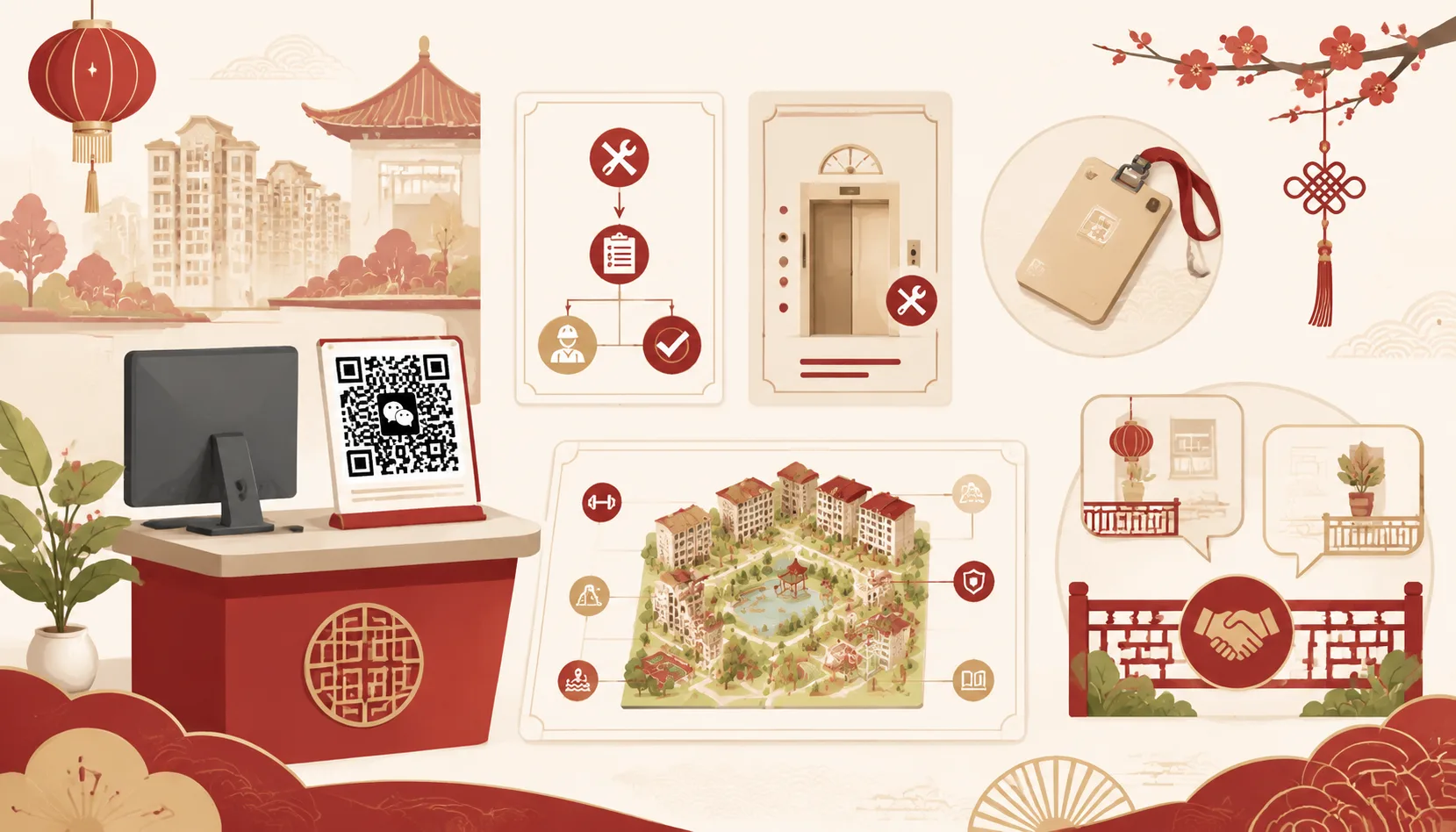
物业 handles common areas, security, and community coordination—not private repairs. Pay your 物业费 on time, join the WeChat group, and file complaints with specific facts. For neighbor disputes, let 物业 mediate—it's more face-saving than direct confrontation.
What 物业 Actually Does (and Doesn't Do)
When you move into a Chinese residential compound (小区 xiǎoqū), the property management office (物业 wùyè) becomes your go-to for anything outside your front door. Their scope is broader than a typical Western building manager. They handle:
- Public area maintenance (corridors, stairwells, lobbies)
- Elevator operation and repair
- Gate and access card management (门禁卡 ménjìn kǎ)
- Common lighting and landscaping
- Communal facility repair (playgrounds, gym equipment)
- Security coordination (guards, CCTV)
- Parking management
- Package room (快递室 kuàidì shì) organization
But here's the key: they are not your private handyman. If your toilet leaks or your light fixture breaks inside your apartment, that's on you (or your landlord). However, if water seeps from your ceiling due to a pipe in the common wall, that's a common-area issue—call 物业.
Actionable tip: Before requesting service, ask yourself: Is this in my private space or shared space? If shared, 物业 is responsible. If private, contact your landlord or hire a local repair person.
What You CAN Request from 物业
物业 is your first call for many daily issues. Here's what they can help with:
- Minor repairs to common facilities – broken hallway light, damaged elevator button, cracked tile in the lobby.
- Access card replacement – lost your 门禁卡? Visit the 物业 office with your ID and apartment number, pay a small fee (usually 10–50 RMB), and get a new one.
- Noise complaints about neighbors – 物业 acts as a neutral mediator. They'll talk to the neighbor or post a notice.
- Reporting water or structural issues in common areas – e.g., a leak in the parking garage or a crack in the stairwell wall.
- Getting added to the building WeChat group – essential for community updates.
Here's a typical dialogue when you call:
You: 你好,我楼道的灯坏了,能派人修一下吗?
(Nǐ hǎo, wǒ lóudào de dēng huài le, néng pài rén xiū yīxià ma?)
Hello, the light in my corridor is broken, can you send someone to fix it?
物业: 好的,我们登记一下,今天下午会安排维修。
(Hǎo de, wǒmen dēngjì yīxià, jīntiān xiàwǔ huì ānpái wéixiū.)
Okay, we'll register it, and arrange repair this afternoon.
Actionable tip: Always ask for a ticket or reference number (单号 dānhào) when you report an issue. It helps you follow up.
What 物业 Cannot Do (Know the Limits)
物业 is a community coordinator, not a judge. They cannot:
- Rule on private disputes with finality – If you and a neighbor argue over a parking spot, 物业 can mediate but not issue a binding verdict.
- Force neighbors to pay damages – If a neighbor's water leak damages your ceiling, 物业 can't make them pay. They can only help document and mediate.
- Access your apartment without permission – Unless it's an emergency (like a fire or major leak), they need your consent. Even then, they usually contact you first.
This means for serious issues, you may need to involve the police (110) or a lawyer. But for most everyday annoyances, 物业 is your best first step.
Actionable tip: If a neighbor damages your property, report to 物业 immediately and ask them to document it with photos. This creates a paper trail that helps if you need to escalate.
Property Management Fees (物业费) – Pay Them on Time
物业费 (wùyèfèi) is the fee that keeps the compound running. It's usually paid annually or quarterly, and the amount depends on your compound's class (typically 1–5 RMB per square meter per month).
Who pays? It depends on your lease contract. Some landlords include 物业费 in the rent; others require you to pay separately. Clarify this before signing – otherwise, you might get a surprise bill.
As a foreigner, you're not exempt. Refusing to pay can lead to:
- Loss of access to services (e.g., your access card may be deactivated)
- Formal notices (催缴通知 cuījiǎo tōngzhī)
- In extreme cases, legal action
Here's how to ask about it:
You: 请问物业费是包含在房租里吗?
(Qǐngwèn wùyèfèi shì bāohán zài fángzū lǐ ma?)
Is the property fee included in the rent?
Landlord: 不包含,你需要自己交。
(Bù bāohán, nǐ xūyào zìjǐ jiāo.)
No, you need to pay it yourself.
Actionable tip: Keep a copy of your payment receipt (收据 shōujù). You'll need it if there's a dispute or if you move out and need to prove you paid.
The WeChat Group: Your Community Lifeline
Soon after moving in, 物业 will likely add you to the building or compound WeChat group (小区业主群 xiǎoqū yèzhǔ qún). This is where all important announcements happen:
- Maintenance notices (e.g., elevator shutdown)
- Temporary water or power shutoffs
- Visitor parking announcements
- Community votes (e.g., on using public funds for repairs)
- Lost and found
Joining is essential, even if you can't read all the messages. You can use WeChat's translation feature or ask a neighbor to summarize.
Here's a typical message you might see:
物业: 各位业主,本周六上午9点至下午2点,小区将进行水管维修,届时会停水,请提前储水。
(Gèwèi yèzhǔ, běn zhōuliù shàngwǔ 9 diǎn zhì xiàwǔ 2 diǎn, xiǎoqū jiāng jìnxíng shuǐguǎn wéixiū, jièshí huì tíngshuǐ, qǐng tíqián chǔshuǐ.)
Dear owners, this Saturday from 9 AM to 2 PM, the compound will undergo water pipe repair, water will be shut off, please store water in advance.
Actionable tip: Set the group to 'mute' but check it daily. If you miss a message about a water shutoff, you'll be caught off guard.
How to Make a Complaint That Gets Results
物业 staff deal with dozens of complaints daily. The ones that get fast action are specific and documented. Emotional venting gets you nowhere.
Good example: “Building 3 elevator has been broken for 3 days. When will it be repaired? It's affecting elderly residents.”
Bad example: “Your service is terrible! Nothing ever works!”
Here's how to structure your complaint:
- State the issue clearly – What exactly is wrong?
- Give dates and times – When did it start? How often does it happen?
- Mention impact – How does it affect you or others?
- Ask for a specific action – “Can you fix it by Friday?”
Example dialogue:
You: 你好,我是3号楼2单元的住户。我们楼下的门禁卡读卡器从周一就坏了,很多人进不来,请问什么时候能修好?
(Nǐ hǎo, wǒ shì 3 hào lóu 2 dānyuán de zhùhù. Wǒmen lóuxià de ménjìn kǎ dúkǎqì cóng zhōuyī jiù huài le, hěnduō rén jìn bù lái, qǐngwèn shénme shíhou néng xiū hǎo?)
Hello, I'm a resident of Building 3, Unit 2. The card reader at our entrance has been broken since Monday, many people can't get in. When can it be fixed?
物业: 我们已联系厂家,预计后天下午修好。
(Wǒmen yǐ liánxì chǎngjiā, yùjì hòutiān xiàwǔ xiū hǎo.)
We've contacted the manufacturer, expected to be fixed by the day after tomorrow afternoon.
Actionable tip: Take photos or videos as evidence. Send them in the WeChat group or via private message to 物业 staff.
Handling Neighbor Disputes via 物业 – The Face-Saving Way
Direct confrontation with a neighbor can be awkward, especially if there's a language barrier. 物业 is your neutral mediator. They know both parties and can communicate without either side losing face (面子 miànzi).
Here's the process:
- Go to the 物业 office in person or call them.
- Explain the situation calmly – give specific dates, times, and incidents.
- Ask them to mediate – they'll talk to the neighbor or post a notice.
Example:
You: 你好,我楼上每天晚上11点以后还有很大的噪音,影响我休息。我已经持续一周了。能不能帮我跟楼上沟通一下?
(Nǐ hǎo, wǒ lóushàng měitiān wǎnshang 11 diǎn yǐhòu hái yǒu hěn dà de zàoyīn, yǐngxiǎng wǒ xiūxi. Wǒ yǐjīng chíxù yī zhōu le. Néng bù néng bāng wǒ gēn lóushàng gōutōng yīxià?)
Hello, my upstairs neighbor has loud noise after 11 PM every night, affecting my rest. It's been a week. Can you help communicate with them?
物业: 好的,我们会联系楼上住户,提醒他们注意。
(Hǎo de, wǒmen huì liánxì lóushàng zhùhù, tíxǐng tāmen zhùyì.)
Okay, we'll contact the upstairs resident and remind them to be mindful.
This approach is safer and more face-preserving than knocking on their door yourself. If the issue persists, you can escalate to the police (110) for noise complaints, but 物业 should be your first step.
Actionable tip: Keep a log of incidents (dates, times, descriptions). This helps 物业 take your complaint seriously.
Key 物业 Vocabulary You'll Actually Use
Here's a quick reference table of essential terms:
| Chinese | Pinyin | English |
|---|---|---|
| 物业费 | wùyèfèi | Property management fee |
| 门禁卡 | ménjìn kǎ | Access card |
| 业主群 | yèzhǔ qún | Owners' WeChat group |
| 维修 | wéixiū | Repair |
| 投诉 | tóusù | Complaint |
| 报修 | bàoxiū | Report for repair |
| 保安 | bǎo'ān | Security guard |
| 公共区域 | gōnggòng qūyù | Common area |
| 停水 | tíngshuǐ | Water shutoff |
| 停电 | tíngdiàn | Power outage |
Knowing these will make your interactions smoother. For example, if you need to report a leak, say “我要报修” (wǒ yào bàoxiū) – “I want to report for repair.”
Actionable tip: Save this table to your phone. You'll thank yourself later.
What Chinese People Actually Say
- 物业费 | wù yè fèi | property management fee | Used when asking about or paying monthly building maintenance costs
- 业主 | yè zhǔ | property owner | Refers to anyone who owns an apartment in the building
- 保修 | bǎo xiū | warranty repair | Report maintenance issues like water leaks or broken appliances
2026 Reality Check
2026 Reality Check: Property management (物业) in China remains essential but with shifting dynamics. The "golden week" moving tradition—where residents avoid moving during Chinese New Year—still holds, especially in older residential compounds. Gen Z tenants are more likely to challenge物业 decisions, using apps to report issues instantly and demand accountability. Older generations still prefer in-person complaints and respect物业 authority more passively.
Beijing/Shanghai vs. Smaller Cities: Tier-1 cities have professionalized物业 services with apps, 24/7 response, and transparent fee displays. Smaller cities still rely on informal relationships—物业 often know residents by name. Rules are followed more strictly in new developments everywhere; older compounds see more flexibility.
Bottom line: The rules persist but enforcement softens. Digital-savvy younger residents push物业to modernize, while traditional etiquette fades in tech-forward urban areas.
Frequently asked questions
What exactly does 物业 cover and what don't they fix in my apartment?
物业 handles shared spaces: lobbies, elevators, hallways, landscaping, and security. They also coordinate community services like garbage collection. They do NOT fix issues inside your unit—like a broken toilet or AC—unless it's a building-wide system. For in-unit problems, contact your landlord or hire a private repairman. Check your lease: some landlords expect you to handle minor repairs yourself.
How do I pay 物业费 (property management fees) as a foreigner?
Most compounds collect 物业费 annually or semi-annually. You can pay via WeChat Pay, Alipay, bank transfer, or cash at the management office. If you rent, your landlord might include it in rent—verify your lease. Ask for a receipt (收据) or invoice (发票). Late payments can incur penalties or even affect your ability to renew your residence permit if the compound reports you.
Can I join the community WeChat group even if I don't speak Chinese?
Yes, and you should. Ask the 物业 office to add you—they usually have a group for owners and tenants. Use WeChat's built-in translate feature for messages. Post questions or complaints in English; many 物业 staff use translation apps too. The group is where you'll learn about water shutdowns, package deliveries, and community events. It's also the fastest way to reach 物业 for non-urgent issues.
What's the best way to file a complaint about a noisy neighbor?
First, message the 物业 WeChat group or call the office with specifics: unit number, time, and type of noise. 物业 will send security to check or talk to the neighbor. If it's after 10 PM, call the police (110) for noise complaints—they can issue a warning. Avoid confronting the neighbor directly, as this can escalate. If 物业 doesn't resolve it after two attempts, escalate to the neighborhood committee (居委会).
Is tipping the 物业 security guard or cleaning staff expected?
No, tipping is not customary in China. However, during Chinese New Year or Mid-Autumn Festival, some residents give small gifts like fruit or a red envelope (红包) of 50–200 RMB to show appreciation. This is voluntary and helps build goodwill. If you need a favor—like holding a package or helping with heavy furniture—a small token is appreciated but never required.
What if 物业 refuses to help with a serious issue like a leaking roof?
If it's a structural or common-area issue, 物业 is legally responsible. Document everything: photos, dates, and written requests. First, escalate to the property manager (物业经理). If no action in 7 days, file a complaint with the local housing authority (房管局) or call the government hotline 12345. For renters, also inform your landlord—they have leverage with 物业 and can pressure them legally.
Try our tools
Related guides

What to Bring to a Chinese Home Dinner: 2026 Gift Guide
Never arrive empty-handed at a Chinese home dinner. Safe options: a fruit basket, quality packaged pastries or snacks, good quality tea, or imported wine/spirit…
Read the guide →
Chinese Neighborhood WeChat Groups: Expat Survival Guide
Join your compound's WeChat group via your property management office or landlord. Use it to get critical notices, participate in group buying, and connect with…
Read the guide →
China Parcel Delivery: Lockers, Stations & Door Delivery
In China, couriers typically leave packages at smart lockers (快递柜) or pickup stations (菜鸟驿站) rather than delivering to your door. You'll receive a pickup code v…
Read the guide →