How should foreigners interact with Chinese residential compound security guards to build goodwill and get practical benefits?
Quick answer
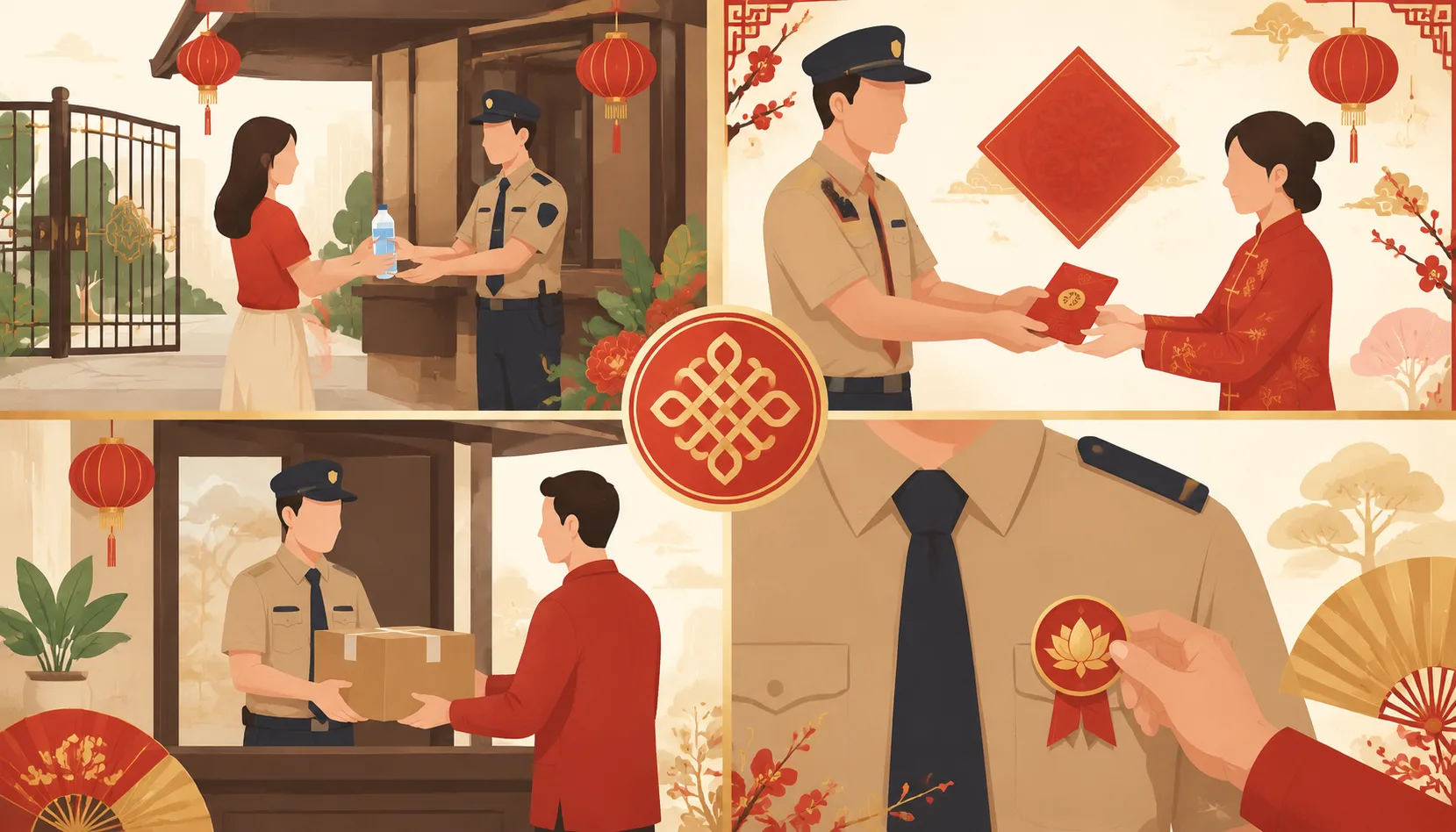
Treat them as respected neighbors, not servants. Address them as 师傅 (shīfu), never tip cash, and show gratitude with small gestures like cold water in summer or a Spring Festival gift. This builds '善意复利' (shànyì fùlì) — compound interest of goodwill — that pays off in smoother package handling, faster gate access, and proactive help.
Why Your Guard Already Knows Your Face (and That's a Good Thing)
When I first moved into my Beijing compound, I was slightly unnerved that the security guard at the south gate greeted me by name after just three days. My Western instinct said 'surveillance.' But after a decade in China, I've learned this is the opposite — it's the compound's security system working exactly as designed.
Chinese 保安 (bǎo'ān) are trained to recognize residents. In a typical 小区 (xiǎoqū, residential compound), guards rotate shifts but share information. Within a week, they know your face, your car, your usual arrival time, and often your family members. This isn't creepy — it's how they keep out strangers, delivery scammers, and unauthorized vendors.
Here's the practical takeaway: your guard's memory is a resource, not a threat. The faster you become a 'known friendly face,' the more the system works in your favor. I've seen guards wave through regulars without even checking their access cards, while making visitors fill out three forms.
Actionable tip: On your first week, introduce yourself briefly. Say, '你好,我刚搬来,住3号楼' (Nǐ hǎo, wǒ gāng bān lái, zhù sān hào lóu — Hello, I just moved in, I live in Building 3). That 10-second investment pays dividends for years.
The Social Capital Opportunity Most Expats Miss
Here's a scene I've witnessed a hundred times: an expat walks past the guard booth, eyes locked on their phone, not even a nod. The guard — who could be a grandfather, a former soldier, or a university student working nights — becomes invisible. That's a missed opportunity.
In Chinese residential life, guards are the unofficial information hub. They know when the water will be shut off for maintenance, which elevator is broken, and which delivery company has been leaving packages in the wrong place. They also control the flow of visitors and packages.
I once mentioned to my guard that I was expecting a large furniture delivery. He not only flagged me the moment the truck arrived but also helped the movers navigate the freight elevator — something I never asked for. Why? Because I'd spent three months greeting him with a smile and a '师傅早' (shīfu zǎo, good morning, master) every day.
Actionable tip: Make it a habit to make eye contact and greet your guard every time you pass. A simple '你好' (nǐ hǎo) or '师傅好' (shīfu hǎo) takes two seconds. Over a month, that's less than five minutes of your time — and it builds a relationship that no amount of money can buy.
Here's a realistic dialogue to get you started:
You: 师傅,今天值班啊?(Shīfu, jīntiān zhíbān a? — Master, you're on duty today?)
Guard: 是啊,你下班啦?(Shì a, nǐ xiàbān la? — Yeah, you're off work?)
You: 对,辛苦了!(Duì, xīnkǔ le! — Yes, thanks for your hard work!)
How to Address Them: 师傅, 大哥, and What to Avoid
Addressing someone correctly in China is social lubrication. For guards, the gold standard is 师傅 (shīfu) — literally 'master' or 'skilled worker.' It's used for anyone doing a service job: drivers, repairmen, delivery workers, and yes, security guards. It conveys respect for their craft and experience. It's never wrong.
Once you're on familiar terms, you can switch to 大哥 (dàgē, elder brother) for male guards — it implies warmth and closeness, like extended family. For female guards, 大姐 (dàjiě, elder sister) works similarly. But if in doubt, stick with 师傅.
What to avoid: never call them 'hey,' 'boy,' or snap your fingers. That's a fast way to become the 'rude foreigner' in the guard booth's daily conversation. Also avoid overly formal titles like 先生 (xiānsheng, mister) — it sounds stiff and distances you.
| Chinese | Pinyin | English |
|---|---|---|
| 师傅 | shīfu | Master (respectful for skilled workers) |
| 大哥 | dàgē | Elder brother (familiar) |
| 大姐 | dàjiě | Elder sister (familiar) |
| 保安 | bǎo'ān | Security guard |
Actionable tip: When you first meet a guard, use 师傅. After a few weeks, if he's friendly and younger than you, try 大哥 with a smile. He'll likely beam — it's a sign you've accepted him as part of your community.
Why You Should NEVER Tip Cash (and What to Do Instead)
In many Western countries, tipping a doorman or security guard for helping with packages is normal. In China, it's a cultural landmine. Handing a guard ¥10 for holding your package reads as either bribery (if it's for a favor) or condescension (if it's for routine work). Both make the guard deeply uncomfortable — they can't accept it without risking their job, and they'll remember you as someone who doesn't understand the rules.
Instead, show gratitude in ways that fit Chinese social norms. The most powerful is verbal acknowledgment: 师傅辛苦了 (shīfu xīnkǔ le) — 'Master, you've worked hard.' This phrase is the Swiss Army knife of Chinese gratitude. It costs nothing but carries enormous weight because it acknowledges the effort behind the service.
Another gesture that's remembered for months: on a hot summer day, buy a few bottles of cold water (about ¥5 total) and casually offer them to the guard booth. Say, '师傅,喝瓶水吧' (Shīfu, hē píng shuǐ ba — Master, have a bottle of water). Don't make a big deal of it; just hand them over and walk on. I did this once in July, and my guard still mentions it in November.
Actionable tip: Keep a mental list of small, non-cash gestures: a cold drink in summer, a warm pack of soy milk in winter, or a piece of fruit from your grocery run. The key is casualness — it's not a transaction, it's neighborly kindness.
The Spring Festival Gift: 善意复利 in Action
If you want to cement your status as a 'good neighbor' for the entire year, give your guards a small gift before Chinese New Year (春节, Chūnjié). This is deeply rooted in Chinese culture — gifts during the festival symbolize gratitude and good wishes for the coming year.
What to give? It doesn't need to be lavish. A box of cookies, a carton of milk, or a red envelope (红包, hóngbāo) with ¥50–100 is perfect. The amount is symbolic, not transactional. I've given a ¥50 red envelope to each of the three guards at my gate, and the effect has been what I call 善意复利 (shànyì fùlì) — compound interest of goodwill.
Here's how it compounds: after the gift, my guards started proactively flagging packages, calling my phone when the gate was temporarily closed, and even helping my elderly mother-in-law carry groceries. None of this was requested — it emerged organically from the relationship.
When giving, say: '师傅,新年快乐,一点小意思' (Shīfu, xīnnián kuàilè, yīdiǎn xiǎo yìsi — Master, Happy New Year, a small token). The phrase '小意思' (xiǎo yìsi, small token) is crucial — it downplays the gift's value and emphasizes the sentiment.
Actionable tip: Mark the lunar new year on your calendar (usually late January or February). Prepare your gifts a week in advance. If you're unsure about red envelopes, a box of quality tea or fruit is equally appreciated.
Practical Requests You CAN Make (and How to Phrase Them)
Once you've built goodwill, you can ask for practical help — but always politely. The magic phrase is 麻烦你 (máfan nǐ), meaning 'sorry to trouble you.' It's the polite preface that softens any request.
Reasonable requests include:
- Holding a package at the guard booth until you get home
- Notifying you when a large delivery arrives (give them your phone number)
- Allowing a vetted guest (like a friend or repairman) temporary access without you being present
- Informing you of building maintenance or access changes
Here's a realistic dialogue for a package request:
You: 师傅,麻烦你,我有个快递到了,能先放你这儿吗?我下班来拿。(Shīfu, máfan nǐ, wǒ yǒu gè kuàidì dào le, néng xiān fàng nǐ zhèr ma? Wǒ xiàbān lái ná. — Master, sorry to trouble you, I have a package that arrived. Can you hold it here? I'll pick it up after work.)
Guard: 没问题,放这儿吧。(Méi wèntí, fàng zhèr ba. — No problem, leave it here.)
You: 太谢谢了!(Tài xièxie le! — Thank you so much!)
Actionable tip: Always follow through — if you say you'll pick it up at 6 PM, be there at 6 PM. Guards remember reliability. And when you pick it up, add a '辛苦了' to close the loop.
Useful Phrases for Everyday Interactions
Here's a cheat sheet of phrases that will cover 90% of your guard interactions. Save this table on your phone for the first few weeks.
| Chinese | Pinyin | English |
|---|---|---|
| 师傅好 | shīfu hǎo | Hello, master |
| 师傅辛苦了 | shīfu xīnkǔ le | Thanks for your hard work |
| 麻烦你 | máfan nǐ | Sorry to trouble you |
| 有我的快递吗? | yǒu wǒ de kuàidì ma? | Is there a package for me? |
| 请帮我开下门 | qǐng bāng wǒ kāi xià mén | Please open the gate for me |
| 新年快乐 | xīnnián kuàilè | Happy New Year |
| 谢谢 | xièxie | Thank you |
Practice these out loud. The tones matter less than the effort — guards appreciate any attempt to speak Chinese. Even a mangled 'shīfu' with a smile beats a perfect 'hello' with a blank stare.
Actionable tip: For the first month, challenge yourself to use at least one phrase from this table every time you pass the guard booth. By the end of the month, it'll be automatic — and your guard will be your biggest ally in the compound.
What Chinese People Actually Say
- 请出示证件 | qǐng chūshì zhèngjiàn | Please show your ID | Use when entering gated communities or buildings—guards say this, but you can also ask politely
- 请问 | qǐng wèn | May I ask / Excuse me | Polite attention-getter before stating your purpose; "请问,这里能停车吗?"
- 谢谢配合 | xièxiè pèihé | Thank you for your cooperation | Say after they check your ID or let you pass—shows good manners
2026 Reality Check
2026 Reality Check: The old rule—"respect security guards, follow their instructions quietly"—is fading fast in major cities but still holds in smaller towns and traditional establishments.
Gen Z vs Older Generations: Young people in Beijing and Shanghai increasingly question guards' authority, especially over privacy and entry rights. Older generations still show deference, viewing guards as representatives of authority. However, even seniors in Tier-1 cities have softened their approach.
Beijing/Shanghai vs Smaller Cities: Tier-1 cities see guards as service workers—people to engage with, not fear. In smaller cities and residential compounds, the hierarchy remains. Guards still expect compliance; residents still comply. Digital check-in systems have reduced face-to-face friction in modern buildings.
Bottom line: The rule isn't dead, but it's contextual. In 2026, it's less about blind obedience and more about reading the room—exactly like everywhere else.
Frequently asked questions
What should I call a Chinese security guard to show respect?
Use 师傅 (shīfu), a respectful term for skilled workers, rather than 保安 (bǎo'ān), which sounds impersonal. It's like calling someone 'boss' or 'master' in English. Avoid 'Mr.' or 'Sir' — it's too formal. A simple '师傅,你好' (shīfu, nǐ hǎo) with a nod goes a long way in building rapport.
Is it okay to tip a Chinese security guard for helping with packages?
No, never tip cash. It can be seen as insulting or even bribery, and guards may refuse it awkwardly. Instead, offer small non-monetary gestures like a bottle of cold water in summer, fruit, or a box of oranges during Spring Festival. These align with Chinese gift-giving culture and feel more sincere.
Why does my security guard seem to ignore me when I wave?
Guards are often overworked, underpaid, and trained to focus on vehicles and monitoring screens. They may not recognize you yet, or they're simply not used to casual greetings from foreigners. Consistency is key — greet them daily, even if they don't respond at first. Within a few weeks, they'll remember you and start proactively helping.
Can I ask my security guard to hold a delivery package overnight?
Yes, but only after you've built goodwill. Many compounds have a designated package shelf or room, so ask politely: '师傅,能帮我收一下快递吗?' (Can you help me receive my package?). If you've been friendly and given small gifts, they're far more likely to accommodate edge cases like large items or late pickups. Never demand it as a right.
What should I do if a security guard stops me at the gate and asks for my ID?
Stay calm and cooperate — this is standard procedure, especially in gated compounds. Show your passport or residence permit, and say '好的,师傅' (OK, shīfu). Don't argue, even if you're a long-term resident. Guards have strict rules and face penalties for skipping checks. A patient attitude now builds trust for future visits.
Is it normal for security guards to be strict in some cities but lax in others?
Yes, it varies hugely. In Beijing and Shanghai, guards are often more formal and rule-bound due to higher security standards. In smaller cities or older neighborhoods, they may be more relaxed and even chatty. Adjust your approach: be more patient and formal in big cities, and more casual and warm in smaller towns. Always observe how they interact with local residents first.
Try our tools
Related guides

What to Bring to a Chinese Home Dinner: 2026 Gift Guide
Never arrive empty-handed at a Chinese home dinner. Safe options: a fruit basket, quality packaged pastries or snacks, good quality tea, or imported wine/spirit…
Read the guide →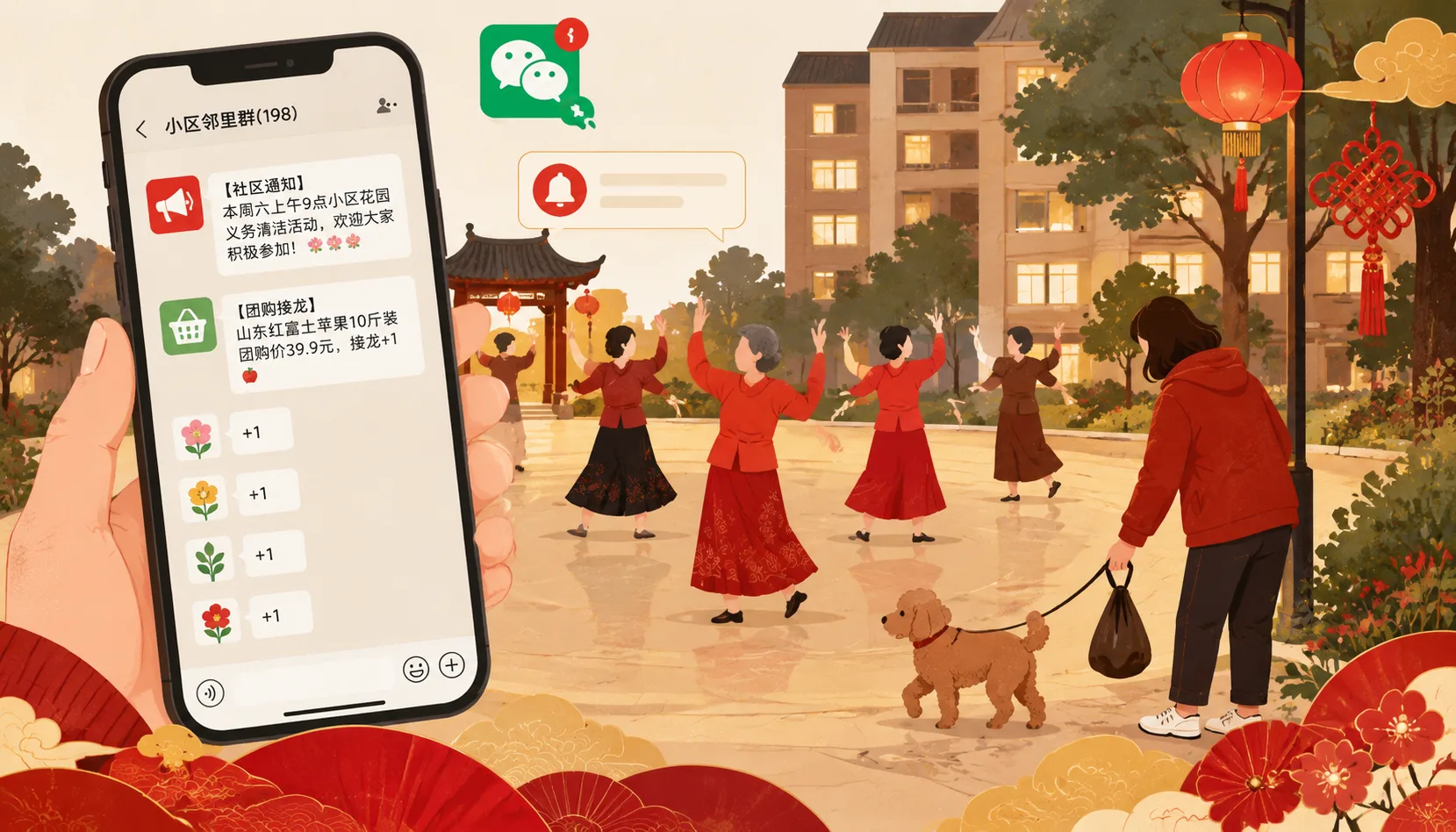
Chinese Neighborhood WeChat Groups: Expat Survival Guide
Join your compound's WeChat group via your property management office or landlord. Use it to get critical notices, participate in group buying, and connect with…
Read the guide →
China Parcel Delivery: Lockers, Stations & Door Delivery
In China, couriers typically leave packages at smart lockers (快递柜) or pickup stations (菜鸟驿站) rather than delivering to your door. You'll receive a pickup code v…
Read the guide →