How should foreigners give gifts to guards, cleaners, and neighbors in a Chinese residential compound?
Quick answer
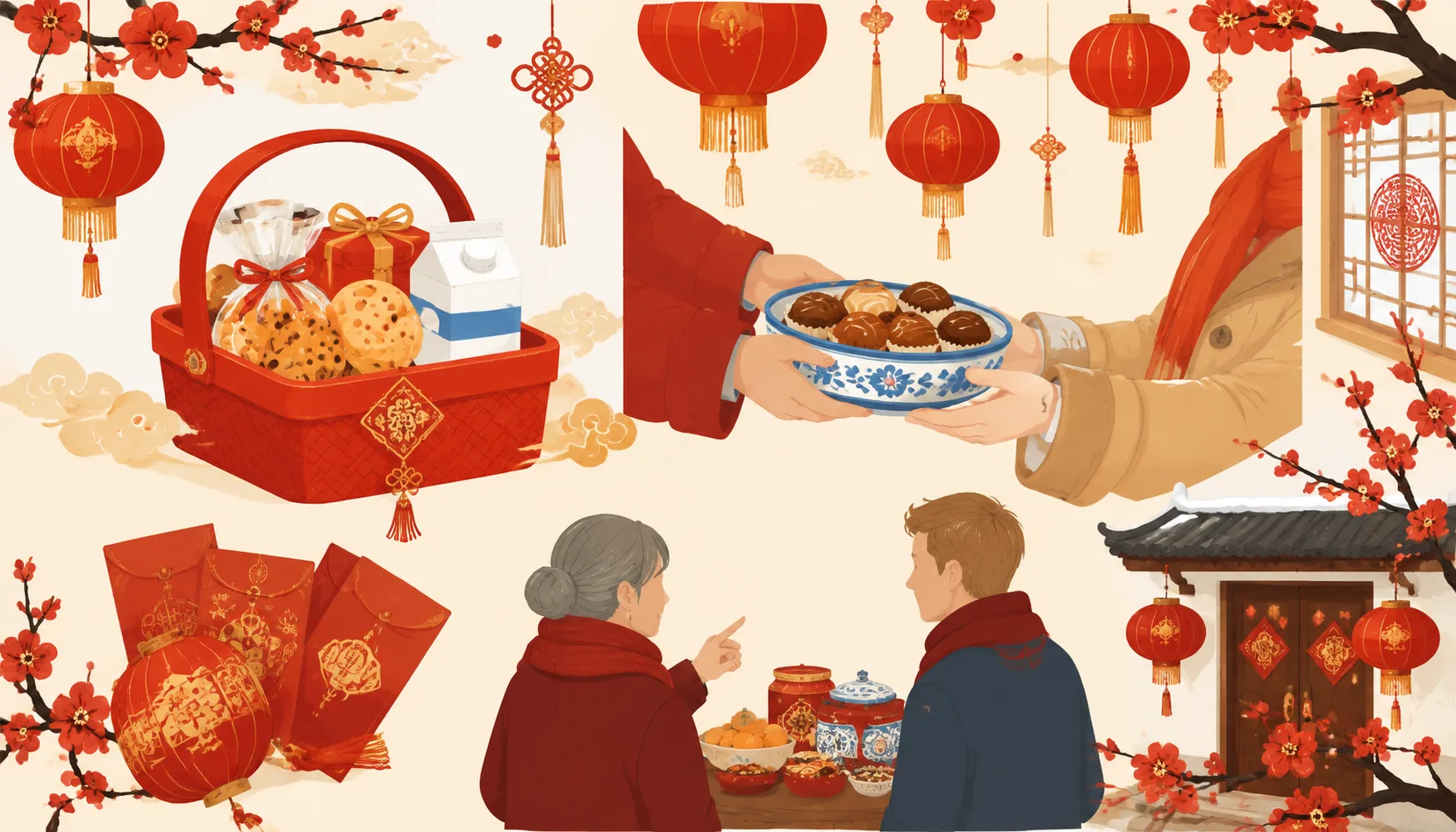
In Chinese compounds, small gifts to guards, cleaners, and neighbors are a normal way to build goodwill (人情 rénqíng). Give practical items like biscuits or fruit before Spring Festival, hand them over casually with a smile, and never return a food container empty. Avoid clocks, pears, and umbrellas as gifts.
Why Gift Giving Matters in Chinese Compounds
When you move into a Chinese residential compound (小区 xiǎoqū), you enter a tightly woven community where daily life is supported by people you may not think about — the security guards at the gate, the cleaners who keep the stairwells spotless, the property management staff who fix your plumbing. In Western contexts, we might say a polite 'thank you' and move on. In China, the glue that holds community life together is 人情 (rénqíng) — the give-and-take of human favor and reciprocity.
Gift giving in this context is not bribery or awkward formality. It's a way of saying, 'I see you, I appreciate you, and we're in this together.' A small box of biscuits or a carton of milk, handed over with a genuine smile, can transform your relationship with the people who make your daily life smoother. They'll remember your kindness when you need a package held, a door unlocked, or a bit of extra help.
Actionable tip: Start small. Next time your guard helps you carry groceries, offer a bottle of water or a piece of fruit. That's the seed of goodwill.
| Chinese | Pinyin | English |
|---|---|---|
| 人情 | rénqíng | human favor, reciprocity |
| 小区 | xiǎoqū | residential compound |
| 善意复利 | shànyì fùlì | compound interest of goodwill |
Spring Festival: The Big Gift-Giving Moment
The most important occasion for compound gift giving is Spring Festival (春节 Chūnjié), the Chinese New Year. In the two weeks leading up to the holiday, it's customary to show appreciation to the people who serve your daily life. This is not obligatory — but it creates enormous long-term goodwill, what I like to call '善意复利 (shànyì fùlì)' — the compound interest of kindness.
Who should you give to? Start with the 保安 (bǎo'ān) — security guards at the gate, the 保洁 (bǎojié) — cleaners who maintain the common areas, and any 物业 (wùyè) property management staff who have helped you during the year. You don't need to give to everyone — just those you interact with regularly.
What to give? Keep it practical and consumable. A box of quality biscuits, a carton of milk, a bag of instant noodles, or a small red envelope (红包 hóngbāo) with ¥50-100 inside. The value is symbolic, not transactional. It says, 'I appreciate your work.'
Actionable tip: Prepare your gifts two weeks ahead. Buy a few identical boxes of biscuits — that way no one feels singled out.
| Chinese | Pinyin | English |
|---|---|---|
| 春节 | Chūnjié | Spring Festival (Chinese New Year) |
| 保安 | bǎo'ān | security guard |
| 保洁 | bǎojié | cleaner |
| 物业 | wùyè | property management |
| 红包 | hóngbāo | red envelope (with money) |
How to Hand Over a Gift Without Awkwardness
Many foreigners feel nervous about giving gifts in China — they worry about making it too formal or creating an obligation. But the Chinese way is refreshingly casual. You don't need a speech or a ceremony. Just walk up to the guard or cleaner, smile, and hand over the gift with a simple phrase.
Here's a realistic dialogue:
You: 过年好,辛苦了!(Guò nián hǎo, xīnkǔ le!) — 'Happy New Year, thank you for your hard work!'
Guard: 哎呀,谢谢谢谢!(Āiyā, xièxie xièxie!) — 'Oh, thank you, thank you!' (with a big smile and maybe a slight bow)
That's it. Don't expect a long thank-you speech. A smile and a nod is the Chinese way of accepting gratefully. If they protest — '不用不用 (bú yòng bú yòng)' meaning 'no need, no need' — that's just politeness. Insist gently: '拿着吧 (ná zhe ba)' — 'please take it.' Then move on.
Actionable tip: Don't linger. A quick handover and a warm smile is perfect. Over-apologizing or over-explaining makes it weird.
| Chinese | Pinyin | English |
|---|---|---|
| 过年好 | guò nián hǎo | Happy New Year |
| 辛苦了 | xīnkǔ le | Thank you for your hard work |
| 不用不用 | bú yòng bú yòng | No need, no need (polite refusal) |
| 拿着吧 | ná zhe ba | Please take it |
Neighbor Gift Exchange: The Container Rule
In Chinese compounds, neighbors often share food — dumplings during Spring Festival, mooncakes for Mid-Autumn, or just a plate of freshly made snacks. When a Chinese neighbor gives you food, there's an unwritten rule that you must never return the container empty. Wash it, and put something inside — a few pieces of imported chocolate, some fruit, a box of tea bags. The value doesn't need to match; the gesture matters.
Here's a typical scenario:
Neighbor: 这是我包的饺子,你尝尝!(Zhè shì wǒ bāo de jiǎozi, nǐ chángchang!) — 'These are dumplings I made, try them!'
You: 谢谢!太好吃了!(Xièxie! Tài hǎochī le!) — 'Thank you! So delicious!'
Then, a day or two later, return the plate with some fruit or a small bag of cookies. Say: 这是给你的,尝尝!(Zhè shì gěi nǐ de, chángchang!) — 'This is for you, try it!'
Actionable tip: Keep a stash of 'return gifts' — small items like chocolate, tea, or fruit that you can quickly put in a returned container.
| Chinese | Pinyin | English |
|---|---|---|
| 饺子 | jiǎozi | dumplings |
| 月饼 | yuèbǐng | mooncake |
| 尝尝 | chángchang | try it (taste) |
Building a Gift Repertoire with Food-Sharing Neighbors
Some neighbors are enthusiastic food-sharers — they'll bring you homemade dishes, seasonal fruits, or festival treats throughout the year. If you have such a neighbor, don't feel pressured to match every gift. Instead, build a repertoire of gestures that show consistent warmth.
Here are ideas that work well:
- Travel souvenirs: When you go back home or travel within China, bring back a local specialty food — cheese from France, maple syrup from Canada, or a box of famous local pastries.
- Festival reciprocity: During Chinese festivals, share something yourself. For Mid-Autumn, buy a box of mooncakes and offer them. For Dragon Boat, try zongzi (sticky rice dumplings) and share a bottle of wine.
- Occasional treats: A bottle of good wine, a box of imported chocolates, or even a bag of fresh fruit from the market — these are always appreciated.
The key is consistency, not equivalence. A small gift every few months builds a warm relationship far better than a lavish gift once a year.
Actionable tip: Keep a mental or written list of what you've given and received. It helps you stay balanced without obsessing over exact value.
| Chinese | Pinyin | English |
|---|---|---|
| 中秋 | Zhōngqiū | Mid-Autumn Festival |
| 端午 | Duānwǔ | Dragon Boat Festival |
| 粽子 | zòngzi | sticky rice dumplings |
What NOT to Give: Taboos to Avoid
While most practical food gifts are safe, there are a few items that carry negative connotations in Chinese culture. Avoid these to prevent unintentional offense:
- Clocks (钟 zhōng): The word sounds like 'zhōng' in 'sòng zhōng' (送终), which refers to funeral rituals. Giving a clock is seen as wishing someone death.
- Pears (梨 lí): The word sounds like 'lí' in 'fēnlí' (分离), meaning separation. Giving a pear suggests you want to part ways.
- Umbrellas (伞 sǎn): The word sounds like 'sǎn' in 'fēnsàn' (分散), meaning to break apart. It's also associated with saying goodbye.
Also avoid sharp objects like knives or scissors, as they symbolize cutting ties. And while flowers are fine, avoid white flowers (associated with funerals) and yellow chrysanthemums (also funeral flowers).
Stick to food items — biscuits, fruit, milk, tea, wine, or snacks — and you'll be perfectly safe. If in doubt, ask a Chinese friend or your neighbor's preference.
Actionable tip: When in doubt, choose something edible. Food is universally safe and always appreciated.
| Chinese | Pinyin | English | Why Avoid |
|---|---|---|---|
| 钟 | zhōng | clock | Sounds like 'death ritual' |
| 梨 | lí | pear | Sounds like 'separation' |
| 伞 | sǎn | umbrella | Sounds like 'break apart' |
Handling Curious Elderly Neighbors with Grace
In Chinese compounds, you'll often encounter the 大爷大妈 (dàyé dàmā) — the elderly men and women who seem to know everything about everyone. They may stop you in the elevator or courtyard and ask questions like: 'Where are you from? What do you do? Do you like Chinese food?'
Don't be annoyed. This is warm curiosity, not interrogation. In Chinese culture, asking personal questions is a way of showing interest and building connection. The best response is to stop, smile, and answer briefly with enthusiasm.
Here's a sample exchange:
Dàmā: 你是哪国人?(Nǐ shì nǎ guó rén?) — 'What country are you from?'
You: 我是法国人,在附近工作。(Wǒ shì Fàguó rén, zài fùjìn gōngzuò.) — 'I'm French, I work nearby.'
Dàmā: 你喜欢中国菜吗?(Nǐ xǐhuan Zhōngguó cài ma?) — 'Do you like Chinese food?'
You: 喜欢!特别是火锅!(Xǐhuan! Tèbié shì huǒguō!) — 'I love it! Especially hotpot!'
This little exchange will make you a beloved figure in the compound. They'll talk about you positively for weeks — 'That foreigner is so friendly!'
Actionable tip: Prepare a 30-second 'elevator pitch' about yourself in Chinese — where you're from, what you do, and one thing you love about China. It'll make these encounters effortless.
| Chinese | Pinyin | English |
|---|---|---|
| 大爷 | dàyé | uncle (elderly man) |
| 大妈 | dàmā | auntie (elderly woman) |
| 火锅 | huǒguō | hotpot |
Seasonal Gift Occasions: A Quick Reference
Beyond Spring Festival, there are other occasions when a small gift can strengthen your compound relationships. Here's a handy table of the main seasonal gift-giving moments:
| Occasion | Chinese | Pinyin | When | Appropriate Gifts |
|---|---|---|---|---|
| Spring Festival | 春节 | Chūnjié | Late Jan/Feb | Biscuits, milk, red envelope (¥50-100) |
| Mid-Autumn Festival | 中秋 | Zhōngqiū | Sept/Oct | Mooncakes, fruit, tea |
| Dragon Boat Festival | 端午 | Duānwǔ | June | Zongzi, rice wine, salted duck eggs |
For guards and cleaners, a small gift on any of these occasions is a lovely gesture. For neighbors, you can simply share food — offer a box of mooncakes or a plate of zongzi.
Remember: the value is always symbolic. A ¥30 box of biscuits is enough. It's the thought and consistency that build goodwill.
Actionable tip: Set calendar reminders for these festivals so you never miss the chance to show appreciation.
What Chinese People Actually Say
- 意思意思 | yìsi yìsi | "just a small gesture" (humble term for a gift) | Use when giving to compound staff to sound modest and non-offensive
- 辛苦费 | xīnkǔ fèi | "hard work fee" (tip for service workers) | Common gift/money given to cleaners or security during holidays
- 薄礼 | bólǐ | "humble/small gift" (self-deprecating term) | Use when presenting to neighbors to show humility and avoid seeming showy
2026 Reality Check
2026 Reality Check: The tradition persists but is fading. In Beijing and Shanghai, younger residents increasingly use digital red envelopes via WeChat, though many still hand physical gifts to guards and cleaners during Chinese New Year. Gen Z shows the weakest adherence—many view it as outdated or inconvenient, preferring quick digital transfers or skipping it entirely.
Generational divide: Older generations (50+) remain the strongest practitioners, viewing it as essential courtesy. Middle-aged residents (35-50) often maintain the habit but with reduced frequency or value. In smaller cities and towns, the custom remains more robust, especially among older residents who value face-to-face community relationships.
Urban vs. rural: Tier-1 cities see declining participation, particularly in newer compounds with transient populations. Smaller cities and traditional neighborhoods still observe the practice, though even there, younger residents are simplifying or abandoning it.
Frequently asked questions
What is a good gift to give the security guard at my Chinese compound?
Practical food items work best: a bag of oranges, a box of biscuits, or a carton of milk. Guards appreciate things they can consume during their shift. Avoid alcohol and cigarettes unless you know the person well, as these can feel impersonal or even inappropriate in some compounds.
Can I give a gift to my cleaner in the building or should I just tip them?
Yes, a small gift is fine and often more appreciated than cash. A box of tea, a packet of dried fruit, or a festive snack before Spring Festival shows respect. If you do tip, put it in a red envelope (红包) and hand it over discreetly with a smile.
When is the best time to give gifts to neighbors in a Chinese compound?
The ideal time is before Chinese New Year (Spring Festival), when everyone is exchanging gifts. Mid-Autumn Festival is also good for mooncakes. Avoid giving gifts during the summer heat for perishable items, and never give a gift when someone is moving out—it can feel like you're celebrating their departure.
How do I give a gift to a neighbor without making it awkward?
Keep it casual. Say something like, 'I bought too many of these, would you like some?' or 'I saw these and thought of your family.' Hand it over with both hands, smile, and don't linger. If they decline, don't insist—just say it's no problem and move on.
Is it rude to refuse a gift from a neighbor in China?
Yes, refusing a gift outright can be seen as rejecting the relationship. If you genuinely can't accept it, take it with both hands, thank them warmly, and later explain you can't keep it (e.g., dietary restrictions). This preserves face and keeps the goodwill alive.
What should I do if a neighbor gives me a gift and I have nothing to give back?
You don't need to reciprocate immediately. A simple thank-you note or a small return gift within a few weeks is enough. If it's a food container, never return it empty—put some fruit or snacks inside as a polite gesture. This completes the cycle of reciprocity (人情) without pressure.
Try our tools
Related guides

What to Bring to a Chinese Home Dinner: 2026 Gift Guide
Never arrive empty-handed at a Chinese home dinner. Safe options: a fruit basket, quality packaged pastries or snacks, good quality tea, or imported wine/spirit…
Read the guide →
China Parcel Delivery: Lockers, Stations & Door Delivery
In China, couriers typically leave packages at smart lockers (快递柜) or pickup stations (菜鸟驿站) rather than delivering to your door. You'll receive a pickup code v…
Read the guide →
China Waste Sorting: A Foreigner's Practical Guide
Learn the 4-category system (recyclables, hazardous, food waste, other), but always check your specific compound's rules. Listen for the music signal to bring o…
Read the guide →