What should a foreigner know about attending a Chinese funeral and mourning customs?
Quick answer
Wear black or white, avoid red and bright colors. Bring a white envelope with cash in an even amount (no 4s) and white flowers — never red roses. Offer brief condolences like '请节哀' (qǐng jié'āi) and follow the family's lead. Be aware of ghost beliefs and paper offerings, which are central to the ceremony.
Dress Code: What to Wear (and Avoid)
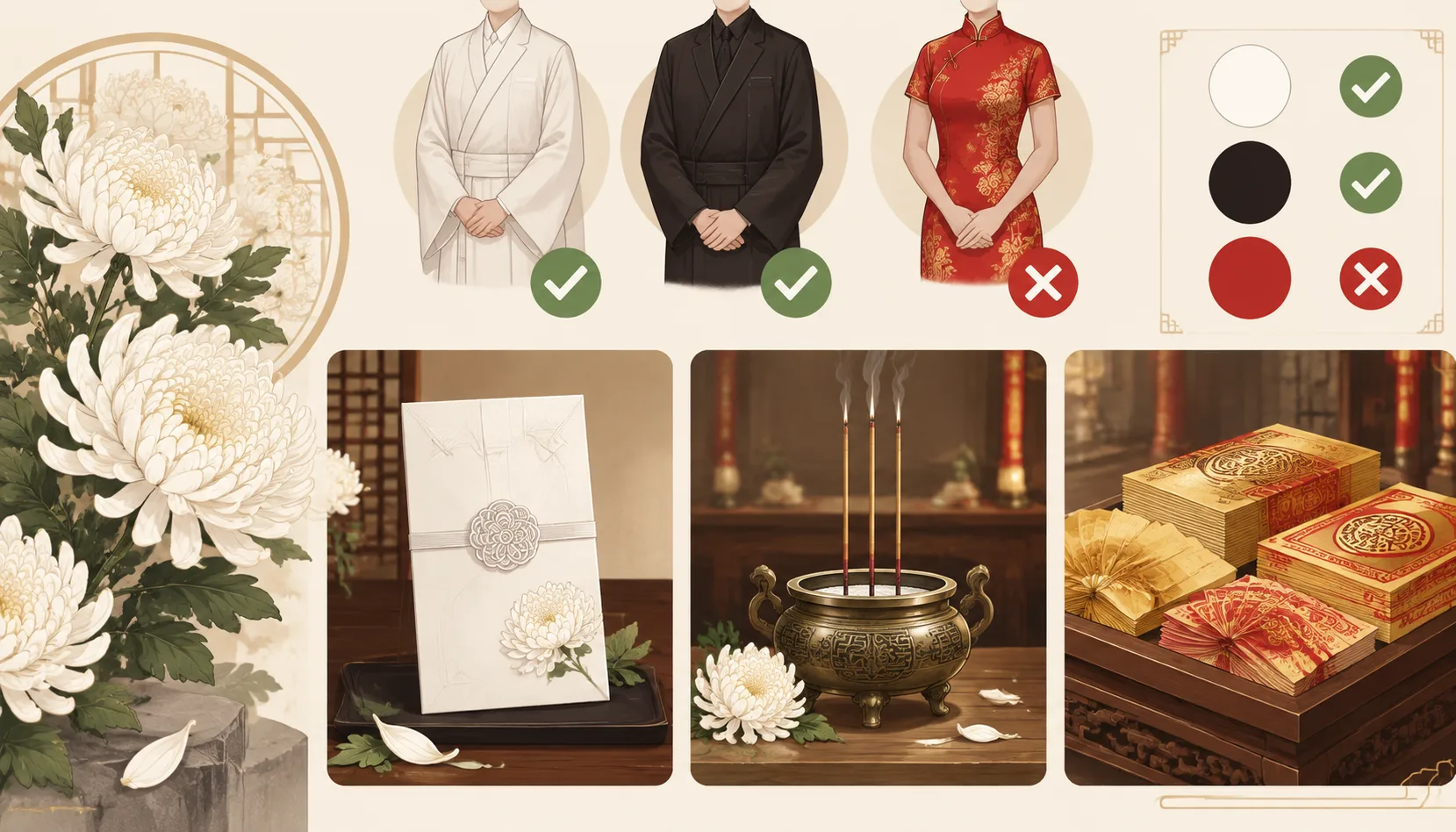
At a Chinese funeral, the dress code is strict: wear black or white — these are mourning colors. Dark suits, dresses, or simple black clothing are appropriate. White is also acceptable, especially in southern regions.
Never wear red — red symbolizes happiness and joy in Chinese culture, and wearing it to a funeral is a serious offense. Also avoid bright colors like yellow, pink, or purple. Even accessories (scarves, ties, handbags) should be subdued.
In some traditional families, mourners may wear a white cloth band around the arm or head — this is provided by the family. If you receive one, wear it as instructed. For shoes, choose black or dark brown; avoid white sneakers that look too casual.
If you're unsure, err on the side of simplicity: a black suit or dress is always safe. Remember, the goal is to show respect, not to make a fashion statement.
What to Bring: Gifts and Money
The most common gift at a Chinese funeral is cash in a white envelope (called 帛金, bójīn). The envelope is white, never red (red is for weddings). You can buy these at stationery shops or the funeral home.
- Amount: Give an even number of money, but avoid the number 4 (sì) because it sounds like 'death' (sǐ). Odd numbers are also avoided because they are associated with misfortune. Common amounts: 101, 201, 501, or 1001 (the extra 1 ensures an odd total, which is considered lucky).
- How to give: Place the cash in the envelope, write your name (optional) on the back, and hand it to the family or place it in a designated box at the entrance. Do not give it directly to the bereaved with a handshake — it's often placed on a table.
- Flowers: White flowers are appropriate — chrysanthemums, lilies, or white roses. Never bring red roses (they symbolize romantic love). Yellow or white chrysanthemums are the most traditional.
If you cannot attend, you can send a flower wreath (花圈, huāquān) with a white ribbon bearing your name and a message of condolence.
What to Say: Condolences and Etiquette
When offering condolences, keep it brief and respectful. The most common phrase is '请节哀' (qǐng jié'āi) — meaning 'Please restrain your grief' or 'My condolences.' Another is '节哀顺变' (jié'āi shùnbiàn) — 'Restrain grief and accept the change.'
You can also say '一路走好' (yīlù zǒuhǎo) — 'May you walk well on the road' (addressed to the deceased, not the family). If you're not comfortable speaking Chinese, a simple 'I'm so sorry for your loss' is acceptable, but it's better to learn the local phrase.
Avoid saying: 'Don't cry' or 'They're in a better place' — these can be seen as insensitive. Also avoid asking about the cause of death or making jokes.
When offering your condolences, bow slightly with your hands clasped in front of you (a gesture of respect). Do not hug or kiss the bereaved unless they initiate it. After the ceremony, it's common to say '请保重' (qǐng bǎozhòng) — 'Please take care of yourself.'
Ghost Beliefs That Shape Behavior
Chinese funeral customs are deeply influenced by beliefs about ghosts and the afterlife. The spirit of the deceased (魂魄, húnpò) is thought to linger for a period after death, and the family must ensure it departs peacefully to avoid becoming a restless ghost (孤魂野鬼, gūhún yěguǐ).
This is why you'll see burning incense and joss paper (纸钱, zhǐqián) — to provide the spirit with money and goods for the afterlife. Paper offerings (纸扎, zhǐzhā) include miniature houses, cars, and even smartphones, all made of paper and burned at the grave or altar.
During the funeral, family members may wail or cry loudly — this is not just grief; it's believed to help guide the spirit away. In some regions, a rooster is placed at the coffin to lead the spirit, or a broken bowl is thrown to scare off evil spirits.
As a foreigner, you don't need to participate in these rituals, but you must respect them. Do not touch the altar, walk in front of the coffin, or take photos (unless explicitly allowed). Also, avoid standing directly in front of the main door — it's believed to block the spirit's path.
Why Burning Paper Offerings Matters
Burning paper offerings (烧纸, shāo zhǐ) is a central ritual in Chinese funerals. The belief is that the deceased's soul needs money and material goods in the afterlife, and burning these items transmits them to the spirit world.
You'll see joss paper (gold or silver foil paper) folded into ingots and burned in a metal container. Larger paper effigies — like houses, cars, servants, or even credit cards — are burned at the grave or during the funeral. This practice is rooted in ancient ancestor worship and the concept of filial piety (孝, xiào): providing for one's parents even after death.
In urban areas, burning is often regulated to prevent fires, so you may see designated incinerators or communal burners. If you're invited to participate, you can help by adding paper to the fire, but do so respectfully — don't throw it in casually. Some families also burn paper money at the gravesite on specific days after the funeral (e.g., the 7th, 49th, or 100th day).
For foreigners, the key is to understand that this is not just a symbolic gesture — it's a serious act of filial duty. Never mock or question it, and never step over the burning paper.
How Long Mourning Periods Last
Mourning periods in Chinese culture are traditionally long and structured. The immediate family observes a period of 49 days (七七, qīqī) — this is the time it's believed the soul takes to be reborn. During this period, the family avoids celebrations, wearing red, and attending happy events.
After 49 days, a memorial service may be held. The full mourning period can last 100 days, after which the family removes the mourning clothes (孝服, xiàofú). In some traditions, mourning lasts three years for a parent, but this is now mostly symbolic — the actual period is often shortened to 100 days or 1 year.
During the mourning period, the family may avoid visiting others during Chinese New Year, as it's considered bad luck to bring death into a home. They also avoid attending weddings or birthday parties.
As a foreigner, if you have a Chinese friend or colleague in mourning, be sensitive: don't invite them to parties, and avoid sending New Year greetings that are too cheerful. A simple message of support is appreciated.
Regional Variations Across China
China's funeral customs vary significantly by region. Here are some notable differences:
| Region | Distinctive Practice |
|---|---|
| Northern China (e.g., Beijing) | More elaborate rituals, including a 'wake' (守灵) where family stays with the body for days. Burning paper offerings is done in large quantities. |
| Southern China (e.g., Guangdong, Fujian) | Heavy emphasis on feng shui for burial sites. Some families hire 'mourners' to cry professionally. White is the dominant mourning color. |
| Rural areas | Traditional ceremonies can last for days, with processions, musicians, and even opera performances. The coffin is carried to the grave by hand. |
| Urban areas | Modern cremation is common, and ceremonies are shorter (1-2 hours). Some families skip traditional rituals due to space and regulations. |
| Ethnic minority regions (e.g., Tibet, Yunnan) | Sky burials (Tibet) or water burials are practiced — these are very different from Han Chinese customs. If invited, follow local guidance strictly. |
No matter where you are, the golden rule is to observe and follow the family's lead. If you're unsure about a custom, ask a trusted Chinese friend or the funeral director discreetly.
What Chinese People Actually Say
- 节哀顺变 | jié āi shùn biàn | "Please accept my condolences" | Use when expressing sympathy to the bereaved family.
- 奠仪 | diàn yí | "Condolence money" | White envelope of money given to support the bereaved family.
- 吊丧 | diào sāng | "To pay respects at a funeral" | Used when attending a funeral to honor the deceased.
2026 Reality Check
White remains the traditional funeral color in 2026, but urban millennials and Gen Z increasingly opt for black or muted tones instead of strict white attire. The practice of burning paper offerings (joss paper) is declining in major cities due to fire safety regulations and environmental concerns, though it remains common in rural areas.
Gen Z vs Older Generations: Younger Chinese often skip traditional rituals like kowtowing or wearing孝服 (mourning clothes), preferring simple floral tributes. Older generations still insist on full funeral rites, including the 49-day mourning period and specific burial procedures.
Beijing/Shanghai vs Smaller Cities: Major cities see more secular, streamlined funerals at funeral homes. Smaller cities and rural areas maintain stronger traditions—extended mourning periods, geomancy consultations, and elaborate ancestor worship continue. Digital memorials are growing in urban areas but remain rare elsewhere.
Frequently asked questions
Can I take photos or videos at a Chinese funeral?
Generally, no. Photography is considered disrespectful and intrusive during mourning. The only exception is if the family explicitly asks you to take photos for remembrance. When in doubt, keep your phone away and follow what other guests are doing.
What should I do if I accidentally wear red to a Chinese funeral?
Don't panic. Apologize briefly to the family and offer to change if possible. Red symbolizes joy and is taboo at funerals, but most families will understand a foreigner's mistake. If you can't change, stay discreet and avoid drawing attention to yourself.
Is it okay to bring children to a Chinese funeral?
It depends on the family and region. Some families welcome children to pay respects, while others believe kids are vulnerable to ghosts or bad luck. Ask the family directly beforehand. If you bring children, keep them quiet and away from the coffin or altar area.
How much money should I put in the white envelope (bai jin)?
There's no fixed amount, but it should be an even number — never odd, and never containing the digit 4, which sounds like 'death.' Common amounts range from 100 to 500 RMB depending on your relationship to the deceased. Ask a Chinese friend for guidance if unsure.
What if the funeral is held at a Buddhist or Taoist temple instead of a funeral home?
Temple funerals follow similar etiquette but may include chanting, incense burning, and bowing rituals. Follow the lead of other mourners — when they kneel or bow, do the same. It's fine to observe quietly if you're not familiar with the religious elements.
Can I send flowers instead of attending the funeral in person?
Yes, but white flowers like chrysanthemums or lilies are appropriate. Avoid red roses entirely. Have the florist deliver them with a note of condolence. However, sending money in a white envelope is often more appreciated and practical in Chinese culture.
Try our tools
Related guides
Chinese Superstitions in Everyday Life: What to Know
Several Chinese superstitions remain genuinely active in modern life — especially around gifts (clocks, pears, green hats), numbers (4 = death, 8 = prosperity),…
Read the guide →
Chinese Lucky and Unlucky Numbers: Why 8 Is Gold, 4 Is Fatal
In China, 8 is the luckiest number (sounds like 'prosper'), 6 means smooth sailing, and 9 means longevity. The number 4 is avoided like death — because it sound…
Read the guide →
Ancestor Worship & Qingming Festival: A Foreigner's Guide
Ancestor worship in China centers on honoring deceased family members through rituals like Qingming grave sweeping, burning paper offerings, and maintaining hom…
Read the guide →