Which hand goes on the outside when doing a Chinese bow greeting?
Quick answer
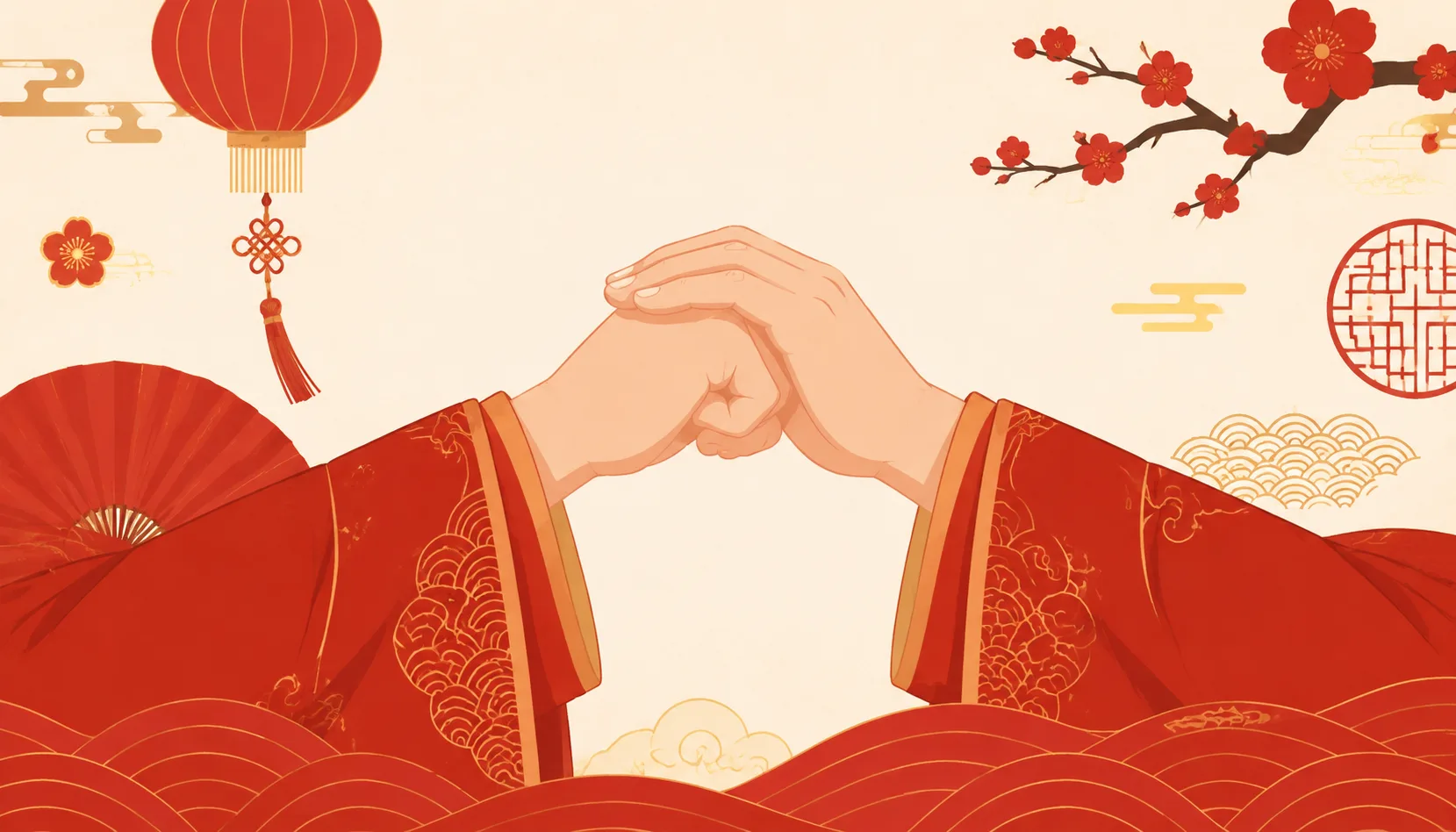
For happy occasions (New Year, celebrations), left hand goes on the outside. Right hand on the outside is used at funerals. Mixing these up is a significant social error.
Why This Rule Matters
In Chinese tradition, left (左) is the auspicious, yang (阳) side associated with life and celebration. Right (右) is the yin (阴) side associated with mourning and death. Performing the funeral bow at a happy event is a serious and embarrassing mistake — Chinese people will notice immediately.
What You Should Do
- For New Year greetings and celebrations: left hand wraps around right fist (left outside)
- For funerals and mourning: right hand wraps around left fist (right outside)
- Bow slightly forward when performing 拱手礼 (gǒng shǒu lǐ) for any occasion
What You Shouldn't Do
- Use the funeral bow gesture at a New Year celebration — this is very bad
- Use the celebration gesture at a funeral
- Skip learning this distinction if you plan to attend Chinese ceremonies
Practical Tips for Foreigners
This rule still matters most at formal ceremonies and in northern China, though many younger urban Chinese no longer observe it. When in doubt, watch what your Chinese host or senior colleague does and follow their lead. Breaking this rule once is forgivable — breaking it repeatedly signals a lack of cultural awareness.
Why Foreigners Get It Wrong So Often
Most foreigners learn 拱手礼 from a quick video or a colleague who says 'just put <a href="/etiquette/wash-hands-before-eating/">your hands</a> together.' What nobody tells you is that the hand position carries the same weight as wearing black to a wedding in the West. Chinese people rarely correct you to your face — they just file it away. A wrong gesture at a funeral in Beijing might get you a silent stare; at a wedding in rural Henan, the bride's grandmother might literally pull your hands apart and rearrange them. The rule isn't just about hands — it's about showing you understand which side of life you're standing on.
Real Scenarios Where This Backfires
- A British expat in Shanghai gave a New Year bow with his right hand outside at a company dinner — his boss laughed it off, but two older colleagues from Suzhou quietly avoided him for weeks.
- An American teacher at a funeral in Chengdu used the left-hand-outside happy gesture. The widow didn't say anything, but the funeral director pulled him aside afterwards and explained the difference — he was mortified.
- In Guangdong, younger professionals at a wedding might not even notice the hand position. But if you're in a room with anyone over 60 from Fujian or rural areas, they will absolutely notice — and they will remember.
Regional and Generational Blind Spots
This rule is strictest in northern China — Beijing, Tianjin, and Shandong — where older generations still use 拱手礼 daily. In the south, especially Guangdong and Shenzhen, younger urbanites often skip the gesture entirely and just nod or shake hands. But don't let that fool you: at formal events like weddings, ancestral ceremonies, or <a href="/holidays/chinese-new-year-gifts/">Spring Festival</a> visits to elders, the stakes go up everywhere. If you work in government, education, or traditional industries (like tea, medicine, or real estate with older clients), mastery of this rule is a cheap way to earn serious respect. In tech hubs like Hangzhou or Shenzhen, you can probably get away with mistakes — but why risk it?
Quick Memory Trick That Works
Think of it as 'left for life' — left hand outside for birthdays, weddings, and New Year. Right is for 'rest' — funerals and mourning. If you're ever unsure, just ask: 'Which hand should go outside?' Chinese people will respect the question far more than a confident mistake. And if you're at a mixed event — like a funeral that ends with a family meal — keep the funeral gesture throughout. Switching mid-event is worse than getting it wrong at the start.
What Chinese People Actually Say
- 左手在外 | zuǒ shǒu zài wài | "left hand on the outside" | Used for weddings, New Year, and celebrations
- 右手在外 | yòu shǒu zài wài | "right hand on the outside" | Used for funerals and mourning ceremonies
- 左手包右手 | zuǒ shǒu bāo yòu shǒu | "left hand wraps the right" | Formal expression for celebratory bowing
2026 Reality Check
2026 Reality Check: The traditional rule—left hand over right for celebrations, right over left for funerals—is largely forgotten by most Chinese under 40. Most people no longer notice or care which hand is on top.
Gen Z vs. Older Generations: Seniors (60+) still sometimes observe this, especially in rural areas. Gen Z finds it "old-fashioned" or doesn't know it exists. Urban youth treat it as cultural trivia, not practice.
Beijing/Shanghai vs. Smaller Cities: In major cities, the rule is effectively dead—even funeral homes don't enforce it. In some rural areas, elderly people may still subtly follow it, but even there it's fading. The younger generation prioritizes convenience over tradition.
Bottom line: This rule survives mostly in history textbooks and viral "did you know" posts. Real-world compliance is near zero in 2026.
Frequently asked questions
Which hand should be on the outside when performing a Chinese bow greeting for a happy occasion?
For happy events like New Year celebrations or weddings, place your left hand on the outside and your right hand inside. This symbolizes good fortune and respect.
What is the correct hand position for a bow greeting at a funeral in China?
At funerals, put your right hand on the outside and your left hand inside. This is a sign of mourning and should not be used for other occasions.
What happens if I accidentally use the wrong hand on the outside during a Chinese bow?
Using the wrong hand is considered a major social faux pas, as it can imply disrespect or even a death wish. If you realize the mistake, apologize briefly and correct your hand position immediately.
Is the hand-on-outside rule the same for both men and women in China?
Yes, the rule applies equally to men and women. The left hand outside is for happy events, and the right hand outside is for funerals, regardless of gender.
Can I use the Chinese bow greeting with left hand outside for business meetings?
Yes, for business meetings or any positive interaction, use the left hand outside. This is appropriate as long as the event is not a somber one like a funeral.
Are there any exceptions to the left-hand-outside rule for happy events in China?
No, the left-hand-outside rule is consistent for all happy occasions, including festivals, birthdays, and congratulations. Always reserve the right-hand-outside for funerals only.
Try our tools
Related guides
Ancient Chinese Etiquette Rules: What Foreigners Must Know
China has thousands of years of accumulated social rules — many of them "unwritten" but universally understood. These rules cover everything from how you sit, h…
Read the guide →
Chinese Business Card Etiquette: How to Exchange Cards
In China, the business card is not a contact-sharing tool. It is a formal introduction of your identity and position. Present it with both hands, Chinese side f…
Read the guide →
Chinese Formal Meeting Etiquette: Seating & Greetings
Chinese formal meetings run on hierarchy: the most senior person enters first, sits facing the door, speaks first on any topic, and leaves first. You wait to be…
Read the guide →