Why shouldn't I step on the threshold (door sill) when entering a Chinese home?
Quick answer
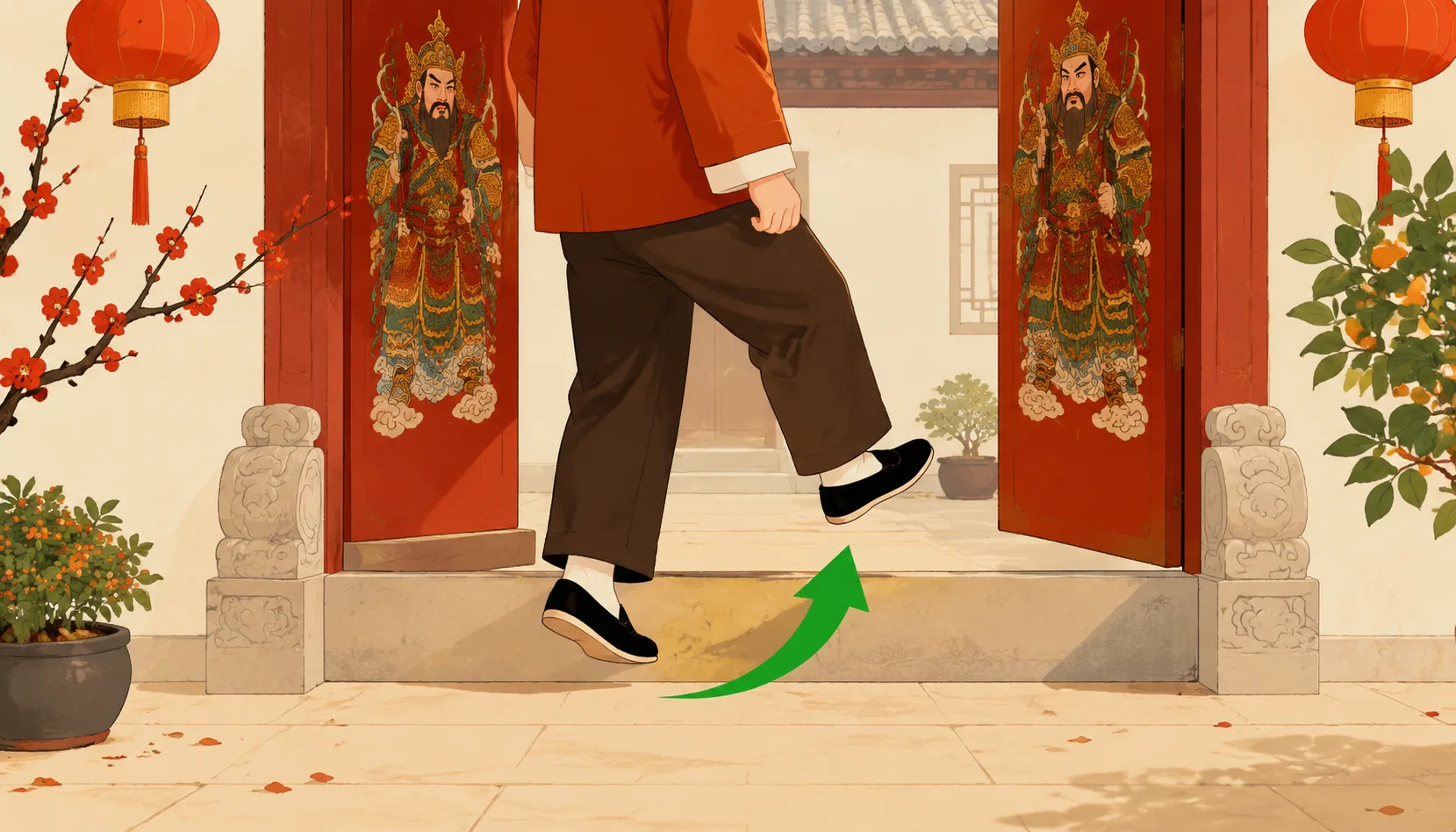
Stepping on the threshold is considered disrespectful and bad luck. Always step over it, not on it.
Why This Rule Matters
In ancient Chinese belief, the threshold (门槛, mén kǎn) was a spiritual boundary protecting the household's 'earth energy' (地气, dì qì) from escaping. Stepping on it was seen as disturbing this protective force. Historically, even servants entering the emperor's chambers were required to step over the threshold, not on it. The belief persists in traditional and rural households today.
What You Should Do
- Step over the threshold with a deliberate, clear step
- Pay attention to traditional homes and temples which often have high thresholds
- Wipe your feet before entering — clean shoes show respect for the home
What You Shouldn't Do
- Step directly on the wooden or metal threshold strip when entering
- Lean or press on the threshold while standing in a doorway
Practical Tips for Foreigners
This rule applies in traditional homes, temples, and older buildings. When in doubt, watch what your Chinese host or senior colleague does and follow their lead. Breaking this rule once is forgivable — breaking it repeatedly signals a lack of cultural awareness.
Regional Differences: South vs. North China
While the threshold rule is widely acknowledged, its intensity varies by region. In northern cities like Beijing and Xi'an, where traditional courtyard homes (siheyuan) with high wooden thresholds are common, older generations still treat it seriously—you'll see them visibly pause and lift their feet. In southern commercial hubs like Shanghai and Shenzhen, younger urbanites in modern apartments often have no threshold at all, so the rule fades naturally. However, in Guangdong and Fujian, especially among families with ancestral halls or rural homes, the threshold is still a spiritual barrier—stepping on it is seen as blocking fortune. Don't assume a modern building means the rule is dead; if you see a visible threshold strip, treat it as sacred.
Real Friction Points: What Hosts Think
- A British expat in Beijing, rushing to a dinner party, planted his foot squarely on the carved wooden threshold of his host's hutong home. The host's 70-year-old father quietly frowned and later told his son, 'He doesn't respect our home'—but said nothing to the guest directly.
- An American manager in Shenzhen visited a local employee's new apartment. No threshold existed, but he awkwardly shuffled his feet at the doorway, mimicking an old habit. The young host laughed and said, 'We're not that traditional here,' but his mother, visiting from Fujian, was quietly offended by the hesitation.
- In Guangzhou, a French consultant stepped on the low metal threshold of a factory owner's office, not a home. The owner, a 55-year-old Cantonese businessman, exchanged a look with his deputy but didn't correct him—later, the consultant noticed the deal felt colder than expected, though nothing was said.
When the Rule Doesn't Apply
Don't stress in every doorway. In modern office towers, shopping malls, and subway stations, there are no thresholds to worry about—stepping over an elevator gap is irrelevant. The rule applies to traditional homes, temple entrances, old-style restaurants, and shops with elevated door sills. Also, if a host is renovating or has removed the threshold for accessibility (e.g., for wheelchair users), they've consciously waived the custom—follow their lead. When in doubt, watch how family members enter; if they step over, you do too.
Why Hosts Won't Tell You Directly
Chinese etiquette often avoids direct confrontation, especially with guests. If you step on a threshold, don't expect a rebuke—your host might subtly clear their throat, glance at your feet, or simply go quiet for a moment. In extreme cases, older hosts may interpret it as a sign of disrespect and become more distant for the rest of your visit, without explaining why. This silence is a cultural friction point: you might think the visit went fine, while they're privately reassessing your character. The fix is simple—be observant and apologize proactively if you slip: a quick '不好意思' (bù hǎo yìsi) with a slight bow often repairs the moment.
What Chinese People Actually Say
- 踩门槛 | cǎi ménkǎn | "to step on the threshold" | Avoid this—considered disrespectful and brings bad luck
- 跨门槛 | kuà ménkǎn | "to step over the threshold" | The correct way to enter; treat the threshold as a boundary
- 不踩门槛 | bù cǎi ménkǎn | "don't step on the threshold" | Common phrase reminding guests to step over instead
2026 Reality Check
The "don't step on the threshold" rule is fading fast in 2026, especially in major cities. Most Beijing and Shanghai residents under 40 either ignore it entirely or do it reflexively without knowing why.
Gen Z in urban China sees it as superstition—something their grandparents worried about. They walk through doorways without a second thought. Older generations (60+) still忌讳 (avoid it), especially during holidays or important events like Chinese New Year.
Smaller cities and rural areas hold stronger to the tradition. In towns where multigenerational households remain common, elders will still scold younger family members for stepping on thresholds. It's tied to beliefs about disturbing household luck or ancestors.
Reality: The rule survives mostly as cultural flavor, not active practice. Urban young people comply only to avoid nagging from elders—and even that's declining.
Frequently asked questions
Why is stepping on the threshold considered bad luck in Chinese homes?
In Chinese tradition, the threshold is seen as a symbolic barrier that keeps out negative energy and protects the household. Stepping on it is thought to bring bad luck or disrespect the home's protective spirit.
Is the threshold rule the same for all types of Chinese homes, like apartments?
Yes, the custom applies to any home with a visible threshold, including traditional houses and some apartments. If there is no raised threshold, just walk in normally, but avoid deliberately stepping on any door frame or sill.
What should I do if I accidentally step on the threshold?
If you accidentally step on it, don't panic. You can briefly apologize or simply continue inside without making a fuss—most hosts will not take offense if it's clearly unintentional.
Does this rule apply to entering shops, temples, or other buildings in China?
Yes, the same courtesy is often observed for temples and some traditional buildings, but it's less critical for modern shops. When in doubt, step over any visible threshold to show respect.
Are there any regional differences in China regarding the threshold rule?
The practice is widespread, but strictness varies by region and family. In northern China, it's more commonly emphasized, while in southern urban areas, many people are less strict. Following the rule universally is always safe.
What is the best way to enter a Chinese home to show respect?
Step over the threshold with your feet, not on it, and wait for the host to invite you in. Remove your shoes if you see indoor slippers or a shoe rack, and greet the host politely.
Try our tools
Related guides

Visiting a Chinese Home: Etiquette Guide for Foreigners
Bring a small gift, arrive 5 minutes late (never early), remove shoes at the door, wait for the host to assign your seat, and let the eldest eat first. Follow t…
Read the guide →
Ancient Chinese Etiquette Rules: What Foreigners Must Know
China has thousands of years of accumulated social rules — many of them "unwritten" but universally understood. These rules cover everything from how you sit, h…
Read the guide →
Chinese Superstitions in Everyday Life: What to Know
Several Chinese superstitions remain genuinely active in modern life — especially around gifts (clocks, pears, green hats), numbers (4 = death, 8 = prosperity),…
Read the guide →