Which Chinese superstitions still affect everyday life, and which ones are mainly historical?
Quick answer
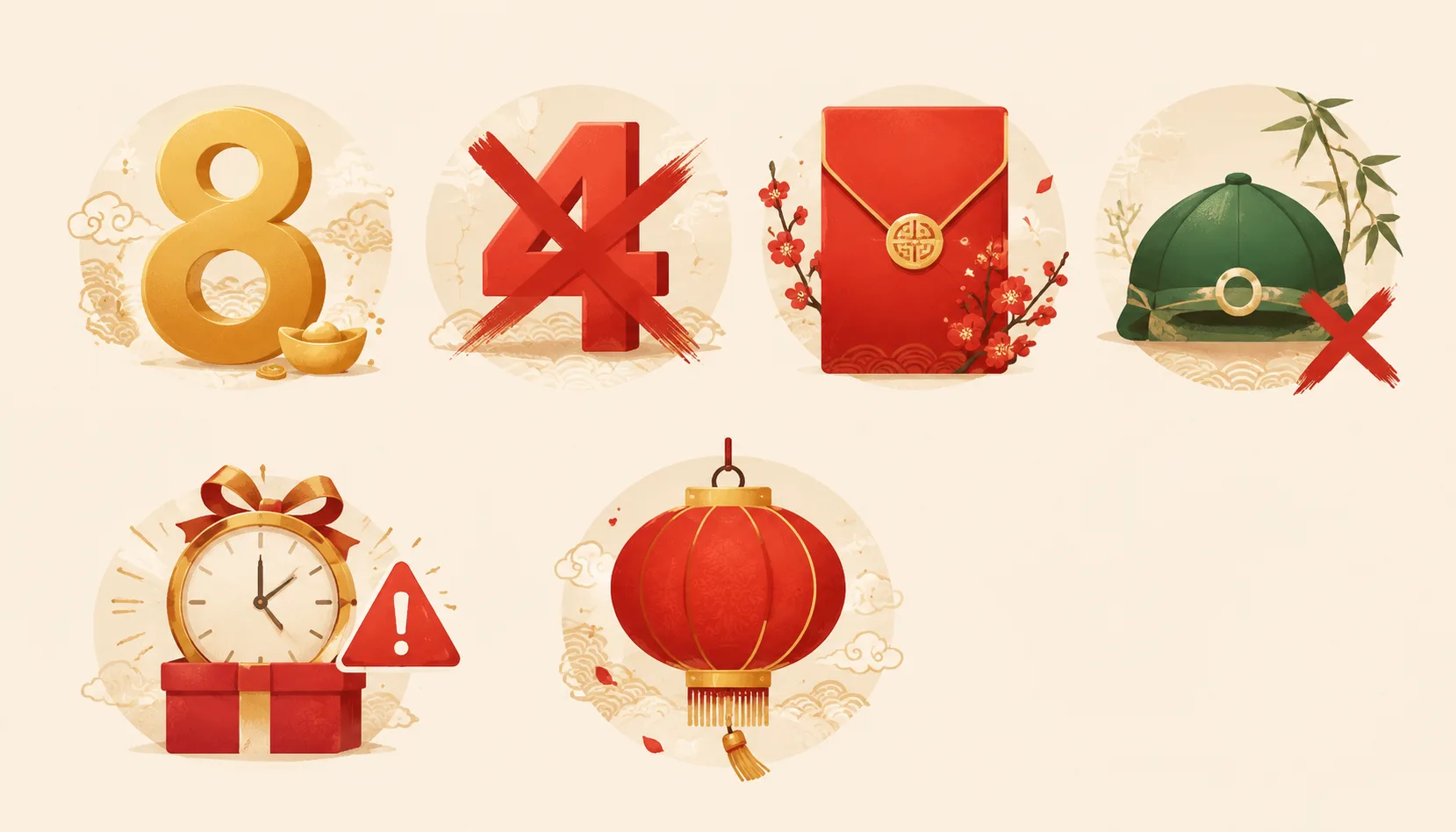
Several Chinese superstitions remain genuinely active in modern life — especially around gifts (clocks, pears, green hats), numbers (4 = death, 8 = prosperity), colors (white for mourning, red for luck), and moving house or starting businesses (choosing an auspicious date). Others (like never whistling at night) are more regional or historical. The ones related to gifts and numbers affect foreigners most directly.
Superstitions That Still Actively Matter
Numbers: The number 4 (四, sì) sounds like 死 (sǐ — death) and is genuinely avoided in many contexts — building floor numbering (no floor 4, 14, 24...), phone numbers, car license plates, and hospital room assignments. The number 8 (八, bā) sounds like 发 (fā — to prosper) and is actively sought — businesses, phone numbers, wedding dates, and addresses with 8s command premium prices. License plates with multiple 8s sell for significant sums.
Gift taboos: These are still actively observed, especially when giving to older recipients or in formal contexts:
- Clocks — 送钟 (sòng zhōng) = 送终 (attending a funeral)
- Pears — 梨 (lí) sounds like 离 (separation)
- Umbrellas — 伞 (sǎn) sounds like 散 (to scatter/dissolve)
- Shoes — suggest the recipient should walk away from you
- Green hats — see below
The Green Hat: China's Most Socially Loaded Accessory
The green hat (绿帽子, lǜ màozi) is one of China's most famous cultural references — and one that catches many foreigners entirely off guard.
In Chinese slang, 戴绿帽子 (dài lǜ màozi — to wear a green hat) means your partner has been unfaithful to you. The origin traces to Ming Dynasty regulations requiring certain men associated with brothels to wear green headwear — the association stuck for centuries.
The practical consequence: never give a Chinese man a green hat as a gift, even as a joke. It is not funny to the recipient and will cause significant embarrassment. In a corporate gift context (branded caps, hats at events), green options should be avoided or at minimum confirmed acceptable with Chinese counterparts first.
More broadly: be aware that green has more complicated associations in Chinese culture than in Western contexts. For general gifting, red, gold, blue, and white (in non-mourning contexts) are safer color choices.
Colors: What They Signal
| Color | Primary association | When to use / avoid |
|---|---|---|
| Red (红, hóng) | Luck, prosperity, celebration | Weddings, New Year, gifts, red envelopes — universally positive |
| Gold/Yellow (金/黄) | Prosperity, imperial prestige | Festive settings, high-end gifts — very positive |
| White (白, bái) | Mourning, death, purity | Avoid for wedding gifts, birthday wrapping. Fine in modern fashion contexts. |
| Black (黑, hēi) | Mourning (traditional) | Avoid for wedding/New Year gifts. Fine in business and fashion. |
| Green (绿, lǜ) | Nature (positive) but green hat = infidelity | Fine for clothing; avoid as gift for men, avoid green hat specifically |
| Blue (蓝, lán) | Generally neutral to positive | Safe for most contexts |
Note: Color associations are strongest in gift-giving and ceremonial contexts. Modern Chinese fashion, interiors, and branding use the full spectrum without these traditional associations triggering — context determines meaning.
Auspicious Dates and Timing Beliefs
Chinese traditional culture uses the lunar calendar and specific divination systems to identify auspicious (吉日, jírì — lucky days) and inauspicious dates for major life events. This practice remains genuinely active for:
- Wedding dates: Many couples consult a fortune teller or use a calendar app to identify auspicious wedding dates. Some dates are booked years in advance at popular venues.
- Moving into a new home: The date and even the time of first crossing the threshold is chosen for luck in many families.
- Business openings: Grand openings are scheduled on auspicious dates, sometimes with a lion dance to attract prosperity.
- Starting major projects: In traditional business culture, the start date of a significant undertaking may be calculated for auspiciousness.
If your Chinese partner or in-laws want to consult an almanac (黄历, huánglì) before scheduling your wedding, moving day, or business launch — this is not superstition they expect you to believe in. It is a cultural practice that carries meaning and respect. Engaging with it graciously ("Of course, let's find a good date") costs nothing and signals respect for their tradition.
What Chinese People Actually Say
- 打破碗 | dǎ pò wǎn | "breaking a bowl" - considered bad luck | Tip: Say "岁岁平安" (suì suì píng ān) to turn bad luck into a blessing
- 送钟 | sòng zhōng | "giving a clock" - sounds like "attending a funeral" (送终) | Tip: Never give clocks as gifts; "送终" sounds like attending a funeral
- 筷子插在饭里 | kuài zi chā zài fàn li | "sticking chopsticks in rice" - resembles incense for the dead | Tip: Always lay chopsticks flat on top of rice or on a chopstick rest
2026 Reality Check
Chinese superstitions remain woven into daily life, though adherence varies significantly by generation and location in 2026.
Gen Z vs Older Generations: Young people in China are largely skeptical of traditional superstitions. Avoiding walking under ladders, not sweeping at night, or refusing to gift clocks (sounding like "death" in Chinese) are seen as old-fashioned by most Gen Z. However, many still avoid the number 4 (sounds like "death") in phone numbers and floor selections, and some participate in lucky rituals during Chinese New Year without truly believing.
Big Cities vs Smaller Cities: Beijing and Shanghai residents, especially younger ones, largely ignore superstitious rules in professional and social settings. Smaller cities and rural areas show stronger adherence—elderly residents still avoid certain foods during holidays, consult fortune tellers for major decisions, and observe taboos around death anniversaries.
Reality Check: Superstitions persist most strongly in three areas: business (feng shui offices, lucky dates for launches), family ceremonies (wedding and funeral customs), and holiday traditions. Belief is declining but customs remain as cultural habit.
Frequently asked questions
Is it really rude to give someone a clock or watch in China?
Yes, avoid giving clocks or watches as gifts. The phrase 'sending a clock' (sòng zhōng) sounds identical to 'attending someone's funeral' in Mandarin. This isn't an outdated folk tale — many younger Chinese people still feel uncomfortable receiving one. If you must give a watch, consider adding a small cash gift or red envelope to 'break' the bad luck.
What should I do if I accidentally give a pear as a gift?
A pear (lí) sounds like 'separation' (lí), symbolizing breaking up or parting. If you've already given one, don't panic. The most practical fix is to offer a follow-up gift like apples (píngguǒ, meaning safety) or oranges (chéng, meaning success). Casually mentioning that you chose it for its freshness can also soften the awkwardness.
Can I wear a green hat in China without causing offense?
Technically yes, but be prepared for stares and giggles. A green hat (lǜ mào) means your partner is cheating on you. This superstition is deeply ingrained and widely understood across all age groups. If you're a foreigner, locals will likely assume you don't know — but wearing one to a business meeting or formal event could damage your credibility.
How seriously do Chinese people actually take the number 4?
Seriously enough that many buildings skip the 4th floor entirely, and phone numbers containing 4 are discounted. However, it's not a hard rule — plenty of people live on floor 4 and use numbers with 4 in them. The key is to avoid 4 in gift amounts, lucky money, or when choosing a phone number for business. The number 8, by contrast, is actively sought after.
Is it true that you shouldn't whistle at night in China?
Yes, but this one is more of a regional folk belief than a nationwide rule. The superstition says whistling at night attracts ghosts or evil spirits. You'll hear it more in southern China and among older generations. In practice, no one will confront you about it, but if you're staying with a Chinese family or in a rural area, it's respectful to avoid whistling after dark.
When should I check the Chinese almanac for an auspicious date?
For major life events — moving into a new apartment, starting a business, getting married, or even signing a big contract — many Chinese people consult the almanac (huánglì). You don't need to do this yourself, but if a Chinese colleague or friend suggests a specific date for a meeting or event, don't dismiss it as superstition. Just go along; it costs you nothing and shows cultural respect.
Try our tools
Related guides
Chinese Zodiac in Daily Life: What Expats Need to Know
The Chinese zodiac influences everything from gift-giving and wedding dates to office dynamics and personal decisions. Many Chinese people consult zodiac compat…
Read the guide →
Chinese Lucky and Unlucky Numbers: Why 8 is Gold and 4 is Catastrophic
In China, 8 is the luckiest number (sounds like 'prosper'), 6 means smooth sailing, and 9 means longevity. The number 4 is avoided like death — because it sound…
Read the guide →
Chinese Color Symbolism: What to Wear & Avoid
In China, red symbolizes luck and joy, white is for mourning, gold means prosperity, and green hats imply infidelity. Wear red at weddings and festivals, avoid …
Read the guide →