What are the norms for public behavior in China that foreigners often get wrong?

Quick answer
Chinese cities have their own public behavior logic: noise levels are higher than Western norms in some contexts and strictly controlled in others, personal space is compressed in crowds but respected in quiet settings, spitting is declining but still present in some regions, and confrontation in public is strongly avoided. Knowing these patterns prevents both unnecessary anxiety and unintentional offense.
Noise: Louder in Some Places, Quieter in Others
China's noise environment is not uniformly loud. Context determines what is acceptable:
| Setting | Noise norm | What's acceptable |
|---|---|---|
| Wet markets, street food areas | Very loud | Shouting orders, vendor calls, haggling |
| Restaurant (casual) | Loud and lively | High conversation volume, toasts, children running |
| Restaurant (formal/private room) | Controlled | Normal conversation; phone calls are stepped outside |
| Metro / high-speed rail | Quiet expected | Normal voice is fine; phone on speaker is frowned upon |
| Hospital / bank / government office | Quiet | Speaking normally; anything disruptive draws sharp looks |
| Residential areas at night | Very quiet expected | Loud talking after 10pm is genuinely disruptive and may draw complaints |
The common thread: public spaces used by everyone are expected to be relatively quiet; social gathering spaces are expected to be lively. Match the context.
Personal Space and Physical Contact
Personal space in Chinese public settings is significantly more compressed than Western norms, particularly in cities.
- Queues: The gap between you and the next person in a queue will be smaller than you are comfortable with. Standing far back signals to others that the space is available to step into — not that you are being politely distant.
- Physical contact between acquaintances: Less common than in Latin or Mediterranean cultures. Close friends may link arms or walk with arms around each other; casual acquaintances generally do not touch.
- Strangers: In public, strangers do not touch, make eye contact for extended periods, or initiate conversation beyond transactional necessity. This is not unfriendliness — it is the standard operating mode for urban public space.
- Children: Be prepared for strangers to touch or admire your children if they are young, especially foreign-looking children. This is a warm-hearted impulse, not aggression.
Confrontation, Disputes, and Losing Your Temper
One of the most important behavioral norms for foreigners: losing your temper publicly in China rarely produces good outcomes and frequently makes things dramatically worse.
When a dispute arises — with a taxi driver, a shop, a hotel — the Chinese social norm is to de-escalate, find a mediator, or walk away rather than to escalate to a public scene. A foreigner shouting or becoming visibly angry in public creates discomfort for everyone present, may draw a crowd (not in your favor), and often results in the other party becoming more entrenched rather than more cooperative.
What actually works:
- Stay calm and speak in a low, clear voice — it signals confidence, not weakness
- Ask for a manager or supervisor (找经理, zhǎo jīnglǐ)
- If your Chinese is limited, show documentation (booking confirmation, WeChat screenshot) — visible evidence is more persuasive than verbal argument
- If the dispute is significant, have a Chinese-speaking friend or your hotel handle it on your behalf — working through a trusted intermediary is culturally normal and effective
Regional and Generational Differences to Know
Public behavior varies significantly across China. Some patterns that help:
- North vs South: Northern Chinese (particularly Beijing) tend to be more direct and louder in public. Southern Chinese (Guangdong, Shanghai) are often perceived as more reserved and precise in public settings.
- Big cities vs smaller cities and rural areas: Major urban centers have formalized public behavior norms enforced by signs, cameras, and social pressure. Smaller cities are more relaxed about many rules.
- Generational shift: Younger Chinese in major cities have largely adopted metro-style courtesy norms (queuing, no phone speakers, not blocking exits). Older generations may operate by older norms.
- Tourist areas vs local areas: Tourist-heavy zones often have explicit English-language rule signs and stricter enforcement. Local neighborhoods operate more on social convention.
The safest approach: watch what the people around you are doing in the specific context you are in, and calibrate accordingly. China's diversity means no single rule applies everywhere — local context is always the most reliable guide.
What Chinese People Actually Say
- 保持安静 | bǎo chí ān jìng | Keep quiet | Use in libraries, museums, and public transport
- 排队 | pái duì | Queue up | Always form lines at bus stops, restaurants, and attractions
- 不要随地吐痰 | bù yào suí dì tǔ tán | Don't spit随地吐痰 | Common public signage; spitting in public is considered rude
2026 Reality Check
Spitting in public: Declining sharply in Beijing and Shanghai, especially among Gen Z. Older generations still do it in smaller cities, though even there it's becoming socially unacceptable.
Queue jumping: Still common nationwide, but major cities have improved. Gen Z tends to queue properly; older generations often push ahead. Tier-3 cities and towns remain chaotic at bus stops and ticket counters.
Smoking indoors: Big cities enforce bans strictly; fines work. Smaller cities ignore it—restaurants and offices still cloudly. Older men are the worst offenders across all regions.
Loud phone calls on trains: Universal problem. No generational or regional difference—everyone does it. Gen Z uses headphones more but still talks loudly when they forget.
Bottom line: Urban youth are more rule-conscious. Rural areas and older citizens largely ignore etiquette that feels "optional." Enforcement and social pressure drive compliance, not cultural change.
Frequently asked questions
Is it rude to spit in public in China, or is it considered normal?
Spitting is officially discouraged and urban residents increasingly view it as dirty, but you'll still see older men doing it, especially in smaller cities and rural areas. You won't be fined as a foreigner, but avoid spitting yourself. If someone spits near you, it's not aimed at you — just move on without making eye contact.
How do Chinese people queue compared to Westerners?
Queuing is more fluid in China. People may cluster near the front or stand close behind you, which feels like pushing to Westerners. This isn't rudeness — it's a different concept of line. For buses and metros, expect jostling at doors. For tickets and counters, lines are usually respected, but be ready to hold your position firmly without confrontation.
Why do Chinese people stare at foreigners in public?
Staring usually comes from curiosity, not hostility. In smaller cities, foreigners are rare, and people — especially older generations and children — may look openly longer than you're used to. The best response is to ignore it or smile. Staring back aggressively can be seen as confrontational, which Chinese culture strongly avoids.
Can I eat or drink while walking down the street in China?
Yes, eating snacks or drinking bubble tea while walking is completely normal in Chinese cities. Unlike some Western countries, there's no social stigma. The exception is on public transport: eating is banned on subways in most major cities, though drinking from a closed bottle is usually tolerated. Just don't bring smelly food like stinky tofu onto a crowded bus.
What should I do if someone bumps into me in a crowd without apologizing?
In crowded Chinese cities, physical contact is unavoidable and apologies are often skipped — not out of rudeness, but because it's simply expected. Don't take it personally or demand an apology. If you're bumped hard, a quick glance to ensure no harm is enough. Confrontation in public is deeply frowned upon, so let minor bumps slide.
Is it acceptable to show public affection like kissing in China?
Hand-holding and linking arms are common among couples and even friends. Brief kisses on the cheek are generally fine in big cities like Shanghai or Beijing. However, prolonged kissing or heavy petting in public is considered inappropriate, especially in smaller towns or near older crowds. Keep displays of affection light and brief to avoid unwanted attention.
Try our tools
Related guides
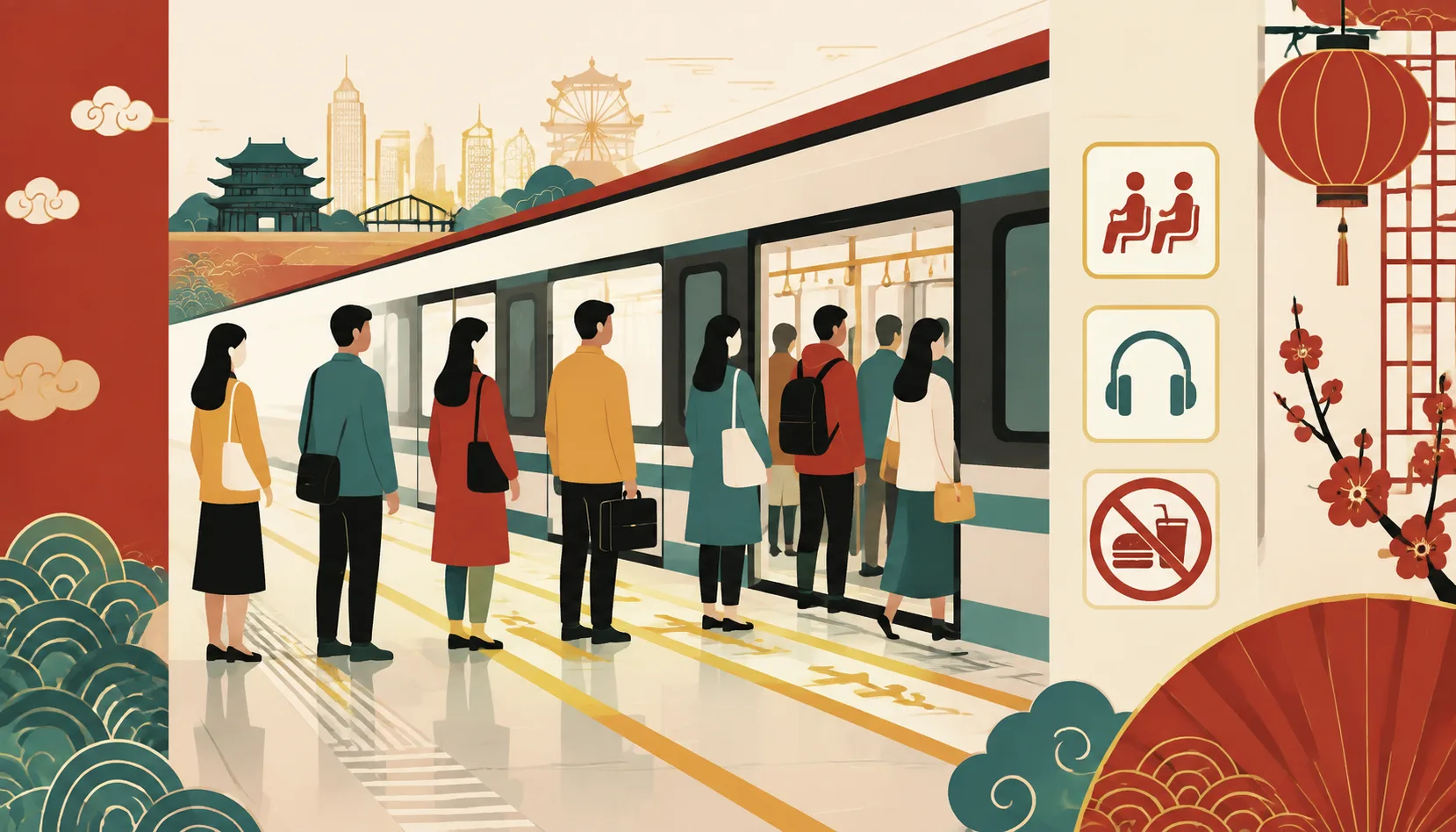
China Subway and Bus Etiquette: The Unwritten Rules
Chinese metro culture has its own logic: people do queue at the painted lines (mostly), crowds at rush hour are extremely dense and this is accepted, phone spea…
Read the guide →
Understanding Mianzi (Face) in China: The Rule Beneath All the Rules
Mianzi (面子) is social reputation and dignity — the invisible currency that governs Chinese social life. It can be given, lost, saved, or attacked. Almost every …
Read the guide →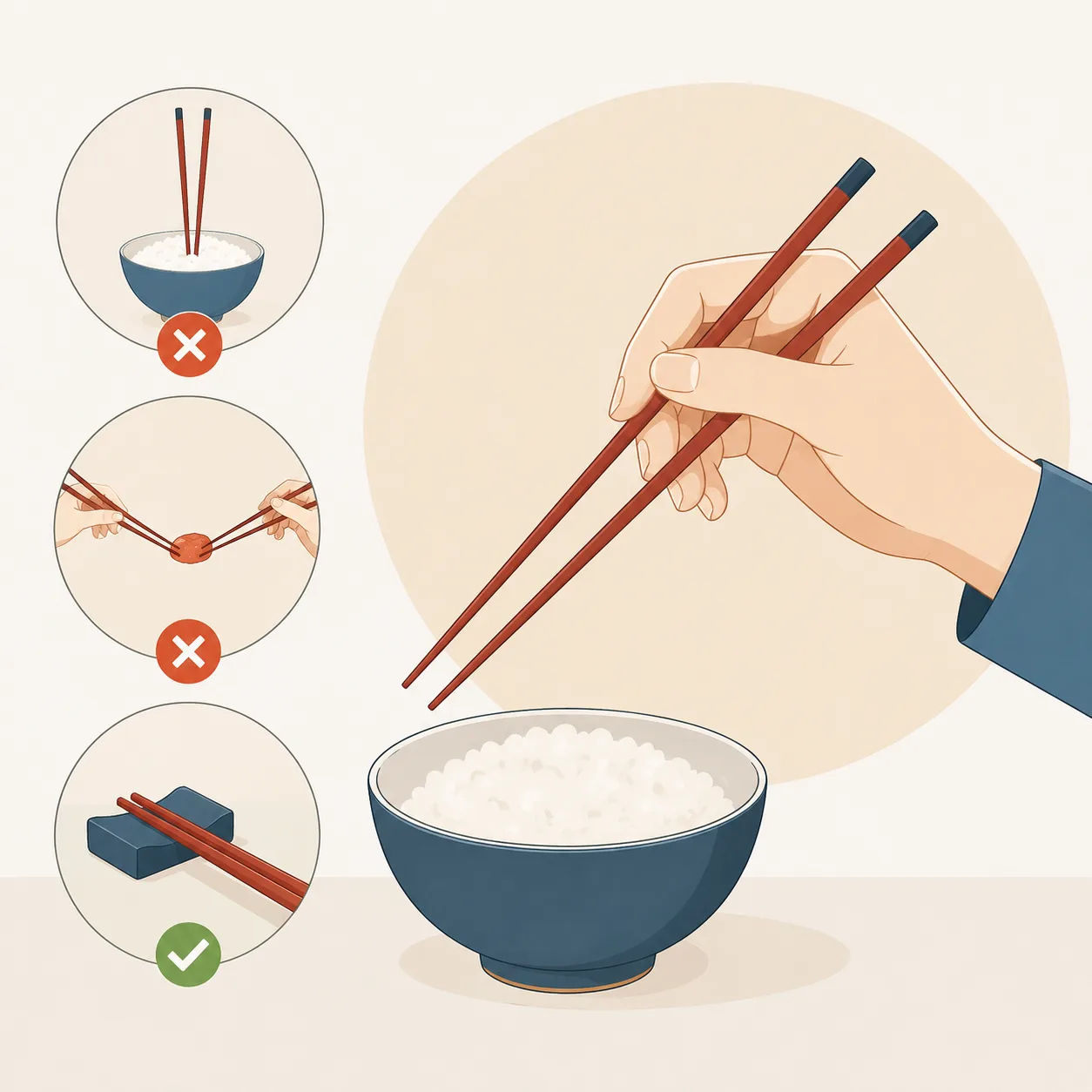
Chopstick Rules in China: What to Do and What to Avoid
The three biggest chopstick taboos in China: never stand them upright in a bowl of rice, never tap your bowl with them, and never dig through shared dishes. Kee…
Read the guide →