How to Give a Gift in China: Two Hands, Three Rounds, and What to Say
Quick answer
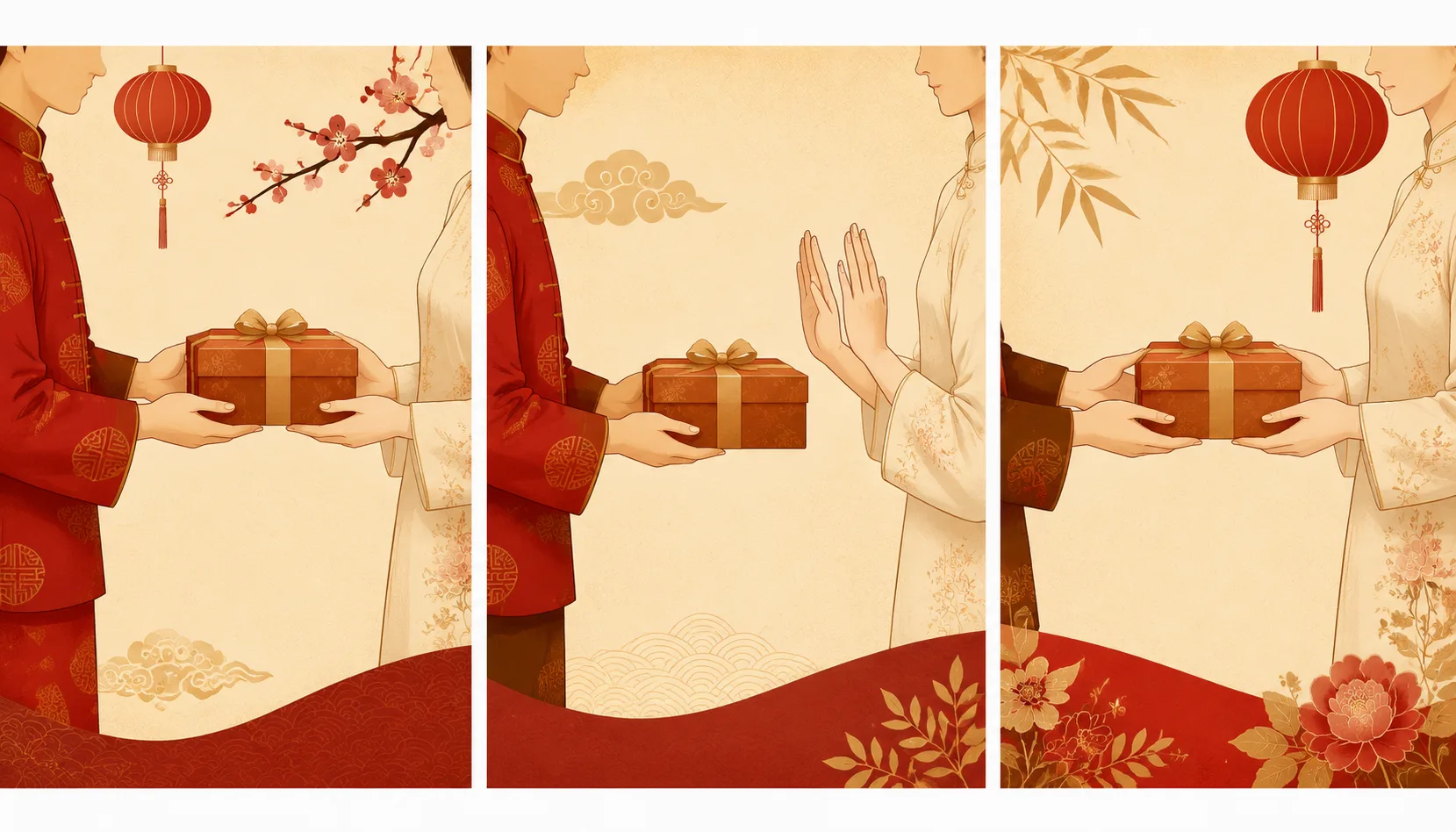
Two hands. Eye contact. Slight forward lean. Say "一点小心意" (a small token). When they refuse, persist twice — then place it in their hands. This is the script. Deviating from it (one hand, no words, giving up at Round 1) signals disrespect, even when you meant none. This guide walks through every detail.
Quick Answer
Two hands. Eye contact. Slight forward lean. Say "一点小心意" (a small token). When they refuse, persist twice — then place it in their hands. This is the script. Deviating from it (one hand, no words, giving up at Round 1) signals disrespect, even when you meant none. This guide walks through every detail.
The Two-Hand Rule
In Chinese culture, presenting something with both hands communicates: "I am giving this with my full attention and respect." Single-hand giving communicates: "This is casual, I'm half-distracted."
The two-hand rule applies far beyond gifts:
- Business cards (→ see business card etiquette guide)
- Documents passed in meetings
- A cup of tea offered to a guest
- Cash payments in formal contexts
The physical form:
- Pick up the gift — cup the base with one hand, steady the side with the other
- Present it with the opening or the "front" of the packaging facing the recipient
- Lean slightly forward (about 10–15 degrees) — not a bow, just a lean
- Make eye contact and smile
- Say your opening line (see below) before they touch it
When to Present the Gift
Timing matters more than most foreigners realize.
For home visits: Present within 2–3 minutes of arriving — after greeting, before sitting. If you present it too early (literally at the door), you look eager. If you wait until you're leaving, you look like an afterthought.
For business visits: Either at the start of the visit (after introductions) or at the end (as you're saying goodbye). Don't present mid-meeting — it interrupts the flow and creates an awkward gift-discussion tangent.
For large group settings: Avoid presenting gifts publicly to one individual if others don't receive one. This creates immediate social discomfort for both of you. Either give everyone something (伴手礼 style, individual packages) or find a private moment.
For holiday gifts: As early in the holiday window as possible. For Chinese New Year: 7–10 days before. The earlier you send, the more "intentional" it reads.
What to Say: The Script with Pronunciation
These phrases are more important than most people realize. In China, the accompanying words are part of the gift. A beautifully wrapped present handed over in silence is incomplete.
| Situation | Chinese | Pinyin | English |
|---|---|---|---|
| Opening (universal) | 一点小心意,不成敬意。 | Yìdiǎn xiǎo xīnyì, bù chéng jìngyì. | Just a small token — not worthy of your respect. |
| First visit | 第一次来,一点心意,请您笑纳。 | Dì yī cì lái, yìdiǎn xīnyì, qǐng nín xiàonà. | First time visiting, a small token — please kindly accept. |
| Bringing something local | 这是我家乡的特产,请您尝尝。 | Zhè shì wǒ jiāxiāng de tèchǎn, qǐng nín chángchang. | A specialty from my hometown — please try it. |
| Holiday gifting | 快过节了,给您拜个早年! | Kuài guòjié le, gěi nín bài gè zǎonián! | The holiday is coming — an early New Year's greeting! |
| Expressing gratitude | 上次多亏您帮忙,一点谢意。 | Shàng cì duōkuī nín bāngmáng, yìdiǎn xièyì. | Thank you for your help last time — a small token of my gratitude. |
| Home dinner | 来蹭饭,不能空手,一点小东西。 | Lái cèng fàn, bùnéng kōngshǒu, yìdiǎn xiǎo dōngxi. | Coming for a free meal, can't arrive empty-handed — just a little something. |
Tip: You don't need perfect tones. A genuine attempt at a Chinese phrase earns enormous goodwill — the effort signals respect for the culture in a way that English never can.
The Push-Pull Ritual: The Full Script
This is the most confusing moment for foreigners giving gifts in China. Someone offers a gift, the recipient says "no, no" — and the foreigner takes it back. This is wrong. Here's why, and what to do instead.
Why the Refusal Happens
Accepting a gift immediately in China reads as greedy — as if you've been waiting for it. Chinese social etiquette requires a performance of modesty: "I don't need this, I'm not that kind of person who accepts things easily." This signals upbringing and self-restraint.
But there's a second reason: the push-pull tests sincerity. If you give up at the first "no," you've signaled that you didn't really want to give it — it was just a gesture. Persisting shows you mean it.
The Three-Round Script
Round 1:
- You: "Please accept this — it's just a small token." (Present with both hands)
- Them: "No, no — you really didn't need to! This is too kind."
- Translation: Normal. Do not withdraw the gift.
Round 2:
- You: "Please — it would mean a lot to me if you'd take it. It's nothing expensive, just a little something."
- Them: "Ah, really, you shouldn't have… this is too much…"
- Translation: Almost there. One more push.
Round 3:
- You: "Please, I insist." (Place the gift firmly in their hands or set it on the table in front of them) "Just leave it here!"
- Them: "Well… you're too kind. Thank you so much."
- Translation: Done. Gift accepted. Relationship strengthened.
After they accept, they'll likely say one of the polite phrases below (see the decoder section). Respond warmly and move on — don't dwell on the gift. The moment has passed.
How to Tell When a Refusal Is Real
Most "no, no" responses are scripted politeness. But sometimes the refusal is genuine — usually for compliance or personal reasons.
Signs of genuine refusal:
- Serious, flat tone (no laughter, no warmth)
- Repeated firm refusals beyond three rounds
- They say words like "原则" (yuánzé — a matter of principle)
- "真的不行" (zhēn de bùxíng — it really won't work)
- They physically push the gift toward you or put it down
- They are a government official or someone in a compliance-sensitive role
What to do if the refusal is real: "I completely understand — I respect that. Let me take it back. But please know the thought was there." Then collect it gracefully. Don't push. Pushing past a genuine refusal is the worst possible outcome — it puts the person in an impossible position.
Hidden Tactical Moves for Tricky Situations
The "Transfer to Family" Move
This is the most powerful tactic when someone is resisting too hard. Instead of "this is for you," say:
"这是给叔叔阿姨和孩子们的,您就别客气了!" (Zhè shì gěi shūshu āyí hé háizi men de, nín jiù bié kèqì le!) "This is for your parents and the kids — please don't be modest about it!"
By shifting the recipient from "you" to "your family," you remove their personal obligation pressure entirely. They're not accepting something for themselves — they're accepting something for people who have no reason to refuse. Success rate is very high.
The "Let Me Just Leave It Here" Move
For persistent refusers: instead of continuing the conversation, place the gift on the table beside them and say:
"那我就放这儿啦,您可别再推了!" (Nà wǒ jiù fàng zhèr la, nín kě bié zài tuī le!) "Then I'll just leave it here — no more refusing!"
This move closes the push-pull loop with a light, cheerful finality. It signals that the conversation is over, creates a fact on the ground (the gift is now at their location), and gives them a face-saving way to accept without formally saying yes.
The Politeness Decoder: What They Say After Accepting
When someone finally accepts your gift, they'll use one of these phrases. Know what each means:
| They say | Literal | Real meaning | Your response |
|---|---|---|---|
| 您太客气了! | "You're too kind" | Thank you / I'm touched | "应该的。希望您喜欢。" ("Of course. Hope you like it.") |
| 下次别这样了! | "Don't do this next time!" | I appreciated this time; please continue doing it | 笑着说"好好好!" ("Of course, of course!") — then give again next time |
| 让您破费了 | "You've made a big expense" | Thank you for spending money on me | "哪里哪里,不成敬意。" |
| 您太有心了! | "You're so thoughtful!" | This is excellent and exactly right | "您喜欢比什么都重要!" ("Your satisfaction matters most!") |
| 那我就收下了 | "Then I'll accept it" | Deal done | Warm smile; change subject |
When You Receive a Gift
The Chinese norm for receiving gifts is the opposite of Western behavior.
In Western culture: Open the gift immediately, react enthusiastically, show appreciation on the spot.
In Chinese culture: Accept graciously, set it aside, and open it after the person leaves. Opening immediately implies eagerness or impatience — that you were waiting for it, that the object matters more than the relationship.
Your script when receiving:
- Accept with both hands (always — this is mirror behavior; you do what they did for you)
- Say: "谢谢您,您太客气了!" (Xièxiè nín, nín tài kèqì le! — "Thank you, you're too kind!")
- Set the gift aside respectfully
- Don't ask what's inside or shake it
- After they leave: open it, photograph it, and send a WeChat message within 24 hours
The 24-hour thank-you message:
"刚打开您送的礼物,太喜欢了!谢谢您的心意!" (Just opened your gift — I love it so much! Thank you for thinking of me!)
This completes the loop. Without the follow-up, the exchange feels unfinished.
The Reciprocity Expectation
China operates on 礼尚往来 (lǐ shàng wǎng lái — reciprocity in gifts and courtesy). Receiving a gift creates an expectation to return one at an appropriate future moment.
Timing: Not immediately (would feel transactional), but at the next natural gift occasion — a holiday, a life event, a visit.
Value: Comparable. Not noticeably less (signals the relationship means less to you), not noticeably more (creates pressure).
Failure mode: Repeatedly accepting gifts without ever reciprocating is noticed. After 2–3 cycles, the other person begins to feel the relationship is one-directional.
FAQ
Q: I gave the gift with one hand by accident. How bad is this? A: In a casual relationship or with someone who knows you're new to Chinese culture, it's forgiven with a smile. In a formal business context, it's a minor mark. Next time: two hands. Consistency over time matters more than perfection once.
Q: What if I forget the Chinese phrase? A: "Please accept this" in English with genuine warmth and a two-handed presentation still communicates respect. The Chinese phrase is ideal, but the physical ritual (two hands, eye contact, forward lean) carries more than the words.
Q: Should I tell them how much I paid for the gift? A: Never. Mentioning the price shifts the gift from "gesture of relationship" to "financial transaction." If they ask (rare, but happens), downplay: "Oh, it wasn't much — just wanted to find something you'd enjoy."
Q: I received a gift and I've already opened it in front of them — Western habit. Is the damage bad? A: Among urban, cosmopolitan Chinese — especially those who've lived abroad — this is understood and not heavily marked. For older or more traditional recipients, a simple "I got so excited I couldn't wait!" with genuine warmth usually smooths it over. Going forward: wait to open.
What Chinese People Actually Say
- 请笑纳 | qǐng xiào nà | Please accept this gift (polite formula) | Use when formally presenting a gift; "笑纳" means "kindly accept"
- 一点心意 | yì diǎn xīn yì | A small token of my appreciation | Humble phrase to downplay the gift's value; shows modesty
- 不成敬意 | bù chéng jìng yì | It's not worthy of your respect (self-deprecating) | Traditional humble expression; shows respect to the recipient
2026 Reality Check
Reality Check 2026: The "two hands, three rounds" (双手递烟/双手递礼) rule is fading but not dead. Older generations (50+) still observe it strictly—refusing with a wave or accepting with both hands signals respect.
Gen Z: Mostly ignores the ritual. They text "thank you" or send digital red packets. Urban youth see it as "old-fashioned" unless dealing with elders or business clients. However, white-collar workers in corporate settings still practice it to impress bosses.
Geography: Beijing and Shanghai have relaxed the most—business is fast, casual acceptance is common. Smaller cities and rural areas? The rule still holds strong. Elders will correct you if you use one hand.
Bottom line: Know your audience. Two hands = safe bet with anyone over 40 or in formal business. Under 40 in big cities? One hand won't get you canceled. Still—offering with both hands never hurts.
Frequently asked questions
Why do Chinese people refuse a gift multiple times before accepting it?
Refusing is a politeness ritual, not actual rejection. Saying 'no' twice shows humility and avoids appearing greedy. The giver insists to show sincerity. If you stop after the first refusal, it looks like you weren't serious. Persist gently three times — the third push usually wins. If they still refuse firmly after three rounds, respect it and try another time.
What should I say in Chinese when giving a gift?
Say '一点小心意' (yì diǎn xiǎo xīn yì), meaning 'a small token of my appreciation.' This downplays the gift's value, making the recipient comfortable. Avoid saying 'this is expensive' or 'I spent a lot' — that creates pressure to reciprocate. Keep it humble, smile, and maintain eye contact while holding the gift with both hands.
Can I give a gift with one hand if I'm in a hurry?
Technically yes, but it signals disrespect and can offend. One hand implies casualness or low regard. Even in a rush, take two extra seconds to use both hands — it's that important. If you genuinely can't (holding something heavy), apologize briefly with '不好意思' and use both hands as soon as possible. Better to delay the gift than to hand it over sloppily.
What if the recipient keeps refusing after three rounds?
After three genuine refusals, the rejection is likely real — not ritual. Stop insisting, put the gift away, and say '那下次吧' (maybe next time). Forcing it further creates awkwardness. This happens with very close friends or superiors who genuinely don't want the burden. Revisit the gesture on a different occasion, like a holiday or after a meal.
Is the two-hand rule the same in southern China and Hong Kong?
The core two-hand rule applies everywhere in China, but southern regions and Hong Kong add nuances. In Hong Kong, use both hands but avoid red envelopes with odd amounts (even numbers are luckier). In Guangdong, the refusal ritual is often shorter — one push is common. In northern cities like Beijing, expect the full three-round dance. Always follow the local rhythm.
When is the worst time to give a gift in China?
Avoid presenting gifts during meals (especially while eating), during business negotiations, or in front of others who didn't receive one — it creates jealousy and embarrassment. Also skip giving clocks (送钟 sounds like 'attending a funeral'), sharp objects, and white or black wrapping. Best moments: arrival, departure, or after a meal in private.
Try our tools
Related guides

Chinese Gift-Giving Guide 2026: Rules, Taboos, and What Actually Works
In China, gift-giving is not about the gift. It's about the relationship. The right gift, delivered at the right time with the right words and two hands, commun…
Read the guide →
14 Chinese Gift Taboos: The Complete Forbidden List (With Salvage Tips)
Most Chinese gift taboos come from homophones — words that sound identical to something unlucky. "送钟" (giving a clock) sounds exactly like "送终" (attending a fun…
Read the guide →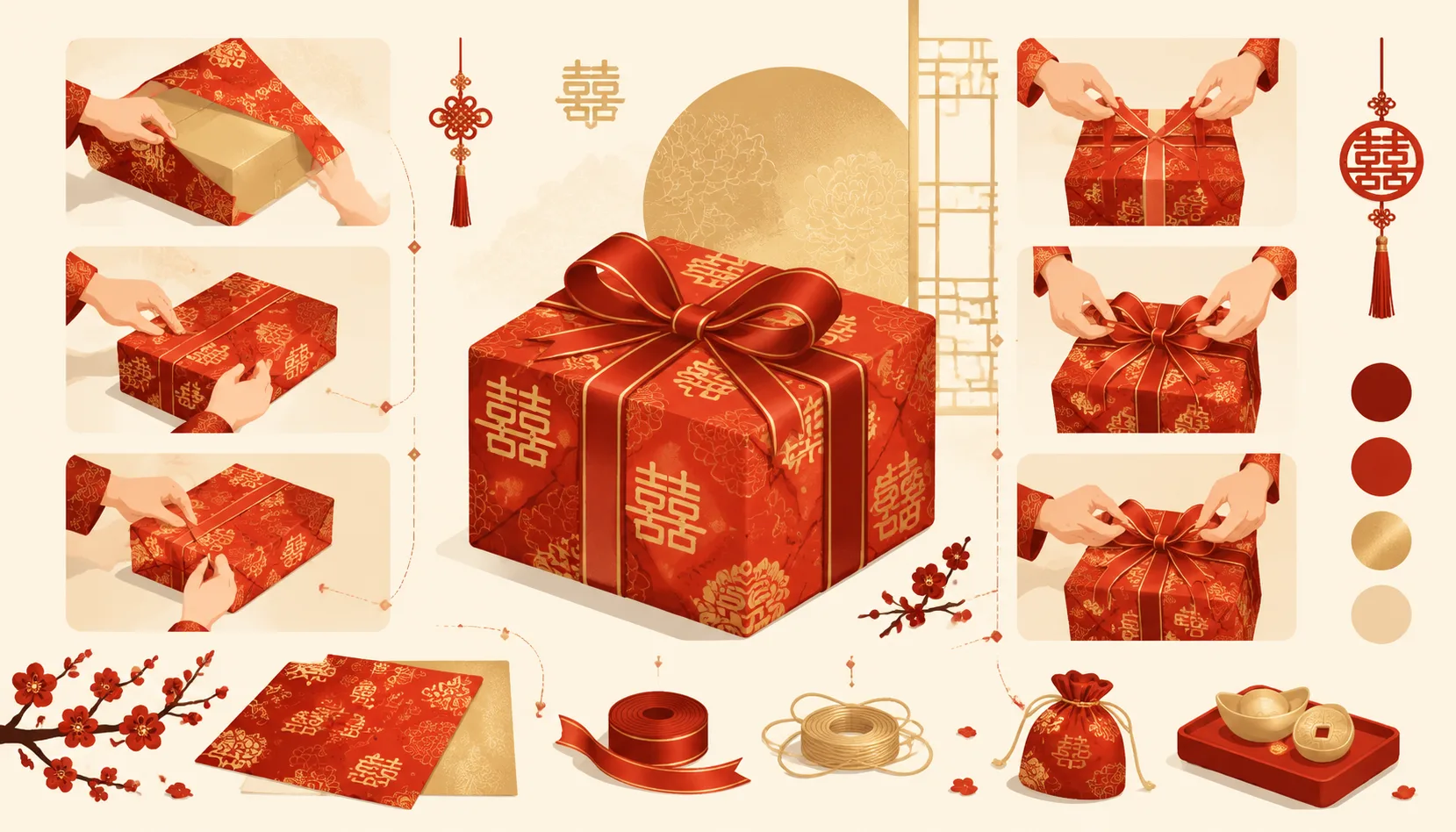
Chinese Gift Wrapping Rules: Colors, Lucky Numbers, and the Packaging Taboos You Need to Know
In China, the packaging communicates before the gift is opened. Red and gold are always safe — they signal joy and prosperity. White and black are funeral color…
Read the guide →