Chinese Business Banquet Protocol: Rules, Sequence, and What Not to Do
Quick answer
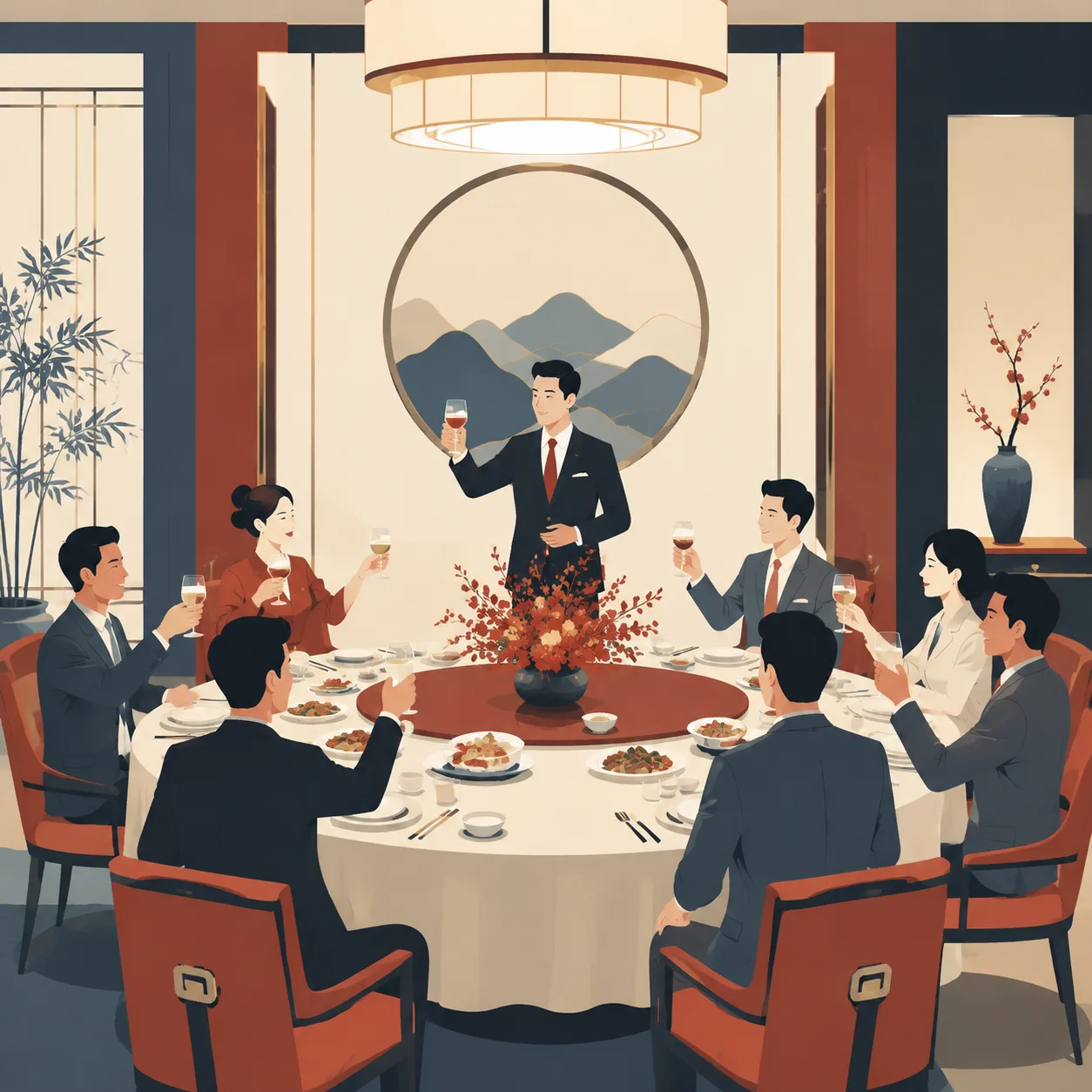
A Chinese business banquet is not a meal — it's a trust-building ceremony disguised as dinner. The food is secondary. The goal is to establish that you are a reliable, relationship-worthy person. Know the seating hierarchy, follow the toasting sequence, never talk business during the meal, and arrive ready to stay 2–3 hours minimum.
Quick Answer
A Chinese business banquet is not a meal — it's a trust-building ceremony disguised as dinner. The food is secondary. The goal is to establish that you are a reliable, relationship-worthy person. Know the seating hierarchy, follow the toasting sequence, never talk business during the meal, and arrive ready to stay 2–3 hours minimum.
DO
- Arrive on time or 5 minutes early — arriving late to your own business dinner is a serious signal failure
- Bring a small gift for the host (nothing extravagant — fruit, tea, or local specialty)
- Wait for the host to guide seating — don't choose your own seat
- Let the host order all the food — don't request specific dishes unless directly asked
- Make a toast to the host in the first few rounds — acknowledge their hospitality specifically
- Exchange business cards using both hands, read the card carefully, then set it respectfully on the table
- Stay until the host signals the end — leaving early sends a negative signal
- Pay attention to who orders the last dish — often a signal the meal is winding down
DON'T
- Don't talk business during the meal — the relationship comes first; deal discussion belongs afterward or at a separate meeting
- Don't order for yourself — let the host manage the food
- Don't ask to split the bill — whoever invited pays, always
- Don't decline the first toast — even a tiny sip or raised tea cup is required
- Don't put your business card away immediately — leave it on the table during the meal
- Don't write on someone's business card at the table
- Don't arrive with a deal memo or contract — this is not a negotiation dinner
- Don't check your phone at the table — this is a serious breach in a business setting
WHY Business Banquets Exist
In China, business is personal. A contract signed between strangers is fragile — it depends entirely on the legal system. A contract between friends (people who trust each other) is self-enforcing, backed by social reputation and mutual interest.
The business banquet's function is to move two parties from strangers to quasi-friends in a single evening. This is done by:
- Sharing vulnerability (alcohol lowers defenses)
- Demonstrating character (how you behave when relaxed)
- Showing respect (the ritual behaviors signal that you understand Chinese culture)
- Creating reciprocity (hosting obligates future cooperation)
"We had dinner" in China means "we have a relationship now." This is why many deals that stall in meetings suddenly move after a banquet.
The Full Protocol: Step by Step
Before arriving:
- Know who the most senior person from each side is
- Have business cards ready in your jacket pocket, easy to access
- Prepare a short toast speech (2–3 sentences) thanking the host
Arriving:
- Greet everyone by seniority — the most senior person first
- Let the host lead you inside and guide seating
- Accept any drink poured immediately (you won't need to drink it yet)
First round:
- Host stands and proposes a toast to the whole table
- Everyone stands and drinks — this is the formal start
- Do not eat or drink before this moment
Ordering:
- The host will order. You may be asked for preferences — express 1–2 with cultural awareness (avoid asking for dishes that are cheap, as hosts are showing hospitality through generous ordering)
- If asked "Is there anything you can't eat?" — answer honestly. This is practical, not an imposition.
Mid-meal:
- Individual toasts circulate. Watch the seniority ladder and toast the most senior guest/host within the first two rounds
- Eat between drinks — this is expected, not rude
- Make conversation: ask about the host's company history, the region, local culture, Chinese food traditions. Genuine curiosity is always welcome.
- Avoid: politics, criticism of China, comparisons to your home country that imply superiority
Late in the meal:
- The lazy Susan rotation slows
- A light soup or congee may signal the meal is nearing its end
- One of the host's team will quietly step out to pay the bill
- Begin to wind down conversation
Leaving:
- Thank the host specifically: "This has been a wonderful evening. Thank you for your generosity."
- Offer one token attempt to pay — reach for your wallet, say "Please let me..." — then accept gracefully when the host refuses
- A short gift or future invitation (your turn to host next time) is appropriate here
Business Card Protocol (名片礼仪)
Business card exchange is the formal opening of a business relationship:
- Present your card with both hands, the text facing the recipient so they can read it directly
- Offer a slight bow as you present
- Receive their card with both hands
- Read the card — look at it for 3–5 seconds, acknowledge the person's title
- Place the card carefully on the table in front of you — never stuff it in your pocket or put it under a plate
- At the end of the meal, carefully put their card in a card holder, not your back pocket
What "No Business Talk" Actually Means
The rule "don't talk business at dinner" doesn't mean you can't discuss work at all — it means don't bring out the PowerPoint or start negotiating terms.
Acceptable business-adjacent topics:
- "How has this year been for your industry?"
- "I heard your company recently expanded — congratulations"
- "We're very excited about the potential here"
Not acceptable:
- "So about clause 7 in the draft agreement..."
- "We need to discuss the pricing structure"
- "Our legal team has some concerns"
The deal conversation happens after trust is built. The banquet is the trust-building. The negotiation meeting comes next.
Paying the Bill (买单 / 抢单)
Whoever invited pays. This is absolute.
The payment ritual:
- The host's team member quietly slips out near the end to settle the bill in advance
- When the meal ends, there's no visible check on the table
- If you're hosting, arrange payment before the dinner — pay ahead of time or instruct the restaurant manager privately
The "fighting over the bill" ritual: Even as a guest, make a gesture toward paying — "Please let me handle this." The host will refuse. You insist once more. They refuse again. You accept gracefully. This exchange is expected; not doing it at all suggests you're not interested in future reciprocity.
If you genuinely want to reciprocate: "Let me invite you next time I'm in [city]." This opens the next relationship chapter.
Real-Life Examples
- A British sales director attended a first-meeting dinner in Chengdu. Midway through, he pulled out a one-pager summarizing his company's proposal and started talking through it. The host smiled politely and nodded, but the energy shifted. His colleague told him afterward: "They've mentally exited the relationship mode. Bring the paper to the meeting tomorrow." The meeting went well; the dinner ended up being written off as awkward.
- A Canadian project manager made one simple move at a Shanghai dinner that his Chinese counterpart later mentioned repeatedly: she memorized the host's assistant's name and used it during the meal — "Thank you, Xiaoming, for organizing this" — directly acknowledging the most junior person at the table. The host was visibly impressed. She got the contract.
- A German executive hosting a Chinese delegation went to a restaurant and chose all the food himself — European dishes, "because I wanted to show them something new." His guests politely ate but were visibly uncomfortable. The host's job in a Chinese context is to order food the guests will enjoy, not to showcase the host's taste.
FAQ
Q: How long does a business banquet typically last? A: Plan for 2–3 hours minimum. Leaving in under 90 minutes unless there's an emergency signals disinterest. Staying past the host's first signal to wrap up is also awkward. Watch for cues: soup appearing, the lazy Susan stopping, the host glancing at their phone.
Q: Should I bring a gift? A: A modest gift is appropriate — quality tea, specialty food from your home region, or a local delicacy. Avoid: clocks (sound like "送终" — attending a funeral), pears (separation), umbrellas (break up), shoes (rude). Also avoid overly expensive gifts that create uncomfortable obligation.
Q: Is it okay to bring my spouse to a business banquet? A: Only if the host has invited partners/spouses explicitly, or if the gathering is clearly social. Bringing a spouse to a working business dinner uninvited can be seen as odd. When in doubt, ask your Chinese colleague beforehand.
Q: What if the dinner goes to karaoke afterward? A: This is common, especially after successful dinners. Declining is acceptable — say you have an early morning. But going — even just for an hour — signals that you're enjoying the company and not rushing away. KTV is about participation and humor, not vocal ability.
Q: Do I need to speak Chinese? A: No, but making any effort — a toast, a phrase, a word — earns disproportionate goodwill. "Ganbei!" alone said loudly and enthusiastically can transform how a table sees you.
What Chinese People Actually Say
- 干杯 | gān bēi | "Cheers" | Say when raising glass; maintain eye contact with toastee.
- 我先敬您一杯 | wǒ xiān jìng nín yī bēi | "Allow me to toast you first" | Use when initiating formal toast to senior or client.
- 请上座 | qǐng shàng zuò | "Please take the seat of honor" | Host says to invite guest of honor to main seat.
2026 Reality Check
Host sits facing door, guest of honor to host's right. Still standard in formal banquets, but less rigid in casual settings. Top executives in Beijing/Shanghai follow it; younger hosts often skip the formal seating chart entirely.
Toast sequence: host first, then VIPs. Widely followed in business contexts, especially with older clients. Gen Z tends to skip formal toasts altogether or just raise glasses casually. In smaller cities, the elaborate multi-toast ritual (bai jiu rounds) remains alive and well—refusing can still offend.
Don't finish your plate (signals host didn't provide enough). Mostly outdated. Gen Z and urban professionals actually prefer "clean plate" as a compliment. This rule persists mainly in rural areas and with older generations.
Business discussion happens after third course. Still observed in traditional settings. Younger professionals in tech/startup scenes often mix business with dining from the start—viewed as more efficient.
Bottom line: Protocol survives in formal/larger events and older demographics. Urban Gen Z is relaxing these rules; smaller cities and older generations still value tradition.
Frequently asked questions
What happens if I arrive late to a Chinese business banquet?
Arriving late is a serious breach of protocol, especially if you are a guest of honor. If you are unavoidably delayed, call your host in advance to apologize and ask them to start without you. When you arrive, apologize sincerely to the host first, then to the table, and drink a small toast or self-punish with a drink as a sign of respect.
Can I refuse a toast at a Chinese business banquet?
Yes, but you must do it gracefully. Never reject a toast outright — it signals disrespect. Instead, explain a medical reason, offer to drink tea or water as a substitute, or ask the toaster for a 'partial' toast. If you are the junior person, you can also offer to toast back with a smaller sip. The key is to show willingness while protecting your limits.
Is it rude to eat before the host starts?
Absolutely. In Chinese banquet protocol, the host traditionally signals when the meal begins, often by picking up chopsticks or inviting everyone to 'start eating.' Wait for that cue, even if food is already on the table. Beginning early is seen as impulsive and self-centered — the opposite of the relationship-building image you want to project.
How do I handle a seating arrangement if I don't know my rank?
When unsure, wait for the host to guide you. Never sit down first. If the host pushes you toward the seat facing the door (the seat of honor), politely decline once or twice before accepting — this shows humility. If no one directs you, choose a seat near the host but not directly opposite the door, and ask 'Where would you like me?' to avoid a faux pas.
What should I do if I can't eat certain foods at a Chinese business banquet?
Mention dietary restrictions to your host in advance, not at the table. If a dish you can't eat is placed in front of you, simply skip it without making a fuss. Do not criticize the food or call attention to your avoidance — that would embarrass the host. If alcohol is a concern, say you have an allergy or are on medication, which is universally accepted.
Can I bring a gift to a Chinese business banquet?
Yes, but only if you are the guest of honor or representing a company. Gifts are typically exchanged before or after the meal, not during. Choose something modest and symbolic — avoid clocks, sharp objects, or white flowers. Present it with both hands and downplay its value ('this is just a small token'). Your host will likely reciprocate, so be prepared to receive a gift gracefully.
Try our tools
Related guides
Chinese Business Etiquette Guide 2026: What Western Professionals Must Know
Chinese business culture runs on three invisible engines: Guanxi (relationships), Mianzi (face), and Hierarchy (rank order). Get these right and deals follow. G…
Read the guide →
Chinese Factory Visit Etiquette: A Complete Guide for Western Buyers
Confirm your visit multiple times, dress professionally with closed shoes, follow your host during the tour, save criticisms for a private debrief, and never sk…
Read the guide →
Hosting Chinese Business Visitors: Complete Etiquette Guide
Host Chinese visitors with senior-level attention: arrange airport pickup by an equally senior colleague, book a top-brand hotel, host a welcome dinner with Chi…
Read the guide →