How can a Western professional decode the real power dynamics at a Chinese business dinner in real time?
Quick answer
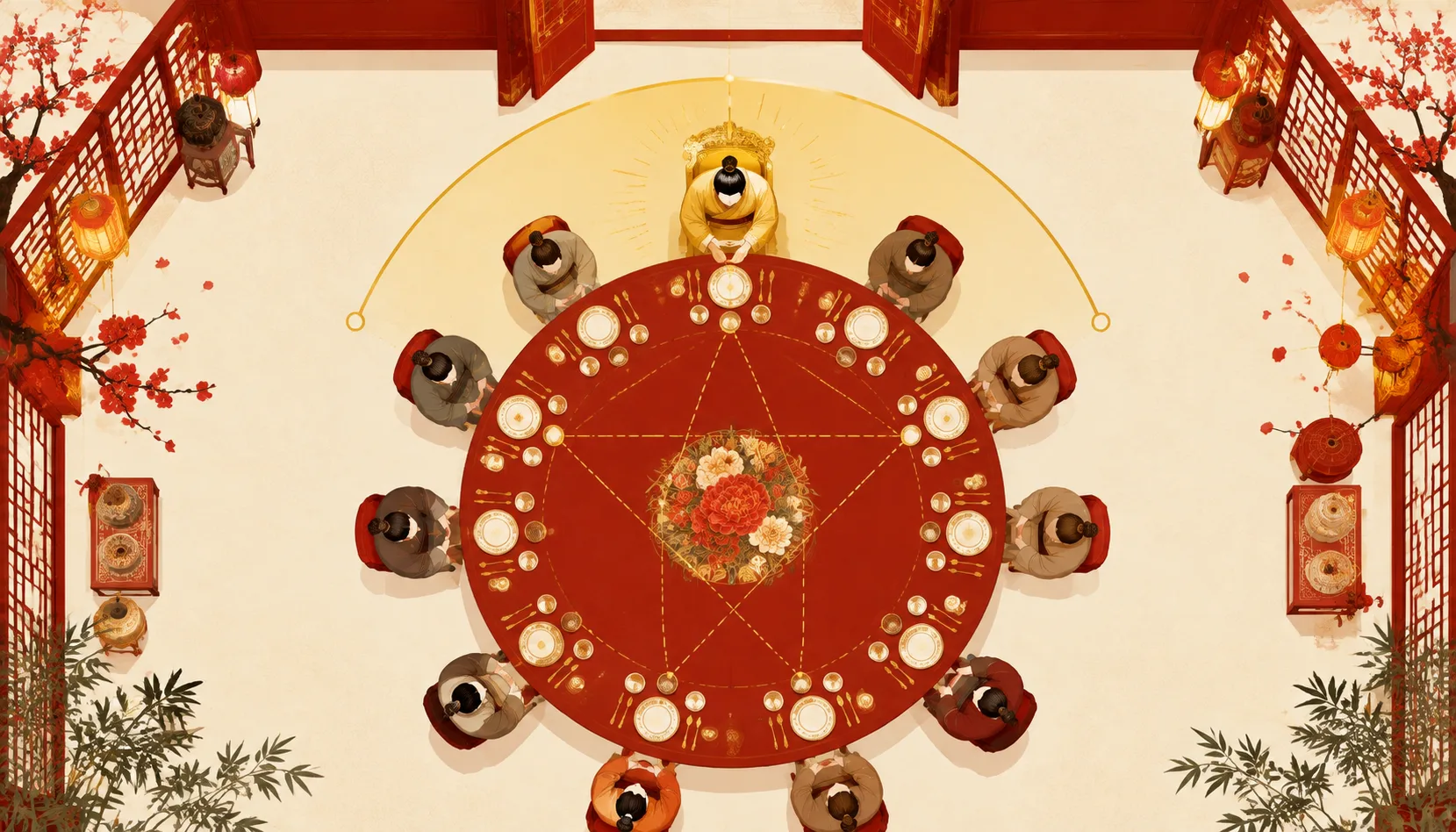
Watch who the host seats within 90 degrees of their own chair, track who gets served and toasted first, and note any mid-dinner seat swaps. The seating chart is a snapshot; the flow of attention and alcohol is the live feed.
The Invitation Is Your First Intelligence Report
Before you even step into the restaurant, the invitation itself is a coded message. The Chinese saying “看一个人怎么安排饭局,就知道他混得怎么样” (kàn yī gè rén zěn me ān pái fàn jú, jiù zhī dào tā hùn dé zěn me yàng) — “watch how a person arranges a banquet, and you’ll know how well they’re doing” — is your first lens. A host who can pull together a table of genuinely influential people—not just titles, but people who can actually move decisions—is signaling their own network power.
Notice the venue choice. An expensive, flashy restaurant in a central location is often about showing off face (面子, miàn zi) — the host wants to be seen. But a deliberately low-key, private room in an obscure location? That’s a signal that the real business is sensitive and the host is protecting it. If you’re invited to the latter, you’re being trusted with something important.
Now, the absent list. Who is not at the table is often more revealing than who is. If a key competitor or a known decision-maker from the other side is conspicuously missing, ask yourself: Is this a deliberate snub? Or is the host keeping them away to negotiate more freely? A junior colleague who was expected but didn’t show might indicate internal friction.
Tactical tip: Before the dinner, ask your local contact (or your own network) who was invited and who declined. The declines are often the most informative. If someone with real power declined, the host may be overstating their influence—or the missing person is sending a message.
Seating: The Static Map
You already know the basics: the host sits facing the door (the “seat of honor” for the host), and the most honored guest sits on the host’s right. But the advanced read is about the “power radiation zone” — the 90-degree arc around the host’s seat. Whoever sits within that arc, whether on the host’s left or right, is the real VIP, regardless of their title on paper.
Why? Because the host will naturally direct their attention, conversation, and toasts to the people they need to influence or impress. Proximity to the host is a direct proxy for importance in that specific context. A person with a modest title seated close to the host is likely the one who will actually sign off on the deal.
Conversely, if you’re placed far from the host, don’t panic. Position is a snapshot, not a verdict. Watch the interaction patterns: who gets served first when the dishes arrive? Who receives the first toast? These micro-signals override the seating chart.
Tactical tip: When you arrive, quickly map the table. Identify the host, then note the two or three people within the 90-degree zone. Those are your targets for relationship-building, not the person with the fanciest business card.
The Case of the Unassuming VIP
I once attended a dinner in Shenzhen where a Western executive was baffled by the seating. The host, a company chairman, had placed a young-looking man in his early 30s on his immediate right—the top guest seat. Across the table sat a vice president with an impressive title and a tailored suit. The Westerner assumed the VP was the decision-maker and spent the evening pitching to him. He ignored the young man, who said little and ate quietly.
Halfway through the dinner, the host turned to the young man and asked, “So, can we move forward on the contract terms?” The young man nodded. The VP across the table had been window dressing—there for face (面子, miàn zi) because the company needed a senior title present, but the real authority lay with the young man, who was the regional director with signing power.
The Westerner had misread the map. The lesson: Never assume title equals power at a Chinese banquet. The person who sits close to the host, who is deferred to by the host, and who speaks rarely but with finality—that’s the one to watch.
Tactical tip: If you’re unsure who the real decision-maker is, watch the toasts. The host will always toast the most important guest first, and the guest’s response (how quickly they stand, how much they drink) reveals their status. If a junior-looking person receives the first toast, recalibrate your strategy immediately.
The Seat-Swap: When Formal Agenda Ends, Real Talk Begins
The most critical moment in any Chinese business dinner is the mid-dinner seat swap. For the first 30–45 minutes, the seating is rigid, and conversation is formal—toasts, pleasantries, and general topics. But then, watch closely. If the host suddenly gets up and moves to sit next to a specific guest, or if two guests quietly exchange seats, the formal agenda is over, and the real negotiation is about to start.
This is a signal that the host wants to speak privately with that person—perhaps to discuss terms that shouldn’t be aired in front of the full table. It’s also a sign that the host is shifting from “face-giving” mode to “deal-making” mode. If you’re the one the host moves to sit next to, you’ve just been elevated to the inner circle. If you’re not, don’t take it personally—it’s about the business, not your worth.
For a Western professional, this is your cue to either lean in or back off. If the host sits next to you, be ready to discuss specifics. If the host moves to someone else, use the time to build rapport with other guests—but keep one ear open. The real decisions often happen in these side conversations.
Tactical tip: When you see a seat swap, don’t interrupt or try to join the conversation. Instead, note who is now sitting next to the host—that’s your new priority contact. After the dinner, follow up with that person directly, referencing the private chat you observed.
What If You’re Seated Low? Read the Interaction, Not the Chair
You’ve done your homework, you’re the senior VP, and yet you’re placed at the far end of the table, near the door. Your first instinct might be to feel slighted. Resist it. In Chinese business culture, seating can be a deliberate test—or simply a reflection of the host’s perception of your role in the deal. But here’s the insider truth: position is a snapshot, but interaction is the live feed.
Watch who gets served first when the dishes arrive. The waiter (or the host) will always serve the most honored guest first. Watch who gets toasted first—the first toast is always directed at the most important person. If you’re seated low but you’re the one receiving the first toast, then your actual status is higher than your seat suggests. The host may be testing your humility or your ability to read the room.
Another possibility: the host deliberately placed you low to see how you react. If you show irritation, you fail the test. If you remain gracious, engage with those around you, and wait for the host to acknowledge you, you pass. In many cases, the host will later “upgrade” you—by moving you closer or by giving you a special toast—if you handle it well.
Tactical tip: If you’re seated low, don’t complain. Instead, use the time to build rapport with the people near you—they might be the host’s trusted advisors. And when the host eventually toasts you (they will, if you matter), stand, raise your glass, and show respect. You’ve just turned a potential slight into a demonstration of your cultural competence.
What If You’re Seated in the Top Guest Seat? You’re Being Tested
You’re the newest person at the table, and the host seats you on their right—the position of the most honored guest. This is a double-edged sword. On one hand, you’re being publicly honored, which means the host wants to give you face (面子, miàn zi). On the other hand, you’re being tested. Can you handle the attention? Will you become arrogant? Or will you deflect gracefully?
The Chinese phrase “捧杀” (pěng shā) — “to kill with praise” — is relevant here. The host may be over-honoring you to see if you lose your composure. The correct response is to talk less, receive well, and deflect gracefully. When the host toasts you, stand, drink, and then immediately redirect the spotlight to the host or another senior guest. Say something like, “I’m honored, but I’m still learning from everyone here.”
This is not just humility; it’s strategic. By deflecting, you show that you understand the social contract—that the host’s face is paramount. You also avoid making enemies among the other guests, who might resent a newcomer taking the top spot.
Tactical tip: If you’re in the top seat, prepare a short, humble speech in advance. Thank the host, acknowledge the other guests by name, and express your desire to learn. Then, after the dinner, send a follow-up note to the host thanking them again—this reinforces your respect and leaves a lasting positive impression.
The Absent Names List: What It Really Tells You
You’ve studied the seating chart, but have you studied the guest list? The people who are not at the table are often more revealing than those who are. In Chinese business culture, invitations are a form of social currency. If a key player from your side—or the other side—is conspicuously absent, it’s a message.
For example, if the host is negotiating with two competing suppliers and only invites one, the absent supplier is being deliberately excluded to signal a shift in preference. Or, if a senior executive from your own company is missing, the host may be signaling that they want to deal with you directly, not through your boss. This can be an opportunity or a trap—assess the context carefully.
Another angle: the absent list can reveal internal politics. If a person who was expected to attend cancels at the last minute, it might indicate a power struggle within their organization. The host’s reaction to the absence—whether they mention it, whether they seem annoyed—tells you how significant that person is.
Tactical tip: Before the dinner, ask your local partner or assistant to discreetly find out who was invited but declined. If a major player declined, consider whether the host’s influence is waning—or whether the declined invitation is a deliberate snub that you need to navigate around. Use this information to adjust your own strategy, but never mention it openly at the table.
What Chinese People Actually Say
- 干杯 | gān bēi | "Cheers" | Raise glass to eye level, make eye contact with senior person before drinking.
- 我敬您 | wǒ jìng nín | "I toast you" (formal) | Use when addressing elders or superiors; both hands hold glass.
- 先干为敬 | xiān gān wéi jìng | "I drink first as respect" | Shows humility; drink empty to demonstrate sincerity.
2026 Reality Check
2026 Reality Check: The "power map" still matters, but it's evolved. Traditional hierarchy seating and toasting order still appear in formal business dinners, especially with state-connected companies. However, younger professionals increasingly push back against rigid protocols.
Gen Z vs. Older Generations: Boomers and Gen X still expect clear seating hierarchy and deference to seniority. Millennials navigate it pragmatically. Gen Z tends to ignore it or find it performative—they'll still participate to avoid conflict, but many see it as outdated theater. Foreign companies operating in China have accelerated this shift.
Beijing/Shanghai vs. Smaller Cities: Tier-1 cities (especially Shanghai) have softened the most—international influence and younger leadership make power maps less rigid. Smaller cities and provincial business scenes still observe traditional hierarchy more strictly. Guanxi culture remains strongest outside major metros.
Frequently asked questions
How can I tell who is the real decision-maker if the host is not the most senior person at the table?
Watch who the host glances at before making a toast or calling for a dish. If the host defers questions to someone else, that person holds informal power. Also, note who gets the first pour of baijiu—often the guest of honor, not the nominal boss. The real decision-maker rarely speaks first but controls the rhythm of the meal.
What does it mean if someone swaps seats halfway through a Chinese business dinner?
A mid-dinner seat swap is a deliberate power move. It usually signals that negotiations are shifting to a more serious phase, or that a lower-ranked person needs to be closer to a key decision-maker for a private conversation. If you are swapped away from the host, expect your influence to be waning—or that you are being sidelined temporarily.
Why is the seat directly opposite the host often considered the weakest position at a Chinese dinner?
The seat opposite the host is the 'host's view'—it is where the host can observe everyone, but it is also the most exposed position. You are in the direct line of toasts and questions, but you are not close enough for private asides. This spot is often given to someone who needs to be watched, not someone who holds real power.
Can I use the order of dishes being served to read power dynamics at a Chinese business dinner?
Yes. The host will always ensure the first dish is placed in front of the highest-status guest. If a dish is served to the host first, then redirected, that is a signal of hierarchy. Also, watch who gets the choicest piece of fish or the head of the fish—this is a classic honor marker. If you get the fish head, you are the guest of honor.
Is there a regional difference in how power is displayed at business dinners in China?
Absolutely. In northern China (Beijing, Shandong), power is shown through loud, frequent toasts and drinking stamina—the person who drinks most is often the strongest. In Shanghai and the south, power is more subtle: it is about who controls the conversation's pace and who gets the quiet one-on-one moments. In Guangdong, business dinners are shorter and more transactional, so power shows in who signs off on the bill.
What should I do if I realize I have been seated in a low-power position at a Chinese business dinner?
Do not panic. You can still gain influence by toasting the host and key guests early, showing respect, and volunteering to refill tea or pass dishes—this signals you understand the hierarchy. Then, during the meal, try to steer a conversation topic that showcases your expertise. If you are truly sidelined, use the time to build rapport with mid-level managers, who often become the next power players.
Try our tools
Related guides
Chinese Business Etiquette Guide 2026: What You Must Know
Chinese business etiquette is easier to navigate when you watch three recurring patterns: relationship-building (guanxi), protecting dignity in public (mianzi),…
Read the guide →
Chinese Business Dinner Exit: Farewell, Follow-Up & Recovery
The farewell is a final power play: let the most senior guest leave first, and never rush out — the host will walk you to the elevator or street, and that lobby…
Read the guide →
How to Extract Real Information at Chinese Business Dinners
Stay for the entire dinner—the last 45 minutes yield 90% of real information. Read the pre-dinner tea signal, decode drunk talk as leads (not conclusions), and …
Read the guide →