How can Western professionals gather genuine business intelligence from Chinese dinner banquets, distinguishing real commitments from face-saving talk?
Quick answer
Stay for the entire dinner—the last 45 minutes yield 90% of real information. Read the pre-dinner tea signal, decode drunk talk as leads (not conclusions), and watch for specific commitments with who/when/how. Debrief within 2 hours to capture who avoided what topics.
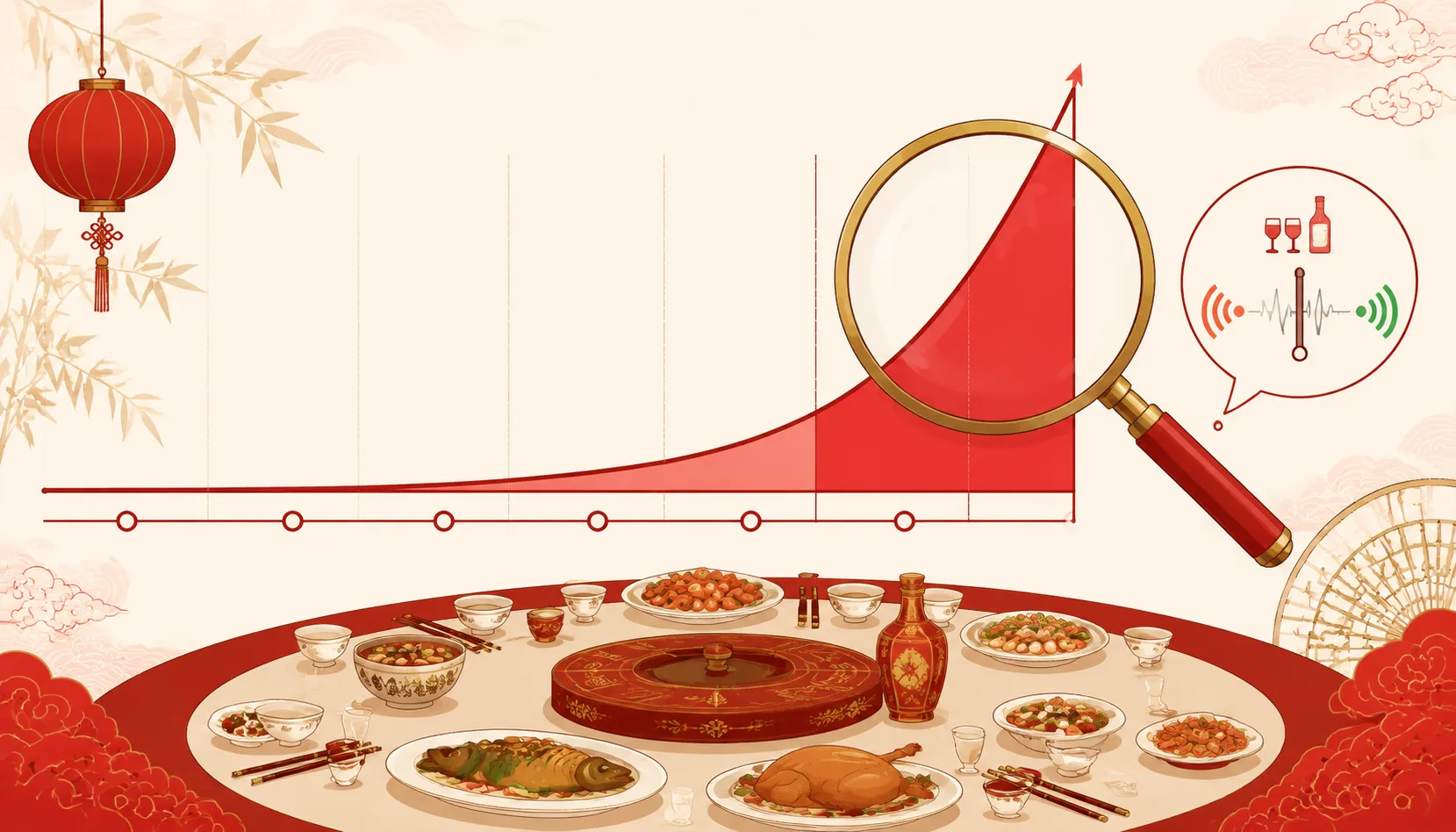
The Information Density Curve: Why the Last Hour Matters Most
Every Chinese business dinner follows a predictable arc of information release. Understanding this curve is your first tactical advantage. The first hour delivers roughly 10% real information—it's all pleasantries, industry platitudes, and mutual face-giving. The second hour sees 40%—probing begins, half-truths emerge as both sides test boundaries. But the final 45 minutes? That's where 90% of actionable intelligence surfaces.
Core insight: Never leave early. More deals have been shaped in the last 45 minutes of a Chinese dinner than in the first two hours combined. Western executives often bow out after the main course, citing jet lag or early meetings—and they miss the entire payoff. The host's real intentions, the supplier's actual capacity, the competitor's weakness—all emerge when the formal agenda dissolves and the baijiu loosens tongues.
Case in point: James, a UK-based sourcing manager, attended a dinner with a potential supplier. At 8:30 PM, with most guests heading out, the procurement director—who had been silent all night—casually mentioned that their current supplier had recurring quality issues. James noted it, said nothing, and sent a sample request to the director directly the next morning. Three months later, he had the contract. The intelligence was only available because James stayed.
Actionable tip: Plan your evening around the dinner's full duration. Schedule nothing after 10 PM. If you must leave early, send a senior deputy to stay in your place—but know that your absence signals disinterest.
The Pre-Dinner Tea Signal: When the Real Conversation Already Happened
Before you even sit down to dinner, read the setup. If your host invited you for a one-on-one tea meeting before the dinner, understand this: the dinner is just the public confirmation ritual. The real negotiation, the actual terms, and the genuine positions were already exchanged over tea. The dinner serves to bless the deal in front of witnesses and to give face to all parties.
This changes your entire approach. If tea happened, your dinner role shifts from negotiator to validator. Your job is to reinforce the agreement, not reopen it. Conversely, if there was no tea meeting, the dinner itself is the primary arena—and you must be far more alert during the early hours.
How to spot the signal: The tea invitation is usually framed as 'let's get to know each other first' (咱们先认识一下, zánmen xiān rènshi yīxià). It's often at a quiet teahouse, not a restaurant. If you receive this, prepare your final positions in advance—the tea is where you'll need them.
Actionable tip: Always accept a pre-dinner tea invitation. Treat it as the real meeting. At the dinner, avoid rehashing details—instead, use the time to build personal rapport and observe who speaks about what.
Decoding Drunk Talk: Real Signals vs. Hot Air
The baijiu flows, inhibitions drop, and suddenly your Chinese counterpart is sharing 'secrets.' But not all drunk talk is equal. You need a decoding system to separate gold from garbage.
Real signals: Look for three markers. First, specific details—actual numbers, names, dates. 'Our supplier in Shenzhen is 15% cheaper' beats 'we have supplier issues.' Second, repetition—if the same point surfaces twice at different moments, it's likely a genuine concern. Third, consistency or revealing contradiction—if the drunk statement matches an earlier formal position, it's confirmation; if it contradicts, it's a window into the real stance.
Hot air markers: Emotional venting with no substance, gross exaggeration ('we can double production overnight'), or internal contradiction within five minutes. These are venting, not intelligence.
The golden rule: treat drunk revelations as leads to verify, not conclusions to act on. Never make decisions based solely on a drunk comment. Instead, note it and follow up the next day through official channels.
Here's a practical phrase table for recognizing commitment language:
| Chinese | Pinyin | English | Signal |
|---|---|---|---|
| 我帮你问问 | wǒ bāng nǐ wèn wèn | Let me ask around | Vague, no commitment |
| 我明天给你答复 | wǒ míngtiān gěi nǐ dáfù | I'll get back to you tomorrow | Specific timing, possible |
| 这个项目我们可以谈 | zhège xiàngmù wǒmen kěyǐ tán | We can discuss this project | Interest, but no details |
| 下周我安排见面 | xià zhōu wǒ ānpái jiànmiàn | I'll arrange a meeting next week | Concrete next step |
Actionable tip: When you hear a drunk revelation, don't react. Nod, change the subject, and mentally file it. Your lack of reaction keeps the flow going and prevents the speaker from clamming up.
The 'Small Commitment' Trap: Spotting Real Momentum vs. Warmth
At the end of any Chinese dinner, you'll hear a flurry of 'let's keep in touch' and 'we should cooperate.' But most of this is face-saving politeness. The trap is mistaking warmth for momentum.
The key distinction: a real commitment comes with who, when, and how. If someone says '我帮你问问' (let me ask around) with no specifics, you've received a polite brush-off. But if they say '我让王经理下周二给你发邮件' (I'll have Manager Wang email you next Tuesday), you have a concrete next step.
How to test the waters: Before the dinner ends, subtly probe for specifics. Ask '那下一步我们怎么安排?' (So how do we arrange the next step?). If the answer is vague, you know the dinner produced goodwill but no forward motion. If they volunteer a name, a date, or a deliverable, you've got real traction.
Case: Sarah, an American software VP, attended a dinner where the client CEO was effusive about a partnership. But when she asked about next steps, the CEO deflected to 'let's talk later.' Sarah didn't chase. Instead, she sent a polite follow-up email the next day, referencing the dinner and asking for a specific meeting. The CEO's assistant replied with a calendar link—that was the real signal. The dinner was warmth; the email was momentum.
Actionable tip: Keep a mental checklist: Did anyone volunteer a specific next step? If not, you have no deal—only a pleasant evening. Follow up within 24 hours with a concrete proposal to test seriousness.
Handling Embarrassing Drunk Disclosures: The Discretion Protocol
Sometimes the drunk talk gets personal—a competitor's secret, a boss's weakness, or a risky confession. Your response in the moment and after determines whether you gain trust or lose it.
Never record, never reference in writing. Pulling out your phone to record is a deal-breaker. Even taking notes at the table can make people clam up. The only acceptable action is to listen, nod, and forget—until you can verify through official channels.
If you need to follow up on the substance, frame it carefully. Instead of quoting the drunk detail, say 'based on our conversation last time' (根据我们上次的谈话, gēnjù wǒmen shàngcì de tánhuà). This acknowledges the conversation without exposing the source or the context. For example, if the procurement director mentioned supplier quality issues, don't write 'You said your supplier has problems.' Instead, say 'I was thinking about our discussion—I'd like to send a sample for evaluation.'
Actionable tip: If someone says something sensitive, change the subject immediately and never bring it up in the group. Later, in a one-on-one setting, you can reference it obliquely. This builds your reputation as a safe confidant—which is itself a business asset.
The Post-Dinner Intelligence Debrief: Capture Within 2 Hours
The dinner ends, the baijiu wears off, and the details blur. But the intelligence you gathered is only valuable if you capture it systematically. Within 2 hours of the dinner, write down everything. Memory decays fast, especially with alcohol involved.
Your debrief should cover three areas. First, who said what in which phase—map each key statement to the dinner's timeline. Was the real comment made in the first hour or the last 45 minutes? That timing tells you its weight. Second, what promises were made—list every commitment, even vague ones, and note the exact language. Third, what topics the host steered away from—avoidance is a signal. If you raised pricing and the host changed the subject, that's intelligence about their sensitivity.
Create a simple template: Date, attendees, phase-by-phase notes, commitments, avoided topics, and follow-up actions. Share this only with your trusted team, not the whole office.
Actionable tip: Keep a dedicated notebook or digital note for dinner debriefs. Within 2 hours, jot down at least five bullet points per category. This habit turns every dinner into a strategic asset.
What Chinese People Actually Say
- 敬酒 | jìngjiǔ | to propose a toast | Raise glass with both hands toward senior guests before drinking
- 干杯 | gānbēi | cheers | Say while making eye contact; finish the drink to show sincerity
- 随意 | suíyì | as you prefer | Use to tell guests they don't have to finish their drink
2026 Reality Check
2026 Reality Check: The "three rounds of toasts" rule still exists but is fading. Younger professionals now often skip formal drinking rituals entirely, preferring coffee or tea meetings where information flows faster anyway.
Gen Z vs. Older Generations: Gen Z sees heavy drinking as inefficient and outdated. They value direct communication and data sharing over alcohol-fueled bonding. Boomers and Gen X still view business dinners as essential relationship-building, though even they are drinking less due to health awareness.
Beijing/Shanghai vs. Smaller Cities: Tier-1 cities have moved toward Western-style professional dinners—shorter, alcohol-light, results-focused. Second and third-tier cities still embrace traditional banquet culture more strongly, where trust is still built through drinking.
Bottom line: The old rule is dying in major cities and among young professionals, but survives in traditional business contexts and smaller markets.
Frequently asked questions
What is the pre-dinner tea signal and how do I read it?
When tea is poured, watch who pours first and how high the cup is filled. A host who fills your cup to the brim is signalling formality and distance—expect generic talk. A half-filled cup signals warmth and openness, meaning real topics may surface early. If the host pours for you before themselves, you're the guest of honour, and information flow will be generous.
How can I tell if a Chinese business partner is making a real commitment or just saving face?
Real commitments include specific details: a named person, a concrete date, and a defined next step. Face-saving talk uses vague phrases like 'we'll look into it' or 'let's discuss later.' Listen for verbs—'I will send the contract on Tuesday' beats 'we should cooperate.' If they volunteer a follow-up meeting time without prompting, treat it as genuine.
Is drunk talk from Chinese executives reliable business intelligence?
Drunk talk is a lead, never a conclusion. Alcohol lowers inhibitions, so executives may reveal frustrations, pricing flexibility, or competitor weaknesses they'd never state sober. But they may also exaggerate. Cross-check any drunk revelation with sober confirmation within 48 hours. If they repeat the point when clear-headed, it's real. If they avoid it, treat it as social lubrication, not fact.
Why should I stay until the very end of the banquet?
The last 45 minutes are when real information emerges. Early on, everyone performs social rituals and polite conversation. As the meal winds down, alcohol has loosened tongues, and the host's guard drops. Key decisions, candid feedback, and genuine intentions surface as guests prepare to leave. Leaving early means you miss the payoff—many deals are verbally sealed in the final toast.
What should I do immediately after a Chinese business dinner to capture the intelligence?
Debrief within 2 hours, while memory is fresh. Write down who said what, who avoided which topics, and any specific commitments with who/when/how. Note body language shifts—who leaned in during pricing talk, who changed the subject when quality was raised. Share notes with a trusted colleague for a second perspective. Do not wait until morning; details fade fast.
Can I ask direct questions during a Chinese dinner to get real information, or does that backfire?
Direct questions can work, but only after rapport is built—usually after the second toast. Phrase them as curiosity, not interrogation: 'I'm curious how your team handled the last project's timeline.' Avoid yes/no questions, which invite face-saving 'yes' answers. Instead, ask open-ended questions about processes and past experiences. If you sense evasion, drop it and revisit later—pushing too hard shuts down the flow.
Try our tools
Related guides
Chinese Business Etiquette Guide 2026: What You Must Know
Chinese business etiquette is easier to navigate when you watch three recurring patterns: relationship-building (guanxi), protecting dignity in public (mianzi),…
Read the guide →
Chinese Business Dinner Phrases: What They Really Mean
In Chinese business dinners, phrases like '大家随意' (be casual) and '我干了,您随意' (I'll drink, you do as you like) are not literal invitations to relax—they are power …
Read the guide →
Reading the Power Map at a Chinese Business Dinner
Watch who the host seats within 90 degrees of their own chair, track who gets served and toasted first, and note any mid-dinner seat swaps. The seating chart is…
Read the guide →