How can Western professionals actively give face (给面子 gěi miànzi) in Chinese business and social situations?
Quick answer
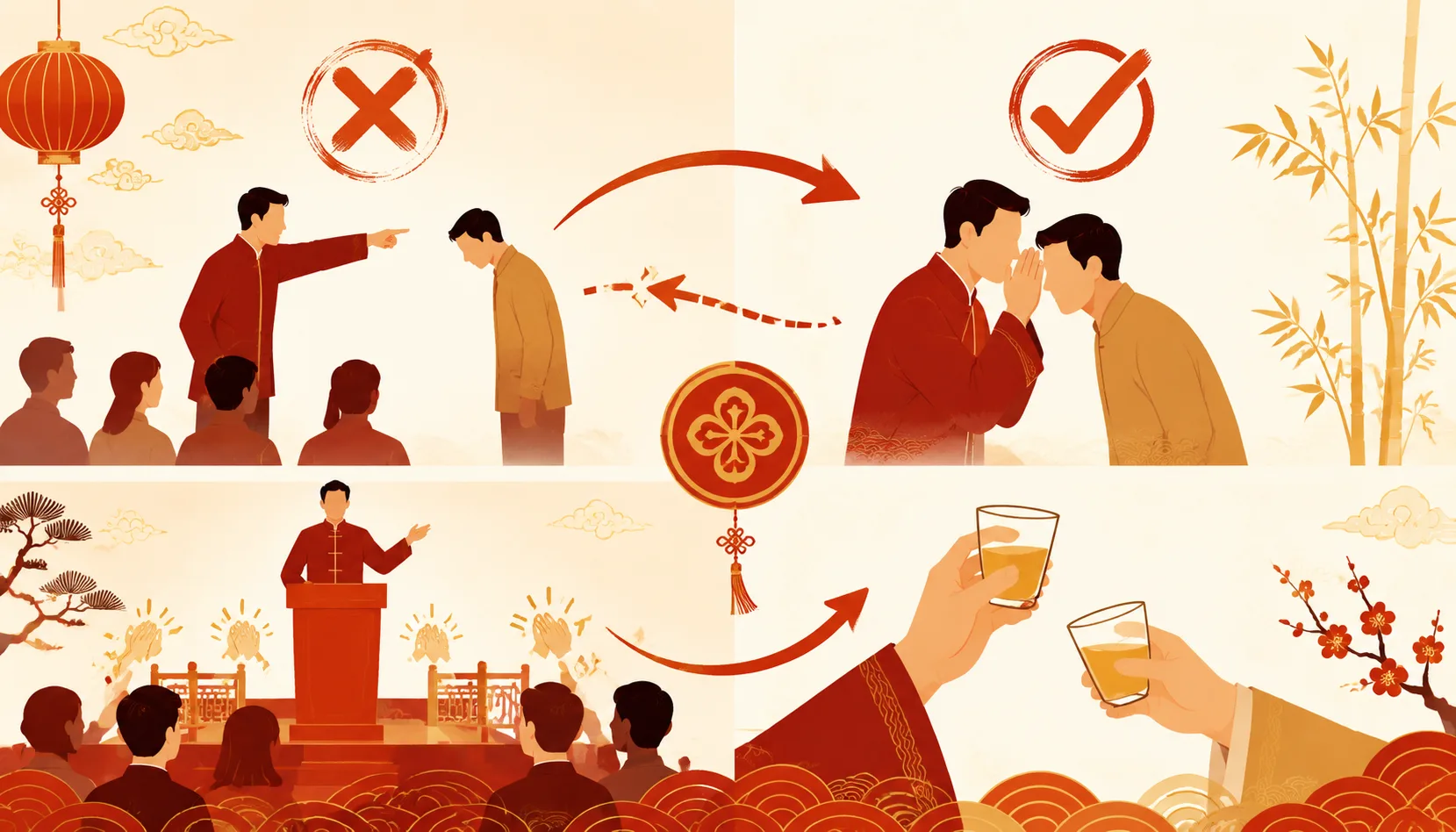
Giving face means proactively protecting or enhancing someone's social standing in front of others. Key moves: praise publicly, criticize privately; introduce by rank; credit the host for meals; build up before requests; toast with your glass lower; offer face-saving exits; deflect compliments with humility.
The Core Principle: Face Is a Social Currency
In Chinese business culture, face (面子 miànzi) is not about vanity—it's a form of social currency that determines influence, trust, and cooperation. When you give face, you are proactively protecting or enhancing someone's social standing in the eyes of others present. This is a deliberate act, not accidental politeness.
For Westerners, the instinct is often to be 'honest' or 'direct,' but in China, directness that damages face is seen as hostile and shortsighted. Instead, think of face as a bank account: every time you give face, you make a deposit; every time you take it away, you make a withdrawal—with interest.
Consider this scenario: In a meeting, a Chinese colleague makes a calculation error. If you point it out publicly, you've just made a withdrawal from their account. But if you wait until after the meeting and say privately, 'I noticed a small detail in the numbers—let's double-check together,' you've made a deposit. The colleague will remember your kindness and reciprocate when you need support.
Actionable takeaway: Before any interaction, ask yourself: 'Will this action raise or lower this person's standing in front of others?' If it might lower it, find a way to do it privately or reframe it as a shared challenge.
Public Praise, Private Criticism: The Golden Rule
The most powerful face-giving behavior is public praise with specific attribution. When something goes right, say it loudly and credit the right person. This isn't flattery—it's a strategic investment in relationships.
Example: Your project succeeded because your Chinese counterpart, Director Zhang, facilitated approvals. In a meeting with his superiors, say: 'Thanks to Director Zhang's leadership (多亏了张总的领导, Duō kuī le Zhāng Zǒng de lǐngdǎo), this project succeeded ahead of schedule.' This gives Zhang face in front of his bosses, and he will owe you a favor.
Conversely, when something goes wrong, never correct publicly. If a colleague misstates a figure, don't interrupt. Instead, after the meeting, say: 'I might have mixed up the numbers earlier—let's verify together (我可能刚才把数字搞混了,我们一起核对一下, Wǒ kěnéng gāngcái bǎ shùzì gǎo hùn le, wǒmen yīqǐ hédùi yīxià).' This gives them an escape route while still addressing the issue.
Actionable takeaway: Make a habit of praising at least one Chinese colleague publicly per meeting. Be specific about their contribution. For corrections, always use 'we' or 'I' language, never 'you made a mistake.'
Introductions: Sequence by Rank, Not by Familiarity
In China, introductions are a microcosm of hierarchy. Introducing a junior before a senior is a micro face-diminishment that will not go unnoticed. Always introduce the highest-ranking person first, regardless of who you know better.
Scenario: You're hosting a dinner with your Chinese partner, General Manager Wang (王总, Wáng Zǒng), and his deputy, Li Jing (李静). You might be closer to Li Jing, but you must introduce Wang first: 'This is General Manager Wang, our esteemed partner (这位是王总,我们尊贵的合作伙伴, Zhè wèi shì Wáng Zǒng, wǒmen zūnguì de hézuò huǒbàn).' Then introduce Li Jing with respect: 'And this is Deputy Manager Li, who has been instrumental in our collaboration (这位是李经理,一直协助我们的合作, Zhè wèi shì Lǐ jīnglǐ, yīzhí xiézhù wǒmen de hézuò).'
Notice the titles: use their title plus surname (王总, 李经理), never just their first name unless invited. This acknowledges their rank and gives them face immediately.
Actionable takeaway: Before any introduction, ask for a list of attendees with their titles. If you're unsure, ask your Chinese colleague discreetly. Then prepare a one-line introduction for each person that highlights their role and achievements.
Banquets: Give the Host Credit for the Meal
A Chinese business dinner is a carefully orchestrated display of paichang (排场, grandeur)—the host's effort to show respect and status through the restaurant, dishes, and ambiance. When you're the guest, your job is to acknowledge and affirm that effort.
As soon as you sit down, or after the first dish arrives, say: 'Wang Zong has chosen an excellent restaurant (王总选的这家餐厅真的很好, Wáng Zǒng xuǎn de zhèjiā cāntīng zhēn de hěn hǎo).' This is not just a compliment—it's a face gift that validates the host's taste and generosity.
During the meal, comment on the freshness of the seafood or the skill of the chef. If the host ordered a special dish, ask about its significance. This shows you appreciate their effort, which is the essence of giving face at a banquet.
Also, when the host proposes a toast, reciprocate with a toast of your own. Raise your glass, say a few words of thanks, and tip your glass lower than theirs when clinking. This physical gesture is a silent but powerful acknowledgment of their status.
Actionable takeaway: Always arrive at a banquet with at least two compliments prepared: one about the venue, one about the food. Deliver them early and sincerely. And remember: never order for yourself; let the host do the ordering—that's their face to give.
The Art of the Request: Build Up Before You Ask
When you need a favor from a Chinese colleague or partner, never ask directly. Direct requests can feel transactional and put the other person on the spot. Instead, build up their status first, then make your request as a natural extension of their capability.
Scenario: You need an introduction to a government official. Instead of saying, 'Can you introduce me to the official?' say: 'With your connections in this field (以您在这个领域的人脉, Yǐ nín zài zhège lǐngyù de rénmài), I wonder if you might be able to help me meet the right person. I know you have deep relationships there.'
This signals that you recognize their social capital—their guanxi (关系)—and that you're not taking it for granted. The person feels valued and is more likely to mobilize their network for you.
After they agree, follow up with a thank-you that again acknowledges their effort: 'I really appreciate your help; this would not be possible without your support (非常感谢您的帮助,没有您的支持这是不可能的, Fēicháng gǎnxiè nín de bāngzhù, méiyǒu nín de zhīchí zhè shì bù kěnéng de).'
Actionable takeaway: Before making any request, prepare a 'status builder'—a sentence that explicitly acknowledges the person's expertise, connections, or experience. Use it in the same breath as your request.
Saving Their Retreat: The Face-Saving Correction
When someone is wrong, the goal is not to win the argument but to save their retreat—give them a logical escape that preserves their dignity while still redirecting the conversation.
Scenario: A Chinese colleague proposes a strategy that you know will fail. Instead of saying, 'That won't work,' try: 'The situation probably wasn't fully clear at the time (当时情况可能不太清楚, Dāngshí qíngkuàng kěnéng bù tài qīngchǔ), but based on the latest data, we might consider an alternative.'
This gives them a face-saving explanation: it wasn't their fault, the situation was unclear. They can accept the alternative without losing face.
Another technique is to blame yourself: 'I think I didn't explain the constraints well enough (我觉得我没有把限制条件说清楚, Wǒ juéde wǒ méiyǒu bǎ xiànzhì tiáojiàn shuō qīngchǔ).' This takes the blame off them entirely, making it easier for them to change course.
Actionable takeaway: When you need to correct someone, use the 'situation not clear' or 'I didn't explain well' formula. Never say 'you are wrong' in a group setting. Save their face, and they'll save yours when you stumble.
Compliments: The Reciprocal Dance of Humility
Chinese compliment culture is reciprocal and deflective. If someone praises you, the expected response is not to accept directly but to deflect and return the compliment. Accepting praise with 'Yes, I am pretty good at this' can register as arrogant and face-damaging.
Scenario: Your Chinese host says, 'Your presentation was excellent (你的演讲非常精彩, Nǐ de yǎnjiǎng fēicháng jīngcǎi).' The correct response is: 'Thank you, but it was only possible because of your team's support (谢谢,但这多亏了你们团队的支持, Xièxiè, dàn zhè duō kuī le nǐmen tuánduì de zhīchí).' This gives face back to the host and their team.
If the compliment is about a personal skill, deflect with modesty: 'I still have a lot to learn (我还有很多要学习的, Wǒ hái yǒu hěnduō yào xuéxí de).' This shows humility, which is highly valued.
Then, return a compliment: 'But I must say, your team's efficiency is truly impressive (但你们团队的高效真的令人印象深刻, Dàn nǐmen tuánduì de gāoxiào zhēn de lìng rén yìnxiàng shēnkè).' This keeps the reciprocal cycle going and builds goodwill.
Actionable takeaway: Practice the 'deflect and return' pattern. When praised, always acknowledge the contribution of others, then offer a specific compliment back. This makes you a pleasant and face-giving partner.
Comparison Table: Face-Giving vs. Face-Damaging Behaviors
| Situation | Face-Giving (给面子) | Face-Damaging (丢面子) |
|---|---|---|
| Meeting | Praise a colleague's contribution publicly; credit their leadership. | Correct a mistake openly; interrupt or contradict. |
| Dinner | Compliment the host's restaurant choice; toast with glass lower. | Criticize the food; refuse a toast; order your own dishes. |
| Introduction | Introduce senior person first with title; highlight achievements. | Introduce junior first; use first names without permission. |
| Correction | Offer a face-saving excuse ('situation unclear'); correct privately. | Say 'you're wrong' in front of others; blame directly. |
| Request | Acknowledge the person's connections/status before asking. | Ask directly without preamble; imply they owe you. |
Actionable takeaway: Print this table and keep it with your meeting notes. Before any interaction, mentally check which column your planned behavior falls into. Aim for the left column every time.
What Chinese People Actually Say
- 给面子 | gěi miànzi | "to give face" - show respect by accepting someone's offer or invitation | Use when acknowledging someone's generosity or hospitality.
- 赏脸 | shǎng liǎn | "to honor with one's presence" - accept an invitation as a favor | Use politely when inviting elders or seniors to events.
- 捧场 | pěng chǎng | "to support/show up" - attend or endorse someone's event or business | Use to describe showing support for a friend's new venture.
2026 Reality Check
Face in 2026: Still matters, but less rigid. Public praise, not embarrassing others, and not rejecting requests outright remain core. However, younger Chinese increasingly call out hypocrisy online, weakening old face rules.
Gen Z vs. Older Gens: Gen Z cares less about hierarchical face-saving. They value authenticity over saving someone's image. Older generations still expect deference and public respect, especially in business settings.
Big Cities vs. Smaller Cities: Beijing and Shanghai are more pragmatic—face matters in business deals but less in daily interactions. Smaller cities and rural areas still strongly observe face etiquette, especially with elders and officials.
Frequently asked questions
What should I do if I accidentally embarrass a Chinese colleague in a meeting?
Stop immediately and give them a face-saving exit. Say something like 这个想法很有潜力 (zhège xiǎngfǎ hěn yǒu qiánlì, this idea has potential), then redirect to a neutral topic. Later, privately apologize and explain your intent. Never force them to acknowledge the mistake publicly. This approach preserves the relationship and your credibility.
Is it rude to refuse food or a toast at a Chinese banquet?
Directly refusing can cause loss of face for the host. Instead, take a small sip or bite, or hold your glass up and say 我敬您 (wǒ jìng nín, I toast you) without drinking fully. If you have dietary limits, explain briefly and offer an alternative like tea. The key is showing respect for the gesture, not the quantity.
Can I give face to someone without speaking Chinese?
Absolutely. Non-verbal actions matter more than language. Arrive early, dress formally, and let your host speak first. When introduced, slightly lower your head and offer a two-handed handshake. During meals, let the host order and pour drinks for others before yourself. These actions communicate respect without a single word.
How do I give face when receiving a compliment in China?
Never accept praise directly—it makes the giver seem insincere and you arrogant. Instead, deflect with 哪里哪里 (nǎlǐ nǎlǐ, where where) or 您过奖了 (nín guòjiǎng le, you flatter me). Then redirect credit to your team or the other person's guidance. This mutual modesty creates a positive exchange of face.
What's the difference between giving face in Beijing versus Shanghai?
In northern cities like Beijing, face is heavily tied to hierarchy and formality—use full titles and follow strict seating order. In Shanghai, face is more transactional, linked to competence and results. Southern cities like Guangzhou are more relaxed, but relationships still matter. Always observe local leaders and mirror their behavior.
Is it ever okay to publicly correct a Chinese colleague's mistake?
Almost never, especially if they're older or senior. Public correction makes you look aggressive and them incompetent. Instead, frame it as a joint problem: 我们可能有个小问题 (wǒmen kěnéng yǒu gè xiǎo wèntí, we might have a small issue). Then suggest a private follow-up. This protects their face while still addressing the issue.
Try our tools
Related guides

Chinese Business Etiquette Guide 2026: What You Must Know
Chinese business etiquette is easier to navigate when you watch three recurring patterns: relationship-building (guanxi), protecting dignity in public (mianzi),…
Read the guide →
The Chinese Business Middleman (中间人): Why You Need One
In China's relationship-based business culture, a 中间人 transfers their personal trust to you, bypassing the cold-start problem of zero trust capital. Find one th…
Read the guide →
Guanxi Circles: Iron vs. Face Relationships in China
Chinese relationships are stratified into concentric circles—from iron relationships (铁关系 tiě guānxi) at the core to face-level acquaintances (面子关系 miànzi guānx…
Read the guide →