How do red envelopes (hongbao) work in China beyond Lunar New Year, and what are the rules for giving, receiving, and amounts?
Quick answer
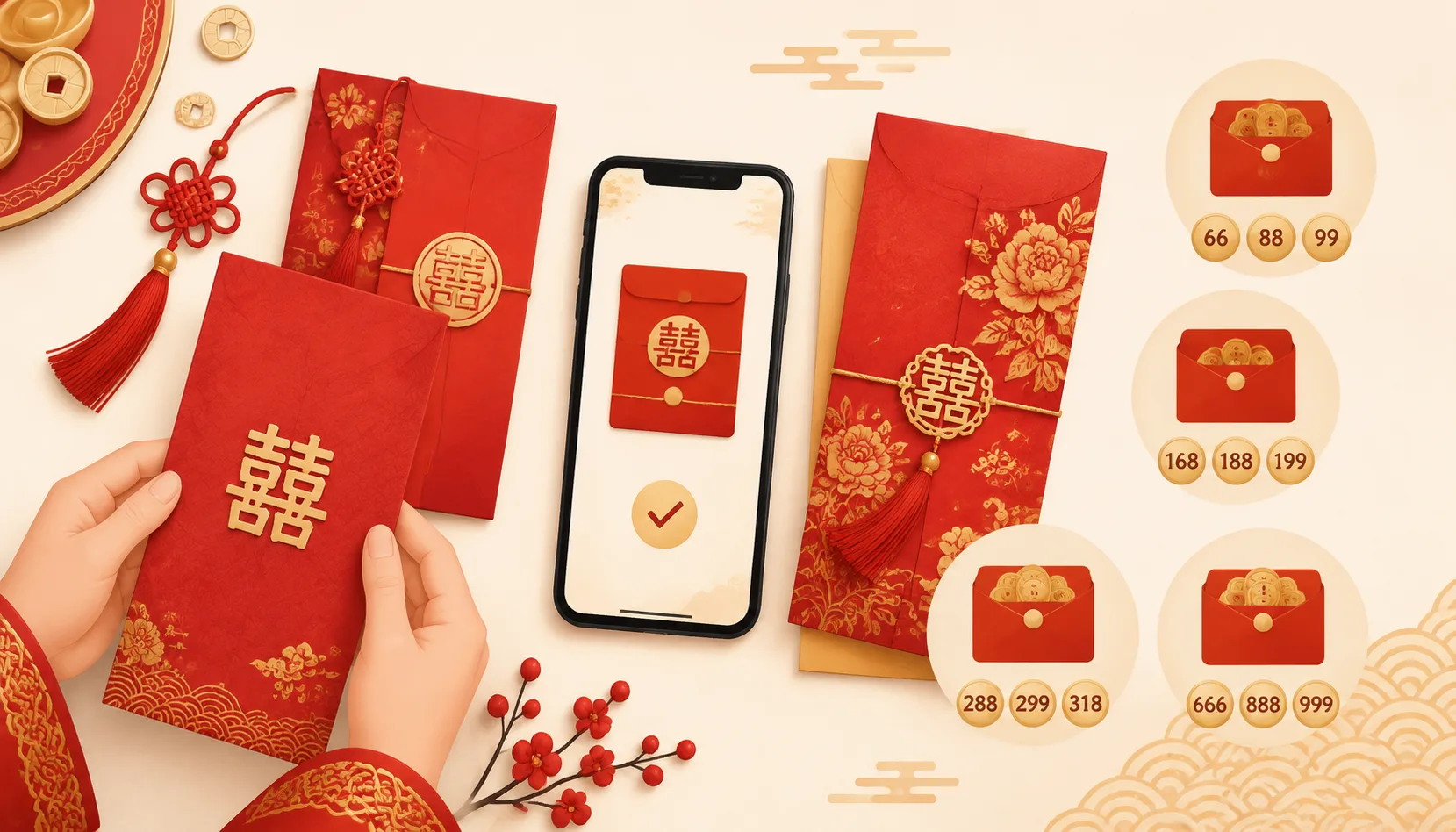
Red envelopes are given at weddings, birthdays for elders, baby full-moon celebrations, and hospital visits, not just New Year. Amounts vary by city and occasion—weddings in tier-1 cities typically range from 500-2000 RMB. Always use lucky amounts ending in 8, avoid 4, and never open the envelope immediately in front of the giver. Receiving one creates a social obligation to reciprocate, but you can politely refuse in certain situations.
Beyond Lunar New Year: When Hongbao Appear
Most foreigners associate red envelopes (hongbao) with Chinese New Year, but they are a year-round currency of social connection. Understanding the occasions is the first step to avoiding awkward moments.
- Weddings (xǐqián): The most significant non-New Year hongbao. Guests give cash in a red envelope, often at a reception desk. Amounts are carefully calibrated to relationship and city.
- Elder birthdays (shòu): For parents, grandparents, or in-laws, especially at milestone ages (60, 70, 80). The envelope is often given with a birthday gift.
- Baby full-moon (mǎnyuè): Celebrated at one month old. Guests give hongbao to the baby (parents) to bring luck and health.
- Hospital visits: When visiting a sick friend or relative, a small hongbao (often 100-500 RMB) is common, along with fruit or flowers.
- WeChat digital hongbao: Sent year-round for any occasion—congratulations, thanks, or just to brighten someone's day. These are smaller (1-200 RMB) and often sent in group chats.
Knowing which occasion calls for a hongbao—and which doesn't—is key. For example, you don't give hongbao for a colleague's promotion, but you might for their wedding.
How Much to Give: A Practical Amount Guide
Amounts are not random—they reflect your relationship, the city's cost of living, and your own financial comfort. Here’s a breakdown:
| Occasion | Tier-1 City (Beijing, Shanghai, Shenzhen) | Tier-2/3 City |
|---|---|---|
| Wedding (close friend) | 1,000-2,000 RMB | 500-1,000 RMB |
| Wedding (colleague/acquaintance) | 500-800 RMB | 300-500 RMB |
| Elder birthday | 500-1,000 RMB | 300-800 RMB |
| Baby full-moon | 300-800 RMB | 200-500 RMB |
| Hospital visit | 100-500 RMB | 100-300 RMB |
| WeChat hongbao (casual) | 1-200 RMB | 1-200 RMB |
These are guidelines, not rules. If you're a student or on a tight budget, it's acceptable to give less—just be consistent. Never give an amount that feels like a burden; the gesture matters more than the number.
Lucky Numbers and Taboos
Numbers carry deep symbolic weight in Chinese culture, and hongbao amounts are no exception.
- 8 (bā) = prosperity: The most auspicious digit. Amounts like 88, 188, 888, or 1,688 are popular. The more 8s, the better.
- 6 (liù) = smoothness: Also lucky, representing 'everything goes smoothly.' 66, 166, 666 are common.
- 9 (jiǔ) = longevity: Good for elder birthdays (e.g., 999) as it sounds like 'long-lasting.'
- 4 (sì) = death: Avoid any amount containing 4 (e.g., 400, 1,400). It's a homophone for 'death' and is a major faux pas.
- Odd vs. even: For weddings and birthdays, even numbers are preferred (except for 4). Odd numbers are sometimes used for funerals, so stick to even.
When in doubt, end with 8 or 6. For example, 200 RMB is fine, but 288 RMB is better—it shows thoughtfulness.
The Etiquette of Receiving: Open or Not?
One of the most common questions foreigners ask: Should I open the hongbao immediately? The answer is a clear no.
- Never open in front of the giver: It's considered rude and greedy. The giver wants to maintain the mystery and avoid embarrassment if the amount is modest.
- Thank the giver verbally: A simple 'xièxiè' (thank you) with a smile is enough. You can add 'nǐ tài kèqi le' (you're too kind) for extra politeness.
- Open later in private: When you do open it, do so away from the giver. It's fine to send a follow-up WeChat message later to express gratitude, especially for larger amounts.
- WeChat hongbao: These are different—you can open them immediately, and a 'thank you' sticker or message is expected. The amount is visible to the sender, but that's the norm.
Remember: the envelope itself is a symbol of good luck. Even if the amount is small, treat it with respect.
The Social Obligation: Reciprocity and Future Giving
Receiving a hongbao is not a one-way transaction—it creates an implicit social debt that you are expected to repay in the future.
- Weddings: If you receive a hongbao at your wedding, you are expected to give at least the same amount when the giver (or their child) gets married. This is often tracked meticulously, sometimes in a notebook.
- Birthdays and baby events: Similar reciprocity applies. If a colleague gives you 500 RMB for your baby's full-moon, you should give 500+ when they have a child.
- WeChat hongbao: In group chats, if you grab a hongbao, you're often expected to send one back (even a smaller amount) to keep the fun going. This is more casual but still a norm.
- No obligation to match exactly: You can give slightly more to show extra gratitude, but never less unless you have a valid reason (e.g., financial hardship).
If you're a foreigner, locals may not hold you to strict reciprocity, but showing that you understand the custom builds immense goodwill.
When Refusing is Acceptable (and How to Do It)
Sometimes you may want to refuse a hongbao—perhaps the amount is too large, or you feel you haven't earned it. Refusing is possible, but it must be done delicately.
- When to refuse: If a colleague tries to give you a hongbao for a minor favor (like helping with a task), it's acceptable to decline. Also, if you're in a position of authority (e.g., a manager receiving from a subordinate), refusing is often expected to avoid conflict of interest.
- How to refuse: Politely push it back with both hands, saying 'bù yòng le, zhēn de bù yòng' (No need, really). You can add 'wǒ hěn gǎnjī, dàn wǒ bù néng shōu' (I'm grateful, but I can't accept).
- Use the 'too much' excuse: Say 'zhè tài duō le, wǒ bù hǎo yìsi' (This is too much, I'm embarrassed). This gives the giver face by implying their generosity is overwhelming.
- When refusing is NOT acceptable: At weddings, funerals, or formal celebrations, refusing is almost never done—it's seen as rejecting the host's goodwill. Accept graciously.
If you do accept, always use both hands to receive the envelope. This shows respect.
WeChat Red Envelopes: The Digital Frontier
WeChat hongbao have revolutionized the tradition, especially among younger generations. Here's what you need to know:
- Types: Individual hongbao (sent to one person) and group hongbao (sent to a chat, where members grab random amounts). There's also 'lucky money' with random amounts.
- When to send: For birthdays, holidays (especially New Year), or just to say thanks. Many people send a hongbao as a fun way to celebrate a colleague's good news.
- Amounts: Usually small—1 to 200 RMB. For group chats, total amounts might be 10-100 RMB split among many.
- Etiquette: If you receive a personal hongbao, send a thank-you message. If you grab a group hongbao, it's polite to send one back (even a small amount) to continue the fun.
- Don't be greedy: In group chats, it's considered rude to immediately grab a hongbao without contributing. Wait a moment, and if others are sending, follow suit.
WeChat hongbao are less formal, but they still carry the spirit of generosity. A small digital envelope can strengthen relationships just as much as a physical one.
What Chinese People Actually Say
- 恭喜发财 | gōng xǐ fá cái | "Wishing you prosperity" | Say when giving or receiving hongbao during Chinese New Year
- 红包拿来 | hóng bāo ná lái | "Give me the red envelope" | Playful phrase used by children or younger family members
- 压岁钱 | yā suì qián | "Lucky money" (CNY money for children) | Traditional term for hongbao given to kids during Lunar New Year
2026 Reality Check
2026 Reality Check: Red envelopes remain popular but are rapidly digitizing. The tradition survives, though the form has shifted.
Gen Z vs. Older Generations: Millennials and Gen Z prefer digital hongbao via WeChat Pay and Alipay—it's faster and more convenient. Seniors still prefer cash in physical red envelopes, viewing digital transfers as impersonal. However, even elders now accept QR code payments for Lunar New Year.
Beijing/Shanghai vs. Smaller Cities: Tier-1 cities see more digital-only exchanges, especially among young professionals. Smaller cities and rural areas still favor traditional red envelopes with cash, though mobile payments are growing. Amounts vary widely: RMB 200-500 in cities, RMB 50-200 in smaller towns.
Bottom Line: The custom isn't dying—it's transforming. Cash persists where tradition runs deep; digital dominates where convenience wins.
Frequently asked questions
Can I give a red envelope to my Chinese colleague for their birthday, or is that weird?
It's acceptable but not expected among coworkers. A small amount (100-200 RMB) is fine if you're close. However, many companies discourage workplace gift-giving to avoid favoritism. A thoughtful alternative is treating them to lunch or coffee. If you do give one, do it privately and casually, not in front of the whole team.
What happens if I accidentally give an amount containing the number 4?
The number 4 sounds like 'death' in Chinese, so it's considered highly unlucky. If you realize your mistake, you can quickly add a small amount (like 1 RMB) to change the total, or apologize and replace the envelope. Most Chinese friends will understand it's a cultural slip, but it may leave a negative impression, especially with older generations.
Is it rude to open a red envelope in front of the giver in China?
Yes, absolutely. Opening it immediately is seen as greedy and disrespectful. Always thank the giver warmly and set the envelope aside unopened. If you're at a wedding or banquet, wait until you're home. In private settings with close friends, you might open it later, but never in front of them.
How much should I give for a Chinese wedding in a smaller city like Chengdu or Xi'an?
In tier-2 cities, wedding hongbao typically range from 300-800 RMB for friends or colleagues, and 800-2000 RMB for close friends or relatives. If you're attending with a partner, add 50-100% more. Check with mutual friends to gauge the local norm—amounts vary widely, and matching the group's standard is safest.
Can I refuse a red envelope without offending the giver?
Yes, politely refuse twice before accepting. Say 'I can't accept this, you're too kind' while gently pushing it back. If they insist a third time, accept it to avoid embarrassment. For WeChat hongbao, simply don't tap it—it auto-returns after 24 hours. Refusing is common when you've done a small favor and don't want to create obligation.
When is it appropriate to give a red envelope for a hospital visit in China?
It's common to give a modest hongbao (200-500 RMB) when visiting a sick friend or relative, especially after surgery or serious illness. Put it under the patient's pillow or in their hand discreetly—never hand it over in front of other visitors. For minor illnesses, fruit or supplements are fine. Some younger Chinese now prefer WeChat transfers, but cash is still traditional.
Try our tools
Related guides
Chinese New Year Red Envelopes (红包): Foreigner's Guide to Giving and Receiving (2026)
A red envelope (红包, hóngbāo) contains cash — it's the primary gift mechanism during Spring Festival. When you receive one: take it with both hands, say "谢谢,祝您身体…
Read the guide →
Chinese Wedding Gift Money (份子钱): How Much to Give and Exactly How to Do It
At Chinese weddings, guests give cash in red envelopes (份子钱, fènzi qián). The amount must be even — never odd. The minimum for a colleague in a tier-1 city is t…
Read the guide →
Chinese Red Envelope (红包) Complete Guide: When to Give, How Much, and What NOT to Do
A red envelope (红包, hóngbāo) is a cash gift in a red wrapper given at Chinese New Year, weddings, births, and milestone birthdays. Key rules: always use red (ne…
Read the guide →